---
image: https://www.antier.com/blogs/wp-content/uploads/2026/09/Building-Next-Gen-Programmable-Stablecoin-for-Enterprise-Payments.webp
title: The Enterprise Playbook for Programmable Stablecoin Payment Infrastructure
description: Explore how programmable stablecoin development enables automated payments, compliance controls, treasury automation, and real-time settlement. Learn A-Z concepts around it.
---
[](https://t.me/Antier_bot)
[](https://wa.me/919878362625)
[ When Should a Business Build an Appchain? A Decision Framework for 2026September 24, 2026](https://www.antier.com/blogs/when-should-a-business-build-an-appchain-a-decision-framework-for-2026/) [ Stablecoin Payment Rails for Cross-Border Fintechs, Neobanks & Remittance PlatformsSeptember 25, 2026](https://www.antier.com/blogs/stablecoin-payment-rails-for-cross-border-fintechs-neobanks-remittance-platforms/)
[Blogs](https://www.antier.com/blogs/) > The Enterprise Playbook for Programmable Stablecoin Payment Infrastructure
# The Enterprise Playbook for Programmable Stablecoin Payment Infrastructure


[Home](https://www.antiersolutions.com/) > [Blogs](https://www.antier.com/blogs/) > The Enterprise Playbook for Programmable Stablecoin Payment Infrastructure
#### Table of Content:
1. [What Is a Programmable Stablecoin?](#what-is-a-programmable-stablecoin)
2. [The Shift from Digital Payments to Programmable Payments](#the-shift-from-digital-payments-to-programmable-payments)
3. [Core Components of Programmable Stablecoin Payment Infrastructure](#core-components-of-programmable-stablecoin-payment-infrastructure)
4. [Where Programmable Stablecoins Create Measurable Enterprise Value](#where-programmable-stablecoins-create-measurable-enterprise-value)
5. [From Payment Automation to Autonomous Payment Operations](#from-payment-automation-to-autonomous-payment-operations)
6. [Build, Integrate, or Customize? The Strategic Decision Enterprises Must Make](#build-integrate-or-customize-the-strategic-decision-enterprises-must-make)
7. [Evaluating Different Models of Programmable Stablecoin Development](#evaluating-different-models-of-programmable-stablecoin-development)
8. [Security Requirements for Enterprises Cannot Ignore](#security-requirements-for-enterprises-cannot-ignore)
9. [Regulatory Considerations Are Becoming a Competitive Advantage](#regulatory-considerations-are-becoming-a-competitive-advantage)
10. [What Separates Enterprise-Ready Infrastructure from a Basic Stablecoin Deployment?](#what-separates-enterprise-ready-infrastructure-from-a-basic-stablecoin-deployment)
11. [Why Enterprises Are Investing in Programmable Stablecoin Payment Infrastructure](#why-enterprises-are-investing-in-programmable-stablecoin-payment-infrastructure)
12. [The Hidden Success Factor: Integration Strategy](#the-hidden-success-factor-integration-strategy)
13. [How Antier Helps Enterprises Build Production-Ready Programmable Stablecoin Infrastructure](#how-antier-helps-enterprises-build-production-ready-programmable-stablecoin-infrastructure)
14.
1. [The Enterprise Opportunity Ahead](#the-enterprise-opportunity-ahead)

Charu
Web3 Growth & Content Strategist
### ✨ AI Summary
- This blog post discusses the potential of programmable stablecoin solutions to enhance enterprise payment systems.
- Traditional financial infrastructure often separates the rules governing payment systems from the actual payment process.
- Programmable stablecoin solutions, however, embed business logic directly into digital money, enabling automation of payment execution, compliance enforcement, settlement conditions, treasury controls, and transaction workflows at the asset level.
- This technology is attracting attention from various financial entities for its potential to automate complex financial workflows.
- The post also highlights several enterprise use cases where programmable stablecoins can deliver significant value, such as conditional supplier payments, marketplace settlement automation, treasury management, and escrow and milestone-based payouts.
Every enterprise payment system is governed by rules.
- Treasury teams define approval workflows.
- Finance departments enforce spending limits.
- Compliance teams monitor transactions against jurisdictional requirements.
- Procurement departments manage supplier payment conditions.
Banks, payment processors, and intermediaries sit between these rules and the actual movement of money. The problem is that most financial infrastructure still separates the rule from the payment itself.
A payment may be approved according to a policy, but the policy exists in ERP systems, banking portals, spreadsheets, compliance tools, and operational processes. The money itself remains passive.
Programmable stablecoin solutions change that equation.
By embedding business logic directly into digital money, enterprises can automate payment execution, compliance enforcement, settlement conditions, treasury controls, and transaction workflows at the asset level. Instead of manually coordinating rules across multiple systems, organizations can create programmable stablecoin payments that execute predefined conditions automatically.
For payment providers, fintechs, banks, treasury platforms, marketplaces, and large enterprises exploring next-generation payment infrastructure, the opportunity extends beyond faster settlement. It introduces a new operating model for enterprise finance.
This article explores how programmable stablecoin payments work, where it delivers measurable value, what enterprises must evaluate before implementation, and how organizations are building enterprise-grade [**stablecoin payment solutions**](https://www.antier.com/stablecoin-remittance-platform-development/) today.
## **What Is a Programmable Stablecoin?**
A programmable stablecoin is a digital asset designed to maintain a stable value while incorporating predefined rules that govern how, when, where, and under what conditions funds can be transferred, held, released, or utilized.
At a technical level, these rules are enforced through smart contracts, policy engines, compliance modules, and transaction automation frameworks operating across blockchain networks.
**In practical business terms, programmable stablecoins enable enterprises to:**
- Automate recurring payments
- Enforce spending restrictions
- Control treasury disbursements
- Trigger settlements based on business events
- Execute conditional payouts
- Automate revenue-sharing agreements
- Integrate compliance checks into payment workflows
- Reduce manual intervention across payment operations
The distinction is important. Traditional payment systems automate payment processing, while programmable stablecoin payments automate payment decision-making.
###### Deploy a Production-Ready Programmable Stablecoin Infra!
Schedule Demo
## **The Shift from Digital Payments to Programmable Payments**
A conventional payment instruction typically follows this sequence:
- A business event occurs
- A payment request is generated
- Rules are checked manually or through external software
- Approval workflows are completed
- Payment is initiated
- Reconciliation occurs afterward
A programmable stablecoin payment solution allows these rules to become part of the payment asset itself.
**Examples include:**
- Releasing supplier payments only after delivery confirmation
- Triggering recurring payouts automatically upon milestone completion
- Restricting fund usage to approved merchant categories
- Enforcing jurisdiction-specific compliance rules
- Automating revenue-sharing distributions
- Scheduling treasury rebalancing based on liquidity thresholds
The payment becomes an executable financial instrument rather than a simple transfer of value. This is why programmable stablecoin development is increasingly attracting attention from enterprise payment providers, digital banking platforms, stablecoin issuers, fintech infrastructure companies, and treasury operators.
## **Core Components of Programmable Stablecoin Payment Infrastructure**
| **Component** | **Purpose** |
| --- | --- |
| Stablecoin Layer | Maintains value stability and settlement functionality |
| Smart Contracts | Executes predefined payment logic |
| Compliance Engine | Enforces AML, sanctions, and transaction policies |
| Identity Layer | Verifies participants and permissions |
| Treasury Controls | Manages liquidity and fund allocation |
| Integration APIs | Connects ERP, banking, and enterprise systems |
| Monitoring Layer | Tracks transactions, audit logs, and exceptions |
Together, these components create a **programmable stablecoin payment platform** capable of automating complex financial workflows.
## **Where Programmable Stablecoins Create Measurable Enterprise Value**
Not every payment workflow requires programmability. However, certain enterprise use cases benefit significantly from rule-based money.
**1. Conditional Supplier Payments**
Manufacturers, distributors, and procurement-intensive enterprises often rely on milestone-based payment structures. Programmable stablecoin payments can automatically release funds once predefined conditions are met, such as:
- Goods received
- Quality verification completed
- Contract milestones achieved
- Required documentation submitted
This reduces settlement delays while maintaining payment governance.
**2. Marketplace Settlement Automation**
Marketplaces frequently manage complex payment distribution models involving vendors, platform fees, commissions, taxes, and service providers. Programmable stablecoin payment processing can automatically split incoming funds across multiple participants according to predefined allocation rules.
This minimizes reconciliation complexity and improves operational scalability.
**3. Treasury Management and Cash Mobility**
Corporate treasury teams increasingly explore stablecoins for liquidity optimization. Programmable stablecoin payment automation enables:
- Automated treasury rebalancing
- Liquidity allocation thresholds
- Yield deployment strategies
- Cross-border cash movement
- Multi-entity treasury coordination
Automating treasury actions based on predefined policies reduces operational overhead while improving responsiveness.
**4. Escrow and Milestone-Based Payouts**
Escrow remains one of the strongest enterprise applications for programmable stablecoin settlement. Funds can remain locked until specific events occur, including:
- Project completion
- Contract fulfillment
- Shipment verification
- Third-party approval
- Compliance clearance
This model is particularly valuable for B2B transactions, trade finance, and professional services engagements.
## **From Payment Automation to Autonomous Payment Operations**
The long-term value of a programmable stablecoin solution extends beyond automation. Organizations increasingly design payment environments that respond to business events without manual intervention. Consider a global SaaS platform operating across multiple jurisdictions.
**The platform could automatically:**
- Collect subscription payments
- Allocate revenue shares
- Calculate platform commissions
- Apply jurisdiction-specific tax rules
- Execute treasury allocations
- Trigger compliance reporting
- Reconcile financial records
All within a unified programmable payment framework. This creates a foundation for autonomous payment operations, where financial workflows become event-driven rather than manually orchestrated.
## **Build, Integrate, or Customize? The Strategic Decision Enterprises Must Make**
One of the most important decisions involves selecting the appropriate implementation approach.
| **Approach** | **Best For** | **Limitations** |
| --- | --- | --- |
| Off-the-Shelf Integration | Rapid deployment requirements | Limited customization and control |
| White Label Stablecoin Payment Platform | Faster go-to-market with branding flexibility | Moderate customization constraints |
| Custom Programmable Stablecoin Development | Complex workflows and unique requirements | Higher implementation effort |
| Hybrid Architecture | Enterprises balancing speed and flexibility | Requires stronger integration expertise |
The right choice depends on payment complexity, regulatory exposure, scalability requirements, and long-term strategic objectives. Businesses planning to invest should evaluate not only current requirements but also how payment infrastructure will evolve over the next three to five years.
## **Evaluating Different Models of Programmable Stablecoin Development**
Not every enterprise requires the same level of control. The right architecture depends on business objectives, regulatory requirements, and operational complexity.
| **Approach** | **Advantages** | **Considerations** |
| --- | --- | --- |
| Public Blockchain Stablecoins | High interoperability and liquidity | Regulatory and governance complexity |
| Permissioned Stablecoins | Greater enterprise control | Limited ecosystem reach |
| Hybrid Models | Balance flexibility and control. | Increased architecture complexity |
| White Label Stablecoin Platforms | Faster deployment | Vendor dependency considerations |
| Custom Infrastructure | Maximum customization | Longer implementation cycles |
The decision should align with payment volume, compliance obligations, integration requirements, and long-term business strategy.
## **Security Requirements for Enterprises Cannot Ignore**
Programmable payments introduce new attack surfaces beyond traditional payment infrastructure. Enterprise-grade stablecoin payment development should address:
- Multi-party computation (MPC) security
- Role-based access controls
- Smart contract audits
- Treasury risk management
- Real-time monitoring
- Key lifecycle management
- Incident response procedures
- Infrastructure redundancy
The objective is not merely protecting assets. It is ensuring uninterrupted payment operations. For many enterprises, operational resilience becomes as important as transaction security.
## **Regulatory Considerations Are Becoming a Competitive Advantage**
The regulatory environment surrounding stablecoin payment solutions for businesses is becoming more defined across major jurisdictions.
Organizations evaluating programmable [**stablecoin payment infrastructure**](https://www.antier.com/blogs/what-is-stablecoin-payment-infrastructure-architecture-components-and-workflow/) should assess:
- Stablecoin issuance frameworks
- Payment licensing requirements
- AML obligations
- Travel Rule compliance
- Data privacy requirements
- Reserve transparency expectations
- Cross-border payment regulations
Increasingly, compliance architecture is becoming a product differentiator rather than a deployment obstacle. Enterprises that build regulatory readiness into their infrastructure from the beginning are often better positioned for long-term scale. Thus, it is always recommended that you get in touch with a renowned stablecoin development company that has years of experience in the payments and rails field.
## **What Separates Enterprise-Ready Infrastructure from a Basic Stablecoin Deployment?**
Many vendors can launch a stablecoin. Far fewer can support enterprise payment operations. Enterprise buyers should evaluate whether a solution includes:
- Policy-based payment automation
- Treasury management capabilities
- Multi-entity support
- ERP integration readiness
- Compliance automation
- Institutional custody architecture
- High-volume transaction scalability
- Audit and reporting frameworks
- Disaster recovery planning
- Multi-jurisdiction deployment support
These capabilities often determine whether a platform remains a pilot project or becomes critical financial infrastructure.
## **Why Enterprises Are Investing in Programmable Stablecoin Payment Infrastructure**
The discussion so far has focused on architecture, automation, and implementation considerations. The natural question for enterprise decision-makers is whether these capabilities translate into measurable business value. Increasingly, organizations are adopting programmable stablecoin payment infrastructure to achieve:
- Payment automation at scale
- Reduced operational costs
- Improved treasury efficiency
- Faster settlement cycles
- Enhanced financial visibility
- Better compliance enforcement
- Reduced reconciliation effort
- New financial product opportunities
The broader objective is creating financial systems that operate according to business policy rather than manual intervention.
###### Launch Programmable Stablecoins Now
Discuss Your Plans!
## **The Hidden Success Factor: Integration Strategy**
Many programmable payment initiatives fail because organizations focus on blockchain implementation while underestimating integration complexity.
A successful deployment typically requires interoperability across:
- ERP systems
- Treasury management platforms
- Banking infrastructure
- Compliance systems
- Accounting software
- CRM environments
- Payment gateways
- Identity verification providers
The quality of these integrations often determines whether a programmable stablecoin payment platform becomes operationally transformative or merely another isolated technology layer.
## **How Antier Helps Enterprises Build Production-Ready Programmable Stablecoin Infrastructure**
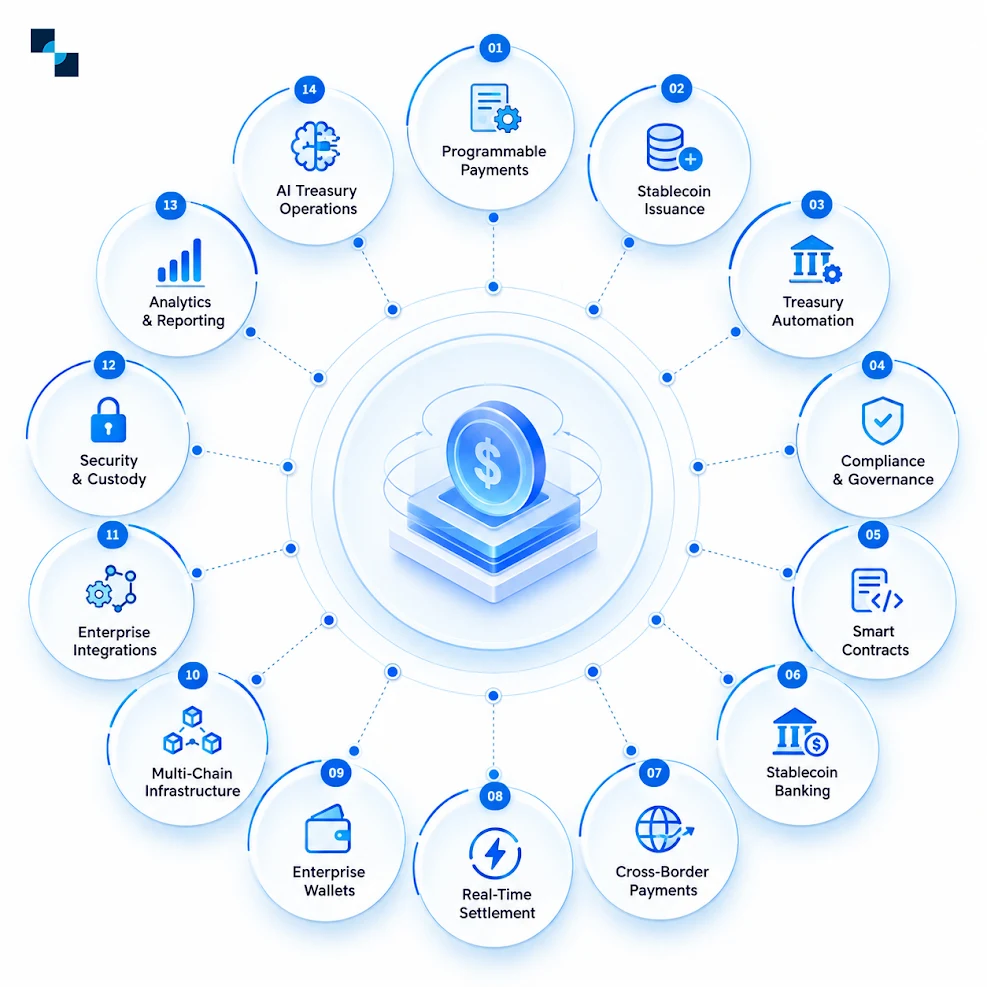
Developing enterprise-grade programmable stablecoin payment solutions requires expertise across blockchain engineering, payment architecture, treasury workflows, compliance frameworks, and enterprise integrations.
Antier is a full-spectrum stablecoin infrastructure partner, supporting organizations across the entire lifecycle. Backed by a team of seasoned blockchain architects, fintech specialists, security engineers, and Web3 product experts, Antier helps enterprises navigate both the technical and operational complexities of launching programmable stablecoin solutions while remaining aligned with evolving market requirements, regulatory expectations, AI-driven automation trends, and next-generation payment infrastructure standards.
Rather than approaching programmable stablecoins as standalone tokens, Antier helps enterprises design comprehensive payment ecosystems capable of supporting settlement automation, compliance controls, governance frameworks, treasury operations, and scalable transaction processing across global markets.
### **The Enterprise Opportunity Ahead**
The next phase of stablecoin adoption will not be defined solely by transaction volume. It will be defined by how intelligently money can operate within business processes.
Programmable [** stablecoin development**](https://www.antier.com/stablecoin-development-company/) enables enterprises to move beyond digital payments toward rule-based financial operations where compliance, settlement, treasury management, and payment execution work as a unified system.
For organizations evaluating payment modernization strategies, the critical question is no longer whether stablecoins can move money more efficiently. The more strategic question is whether payment infrastructure can become programmable enough to reduce operational complexity, improve governance, and create entirely new levels of automation. Enterprises that answer that question effectively will be better positioned to build scalable, efficient, and future-ready payment ecosystems.
Schedule a call with our experts today!
## Frequently Asked Questions
01. What is a programmable stablecoin?
A programmable stablecoin is a digital asset that maintains a stable value while incorporating predefined rules for transferring, holding, releasing, or utilizing funds, enforced through smart contracts and automation frameworks on blockchain networks.
02. How do programmable stablecoins benefit enterprises?
Programmable stablecoins enable enterprises to automate recurring payments, enforce spending restrictions, control treasury disbursements, trigger settlements based on business events, and integrate compliance checks into payment workflows, reducing manual intervention.
03. What challenges do enterprises face with traditional payment systems?
Traditional payment systems often separate rules from the actual movement of money, requiring manual coordination across multiple systems, which can lead to inefficiencies and increased risk of errors in payment execution and compliance enforcement.
##### Author :

Charu 
Web3 Growth & Content Strategist
Charu, a Sr. Content Marketer with 6+ years of expertise in Web3 & Blockchain. Expert in research, master at simplifying complex ideas into industry-focused insights across Wallets, DIDs, Fintech, RWAs, and Stablecoins.
Article Reviewed by:
###### DK Junas
[](https://in.linkedin.com/in/dev-kumar-junas)
##### Talk to Our Experts
#### Related posts
October 9, 2026
[](https://www.antier.com/blogs/decentralized-stablecoin-development-a-step-by-step-guide/)
#### [Decentralized Stablecoin Development: A Step-by-Step Guide](https://www.antier.com/blogs/decentralized-stablecoin-development-a-step-by-step-guide/)
✨ AI Summary This blog post provides an in-depth guide on decentralized \[…]
Do you like it?
[Read more](https://www.antier.com/blogs/decentralized-stablecoin-development-a-step-by-step-guide/ "Decentralized Stablecoin Development: A Step-by-Step Guide")
October 6, 2026
[](https://www.antier.com/blogs/stablecoin-payment-platform-development-in-2027-what-regulated-enterprises-need-to-build-next/)
#### [Stablecoin Payment Platform Development in 2027: What Regulated Enterprises Need to Build Next](https://www.antier.com/blogs/stablecoin-payment-platform-development-in-2027-what-regulated-enterprises-need-to-build-next/)
✨ AI Summary This blog post explores the development and uses of \[…]
Do you like it?
[Read more](https://www.antier.com/blogs/stablecoin-payment-platform-development-in-2027-what-regulated-enterprises-need-to-build-next/ "Stablecoin Payment Platform Development in 2027: What Regulated Enterprises Need to Build Next")
September 25, 2026
[](https://www.antier.com/blogs/stablecoin-payment-rails-for-cross-border-fintechs-neobanks-remittance-platforms/)
#### [Stablecoin Payment Rails for Cross-Border Fintechs, Neobanks & Remittance Platforms](https://www.antier.com/blogs/stablecoin-payment-rails-for-cross-border-fintechs-neobanks-remittance-platforms/)
✨ AI Summary Cross-border payment infrastructure is becoming more modular, with stablecoins \[…]
Do you like it?
[Read more](https://www.antier.com/blogs/stablecoin-payment-rails-for-cross-border-fintechs-neobanks-remittance-platforms/ "Stablecoin Payment Rails for Cross-Border Fintechs, Neobanks & Remittance Platforms")
### Launch your idea with us now
Turn your idea into reality – start today and build something meaningful.
X
### Claim Your Free Guide
Download your detailed analysis and real-world case insights instantly.

X
### Schedule Free Demo
Please fill out the form to make the request. We’ll be in touch to schedule a free demo.

X
X
## Browse by Topic
- [Ai Agents](https://www.antier.com/blogs/ai-agents/)
- [AI Chatbot Development](https://www.antier.com/blogs/ai-chatbot-development/)
- [AI Development Services](https://www.antier.com/blogs/ai-development-services/)
- [Asset Management](https://www.antier.com/blogs/asset-management/)
- [Asset Tokenization Services](https://www.antier.com/blogs/asset-tokenization-services/)
- [Binance Smart Chain](https://www.antier.com/blogs/binance-smart-chain/)
- [Blockchain](https://www.antier.com/blogs/blockchain/)
- [Centralized Exchange](https://www.antier.com/blogs/centralized-exchange/)
- [Coin/Token Development](https://www.antier.com/blogs/coin-token-development/)
- [Crypto Arbitrage Bot](https://www.antier.com/blogs/crypto-arbitrage-bot/)
- [Crypto Banking](https://www.antier.com/blogs/crypto-banking/)
- [Crypto Cards Development](https://www.antier.com/blogs/crypto-cards-development/)
- [Crypto Exchange Development](https://www.antier.com/blogs/crypto-exchange-development/)
- [Cryptocurrency Payment Gateway Development](https://www.antier.com/blogs/cryptocurrency-payment-gateway-development/)
- [Cryptocurrency Wallet Development](https://www.antier.com/blogs/cryptocurrency-wallet-development/)
- [DAO Development](https://www.antier.com/blogs/dao-development/)
- [dApps Development](https://www.antier.com/blogs/dapps-development/)
- [DeFi Crypto Exchange](https://www.antier.com/blogs/defi-crypto-exchange/)
- [DeFi Development](https://www.antier.com/blogs/defi-development/)
- [DeFi Wallet Development](https://www.antier.com/blogs/defi-wallet-development/)
- [Derivatives Exchange](https://www.antier.com/blogs/derivatives-exchange/)
- [Digital Identity](https://www.antier.com/blogs/digital-identity/)
- [Game Development](https://www.antier.com/blogs/game-development/)
- [Generative Ai](https://www.antier.com/blogs/generative-ai/)
- [Healthcare](https://www.antier.com/blogs/healthcare/)
- [ICO Development](https://www.antier.com/blogs/ico-development/)
- [IDO development](https://www.antier.com/blogs/ido-development/)
- [Intelligent Document Processing](https://www.antier.com/blogs/intelligent-document-processing/)
- [Launchpad Development](https://www.antier.com/blogs/launchpad-development/)
- [Margin Trading Exchange](https://www.antier.com/blogs/margin-trading-exchange/)
- [Meme Coin](https://www.antier.com/blogs/meme-coin/)
- [Metaverse Development](https://www.antier.com/blogs/metaverse-development/)
- [NFT Development](https://www.antier.com/blogs/nft-development/)
- [NFT Wallet Development](https://www.antier.com/blogs/nft-wallet-development/)
- [P2P Exchange](https://www.antier.com/blogs/p2p/)
- [P2P Lending](https://www.antier.com/blogs/p2p-lending/)
- [Polkadot Development](https://www.antier.com/blogs/polkadot-development/)
- [Prediction Marketplace](https://www.antier.com/blogs/prediction-marketplace/)
- [Real Estate](https://www.antier.com/blogs/real-estate/)
- [Real Estate Tokenization](https://www.antier.com/blogs/real-estate-tokenization/)
- [Smart Contract](https://www.antier.com/blogs/smart-contract/)
- [Stablecoin Development](https://www.antier.com/blogs/stablecoin-development/)
- [STO Development](https://www.antier.com/blogs/sto-development/)
- [Super Crypto App Development](https://www.antier.com/blogs/super-crypto-app-development/)
- [Web3 Development](https://www.antier.com/blogs/web3-development/)
- [Web3 Wallet Development](https://www.antier.com/blogs/web3-wallet-development/)
- [White Label Exchange](https://www.antier.com/blogs/white-label-exchange/)
- [Whitepaper Development](https://www.antier.com/blogs/whitepaper-development/)
X
```json
{"@context":"https:\/\/schema.org","@graph":[{"@type":"Article","@id":"https:\/\/www.antier.com\/blogs\/the-enterprise-playbook-for-programmable-stablecoin-payment-infrastructure\/#article","isPartOf":{"@id":"https:\/\/www.antier.com\/blogs\/the-enterprise-playbook-for-programmable-stablecoin-payment-infrastructure\/"},"author":{"name":"Charu","@id":"https:\/\/www.antier.com\/blogs\/#\/schema\/person\/2e7e1d6ee042c132db18c07201ffc07a"},"headline":"The Enterprise Playbook for Programmable Stablecoin Payment Infrastructure","datePublished":"2026-09-24T11:13:42+00:00","mainEntityOfPage":{"@id":"https:\/\/www.antier.com\/blogs\/the-enterprise-playbook-for-programmable-stablecoin-payment-infrastructure\/"},"wordCount":1715,"commentCount":0,"image":{"@id":"https:\/\/www.antier.com\/blogs\/the-enterprise-playbook-for-programmable-stablecoin-payment-infrastructure\/#primaryimage"},"thumbnailUrl":"https:\/\/www.antier.com\/blogs\/wp-content\/uploads\/2026\/09\/Building-Next-Gen-Programmable-Stablecoin-for-Enterprise-Payments.webp","keywords":["Programmable Stablecoin Development","Programmable Stablecoin Infrastructure","Programmable Stablecoin Payment Infrastructure","Programmable Stablecoin Payments","Stablecoin Payment","Stablecoin Payment Automation","Stablecoin Payment Development","stablecoin payment infrastructure","Stablecoin Payment Platform","Stablecoin Payment Processing","Stablecoin Payment Solutions","Stablecoin Payment Solutions for Businesses","stablecoin settlement"],"articleSection":["Stablecoin Development"],"inLanguage":"en-US","potentialAction":[{"@type":"CommentAction","name":"Comment","target":["https:\/\/www.antier.com\/blogs\/the-enterprise-playbook-for-programmable-stablecoin-payment-infrastructure\/#respond"]}]},{"@type":"WebPage","@id":"https:\/\/www.antier.com\/blogs\/the-enterprise-playbook-for-programmable-stablecoin-payment-infrastructure\/","url":"https:\/\/www.antier.com\/blogs\/the-enterprise-playbook-for-programmable-stablecoin-payment-infrastructure\/","name":"Programmable Stablecoin Development for Enterprise Payments","isPartOf":{"@id":"https:\/\/www.antier.com\/blogs\/#website"},"primaryImageOfPage":{"@id":"https:\/\/www.antier.com\/blogs\/the-enterprise-playbook-for-programmable-stablecoin-payment-infrastructure\/#primaryimage"},"image":{"@id":"https:\/\/www.antier.com\/blogs\/the-enterprise-playbook-for-programmable-stablecoin-payment-infrastructure\/#primaryimage"},"thumbnailUrl":"https:\/\/www.antier.com\/blogs\/wp-content\/uploads\/2026\/09\/Building-Next-Gen-Programmable-Stablecoin-for-Enterprise-Payments.webp","datePublished":"2026-09-24T11:13:42+00:00","author":{"@id":"https:\/\/www.antier.com\/blogs\/#\/schema\/person\/2e7e1d6ee042c132db18c07201ffc07a"},"description":"Explore how programmable stablecoin development enables automated payments, compliance controls, treasury automation, and real-time settlement. Learn A-Z concepts around it.","breadcrumb":{"@id":"https:\/\/www.antier.com\/blogs\/the-enterprise-playbook-for-programmable-stablecoin-payment-infrastructure\/#breadcrumb"},"inLanguage":"en-US","potentialAction":[{"@type":"ReadAction","target":["https:\/\/www.antier.com\/blogs\/the-enterprise-playbook-for-programmable-stablecoin-payment-infrastructure\/"]}]},{"@type":"ImageObject","inLanguage":"en-US","@id":"https:\/\/www.antier.com\/blogs\/the-enterprise-playbook-for-programmable-stablecoin-payment-infrastructure\/#primaryimage","url":"https:\/\/www.antier.com\/blogs\/wp-content\/uploads\/2026\/09\/Building-Next-Gen-Programmable-Stablecoin-for-Enterprise-Payments.webp","contentUrl":"https:\/\/www.antier.com\/blogs\/wp-content\/uploads\/2026\/09\/Building-Next-Gen-Programmable-Stablecoin-for-Enterprise-Payments.webp","width":931,"height":551,"caption":"Building Next Gen Programmable Stablecoin for Enterprise Payments"},{"@type":"BreadcrumbList","@id":"https:\/\/www.antier.com\/blogs\/the-enterprise-playbook-for-programmable-stablecoin-payment-infrastructure\/#breadcrumb","itemListElement":[{"@type":"ListItem","position":1,"name":"Home","item":"https:\/\/www.antier.com\/blogs\/"},{"@type":"ListItem","position":2,"name":"The Enterprise Playbook for Programmable Stablecoin Payment Infrastructure"}]},{"@type":"WebSite","@id":"https:\/\/www.antier.com\/blogs\/#website","url":"https:\/\/www.antier.com\/blogs\/","name":"Antier","description":"","potentialAction":[{"@type":"SearchAction","target":{"@type":"EntryPoint","urlTemplate":"https:\/\/www.antier.com\/blogs\/?s={search_term_string}"},"query-input":{"@type":"PropertyValueSpecification","valueRequired":true,"valueName":"search_term_string"}}],"inLanguage":"en-US"},{"@type":"Person","@id":"https:\/\/www.antier.com\/blogs\/#\/schema\/person\/2e7e1d6ee042c132db18c07201ffc07a","name":"Charu","image":{"@type":"ImageObject","inLanguage":"en-US","@id":"https:\/\/www.antier.com\/blogs\/wp-content\/uploads\/2025\/08\/charu-sharma.png","url":"https:\/\/www.antier.com\/blogs\/wp-content\/uploads\/2025\/08\/charu-sharma.png","contentUrl":"https:\/\/www.antier.com\/blogs\/wp-content\/uploads\/2025\/08\/charu-sharma.png","caption":"Charu"},"description":"Charu, a Sr. Content Marketer with 6+ years of expertise in Web3 & Blockchain. Expert in research, master at simplifying complex ideas into industry-focused insights across Wallets, DIDs, Fintech, RWAs, and Stablecoins.","sameAs":["https:\/\/www.linkedin.com\/in\/charu-sharma-532445191\/"]}]}
{"@context":"https://schema.org","@type":"FAQPage","mainEntity":[{"@type":"Question","name":"What is a programmable stablecoin?","acceptedAnswer":{"@type":"Answer","text":"A programmable stablecoin is a digital asset that maintains a stable value while incorporating predefined rules for transferring, holding, releasing, or utilizing funds, enforced through smart contracts and automation frameworks on blockchain networks."}},{"@type":"Question","name":"How do programmable stablecoins benefit enterprises?","acceptedAnswer":{"@type":"Answer","text":"Programmable stablecoins enable enterprises to automate recurring payments, enforce spending restrictions, control treasury disbursements, trigger settlements based on business events, and integrate compliance checks into payment workflows, reducing manual intervention."}},{"@type":"Question","name":"What challenges do enterprises face with traditional payment systems?","acceptedAnswer":{"@type":"Answer","text":"Traditional payment systems often separate rules from the actual movement of money, requiring manual coordination across multiple systems, which can lead to inefficiencies and increased risk of errors in payment execution and compliance enforcement."}}]}
```