



✨ Yapay Zeka Özeti
- South Korea's Financial Services Commission (FSC) has outlined a three-phase roadmap for a regulated tokenization ecosystem, with the first phase set to begin on February 4, 2027.
- This phase includes privately pooled money market funds and bonds for institutional investors, unlisted stocks through trust structures, and publicly offered fractional investment securities.
- The roadmap expands beyond fractional investment products to conventional securities such as stocks, bonds, and funds.
- The FSC's plan turns tokenized securities from a regulatory concept into a live market-infrastructure requirement, making lifecycle management, regulatory alignment, and security crucial to any market-entry strategy.
- As the roadmap progresses, the tokenization market in South Korea is expected to reach a projected revenue of USD 215.8 million by 2033, presenting a significant opportunity for financial institutions and operators.
MKS tokenizasyon ekosistemi in South Korea has evolved into a regulated market infrastructure. The Financial Services Commission has outlined a three-phase roadmap, with the first phase scheduled to begin when amendments to the Electronic Registration Act take effect on February 4, 2027. The initial scope includes privately pooled money market funds and bonds for institutional investors, unlisted stocks through trust structures, and publicly offered fractional investment securities. For financial institutions, issuers, infrastructure providers, and technology businesses, this changes the question from whether tokenization will become commercially relevant to whether the underlying infrastructure will be ready when the market opens.
The roadmap extends beyond issuing securities on a distributed ledger where South Korea is preparing infrastructure which supports issuance, circulation, account management, investor protection, settlement, and eventually on-chain payments. The FSC has also indicated that the broader roadmap will cover conventional securities such as stocks, bonds, and funds rather than remaining limited to fractional investment products. This creates a narrow preparation window for businesses evaluating South Korea tokenized securities and makes architecture, regulatory alignment, interoperability, security, and lifecycle management central to any serious market-entry strategy.
The Move of South Korea’s Tokenized Securities Roadmap From Policy To Infrastructure
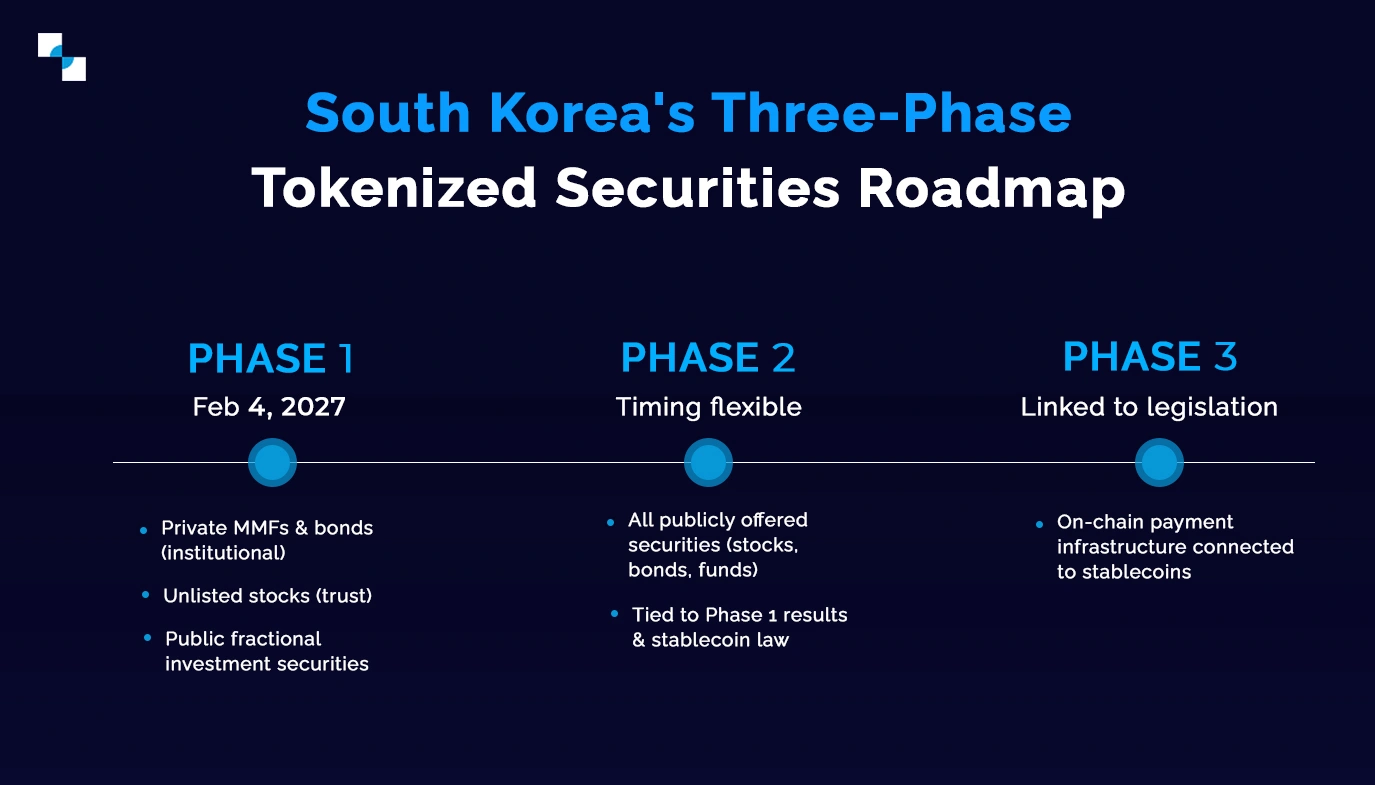
On September 4, 2026, South Korea’s FSC published a three-phase roadmap- Phase 1 (Feb 4, 2027), Phase 2 (flexible timing), Phase 3 (linked to stablecoin legislation) that turns tokenized securities from a regulatory concept into a live market-infrastructure requirement.
South Korea has moved its tokenized securities strategy from regulatory preparation toward market infrastructure implementation. On September 4, 2026, the Financial Services Commission introduced a three-phase roadmap covering the issuance and circulation of tokenized securities, with the framework extending beyond fractional investment products to conventional securities such as stocks, bonds, and funds. The roadmap places securities companies and the Korea Securities Depository at the center of infrastructure development while also establishing requirements around distributed-ledger connectivity, issuer account management, OTC intermediation, and operational resilience.
For institutions evaluating South Korea tokenized securities is that the market is no more defined only by if securities can be represented on-chain. Rather, the notable part is whether the technology can connect tokenized ownership with regulated issuance, investor eligibility, securities accounts, transfer controls, settlement, reporting, and business-continuity requirements.
Phase 1: Setting The Initial Production Environment
The first phase is scheduled to begin when the amended Electronic Registration Act takes effect on February 4, 2027. It will cover privately pooled money market funds and bonds for institutional investors, unlisted stocks through trust structures, and publicly offered fractional investment securities. This means the initial production environment is being designed around controlled securities categories rather than unrestricted token issuance.
For tokenized securities platform development, this creates a requirement for configurable issuance and eligibility logic rather than a generic token-minting engine.
Phase 2: Expanding Tokenization Across Public Securities
The second phase is intended to expand tokenization to all publicly offered securities. However, the FSC has deliberately left its timing flexible and tied future implementation to the outcome of the first phase, technological adoption, and developments around stablecoin legislation.
This makes extensibility a core architectural requirement. A platform built for a narrow first-phase asset class should be capable of evolving into a broader securities infrastructure without rebuilding its identity, compliance, ledger, custody, and transaction layers.
Phase 3: Connecting Securities With On Chain Payments
The roadmap ultimately points toward an on-chain payment infrastructure linked to stablecoins. Importantly, this is not presented as an immediate launch requirement. The FSC has linked the timing to the performance of earlier phases, technological development, and pending stablecoin legislation.
For tokenized securities infrastructure, that future direction has architectural implications today. Payment rails, settlement logic, digital wallets, asset servicing, and transaction records may eventually need to operate as interconnected components rather than isolated systems.
The Market Opportunity Extends Beyond Security Token Issuance
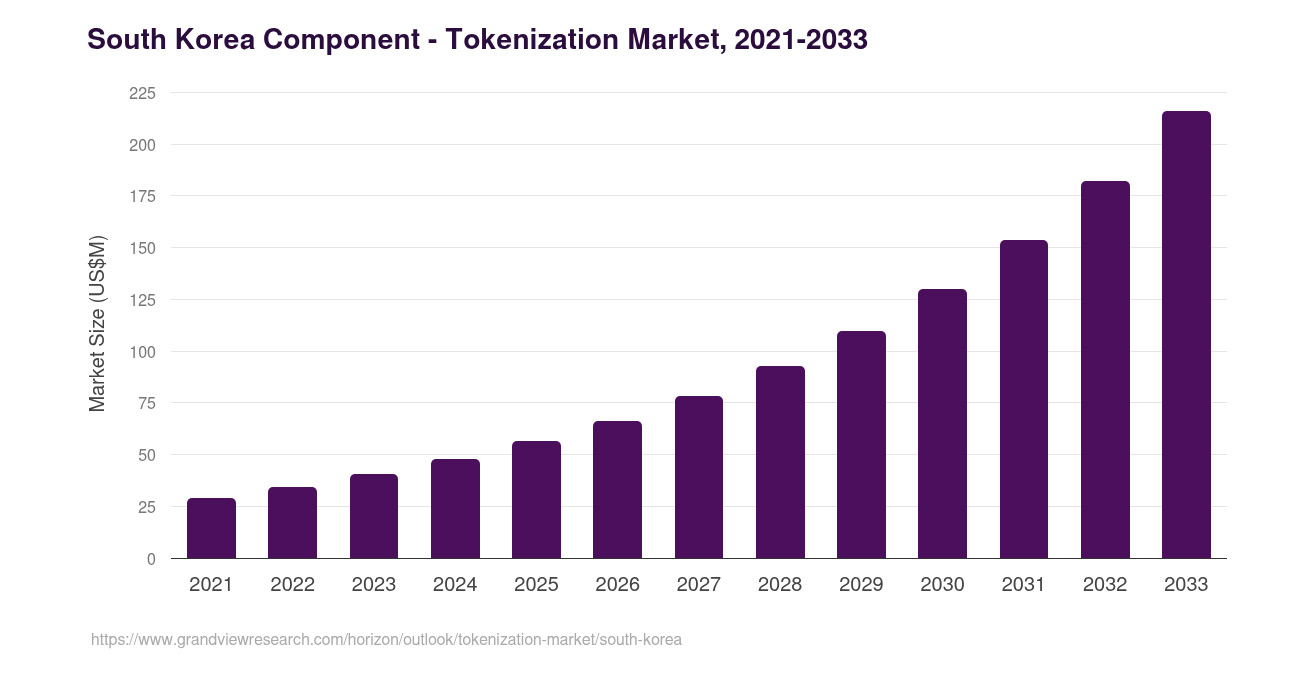
The tokenization market in South Korea is expected to reach a projected revenue of USD 215.8 million by 2033. A compound annual growth rate of 18.33% is expected of South Korea tokenization market from 2026 to 2033.
Kaynak: https://www.grandviewresearch.com/horizon/outlook/tokenization-market/south-korea
As the regulatory roadmap progresses toward implementation, this market opportunity extends beyond individual security token offerings to the infrastructure required to support them at scale. The growth of South Korea tokenized securities will create demand for integrated capabilities spanning issuance, investor onboarding, compliance, asset servicing, ownership management, and secondary-market transactions. This positions tokenization as a broader market-infrastructure opportunity for financial institutions and operators preparing to connect regulated securities workflows with blockchain-based ownership and settlement.
The shift also changes the technology requirements for institutions entering the market. Rather than approaching tokenization as a standalone issuance exercise, market participants can establish the underlying rails through tokenized securities platform development, bringing issuance, compliance controls, transaction management, and lifecycle administration into a unified environment. As regulation matures and adoption moves beyond controlled pilots, scalable infrastructure will become increasingly important for supporting institutional participation and the broader expansion of tokenized financial products.
Yes. The pointers should carry the substance rather than leaving the sections as long prose. I would structure the first three sections with a short setup paragraph followed by concise enterprise-focused pointers. The final Antier section can remain narrative to create a stronger promotional close.
Discover How Tokenized Securities Are Reshaping Finance Bu Blog'da.
What a South Korea Ready Tokenization Platform Should Include
A market-ready platform for South Korea needs to support more than the creation of digital representations of securities. Its architecture must accommodate the controls that sit around each asset throughout its lifecycle, from investor onboarding and issuance to transfers, servicing, reporting, and redemption. A security tokenization platform should therefore combine regulatory controls with operational capabilities that allow institutions to manage tokenized securities within defined market and investor parameters.
- Permissioned Token Issuance: Enables issuers to create digital securities within controlled environments, with issuance parameters defined according to the asset and applicable requirements.
- KYC and KYB: Integrates investor and entity verification into the onboarding process to establish eligibility before participation.
- Investor Whitelisting: Restricts access and transactions to approved investors based on defined eligibility criteria and jurisdictional requirements.
- Aktarım Kısıtlamaları: Applies programmable controls to prevent transfers that fall outside permitted investor, asset, or regulatory conditions.
- Akıllı Sözleşmeler: Automates predefined rules for issuance, ownership changes, distributions, transfers, and other lifecycle events.
- Varlık Hizmeti: Supports ongoing activities such as distributions, corporate actions, redemptions, and investor communications after issuance.
- Birincil Tahvil İhracı: Provides controlled workflows for creating and distributing tokenized securities to eligible participants.
- İkincil Ticaret: Supports compliant transfer and trading workflows as tokenized securities move beyond their initial issuance.
- Custody Integration: Connects the platform with custody and wallet infrastructure to support secure asset holding and transaction authorization.
- Raporlama: Maintains transaction, ownership, and investor records required for operational, regulatory, and management reporting.
- Uyumluluk izleme: Continuously monitors transactions and participant activity against predefined compliance rules and risk parameters.
Together, these capabilities create an infrastructure layer that can support the full operating lifecycle of tokenized securities rather than limiting the platform to token issuance alone.
| Yetenek | Bu ne yapar |
|---|---|
| Permissioned Token Issuance | Enables issuers to create digital securities within controlled environments, with issuance parameters defined according to the asset and applicable requirements. |
| KYC ve KYB | Integrates investor and entity verification into the onboarding process to establish eligibility before participation. |
| Investor Whitelisting | Restricts access and transactions to approved investors based on defined eligibility criteria and jurisdictional requirements. |
| Transfer Kısıtlamaları | Applies programmable controls to prevent transfers that fall outside permitted investor, asset, or regulatory conditions. |
| Akıllı Sözleşmeler | Automates predefined rules for issuance, ownership changes, distributions, transfers, and other lifecycle events. |
| Varlık Servisi | Supports ongoing activities such as distributions, corporate actions, redemptions, and investor communications after issuance. |
| Primary Issuance | Provides controlled workflows for creating and distributing tokenized securities to eligible participants. |
| İkincil Ticaret | Supports compliant transfer and trading workflows as tokenized securities move beyond their initial issuance. |
| Velayet Entegrasyonu | Connects the platform with custody and wallet infrastructure to support secure asset holding and transaction authorization. |
| Raporlama | Maintains transaction, ownership, and investor records required for operational, regulatory, and management reporting. |
| Uyumluluk izleme | Continuously monitors transactions and participant activity against predefined compliance rules and risk parameters. |
What Institutional Investors Should Evaluate Before Entering the Market
For institutional investors, entering the tokenized securities market is fundamentally an infrastructure decision. The assessment needs to go beyond whether a platform can issue tokens and examine how well it can support the controls, processes, and integrations that underpin regulated securities operations. An institutional tokenization platform should fit within the institution’s existing operating model while providing sufficient flexibility to accommodate evolving regulatory and market requirements.
- Regulatory Readiness: The platform should provide configurable controls for investor eligibility, issuance, transfers, reporting, and other requirements without hard-coding assumptions that may become restrictive as the regulatory framework develops.
- Lifecycle Management: Tokenization should cover the complete asset lifecycle, including issuance, ownership records, transfers, distributions, servicing, settlement, and redemption. Fragmented workflows can create operational gaps even when the underlying token technology is sound.
- Integration With Existing Systems: The ability to connect with securities accounts, custody systems, identity providers, compliance platforms, payment infrastructure, and internal financial systems should be assessed at the architecture level.
- Security and Control: Institutions should examine how the platform manages privileged access, transaction authorization, wallet security, smart contract governance, audit trails, and operational monitoring. These controls are central to maintaining institutional-grade infrastructure.
- Scalability and Performance: The architecture should be capable of supporting larger investor populations, transaction volumes, and additional asset classes without requiring fundamental changes to the underlying system.
- Interoperability: As tokenized securities develop across different platforms and market participants, interoperability can determine whether assets and data can move efficiently across the wider financial ecosystem.
- Operational Governance: Institutions should establish clear ownership of platform administration, compliance decisions, transaction approvals, exceptions, and business-continuity procedures before moving into production.
- Future Expansion: The technology should provide room for new securities, secondary-market mechanisms, settlement models, and payment integrations as South Korea’s tokenization framework progresses.
The right infrastructure should therefore be assessed not only on what it can deliver at launch, but on how effectively it can operate within an institution’s existing financial architecture and support the market as it matures. This distinction becomes critical when moving from a controlled tokenization initiative to sustained institutional participation.
What Infrastructure Will South Korea’s Tokenized Securities Market Require?
| tabaka | Gerekli Altyapı |
| İhraç | Digital securities issuance |
| Uygunluk | KYC, AML, eligibility, transfer restrictions |
| dizgeciklere | Security token standards and smart contracts |
| Gözaltı | Kurumsal düzeyde saklama |
| Yatırımcı katılımı | Whitelisting and identity verification |
| Trading | Primary and secondary market infrastructure |
| Yerleşme | On-chain settlement mechanisms |
| Varlık servisi | Dividends, interest, redemptions, corporate actions |
| Veri | Oracles and asset data |
| Yönetim | Permissions, controls and auditability |
Building South Korea’s Next Generation Securities Infrastructure with Antier
South Korea’s transition toward regulated tokenized securities requires technology infrastructure that can accommodate today’s requirements while remaining adaptable to the market’s next stage. Antier approaches this requirement through an integrated development model covering architecture, platform engineering, smart contracts, compliance workflows, security, integrations, and lifecycle management. Its tokenized securities platform development services are structured to help financial institutions and market participants establish infrastructure aligned with their intended operating and regulatory models.
The focus extends beyond deploying a standalone blockchain application. anter brings together issuance, investor management, compliance, asset servicing, custody, transaction management, reporting, and integration requirements within a unified technology architecture. This approach enables institutions to establish the technology foundation required to participate in a market that is progressively moving from regulatory development toward production-grade digital securities infrastructure.
SSS
What features should a South Korea ready tokenization platform include?
It should support permissioned issuance, KYC and KYB, investor whitelisting, transfer restrictions, smart contracts, asset servicing, primary issuance, secondary trading, custody integration, reporting, and compliance monitoring.
Why is interoperability important for institutional tokenization?
Interoperability allows tokenized securities infrastructure to connect with existing financial, custody, compliance, payment, and reporting systems rather than operating as an isolated blockchain environment.
What should institutions evaluate before selecting a tokenization platform?
Key considerations include regulatory alignment, security, lifecycle coverage, investor controls, interoperability, scalability, governance, operational resilience, and future adaptability.
How can smart contracts support tokenized securities?
Smart contracts can automate predefined rules governing issuance, ownership, transfers, distributions, eligibility, and other securities lifecycle processes.
Can Antier develop infrastructure for institutional tokenized securities?
Antier can support the architecture and development of tokenized securities infrastructure across platform engineering, smart contracts, compliance workflows, security, integrations, custody connectivity, and lifecycle management.