BlockMaze: building the infrastructure layer for a regulated enterprise blockchain network
BlockMaze is a regulated enterprise blockchain network built for real world assets like gold, stocks, and real estate. Antier designed and built the full technology stack behind BlockMaze, from the base protocol to the exchange where tokens trade.

At a glance

BlockMaze launched with more than 40 financial regulatory licences already in place across its ecosystem, a result Guinness World Records later recognized. This case study walks through the architecture decisions behind the launch, including a mid build change from a Layer 1 chain to a Layer 0 settlement network.

Client

BlockMaze, a regulated enterprise blockchain network for real world asset tokenization

Challenge

Build a network regulators, institutions, and asset issuers trust, without sacrificing decentralization

Approach

Protocol level compliance modules, a mid build shift from Layer 1 to Layer 0, and a governance model designed to resist capture

Delivery

Full stack build, base chain through exchange, plus documentation and validator infrastructure

Result

Over 40 financial regulatory licences in place at launch, later recognized by Guinness World Records

The problem with building trust into code

Real world asset tokenization sits at the center of where major banking research places the next phase of Web3 adoption. McKinsey's 2022 analysis of the space named tokenized assets, alongside infrastructure and services, among the three areas where institutional opportunity would concentrate, and flagged regulatory clarity as the primary barrier standing in the way.

Smart contracts, the research noted, are not yet legally enforceable in most jurisdictions, a gap limiting adoption by regulated institutions more than any technical constraint does.

BlockMaze closed the gap at the protocol level rather than through policy alone.

Governments have no built in way to recognize or control which assets get tokenized on a network
No native proof confirms a token claiming to represent gold is backed by gold in a vault
Tax and regulatory rules vary by jurisdiction and rarely get automated
Settlement finality, on its own, says nothing about whether the issuer behind an asset answers to anyone

Antier treated each of these gaps as a protocol level requirement, not a policy document.

Sovereign Gatekeeper Module restricts minting and burning to whitelisted, state-controlled addresses
A Proof-of-Reserve oracle brings attested reserve data on-chain, making gold backing verifiable
An upgradable stamp-duty module applies country-specific transfer fees, easing issuer compliance
Every issuer goes through KYC and legal authorization before they tokenize anything

Our team built this network's infrastructure, start to finish.

Why BlockMaze chose Antier

BlockMaze needed a partner who had already shipped production networks on more than one blockchain framework, because the base layer decision itself was still open. Antier's protocol team had hands on experience across Cosmos SDK, EVMOS, Substrate, Geth, and enterprise frameworks like Hyperledger Fabric and R3 Corda. This depth mattered directly. BlockMaze changed its underlying framework midway through the build, moving from an application focused Layer 1 design to a Layer 0 shared security architecture. A team with narrower framework experience would have needed to restart the engagement or bring in a second vendor. Antier absorbed the change inside the same team, the same codebase, and the same delivery timeline.

BlockMaze also needed a partner comfortable building compliance logic directly into consensus and token standards, not bolting compliance on top as a separate service. Antier's background in enterprise and permissioned network development gave the team a working vocabulary for regulatory requirements from day one.

A Mid Build Change: From Layer 1 to Layer 0

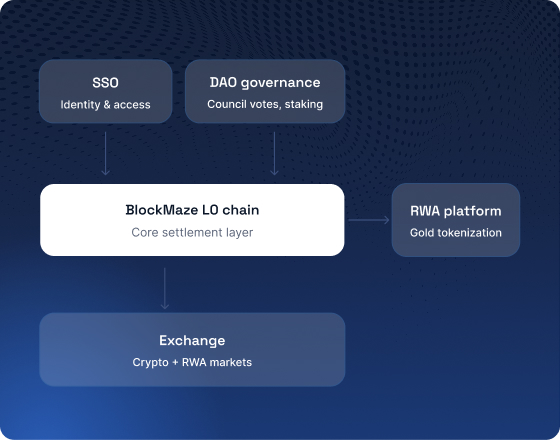
The engagement did not stay static. BlockMaze started as a Layer 1 chain, designed to execute applications directly. Partway through, the scope changed to something more ambitious. The new goal was a Layer 0 shared security architecture where other rollups and sovereign Layer 1 chains settle.

This is a different network to build. A Layer 1 secures itself. A Layer 0 validates its own blocks, verifies rollup fraud proofs, and processes cross chain messages between connected networks. The new scope added:
A Chain Registry for onboarding external rollups and independent L1s
A Rollup SDK and L1 Blockchain SDK for developers
A multi layer explorer covering L0, rollup, and cross chain activity in one view
Rebuilt base chain with dual EVM/WASM execution, fast finality, and 6-second blocks.
BlockMaze did not choose to compete for users as one more application chain. BlockMaze chose to become the infrastructure other chains settle on and pay to use.

Governance built to enforce itself

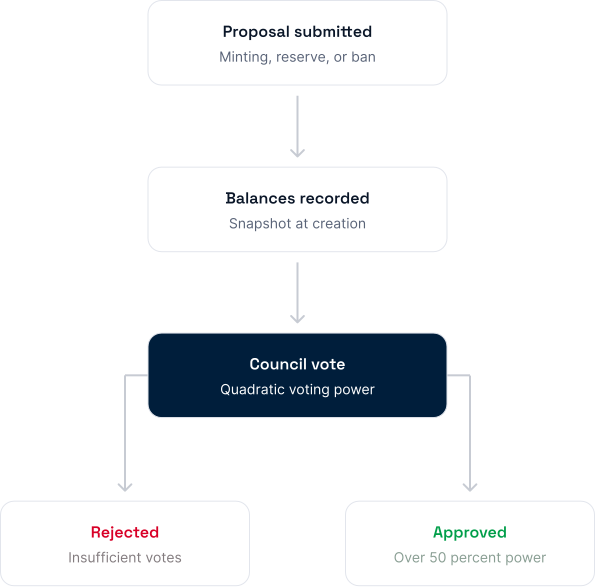
BlockMaze's compliance model only works if governance stays resistant to whoever holds the most tokens. Antier built the DAO around quadratic voting, where voting power scales with the square root of a wallet's staked GBMZ balance, not the balance itself. This design limits control by large holders.
A three wallet Governance Council votes on minting approvals, Proof of Reserve validation, and issuer blacklisting, each with a defined voting window and outcome rule
A minting proposal needs more than 50 percent of quadratic voting power to pass, and zero votes trigger automatic rejection
Balances get recorded at proposal creation, so nobody buys tokens mid vote to change an outcome
The token model splits utility and governance in two. BMZ is the native token, covering staking, gas, transaction fees, and contract deployment. GBMZ comes from staking BMZ one to one, stays non spendable, and exists only to carry governance weight. Separating these two tokens keeps the DAO independent from whoever transacts the most.

How a real-world asset gets minted

How a governance proposal resolves
Validator infrastructure without custody risk

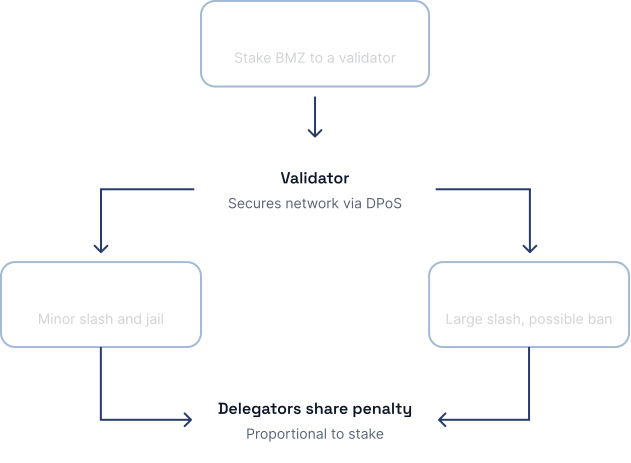
Delegated Proof of Stake secures the network. Slashing conditions scale by severity, a small slash and temporary jail for downtime, a larger slash and possible permanent ban for double signing. Delegators share proportionally in whatever penalty their validator receives, standard for this model.

BlockMaze pairs this with a Genesis Validator program built to lower the barrier to running a node. Node infrastructure and validator onboarding for the network run through Instanode, which operates the infrastructure layer only and never holds custody of BMZ tokens, staked assets, or validator keys.
The Result

BlockMaze launched with over 40 financial regulatory licences already in place across the ecosystem, spanning jurisdictions including the EU, UAE, South Africa, Bahrain, Canada, Australia, and Mauritius. Guinness World Records recognized this as the most financial regulatory licences secured at a blockchain ecosystem launch. The award ceremony included UAE Minister of State for Foreign Trade Thani bin Ahmed Al Zeyoudi and Guinness World Records officials.

This record did not come from a marketing push bolted onto a generic chain. The record came directly from building compliance into the protocol from day one, the Sovereign Gatekeeper Module, the Proof of Reserve oracle, the verified issuer framework, and a governance model regulators audit directly.

The full delivery spanned

The L0 core chain
The DAO governance portal
Validator and delegator applications
The tokenomics locking and vesting platform
The RWA tokenization and issuance framework
A regulated spot exchange
The multi layer explorer
Documentation included a technical whitepaper, yellow paper, security model, and validator handbook.

What this means for enterprises evaluating tokenization

BlockMaze answers three questions every regulated institution asks before touching a blockchain network for real world assets.

Who controls minting and burning, and does a regulator verify the control directly?

BlockMaze answers with the Sovereign Gatekeeper Module, a whitelisted address a nation state entity controls directly, without an intermediary.

Does a reserve claim get verified without trusting the issuer's word alone?

BlockMaze answers with a Proof of Reserve oracle pulling third party attested data on chain, so the claim gets checked independently.

Does governance stay resistant to whoever holds the most tokens?

BlockMaze answers with quadratic voting, where power scales with the square root of a staked balance, rather than the balance itself.
If you are evaluating a similar build for your institution, ask vendors these same three questions before signing.

Why it worked:
execution, not just engineering

Strong architecture only carries a project so far. The BlockMaze engagement worked because Antier treated the mid build shift from Layer 1 to Layer 0 as a design decision, not a scope problem to manage around. The team rebuilt the consensus layer, the SDK offering, and the explorer without stalling the rest of the roadmap.

Compliance requirements came from regulators, not from a product spec written once and left alone. Antier's team stayed close to the changing requirements across jurisdictions and translated each one into a protocol rule, the gatekeeper module, the stamp duty logic, the KYC gated issuer flow. Engineering depth made the launch possible. Staying tied to the regulatory and business reality made the launch real.

What's next

BlockMaze's roadmap continues past launch
Phase 1

Liquidity architecture

A native DEX listing for BMZ and USDC pools, streamlined cross chain UX tooling, and a stablecoin settlement rail
Phase 2

TradFi integration

yield bearing debit card partnerships and B2B settlement work with regional neo banks
Phase 3

Security and compliance depth

A bug bounty program, retainer audits, and continuous Proof of Reserve verification
Phase 4

Narrative and positioning

regulated yield and utility, aimed at institutional and Web3 native audiences
Regulatory clarity for Web3 remains a work in progress across most jurisdictions. Institutions waiting for the picture to settle will compete against ecosystems already built to answer regulators directly. BlockMaze shows what a network designed around this expectation looks like, from consensus to compliance to governance.

Antier's protocol team builds base-layer infrastructure for institutions.

Start a conversation with Antier

Connect with our consulting and engineering leads to scope your digital transformation from architecture review to production deployment.


    Please refer to our privacy policy for details.