





✨ AI Summary
- This blog post discusses the varying costs of AI development in the business world.
- The cost of developing AI solutions varies greatly depending on business objectives, data readiness, security needs, system complexity, and the expected scale of the system.
- The blog post provides a comprehensive breakdown of AI development costs in 2026, discussing the influencing factors and comparing costs across different AI solutions.
- It also highlights overlooked expenses and offers practical guidance for budgeting and strategic decision-making.
- The blog includes a detailed cost breakdown for different types of AI solutions, such as chatbots, AI agents, and enterprise AI platforms.
Business leaders are under growing pressure to turn AI from a promising concept into measurable business value. Yet one question continues to dominate boardroom discussions and budget planning conversations.
How much does AI development cost?
The answer is rarely straightforward. A customer support chatbot, an enterprise knowledge assistant, an AI-powered workflow system, and a multi-agent platform may all fall under the AI umbrella, but their costs can differ significantly based on business objectives, data readiness, security requirements, system complexity, and expected scale.
This is why the cost of AI development varies from one organization to another. Two companies pursuing similar goals can end up with vastly different budgets depending on the quality of their data, the systems involved, the level of customization required, and the outcomes they expect to achieve.
For business leaders, the more relevant question is not simply how much AI costs. It is how much investment is required to create a meaningful business impact while maintaining long-term value.
This guide provides a complete breakdown of AI development costs in 2026. It examines the factors that influence pricing, compares costs across different AI solutions, uncovers expenses that organizations often overlook, and offers practical guidance for budgeting, ROI evaluation, and strategic decision-making.
Why Businesses Are Increasing Their AI Investments in 2026
AI Adoption Has Become Mainstream Across Enterprises
AI is no longer confined to pilot projects or isolated experiments. According to McKinsey’s State of AI report, 78 percent of organizations reported using AI in at least one business function in 2025, up from 72 percent a year earlier.
Enterprise AI Spending Continues to Rise
Organizations are allocating larger portions of their technology budgets to AI initiatives. Gartner forecasts global AI spending to surpass $2 trillion in 2026 as enterprises expand AI adoption across business operations, customer engagement, and decision support systems.
AI Could Add Trillions to the Global Economy
The economic opportunity surrounding AI remains one of the largest drivers of enterprise investment. PwC estimates that AI could contribute up to $15.7 trillion to the global economy by 2030, representing a significant increase in global economic output driven by productivity gains and increased consumer demand.
Businesses Are Beginning to See Measurable Returns
Investment decisions are increasingly supported by financial outcomes. McKinsey’s analysis of AI leaders found that top-performing organizations are generating approximately three dollars in value for every dollar invested in AI. Many organizations began realizing returns within one to two years after deploying AI initiatives focused on high-impact business functions.
The Conversation Has Shifted From Adoption to Budgeting
The question for most business leaders is no longer whether AI should be part of their strategy. The focus has shifted toward understanding the appropriate AI development cost, identifying the highest value use cases, and determining how to allocate budgets across short term initiatives and long-term AI programs.
AI Development Cost at a Glance
For organizations planning AI initiatives in 2026, budgeting expectations can vary significantly depending on the type of solution being developed. A customer support chatbot, an enterprise knowledge assistant, and a multi-agent decision support system may all use AI, yet their complexity, timelines, and investment requirements differ considerably.
The table below provides a high-level view of typical budget ranges and development timelines for common AI solutions. Actual costs may vary based on customization requirements, data availability, security requirements, deployment environment, and business objectives.
| AI Solution | Typical Budget Range | Estimated Timeline |
|---|---|---|
| AI Chatbot | $20,000 to $80,000 | 4 to 12 weeks |
| AI Knowledge Assistant | $40,000 to $150,000 | 6 to 16 weeks |
| AI Workflow Automation System | $50,000 to $250,000 | 8 to 20 weeks |
| AI Copilot | $75,000 to $300,000 | 10 to 24 weeks |
| Generative AI Application | $80,000 to $500,000+ | 12 to 32 weeks |
| AI Agent | $100,000 to $500,000+ | 12 to 36 weeks |
| RAG System | $75,000 to $400,000+ | 8 to 24 weeks |
| Multi-Agent System | $250,000 to $1,000,000+ | 4 to 12 months |
| Enterprise AI Platform | $500,000 to $5,000,000+ | 6 to 18 months |
These figures should be viewed as directional benchmarks rather than fixed pricing estimates. The same type of AI solution can have vastly different costs depending on the number of users, data sources, security requirements, business processes involved, and level of customization required.
Get a Tailored AI Cost Estimate for Your Business
What Determines AI Development Cost in 2026
Understanding the factors that influence AI development cost is essential for setting realistic budgets and evaluating potential returns. While every AI project is unique, several variables consistently have the greatest impact on cost, timeline, and overall project scope.
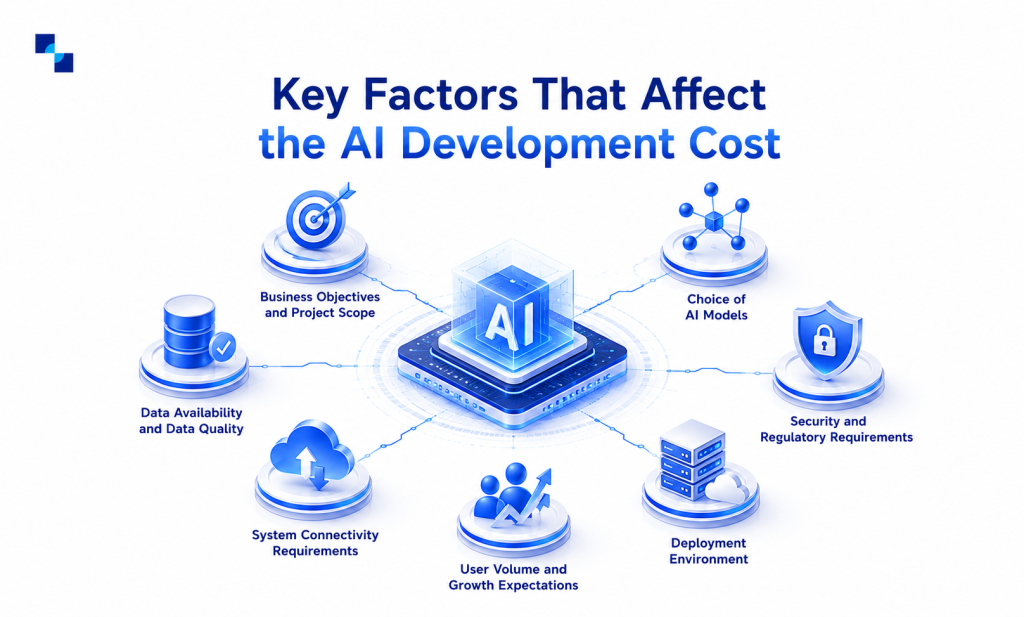
Business Objectives and Project Scope
The business problem being solved is often the strongest determinant of project cost. A simple AI assistant designed to answer customer queries requires far fewer resources than an enterprise system responsible for decision support, workflow execution, or cross-departmental knowledge management. As project scope expands, development requirements, testing efforts, governance controls, and deployment complexity typically increase as well.
Data Availability and Data Quality
AI systems depend on data to deliver meaningful outcomes. Organizations with well-structured, accessible, and reliable data are often able to move faster and control costs more effectively. On the other hand, businesses with fragmented data sources, inconsistent records, or limited data governance may need significant preparation work before development can begin. Data collection, cleansing, labeling, and validation often represent a substantial portion of the overall AI project cost.
Choice of AI Models
The type of AI model selected can significantly influence development expenses. Organizations may choose from open source models, commercial foundation models, fine-tuned models, or fully customized models built for specialized use cases. Open source models can reduce licensing expenses but may require additional engineering effort. Commercial models can accelerate development but often introduce recurring usage costs. Fine-tuned and custom models generally require greater investment due to additional data preparation, testing, and performance validation requirements.
System Connectivity Requirements
Most enterprise AI solutions do not operate in isolation. They often need access to customer platforms, enterprise applications, internal databases, document repositories, communication tools, and business workflows. As the number of connected systems increases, so does the effort required to establish secure data access, manage permissions, maintain data consistency, and ensure reliable performance. These factors can significantly influence AI implementation cost.
Security and Regulatory Requirements
Organizations operating in regulated industries often face additional requirements related to privacy, compliance, data protection, auditability, and access controls. Healthcare providers, financial institutions, government agencies, and large enterprises frequently require extensive security reviews and governance processes before AI solutions can be deployed. These requirements increase both development effort and long-term operating costs.
User Volume and Growth Expectations
The number of users an AI system is expected to support can have a major impact on infrastructure, performance requirements, and deployment planning. An internal AI assistant serving a small team may require a relatively modest budget. An enterprise platform supporting thousands of employees or customers may require significantly greater investment in infrastructure, monitoring, and scalability planning.
Deployment Environment
Deployment decisions also influence the final AI development cost. Organizations may choose public cloud environments, private cloud environments, or on-premises deployments depending on their business requirements and regulatory obligations. Public cloud deployments often reduce initial infrastructure investments. Private cloud and on-premises environments may provide greater control but frequently require additional resources for setup, maintenance, security, and ongoing management.
AI Development Cost Versus Long-Term Operating Costs
When evaluating AI development cost, many organizations focus primarily on the initial budget required to design, build, and deploy the solution. While these expenses are important, they represent only part of the overall investment.
Initial Development Costs
Initial project costs typically include discovery, solution design, data preparation, model selection, development, testing, deployment, and user onboarding. These activities form the foundation of the AI solution and usually represent the largest upfront investment. The final amount depends on project scope, customization requirements, data complexity, and security considerations.
Model Usage Costs
Many AI applications rely on foundation models that charge based on usage. As adoption increases, model-related expenses can become a significant part of the overall AI investment cost. The number of users, query volume, response length, and business activity levels all influence ongoing model expenses.
Infrastructure Costs
AI systems require computing resources to process requests, store data, manage workloads, and support users. Infrastructure spending may include cloud services, storage resources, networking requirements, databases, and performance management tools. As organizations expand AI usage across departments, infrastructure requirements often increase as well.
Maintenance and Support Costs
AI systems require ongoing attention to maintain performance and reliability. Support activities may include issue resolution, feature enhancements, performance improvements, model updates, and compatibility updates as business systems evolve. Organizations should view these costs as part of the total cost of AI development rather than separate expenses.
Monitoring and Governance Costs
AI systems require continuous oversight to ensure accuracy, reliability, security, and compliance. Monitoring activities help identify performance issues, unexpected behavior, data quality concerns, and operational risks before they affect business outcomes. Governance efforts become increasingly important as AI systems support critical business processes and decision-making activities.
Continuous Improvement Costs
Business requirements rarely remain static. Organizations often expand AI capabilities, add new data sources, introduce additional workflows, and support new user groups after deployment. These enhancements create ongoing investment requirements that should be considered during budget planning.
Planning an AI Initiative in 2026?
AI Development Cost Breakdown by Solution Type
Not all AI solutions require the same level of investment. The budget required for a customer support chatbot differs significantly from the budget needed for an enterprise AI platform that supports multiple departments, business processes, and data sources. The following breakdown provides a practical view of how AI development costs can vary across different solution categories in 2026.
AI Chatbot Development Cost
AI chatbots remain one of the most common entry points for organizations adopting AI. These solutions are typically used for customer support, employee assistance, lead qualification, and information retrieval. The typical AI chatbot development cost ranges from $20,000 to $80,000 for straightforward deployments. More advanced enterprise chatbots connected to multiple business systems, internal knowledge bases, and customer platforms may require investments exceeding $150,000.
AI Agent Development Cost
AI agents extend beyond answering questions. They can reason through tasks, access information, make decisions within defined boundaries, and execute business actions across workflows. The typical AI agent development cost ranges from $100,000 to $500,000 or more, depending on the complexity of the workflows involved.
Generative AI Development Cost
Generative AI applications create content, generate insights, summarize information, produce recommendations, and support knowledge-intensive business functions. The average Generative AI development cost typically ranges from $80,000 to $500,000 or more, depending on the use case and customization requirements.
RAG Development Cost
Retrieval Augmented Generation systems combine large language models with enterprise knowledge sources to provide more accurate and context-aware responses. The typical RAG development cost ranges from $75,000 to $400,000. Organizations often adopt RAG systems to improve knowledge access without requiring extensive model customization.
AI Copilot Development Cost
AI copilots assist employees by providing recommendations, automating repetitive work, retrieving information, and supporting decision making processes. The typical AI copilot development cost ranges from $75,000 to $300,000, depending on the business function being supported.
AI Workflow Automation Cost
Organizations increasingly deploy AI to automate operational workflows, reduce manual effort, and improve process execution. The typical AI workflow automation cost ranges from $50,000 to $250,000.
Multi-Agent System Development Cost
Multi-agent systems consist of multiple AI agents working together to solve complex business challenges, coordinate tasks, and support large-scale operations. The typical Multi Agent System Development Cost ranges from $250,000 to more than $1 million.
Enterprise AI Platform Development Cost
Enterprise AI platforms represent the most comprehensive category of AI solutions. These platforms often support multiple business functions, departments, user groups, and data environments within a single ecosystem. The typical Enterprise AI development cost ranges from $500,000 to several million dollars, depending on organizational scale and business objectives.
AI Development Cost by Project Stage
Understanding how budgets are distributed across the development lifecycle can help organizations plan more effectively and avoid unexpected spending. While every project is different, most AI initiatives follow a similar sequence of stages.
Discovery and Planning
This stage focuses on defining business objectives, identifying use cases, evaluating data readiness, and establishing success criteria. Early planning helps reduce risks and creates a clearer roadmap for execution.
Architecture Design
During this phase, teams define the technical foundation of the solution, including model selection, data flows, system connections, security requirements, and deployment strategy.
Development
This stage involves building the AI solution, connecting data sources, developing workflows, configuring models, and creating user experiences. Development often represents the largest share of the overall AI development cost.
Testing and Quality Assurance
Before deployment, organizations validate performance, accuracy, security, reliability, and business readiness. Thorough testing helps identify issues before they affect users and operations.
Deployment
The deployment stage includes launching the solution, configuring production environments, onboarding users, and preparing operational support processes.
Ongoing Support and Maintenance
After launch, organizations continue to invest in monitoring, performance improvements, security updates, model updates, and new feature development. These activities help ensure the AI solution continues to deliver business value over time.
The distribution of spending across these stages varies from project to project. Organizations that invest sufficient time in planning and architecture often reduce costly rework later in the lifecycle, resulting in better outcomes and more predictable budgets.
How AI Development Costs Differ Across Industries
The AI development cost can vary significantly across industries due to differences in regulatory requirements, data complexity, operational scale, and business objectives.
Healthcare
Higher costs are often driven by patient data protection requirements, compliance obligations, and clinical accuracy expectations.
Financial Services
Projects frequently require advanced security controls, fraud detection capabilities, audit trails, and regulatory oversight.
Retail and E-commerce
Costs depend on personalization requirements, customer volume, recommendation engines, and commerce platform connectivity.
Manufacturing
Budgets are influenced by predictive maintenance requirements, production data, equipment connectivity, and operational scale.
Logistics and Supply Chain
AI solutions often involve route optimization, forecasting, warehouse operations, and real-time visibility across multiple systems.
Insurance
Claims processing, risk assessment, underwriting support, and customer service automation often require extensive data analysis capabilities.
Real Estate
Property valuation, market intelligence, document processing, and customer engagement solutions influence project scope and cost.
Telecommunications
Large customer volumes, network data, service automation, and support operations can increase complexity and investment requirements.
Education
AI-powered learning assistants, content generation, student support systems, and personalized learning experiences shape project budgets.
Energy and Utilities
Projects frequently focus on asset monitoring, predictive maintenance, demand forecasting, and operational planning.
Government and Public Sector
Security requirements, governance controls, transparency expectations, and large scale deployments often contribute to higher project costs.
Not Sure Whether to Build or Buy an AI Solution?
Build Versus Buy: Which Option Makes More Financial Sense?
One of the most important decisions affecting AI development cost is whether to build a custom solution, purchase an existing platform, or combine both approaches. The right choice depends on business objectives, customization requirements, available resources, and long-term goals.
| Factor | Build | Buy | Hybrid |
|---|---|---|---|
| Initial Cost | Higher | Lower | Moderate |
| Time to Deployment | Longer | Faster | Moderate |
| Customization | High | Limited | High |
| Ownership | Full | Vendor Controlled | Shared |
| Scalability | Greater Flexibility | Depends on Vendor | Flexible |
| Long Term Control | High | Limited | Moderate to High |
When Building Makes Sense
A custom solution is often the preferred choice when AI capabilities are closely tied to business processes, competitive differentiation, or specialized operational requirements. While custom AI development cost is generally higher, organizations gain greater control, flexibility, and ownership.
When Buying Makes Sense
Commercial AI platforms can reduce upfront investment and accelerate deployment. This approach is often suitable for organizations seeking standardized capabilities without extensive customization requirements.
When a Hybrid Approach Makes Sense
Many enterprises adopt a hybrid strategy by combining commercial AI models with custom business logic, proprietary data, and organization-specific workflows. This approach can balance cost, speed, and flexibility while helping organizations manage overall AI investment costs more effectively.
How AI Development Costs Are Expected to Change Beyond 2026
The economics of AI are changing rapidly. While demand for AI solutions continues to grow, several trends are expected to influence AI development costs in the years ahead.
Lower Model Costs
Growing competition among AI providers and continued advances in open source models are expected to reduce the cost of accessing powerful AI capabilities.
This could make AI more accessible to organizations that previously faced budget constraints.
Greater Availability of AI Building Blocks
Prebuilt models, frameworks, and development tools are reducing the amount of custom development required for many use cases.
As a result, organizations may be able to launch AI initiatives faster and with lower upfront investment.
Rising Demand for AI Agents
As businesses adopt AI agents for more complex tasks, spending is likely to shift toward workflow orchestration, governance, monitoring, and operational oversight.
While model costs may decline, the overall AI agent development cost for enterprise deployments may remain substantial due to increasing business complexity.
Increased Focus on Governance and Security
As AI becomes more deeply embedded in business operations, organizations will continue investing in security, risk management, compliance, and governance controls.
These areas are expected to represent a growing share of long-term AI spending.
Expansion of Enterprise AI Programs
Many organizations are still in the early stages of AI adoption. As AI moves from individual projects to enterprise-wide programs, spending will increasingly focus on scalability, reliability, and cross-functional deployment.
How Antier Helps Businesses Make Smarter AI Investment Decisions
Being a trusted AI development company, Antier helps organizations evaluate AI development cost through a business lens rather than a technology lens.
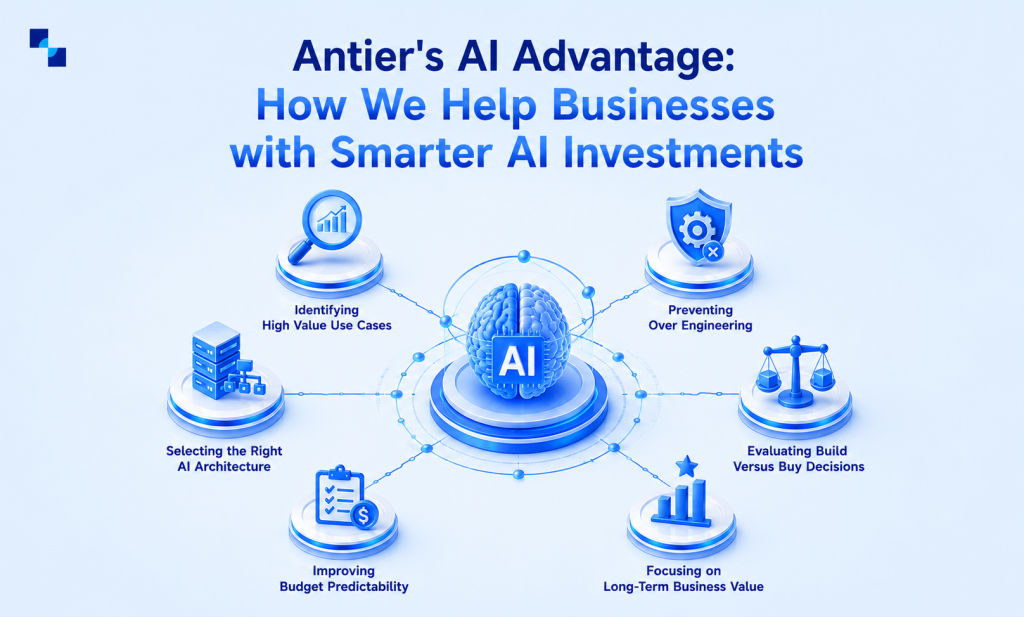
Identifying High Value Use Cases
Many organizations begin with broad AI ambitions that can quickly lead to inflated budgets and unclear outcomes. Antier works closely with stakeholders to identify use cases that offer the strongest business impact, helping organizations focus investments where they can generate the greatest returns.
Preventing Over Engineering
Not every project requires a custom model, enterprise platform, or multi-agent architecture. Our teams assess business requirements and recommend the most practical approach based on expected outcomes, helping organizations avoid unnecessary development expenses.
Selecting the Right AI Architecture
The architecture chosen at the beginning of a project can significantly influence both upfront spending and long term operating costs. Antier helps organizations evaluate different approaches and select architectures that support current objectives while accommodating future growth.
Evaluating Build Versus Buy Decisions
Organizations often struggle to determine whether they should develop a custom solution, adopt an existing platform, or combine both approaches. Antier provides guidance based on business priorities, customization needs, ownership requirements, and long term cost considerations.
Improving Budget Predictability
Unexpected expenses often arise when project scope, data readiness, system dependencies, and governance requirements are not assessed early. Through structured discovery and planning, Antier helps organizations develop more accurate budget expectations and reduce the likelihood of costly surprises later.
Focusing on Long-Term Business Value
The goal is not simply to reduce AI investment cost. The goal is to ensure that every investment supports measurable business outcomes, operational improvements, and sustainable growth. By combining strategic planning with deep technical expertise, Antier helps organizations make informed decisions that balance cost, scalability, and long-term value.
Make More Confident AI Investment Decisions
Consult Antier’s AI experts
Conclusion
The question is no longer whether businesses should invest in AI. The question is how to invest wisely.
As this guide demonstrates, AI development cost can vary significantly based on business objectives, data readiness, solution complexity, governance requirements, and deployment scale. While some organizations may begin with focused AI applications, others may pursue enterprise-wide initiatives that require larger investments and longer planning horizons.
The most successful organizations do not evaluate AI solely through the lens of cost. They assess how AI can improve productivity, strengthen decision making, automate business processes, enhance customer experiences, and create long term business value.
Understanding the true cost of AI development requires looking beyond initial budgets and considering operating expenses, scalability requirements, governance obligations, and expected returns over time.
For business leaders, the goal should not be to minimize spending. The goal should be to direct investments toward AI initiatives that solve meaningful business problems and generate measurable outcomes.
Organizations that combine disciplined planning, realistic budgeting, and a clear business strategy will be in the strongest position to capture value from AI in 2026 and beyond.
Frequently Asked Questions
01. It seems that the blog content you intQ1: Why do AI projects vary so much in cost?
AI projects differ in complexity, business objectives, data readiness, system connectivity requirements, governance obligations, and user scale. These factors can significantly influence the overall cost of AI development.
02. How long does AI development take?
Timelines vary by project type. Simple AI applications may take a few weeks, while enterprise AI platforms and multi-agent systems can require several months or longer.
03. What factors influence AI development cost the most?
Business objectives, data quality, model requirements, system connectivity, security requirements, user volume, and deployment environment are among the most significant cost drivers.
04. Is custom AI more expensive than off-the-shelf software?
Custom AI solutions often require higher upfront investment. In return, organizations gain greater flexibility, ownership, customization, and long-term control.
05. What are the ongoing costs of AI?
Ongoing expenses may include infrastructure, model usage, monitoring, maintenance, governance, security reviews, and continuous improvements.
06. How can organizations reduce AI development costs?
Organizations can control AI investment cost by prioritizing high-value use cases, improving data readiness, adopting phased deployments, using proven models where appropriate, and establishing clear business objectives.
07. What industries spend the most on AI?
Financial services, healthcare, manufacturing, telecommunications, government, and large enterprise organizations often allocate significant budgets to AI initiatives due to operational complexity and regulatory requirements.
08. How should businesses evaluate AI ROI?
Organizations should assess AI investments based on revenue growth, cost reduction, productivity improvements, decision-making speed, customer experience outcomes, and long-term business value rather than focusing solely on upfront spending.ended to provide is missing. Please share the content so I can generate the FAQ Q/A pairs for you.


