



✨ AI Summary
- The blog post discusses the emerging trend of fine wine as a high-value alternative investment.
- Tokenized wine investments convert a physical asset into a digital record, making it easier for investors to buy, sell, and verify authenticity.
- Fine wine’s value increases over time due to its finite supply and improving quality, and is also considered an inflation hedge as its value is less affected by monetary policy.
- However, challenges to fine wine investment include high entry costs, illiquidity, authentication risks, complex storage requirements, and opaque ownership records.
- Tokenization addresses these challenges by allowing fractional ownership and global liquidity, programming compliance rules into the token, and providing a transparent ownership history.
Every established investment portfolio eventually confronts the same question: how much exposure should be allocated to physical, tangible assets that sit outside traditional public markets. Gold answered that question for institutional allocators generations ago. Fine art and private equity followed, each earning a permanent line item in diversified strategies. Fine wine is now entering that same conversation, not as a curiosity reserved for collectors, but as a recognized real world asset class carrying its own custody requirements, valuation logic, and liquidity constraints.
For portfolio managers, family offices, and wealth advisors, the pain point has rarely been whether fine wine holds value. Auction records and specialist funds have demonstrated that for decades. The real difficulty has always been access: how does a decision maker allocate capital to a bottle resting in a temperature-controlled warehouse on another continent, confirm its authenticity, and exit the position without waiting months for the right buyer to appear. Tokenized wine investments are built to answer precisely that question, converting a verified, custody backed claim on the wine into a digital record that can be divided, transferred, and settled the way other on chain assets already are.
Why Fine Wine Is Emerging as a High-Value Alternative Investment
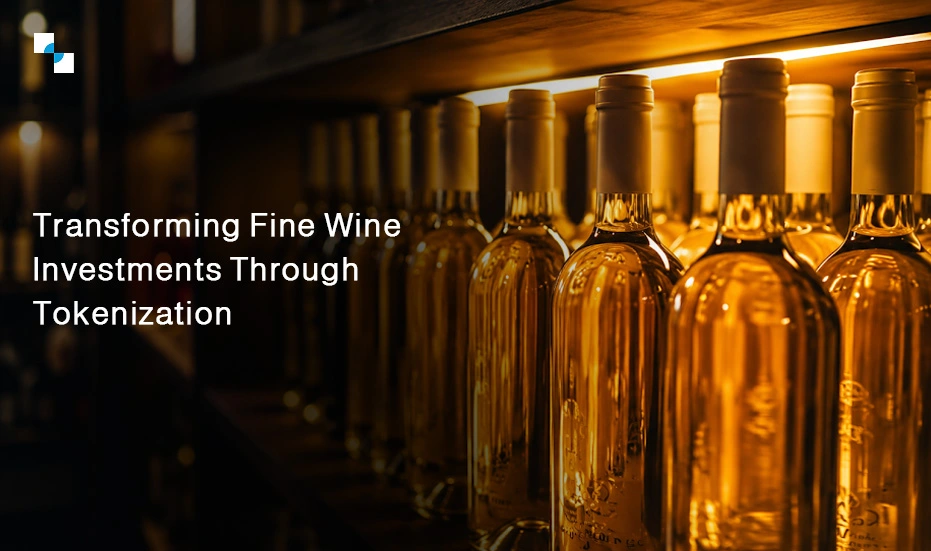
Fine wine occupies a category few asset classes can claim value that increases through the simple act of doing nothing. A bottle placed in proper storage today is often worth more a decade from now, not because of speculation, but because available supply diminishes with every bottle consumed while quality continues to develop inside the bottle. This dynamic has attracted family offices, private banks, and specialist funds long before fine wine tokenization development made the asset programmable. What has changed is not the appeal of wine itself, but the infrastructure now available to hold, trade, and prove ownership of it.
- Scarcity: Every vintage is finite the moment harvest ends. Once a producer’s allocation for a given year is bottled, no additional supply will ever enter the market for that exact vintage, placing a hard ceiling on availability regardless of how demand moves.
- Vintage appreciation: Unlike most consumable goods, correctly cellared wine improves with age up to a defined maturity window, and market value typically tracks that improvement. Time itself becomes a value driver here rather than the depreciation factor it represents for most physical goods.
- Inflation hedge: Wine values have historically moved with a degree of independence from currency cycles, since demand is shaped by scarcity and reputation rather than monetary policy alone. Investors researching wine asset tokenization solutions frequently cite this independence as a reason to diversify away from cash heavy or bond heavy allocations.
- Global demand: Consumption and collecting patterns are no longer concentrated in a handful of traditional producing regions. Emerging wealth across multiple continents has widened the buyer base considerably, giving fine wine a genuinely global demand curve that supports long term price resilience.
The Challenges Preventing Fine Wine from Becoming a Mainstream Asset
Despite its appeal, fine wine has remained a niche allocation for most portfolios, and the reasons are structural rather than a lack of investor interest. Physical custody, authentication, and settlement all rely on processes built for a pre digital era of trading, and much of the wine investment world still runs on relationships, paper trails, and specialist intermediaries rather than standardized digital infrastructure. Firms exploring wine tokenization platform development services consistently point to the same set of operational barriers standing between fine wine and mainstream, institution grade adoption, and each barrier tends to reinforce the others rather than existing in isolation.
High entry costs
A single case of an investment grade vintage can require a capital outlay that excludes all but a narrow band of investors, limiting meaningful participation to those able to commit substantial sums to one bottle or case at a time. This pricing reality has historically kept fine wine positioned as a pursuit for high-net-worth individuals and specialist funds rather than a broadly accessible allocation. Even investors who understand the asset’s long-term appeal often find themselves priced out of any single, whole unit purchase, which narrows the pool of potential capital flowing into the category and slows its growth as a mainstream alternative investment.
Illiquidity
Selling a physical holding typically means locating a specialist buyer, negotiating price, and waiting for an auction cycle or private sale to close, a process that can stretch across several months from the decision to sell through to final settlement. Unlike listed securities, there is no continuous, centralized marketplace where a seller can simply place an order and expect near immediate execution at a known price. This extended timeline creates real friction for investors who may need to access capital on shorter notice, and it is precisely the gap fine wine tokenization development is now being engineered to close by introducing more continuous, marketplace style trading mechanics to an asset that has traditionally lacked them.
Authentication risk
Counterfeit bottles and inconsistent provenance documentation remain a persistent concern across the physical wine trade, and verifying a wine’s full chain of custody without specialized expertise is genuinely difficult for most individual investors. A label can be replicated, a cork can be altered, and a certificate can be forged with enough sophistication to fool a casual buyer. Even experienced collectors sometimes rely heavily on the reputation of the seller rather than independently verifiable evidence, which introduces a layer of trust that does not scale well as the market grows, and transactions increasingly happen between parties who have never met.
Storage and custody complexity
Correct aging requires controlled temperature, humidity, and handling across the entire holding period, and any lapse in these conditions, even a brief one, can materially reduce a bottle’s eventual value or render it undrinkable altogether. Maintaining this environment consistently, often for many years, requires specialized facilities that most individual investors are not equipped to manage on their own. This dependency on professional grade storage introduces an additional layer of cost and operational risk that has no real equivalent in most other alternative asset categories, where the underlying holding does not physically degrade if conditions are imperfect for a short stretch of time.
Opaque ownership records
Ownership history is often recorded across paper certificates, fragmented invoices, and informal correspondence, making it difficult to establish a clean, verifiable title once a bottle has changed hands multiple times over a period of years or decades. Each additional transfer without a standardized, centralized record increases the chance that some portion of the provenance trail becomes unclear or disputed. For an asset whose value is closely tied to a credible, unbroken history of proper storage and legitimate ownership, this kind of record keeping fragility represents a structural weakness that becomes more pronounced the longer a bottle remains in circulation.
Limited access to global buyers
Cross border sale of physical wine involves logistics, import duties, and jurisdictional paperwork that can be prohibitive for a single bottle or case transaction, keeping many willing buyers permanently out of reach of a given seller. A collector in one country may have genuine interest in a holding located elsewhere, but the practical cost and complexity of physically shipping, insuring, and clearing that wine through customs can outweigh the value of the transaction itself. This friction narrows the effective marketplace for any given bottle to buyers who happen to be reasonably close, geographically or logistically, to wherever that bottle is currently stored.
How Tokenized Wine Investments Solve These Challenges
Tokenized wine investments address each of these barriers directly by converting a physical, custody verified asset into a digital record that can be divided, transferred, and tracked on a blockchain ledger. Tokenization does not replace the fundamentals of wine investing; it changes how ownership is recorded, how capital is deployed, and how quickly a position can be exited. The result is an asset class that keeps its physical scarcity while adopting the accessibility and settlement speed of digital markets, giving decision makers a structure that finally matches the sophistication of the underlying asset.
Fractional ownership
Instead of purchasing an entire case, an investor can hold a defined share of a token backed by that same case, lowering the capital required to participate meaningfully in a specific vintage or producer. Fine wine tokenization development makes it possible to divide a single physical asset among many holders without ever dividing the bottle itself, since the token, not the wine, is what gets split. This opens the category to a much broader base of investors who previously could only watch fine wine appreciation from the sidelines, while the physical asset continues to be stored and managed exactly as it would be for a single owner.
Programmable ownership
Smart contracts can encode transfer restrictions, holding periods, and eligibility rules directly into the token, so ownership changes automatically follow the terms set for that specific offering rather than relying on manual paperwork and case by case verification. This means compliance is not something layered on after a trade happens; it is built into the mechanics of the trade itself, which reduces the administrative burden on issuers and gives investors more confidence that every transfer they see recorded actually complied with the applicable rules at the moment it occurred.
Global liquidity
Once a wine backed token exists on a compatible network, it can be listed for trading among a global pool of verified investors, removing many of the geographic limitations that constrain a physical sale. A buyer in one part of the world can acquire an interest in a case stored on another continent without arranging shipping, insurance, or customs clearance, since what changes hands is the digital claim rather than the bottle. This expands the realistic buyer pool for any given holding well beyond what would ever be practical for a physical transaction alone.
Transparent ownership history
Every transfer of a token is recorded permanently on the ledger, creating a verifiable chain of custody that is considerably harder to falsify than a paper certificate or a fragmented set of invoices. Anyone reviewing the token’s history can see exactly how many times it has changed hands and under what recorded terms, without needing to take a seller’s word for it. This is a core advantage that wine asset tokenization solutions bring to an asset class long troubled by provenance disputes, since the record itself becomes the primary source of truth rather than a collection of documents that must be independently cross checked.
Faster settlements
Trades that would otherwise take weeks to clear through traditional channels, involving physical verification, paperwork, and manual reconciliation, can settle within a far shorter window once ownership is represented on chain, freeing capital for reallocation sooner rather than later. Wine tokenization platform development services are built specifically to compress this settlement cycle without compromising custody integrity, meaning the speed gain does not come at the expense of the verification and security standards that make the underlying asset trustworthy in the first place.

Technologies Powering Wine Tokenization Platforms
The credibility of any tokenized wine offering depends on the technology stack behind it, not only the presentation around it. Firms providing wine tokenization platform development services typically combine several layers of infrastructure: a base blockchain network for issuing and transferring tokens, a token standard that enforces compliance, an oracle layer that connects real world data to the contract, decentralized storage for documentation, and physical monitoring hardware that keeps the underlying bottles verifiably intact. Each layer plays a distinct role in making sure the digital token and the physical asset never drift apart, and the choices made at this stage tend to determine how the platform performs years after launch, not just at the point of issuance.
- Ethereum: The most established smart contract network, offering the deepest pool of developer tooling, audited standards, and institutional familiarity, which makes it a common base layer for security grade token issuance. Its long operating history and broad ecosystem of auditors, custodians, and compliance tooling give issuers a well-tested environment to build on, which matters considerably when the underlying asset represents real, physical value rather than a purely digital collectible.
- Polygon: A scaling network built to reduce transaction costs and confirmation times while remaining compatible with Ethereum tooling, which is particularly useful for platforms expecting a high volume of smaller fractional trades. Because fractional wine ownership can involve many small transfers as tokens change hands among a broad investor base, keeping per transaction costs low becomes an important practical consideration rather than a secondary detail.
- Avalanche: A high throughput network with fast finality, often selected when a platform needs rapid settlement for tokenized wine investments traded across multiple time zones and market hours. Fast finality reduces the window during which a trade could theoretically be reversed or disputed, which is a meaningful consideration for a marketplace intended to operate continuously across a globally distributed investor base.
- ERC 3643: A permissioned token standard purpose built for regulated securities, allowing rules such as investor eligibility, jurisdictional restrictions, and transfer limitations to be enforced automatically inside the smart contract itself rather than through a separate manual review process. This is particularly relevant for wine backed tokens, which typically need to behave as compliant securities rather than freely transferable digital collectibles.
- ERC 721: The standard behind unique, non-interchangeable tokens, well suited to representing a single rare bottle or case where each unit must remain individually identifiable rather than treated as interchangeable with another otherwise similar holding. This distinction matters for wine specifically, since two bottles from the same vintage and producer can still differ in condition, storage history, or documentation completeness.
- Chainlink Oracles: A decentralized oracle network that feeds verified off chain information, such as custody confirmations, authentication updates, or storage condition reports, into the smart contract so the token accurately reflects the physical asset’s current status rather than a static snapshot taken only at issuance. Without this kind of ongoing connection to real world data, a token risks becoming disconnected from the actual state of the wine it is supposed to represent.
- IPFS: A distributed storage protocol used to hold authentication certificates, provenance documents, and imagery in a tamper resistant format that stays accessible without depending on a single centralized server that could fail, be altered, or become unavailable. This decentralized approach to documentation storage adds a further layer of resilience to the overall provenance record supporting each token.
- Multi signature custody: A security model that requires multiple independent approvals before any custody related action can be executed, reducing the risk of a single point of failure, whether through error or bad intent, controlling the underlying wine. Requiring several independent parties to authorize significant actions creates a meaningful check against unilateral decisions that could otherwise compromise investor confidence in the custody arrangement.
- IoT sensors: Connected devices installed within storage facilities that continuously monitor temperature and humidity, feeding real time condition data to the ledger so that wine asset tokenization solutions can prove storage integrity rather than merely claim it in an offering document. This continuous monitoring transforms storage assurance from a one-time promise made at the point of sale into an ongoing, verifiable record that investors can reference throughout the entire holding period.
Build Your Wine Tokenization Platform
Choosing the Right Wine Tokenization Platform Development Partner
Selecting a partner for fine wine tokenization development is a decision that extends well beyond writing smart contracts. The right partner must understand securities compliance across multiple jurisdictions, structure custody arrangements with bonded warehouses and authentication specialists, and build a token architecture able to withstand regulatory scrutiny as the market matures. Decision makers evaluating vendors should look for demonstrated experience across the full lifecycle, legal structuring, technology architecture, custody integration, and investor facing marketplace design, rather than a narrow point solution that addresses only one stage of the process. Enterprises that treat platform selection as a strategic decision, rather than a purely technical procurement exercise, tend to move from concept to a compliant, tradable offering far more efficiently.
Antier brings this end-to-end capability to organizations preparing to enter the fine wine asset class. With more than nine years of dedicated blockchain engineering experience, Antier has supported clients across real estate, gold, and broader real world asset categories with compliance ready infrastructure suited to regulatory frameworks in the UAE, the European Union, the United States, and Singapore. Our wine tokenization platform development services cover the complete build: authentication integration, custody workflows, multi chain smart contract deployment, investor onboarding, and marketplace design, all delivered by a single accountable team rather than a fragmented vendor stack. For decision makers ready to convert cellar assets into structured, tokenized wine investments, Antier provides the technical depth and global delivery experience needed to move from concept to a fully operational platform.
Frequently Asked Questions
01. Why is fine wine considered a valuable alternative investment?
Fine wine is valued as an alternative investment because its worth often increases over time due to diminishing supply and improving quality, making it a unique asset class that appreciates without speculation.
02. What challenges do investors face when allocating capital to fine wine?
Investors face challenges such as confirming the authenticity of the wine, managing custody requirements, and exiting their position without lengthy delays in finding a buyer.
03. How does tokenization improve fine wine investments?
Tokenization converts verified claims on fine wine into digital records, allowing for easier division, transfer, and settlement, thereby enhancing accessibility and liquidity for investors.