




✨ AI Summary
On July 28, 2026, 1inch took its Aqua protocol public across 13 EVM chains, introducing a “shared liquidity” model. It allowed liquidity providers to back multiple trading positions from a single wallet balance instead of depositing into pools, and tokens move only at the moment a swap actually settles. This breakdown explores 1inch Aqua’s registry-based architecture, compares shared liquidity against AMMs and aggregators, and outlines key design requirements for protocol builders.
Two DeFi development teams can both call what they’re building “DeFi liquidity protocol development” and still end up building two different systems. One of them may build a fork of Uniswap’s constant-product or concentrated-liquidity math, tuned for a new chain or fee tier while the other might build something closer to 1inch Aqua’s shared liquidity model.
1inch Aqua replaces traditional liquidity pools with a virtual registry. Instead of depositing assets into smart contracts, liquidity providers keep tokens in their own wallets while committing allowances across multiple strategies. Trades settle in a single atomic transaction, pulling and pushing tokens directly to and from the LP’s wallet only at the moment of execution.
What is shared liquidity in DeFi?
Shared liquidity is a liquidity-provision model where the same token balance backs multiple trading positions or strategies at the same time, without the assets ever being deposited into a liquidity pool. In a shared liquidity model, most notably popularized by 1inch Aqua, the DeFi protocol acts as the registry tracking how balances are committed across positions. Rather than locking assets in a pool, the protocol monitors revocable allowances and executes atomic settlement directly from the LP’s wallet when a swap fills.
Why DeFi Needs Shared Liquidity: Solving the $1.8B Idle Capital Problem
The core purpose of concentrated liquidity in DeFi protocol development was to boost capital efficiency for liquidity providers. While it delivered a real improvement over legacy v2 models, significant inefficiencies remain. A Dune Analytics study commissioned by 1inch evaluated approximately $1.84 billion in concentrated liquidity across seven chains, utilizing 26 weekly snapshots throughout H1 2026. The research revealed that $542M per week, which makes 29.5% of the total capital, sat outside active price ranges and earned nothing. When including capital that was technically in range but never actually used in a trade, total underutilized capital reached 85% nearly. The study also estimated that idle LPs collectively forebore roughly $150M in annual fees. Underutilization reached 98.7% for constant-product AMMs (Uniswap v2 style), compared to roughly 85% for concentrated liquidity pools.
Most DeFi liquidity protocol development over the past few years optimized the taker side of the problem with smart order routing, DEX aggregation, cross-chain routing, etc. The maker-side of the problem was left unresolved as LPs still had to pre-split their capital across pools and price ranges before knowing where demand would land. Aqua became a mainstream attempt to fix that maker-side challenge directly.
Ready to build high-efficiency liquidity protocols?
Three DeFi Liquidity Protocol Development Models Compared
| Dimension | Pool-based AMM | Aggregator / smart order routing | Shared liquidity layer (Aqua model) |
|---|---|---|---|
| Capital model | LPs deposit assets into a pool contract. Capital is allocated to a specific pool and, in concentrated-liquidity designs, to a selected price range. | Does not normally change how LPs provide capital. It reads liquidity from existing pools, RFQ systems and other venues, then routes taker orders across them. | LP assets remain in the maker’s wallet. A revocable token allowance lets multiple strategies reference the same wallet balance; the balance itself remains the binding limit. |
| Custody | Non-custodial at the protocol level, but assets are transferred into and held by the pool contract until withdrawal. | The aggregator generally does not custody LP capital and settlement occurs through the underlying liquidity sources. | It is self-custodial from the LP’s perspective. Aqua says it does not hold maker tokens, and assets move only when a swap fills. The allowance and smart-contract architecture still create technical risk. |
| Capital utilization | Can be inefficient. Concentrated liquidity becomes inactive when price leaves a position’s range; even in-range capital may not be reached by actual trades. developers. | Improves execution for takers by finding and combining existing liquidity. It does not, by itself, make idle LP capital more productive. | Designed to improve maker-side utilization by allowing one wallet balance to support multiple positions and strategies. This is a protocol design objective, not a guaranteed utilization rate. |
| MEV / JIT exposure | Concentrated-liquidity pools can be exposed to JIT liquidity and other MEV strategies because liquidity can be added around a swap and fees are distributed according to pool mechanics. | Aggregators may reduce some routing inefficiencies, but takers and underlying LPs can still face sandwiching, adverse selection, stale-price pickoff and other MEV risks. | Aqua is designed to reduce JIT fee sniping because each position has a single LP owner and outside liquidity cannot be inserted into that position. This is best described as JIT-resistant by design, not universally MEV-proof. blog. |
| Permission model | Usually permissionless: anyone can deposit into an eligible pool, subject to the protocol’s rules. | Takers can use the aggregator, but the aggregator decides which venues, pools, RFQ providers or resolvers are eligible for routing. | Liquidity can be maker-controlled through allowances and, where enabled, conditional access. Fills are routed through verified resolvers or counterparties rather than being fully open to every actor. finance. |
| DeFi Liquidity Protocol Development complexity | Mature but still complex as they require pool mathematics, pricing curves, tick accounting, fee logic, oracle considerations and security testing. | High routing complexity comes with real-time pricing, pathfinding, split orders, gas estimation, source reliability and execution protection. | Novel accounting and settlement model development is complex due to allowance management, virtual balances, strategy accounting, resolver verification, atomic settlement and failure handling. |
| Best fit | Permissionless LP onboarding, long-tail assets and straightforward trading pairs. | A demand-side execution layer that improves taker pricing across fragmented venues. | Capital-efficiency-focused market makers, professional LPs and controlled or institutional liquidity that needs self-custody and strategy-level access controls. |
How 1inch Aqua’s Shared Liquidity Layer Actually Works
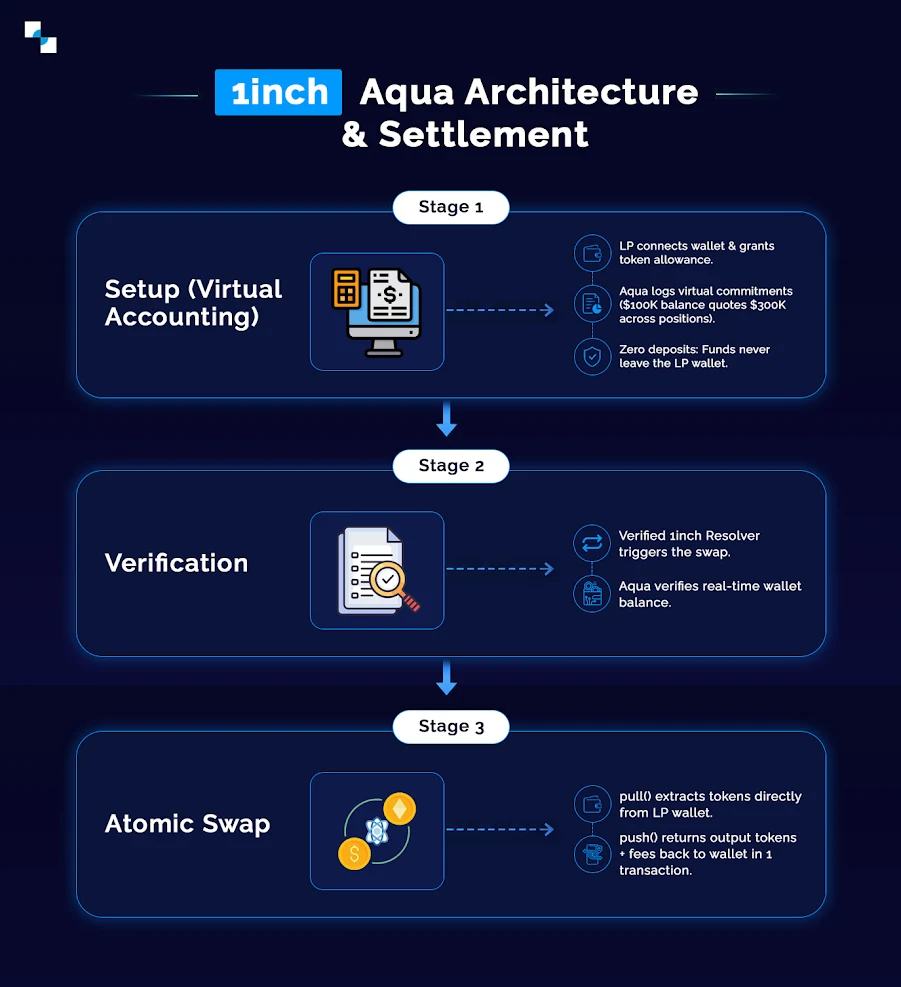
This is something that anyone planning AMM alternative development must know. Aqua is built as a registry mechanism, not a vault. To get started, a liquidity provider connects their wallet and sets a revocable spending allowance per token and chain. This allowance acts as a safety cap, limiting the maximum amount any single trade can pull. Using that allowance, the LP can open single or multiple positions such as full-range, concentrated, or pegged setups. Each position is compiled into an immutable, hash-addressed strategy that is executed directly by 1inch’s SwapVM engine.
Nothing is deposited to a vault. Aqua’s smart contracts never hold LP tokens. They maintain virtual balance records through a ship()/dock() lifecycle where,
- ship() creates a strategy with its liquidity allocation
- dock() withdraws it
- actual tokens move only through pull() and push(), which fire exclusively at swap execution, atomically, in one transaction.
The result is what 1inch calls “coordinated overbooking”. A $100k wallet balance can quote $300k across three positions, but max fills are capped at the LP’s actual wallet balance, i.e. $100k. If a swap exceeds real time funds, the transaction simply reverts.
The 1inch Aqua liquidity protocol doesn’t use leverage or borrowing. It is explicit that the “Shared Liquidity Ratio” measures availability, not leverage or exposure.
Key Architectural Takeaways For DeFi Liquidity Protocol Development
If you are evaluating the shared liquidity pattern as an architecture for your own DeFi liquidity protocol development rather than just a user product, two technical design choices stand out:
- Permissioned Execution via Credentialed Resolvers
Swaps against Aqua positions are not fully open-permissionless. Trades must be executed by 1inch Resolvers who are verified market makers holding on-chain access credentials. This creates a risk-controlled execution layer, though developers can still layer optional Conditional Access Rules (e.g., gating liquidity by NFTs, DAOs, or institutional KYC) for tailored enterprise use cases. - Native Immunity to JIT Fee Sniping
Because every position belongs to a single owner rather than a shared pool, there is no communal fee pool for searcher bots to exploit. This structurally blocks Just-In-Time (JIT) liquidity attacks, a practice that drains up to 44% of fee income from passive LPs in standard AMM pools.
What Does Shared Liquidity Protocol Development Require?
If a shared-liquidity model looks like the right fit for DeFi liquidity protocol development, rather than another AMM fork or another aggregator, here’s what a development team needs to consider before writing contract code:
- Counterparty Credentialing: Decide upfront whether fills need a verified-resolver layer (Aqua’s model) or a fully open taker set? This changes both the legal posture and the contract surface area.
- Decoupled Accounting: Keep the liquidity-lifecycle logic (creating and withdrawing strategies) separate from the swap-execution logic (pulling and pushing tokens). Mixing them is where most of the reentrancy risk lives.
- Atomic-Revert Handling: A shared-liquidity swap must fail cleanly when the real wallet balance can’t cover it at the moment of execution, not partially execute or leave a strategy in an inconsistent state.
- Reentrancy Protection: Multiple positions can reference the same balance at once, so pull()/push() calls need to be guarded against nested or re-entrant swap execution.
- Display True “Pullable” Liquidity: Frontends must display an LP’s actual available capital which is calculated as the lower of their strategy’s allocation versus their real-time wallet balance.
((StrategyAllocation,WalletBalance)).
Displaying the raw ERC-20 allowance alone is misleading, as it merely acts as a spending ceiling rather than available funds.
- Optional Gating Hooks: During liquidity protocol development, one must build conditional-access rules (NFT-gated, DAO-gated, institutional) as a layer on top of the core registry, not baked into it, so open and permissioned liquidity can coexist.
- 13-Chain Cross-Network Tracking: Because 1inch Aqua deploys across 13 EVM chains with independent per-token allowances, protocol dashboards must aggregate and track LP exposure across 13 separate network environments in real time.
Also Read>>> Cost To Build A DeFi Platform in 2026: Pricing Breakdown By Protocol Type
Is Shared Liquidity Protocol Development Compliant? Navigating DeFi Regulatory Frameworks
A shared-liquidity layer may reduce custodial exposure because liquidity providers can retain assets in their own wallets rather than depositing them into a pooled contract. However, that design advantage is not a regulatory exemption. The key questions that regulators ask are:
- what the resolver network does
- whether it matches or routes transactions
- who controls access and counterparties
- whether any entity operates the venue
- how the system is paid
Those functions, rather than the word “non-custodial”, determine which licensing, AML, market-conduct and financial-services rules may apply to a DeFi liquidity protocol development.
| Jurisdiction | Relevant framework | What to watch for in a shared-liquidity design |
|---|---|---|
| United States | FinCEN/MSB rules, state money-transmitter laws, SEC and CFTC rules, depending on the assets and functions involved | Self-custody may reduce custodial exposure, but the resolver layer could create broker, exchange, dealer, money-transmission or market-infrastructure questions if it solicits, matches, routes or executes transactions. The regulators analyse the actual functions rather than the label “non-custodial protocol” so you must also consider this during liquidity protocol development. |
| United Kingdom | FCA cryptoasset AML regime now; FSMA Cryptoassets Regulations 2026, with the broader regime scheduled to start on 25 October 2027. | Assess whether the operator, resolver network or credentialing body performs a regulated activity such as operating a trading platform, arranging deals, dealing as agent, custody or lending. Do not rely on “no identifiable controller” as a safe harbour. |
| UAE / Dubai | VARA Virtual Assets and Related Activities Regulations and the 31 March 2026 Exchange Services Rulebook. | Determine whether the layer conducts exchange, conversion, order matching, order-book or related intermediary activity. A VARA-licensed liquidity protocol may provide a possible operating structure, but the protocol, resolver and venue roles still need to be mapped separately. |
| Australia | AUSTRAC AML/CTF rules and ASIC’s Digital Assets Framework for covered Digital Asset Platforms and Tokenised Custody Platforms. | Analyse whether the operator holds client assets, operates a platform, provides dealing or arranging services, or handles financial products. Resolver operation as a business may create licensing and governance obligations, but the result depends on the exact service and asset. |
Need tailored regulatory guidance for your DeFi architecture?
Which Web3 Teams Benefit Most from Shared Liquidity Protocol Development?
The shared liquidity design isn’t a fit for every DEX or liquidity protocol development roadmap. Two profiles get real value from it:
| Target Profile | Core Challenge Solved | Why Build Shared Liquidity? |
|---|---|---|
| United States | Idle capital in traditional AMM pools | Differentiates protocol architecture by offering non-custodial, wallet-backed liquidity instead of launching another standard pool fork. |
| Market Makers & Trading Desks | Capital fragmented across venue deposits | Enables quoting directly from a central balance sheet, aligning with how institutional desks actually deploy inventory. |
Conclusion: Choosing the Right Liquidity Architecture for Your DeFi Liquidity Protocol Development
Evaluating whether a shared-liquidity layer, a pool-based AMM, or an aggregator-first approach fits your roadmap is an architectural decision worth getting right before writing a single line of smart contract code. Each model carries distinct trade-offs in capital efficiency, custody mechanics, execution security, and accounting complexity.
Antier’s specialized DeFi development team helps Web3 founders and enterprise engineering teams in:
- Scoping their core liquidity architecture
- Designing and building custom accounting and atomic settlement layers
- Managing the full pipeline through security audits to mainnet deployment
Planning your protocol’s liquidity engine? Talk to Antier’s blockchain architects before committing to a DeFi liquidity protocol development model.
Frequently Asked Questions
01. What is shared liquidity in DeFi?
It's a liquidity-provision model where the same wallet balance backs multiple trading positions at once, without depositing into a pool. Liquidity providers grant an allowance, and tokens move only when a swap actually fills, directly from the wallet.
02. How is a shared liquidity layer different from a standard AMM pool?
A pool requires LPs to deposit tokens into a shared contract, where they're locked to that pool and often sit idle outside the active trading range. A shared-liquidity layer keeps tokens in the LP's wallet and lets one balance back several positions simultaneously, with tokens moving only at the moment of settlement.
03. Is shared liquidity the same as using leverage?
No. Nothing is borrowed and there's no debt. A swap can only ever pull what's actually in the LP's wallet at that moment — the model measures how much of a balance is available across positions, not exposure beyond what's held.
04. Can a shared liquidity protocol be fully permissionless?
It can be designed either way, but 1inch's own implementation isn't fully open — fills run through resolvers that complete a verification process and hold an access credential. Teams building their own version need to decide this trade-off explicitly rather than default to either extreme.
05. How long does DeFi liquidity protocol development take for a shared-liquidity model versus a standard AMM?
A standard AMM (constant-product or concentrated-liquidity) can typically ship in 2–4 months given how mature the tooling and audit patterns are. A shared-liquidity layer is a newer primitive — the allowance-accounting, atomic-settlement, and resolver-verification components add real scope, and teams should budget meaningfully more time for design review and audit before treating timelines as comparable.