




✨ AI Summary
The GENIUS Act stablecoin compliance generally becomes effective on January 18, 2027. As of September 2026, key OCC, FDIC, Federal Reserve, NCUA and Treasury-related rules remained in unfinished form. DeFi developers are not automatically payment-stablecoin issuers and do not generally need a banking charter merely because they integrate or support regulated stablecoins. However, DeFi protocols that create, offer, redeem or control must qualify under permitted-issuer pathways.
The countdown to January 18, 2027 has become one of the most discussed milestones in U.S. stablecoin regulation history. Yet, many DeFi development teams remain uncertain about what the GENIUS Act actually requires and whether the law applies directly to their protocols.
The confusion is quite obvious and understandable. The GENIUS Act compliance for DeFi is applicable, but the final implementing rules are still being completed by multiple regulators.
Existing guidance targets banks and fintechs who want to become licensed issuers, not the protocols, DAOs, and yield platforms building on top of them. As stablecoins become the settlement layer for lending, payments, tokenized assets, and institutional DeFi infrastructure, DeFi protocol teams should still be evaluating their exposure rather than waiting for the final rollout.
What GENIUS Act Actually Changes For DeFi Platform Development?
The GENIUS Act stablecoin compliance establishes a federal framework for payment stablecoin operations and issuance in the United States. It doesn’t directly create a general regulatory regime for DeFi protocols, decentralized applications or smart contracts. In fact, the statute excludes several activities from its definition of “digital asset service provider”, including distributed-ledger protocols, protocol development, self-custodial software interfaces, transaction validation and peer-to-peer liquidity pools.
However, the exclusion is not universal. A DeFi company may still face obligations if it operates a custodial service, exchange, transfer service, or stablecoin issuance function. Ultimate legal exposure depends on the platform’s actual architecture and function, not simply on whether it labels itself as “DeFi”.
Ultimately, the GENIUS Act DeFi compliance reshapes DeFi through its impact on stablecoins. Since stablecoins serve as DeFi’s primary medium of exchange, collateral, and settlement layer, the following rules around issuer authorization, reserves, and redemptions will indirectly dictate asset support, liquidity management, and protocol compliance design.
- Permitted Payment Stablecoin Issuers
The GENIUS Act stablecoin compliance 2027 establishes a framework for regulated entities that can legally issue payment stablecoins. These generally include:
- insured depository institutions
- federally qualified non-bank issuers
- approved state-regulated entities operating under federal standards
For protocols issuing stablecoins: Any DeFi protocol planning to mint, back, or manage its own payment stablecoin must secure a permitted-issuer license or risk operating unlawfully in the U.S.
For protocols integrating stablecoins: An issuer’s regulatory status becomes a critical due diligence factor when selecting supported collateral and liquidity assets for DeFi platform development.
- Issuance Restrictions
The legislation imposes restrictions on who can issue payment stablecoins and under what conditions. Requirements include 1:1 liquid backing, segregated reserves, on-demand redemptions, and a prohibition on paying yield to holders.
The GENIUS Act also prohibits payment stablecoin issuers from paying interest or “economically equivalent” yield directly to token holders. This restriction applies to issuers rather than the broader DeFi ecosystem. As a result, non-issuers DeFi lending protocols, tokenized Treasury products, and other third-party yield-generating applications remain the primary venues where users can earn returns on stablecoin-denominated assets.
For DeFi protocols issuing stablecoins: Aspiring protocol issuers must align their token mechanics, such as yield distribution and mint/burn control, with Federal Reserve and operational standards.
For DeFi protocols integrating stablecoins: DeFi development teams dependent on third-party stablecoins must examine whether an issuer’s compliance constraints (or potential reserve/redemption bottlenecks) could impact protocol liquidity or collateral stability.
- Offering and Selling Restrictions
The GENIUS Act stablecoin compliance establishes restrictions on the offering and sale of payment stablecoins in the United States. In general, a payment stablecoin may only be issued and offered by a permitted issuer operating under the Act’s regulatory framework. The legislation also creates guardrails around the distribution of non-compliant stablecoins, particularly where issuers have not satisfied applicable federal or state authorization requirements.
For DeFi platforms issuing stablecoins: Stablecoin issuer DeFi protocols must ensure their distribution models, redemption processes, disclosures, and market-access strategies comply with applicable federal requirements before making payment stablecoins available to U.S. users.
For DeFi platforms integrating stablecoins: DeFi development teams should understand the regulatory status of the stablecoins they support, particularly when building lending markets, payment applications, institutional liquidity pools, or tokenized asset platforms that rely on stablecoin settlement. Changes affecting a stablecoin’s ability to be lawfully offered in the U.S. could influence liquidity, accessibility, and institutional adoption.
- Reserve Requirements.
The Act mandates 1:1 reserve backing in liquid assets that include the following, along with periodic audit disclosures:
- such as U.S. currency
- demand deposits
- Treasury bills with short maturities
- repurchase agreements backed by Treasuries
- other highly liquid assets specified by regulators
The GENIUS Act framework for DeFi also requires issuers to provide timely redemption rights, ensuring holders can exchange stablecoins for equivalent fiat value under defined conditions.
For DeFi platform developers issuing stablecoins: Aspiring issuers must structure treasury operations to meet strict liquidity, asset-eligibility, and audit standards.
For DeFi platforms integrating stablecoins: Verified reserve transparency becomes a baseline requirement when evaluating stablecoins used as DeFi protocol collateral or treasury reserves. DeFi protocols must also carefully examine how issuer redemption mechanisms affect liquidity during periods of market stress.
- AML and Sanctions Obligations
Issuers and intermediaries must maintain robust Anti-Money Laundering (AML) and Office of Foreign Assets Control (OFAC) compliance frameworks.
For DeFi platforms issuing stablecoins: DeFi development teams must build compliant identity and monitoring capabilities directly into their stablecoin issuance and redemption architecture.
For DeFi platforms integrating stablecoins: Although the Act directly targets issuers, issuers’ mandatory token-freezing capabilities and institutional demand are driving DeFi toward KYC-whitelisted and permissioned liquidity pools.
- Treatment of Foreign-Issued Stablecoins
The GENIUS Act establishes a pathway for certain foreign-issued stablecoins to access U.S. markets, subject to comparability determinations, information-sharing requirements, reserve standards, and supervisory cooperation between jurisdictions.
For DeFi protocols issuing stablecoins: Offshore DeFi development teams issuing stablecoins must meet recognized comparability standards or maintain non-U.S. safe harbors to avoid regulatory conflict while operating in the U.S.
For DeFi platforms integrating stablecoins: Rules may fragment global liquidity, forcing protocols to manage separate pools for U.S. and foreign-compliant assets.
Why GENIUS Act January 2027 Deadline Matters For DeFi Builders?
January 18, 2027 marks the expected implementation milestone for the GENIUS Act’s federal stablecoin framework. While the GENIUS Act January 2027 deadline applies primarily to payment stablecoin issuers, it is also an important planning date for DeFi builders that rely on stablecoins for liquidity, collateral, lending, payments, and settlement.
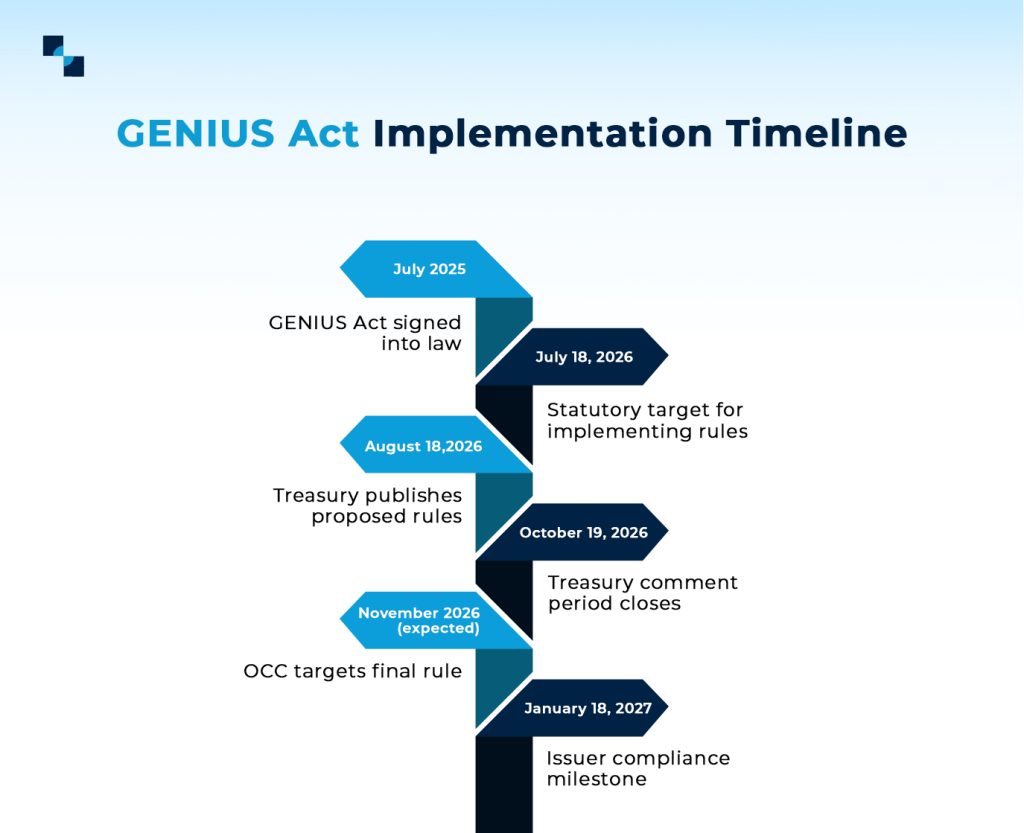
Payment stablecoin issuers must comply with the GENIUS Act framework by January 18, 2027, or 120 days after the final implementing rules are issued, whichever comes first. The GENIUS compliance framework introduces requirements across several areas, including:
- licensing pathways (PPSI status)
- prudential rules (reserves and redemptions)
- structural restrictions (yield prohibitions)
- ecosystem controls (AML, sanctions, and foreign-token distribution).
Despite the approaching implementation milestone, several key regulatory requirements remain unfinished. As of September 2026:
- The OCC had not finalized its GENIUS Act rulemaking
- Treasury had released proposed rules and was collecting feedback
- The FDIC had not published final requirements
- Several operational standards remained under development
This leaves issuers, infrastructure providers, and DeFi builders preparing for a framework whose operational details are still evolving.
Areas DeFi Builders Should Evaluate Before the GENIUS Act January 2027 Deadline
DeFi platform development teams must monitor the implementation process because stablecoins are deeply embedded across DeFi infrastructure. The regulatory changes mandated by the GENIUS act could influence the following key areas:
- Supported stablecoins and issuer status
- Stablecoin liquidity and redemption dependencies
- Lending and borrowing markets
- Yield-generation architecture
- Collateral and treasury management
- Cross-border payments and foreign-issued assets
- Institutional onboarding and permissioned access
- Tokenized asset settlement infrastructure
- Compliance and monitoring capabilities
- Long-term protocol upgrade and governance planning
Non-issuing DeFi protocols should, therefore, view the GENIUS Act January 2027 deadline as a strategic milestone to assess how new rules on regulated stablecoins will affect their platform’s liquidity, asset support, and collateral risks.
Planning Ahead Of GENIUS Act January 2027 Deadline?
For DeFi platform development teams building on stablecoins, the months ahead are less about reacting to regulation and more about making informed infrastructure decisions. Understanding issuer status, liquidity dependencies, reserve transparency, and evolving market standards can help protocols adapt more effectively as the stablecoin framework matures.
Building a DeFi platform that relies on stablecoins? Connect with Antier’s DeFi experts to evaluate your architecture, integrations, and long-term platform strategy.
Frequently Asked Questions
01. Does the GENIUS Act regulate DeFi protocols directly?
No.The GENIUS Act regulates issuers of payment stablecoins—banks, trust companies, and licensed nonbanks—not the protocols or applications that hold, lend, or trade those tokens. DeFi builders are affected if they issue stablecoins or indirectly through the stablecoins they integrate.
02. What is the actual compliance deadline?
The GENIUS Act takes effect on the earlier of January 18, 2027, or 120 days after the primary federal payment stablecoin regulators issue final implementing rules. Because those rules were still not final in September 2026, the effective date is effectively January 18, 2027 unless all regulators finalize rules very soon.
03. Can DeFi protocols still offer yield on stablecoins after the GENIUS Act?
Yes. The no‑yield rule applies only to yield paid directly by the stablecoin issuer. Permissionless lending protocols like Aave and Morpho, and tokenized Treasury products structured as fund interests rather than stablecoins, are unaffected. Yields on DeFi stablecoin markets have generally been in the low single digits and vary continuously by protocol and market conditions.
04. What happens if an issuer misses the deadline?
Civil penalties for knowing or willful violations can reach $500,000 per violation for the issuer (separate, lower per‑day penalties can apply to certain digital asset service providers under other provisions). For DeFi protocols integrating that issuer’s token, the more immediate risk is disruption to redemption, liquidity, or reserve transparency rather than direct penalties.
05. Should DeFi builders wait until January 2027 to act?
No. The rulemaking process through Q4 2026 (including OCC’s targeted November final rule and Treasury’s mid‑October comment period) will clarify the real constraints well before the statutory deadline. Builders who map their stablecoin exposure now have more runway to adjust than those who wait for the cliff itself.