


✨ AI Summary
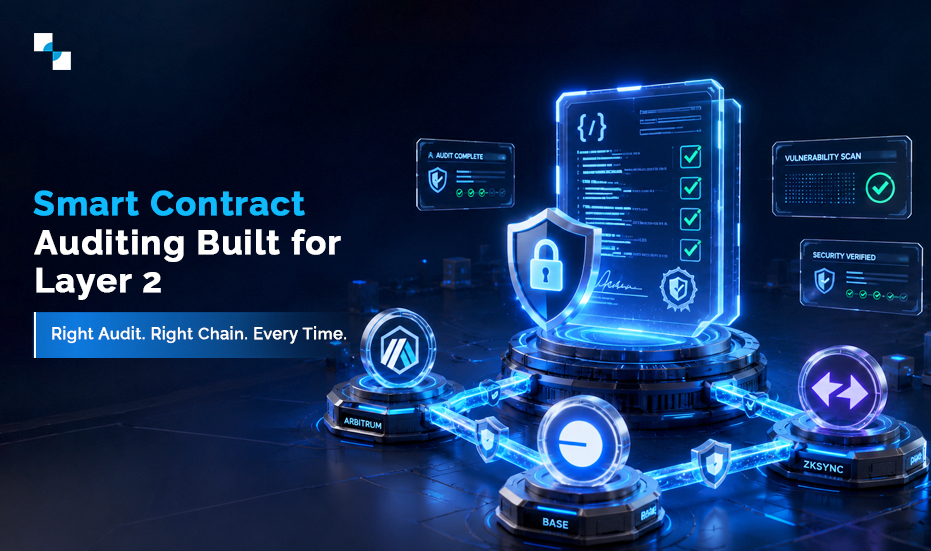
- This blog post highlights the importance of smart contract auditing for layer 2 blockchain solutions, such as Arbitrum, Base, and zkSync, and the risks associated with unaudited rollup deployments.
- Notably, it warns that mainnet audits do not necessarily guarantee safety on layer 2, due to differences in execution environments, opcode support, fee models, and trust assumptions.
- This post presents a comprehensive guide on what a rollup-ready audit should cover, highlighting the unique security considerations for each platform.
- It also discusses smart contract auditing best practices for layer 2 rollup deployments, such as testing in the target chain's environment and auditing opcode compatibility.
- The post emphasizes the importance of auditing bridge and cross-chain vulnerabilities, as well as providing a checklist for effective layer 2 smart contract auditing services.
Your mainnet audit is not a safety net on Layer 2. That is not a knock on the auditor, it is a structural reality most teams discover too late. Arbitrum, Base, and zkSync each run on distinct execution environments with different opcodes, sequencer models, and bridge logic. A contract that passes every test on a forked Ethereum environment can still fail on the rollup it was built for.
Layer 2 solutions now collectively hold approximately $47 billion in TVL, with daily transactions already eclipsing Ethereum mainnet as of 2025. That concentration of value makes every unaudited rollup deployment a high-stakes risk and the attack surface on rollups is different enough that standard EVM tooling consistently falls short.
In this blog, we break down what smart contract auditing on blockchain layer 2 solutions must cover in 2027 and what a rollup-ready audit looks like on Arbitrum, Base, and zkSync.
The L2 Security Problem No One Is Talking About Enough
The explosion of layer 2 solutions has been one of the most positive developments in blockchain infrastructure over the last three years. Cheaper fees, faster finality, and Ethereum-level security at least in theory. But there is a security gap that has quietly followed this growth, and most development teams do not discover it until after something goes wrong.
The problem is straightforward: the security assumptions that hold on Ethereum mainnet do not automatically transfer to rollups. Yet the majority of teams deploying on Arbitrum, Base, or zkSync still rely on mainnet-oriented audits. They test against a forked Ethereum environment. They use tooling calibrated for mainnet behaviour. And they go live with contracts that have never been stress-tested against the actual execution environment they will run in.
Base and Arbitrum alone now capture over 77% of all Layer 2 DeFi TVL. That concentration of value makes these chains a primary target and the auditing industry has not fully caught up with the specificity that rollup deployments require.
Did You Know?
“If an attacker can forge a proof, they can forge anything: mint tokens from nothing, rewrite state, steal funds.” – Ethereum Foundation, December 2025 | blockchain.news
Why Blockchain Layer 2 Solutions Need Their Own Audit Playbook
This is the core misconception worth addressing directly: blockchain layer 2 solutions are not Ethereum with lower fees. They are distinct execution environments with different opcode support, different fee models, different sequencer architectures, and different trust assumptions and every one of those differences creates a security implication.
When a team ports a smart contract from mainnet to a rollup without a chain-specific audit, they are making several assumptions that can break in production:
- That all opcodes behave identically (they do not on zkSync)
- That block timestamps are reliable (sequencer-controlled environments treat time differently)
- That gas logic works the same way (L2 fee models diverge meaningfully from mainnet)
- That msg.sender behaves consistently (on zkSync with native account abstraction, it sometimes does not)
Each of these assumptions is a potential exploit vector. The protocols that have avoided rollup-specific attacks are not just lucky – they audited for rollup-specific risks before deploying. Smart contract auditing that does not account for these differences is not auditing for the environment the contract will actually run in.
Arbitrum, Base, and zkSync: What Makes Each Smart Contract Auditing Scope Unique
Not all rollups are the same, and a smart contract audit company that treats them as interchangeable will miss the vulnerabilities that are unique to each chain’s architecture. Here is what separates the audit scope for each platform.
| Chain | Architecture | Key Audit Considerations |
|---|---|---|
| Arbitrum One | Nitro (Optimistic Rollup, fraud proofs) | Fraud proof window timing, ArbOS precompile interactions, delayed inbox message handling, reentrancy via cross-chain callbacks |
| Base | OP Stack (Optimistic Rollup, Coinbase-sequenced) | Sequencer trust assumptions, OP Stack bridge logic, EIP-1559 fee model differences, shared OP Stack component risks |
| zkSync Era | ZK Rollup (native AA, LLVM compiler) | Native account abstraction, keccak256 as precompile not opcode, Paymaster contract logic, LLVM compilation differences |
Arbitrum uses a 7-day fraud proof window, which means contracts with time-sensitive withdrawal or settlement logic must account for dispute delays that do not exist on mainnet. Any contract that assumes near-instant L1 finality will behave incorrectly in an Arbitrum production environment.
Base inherits the OP Stack architecture which is both a strength and a risk. When vulnerabilities are found in shared OP Stack components, they affect every chain built on that stack simultaneously. An auditor without OP Stack familiarity will miss systemic risks that sit above the individual contract level.
zkSync is the most architecturally distinct of the three. Its native account abstraction (AA) changes how msg.sender behaves in certain contract interactions, and its keccak256 is implemented as a precompile rather than an opcode – a subtle difference that breaks contracts that assume otherwise. The LLVM-based compiler also means that contracts compiled for mainnet may not behave byte-for-byte identically on zkSync.
Secure Your Layer 2 Smart Contracts Before They Go Live.
Smart Contract Auditing Best Practices for Layer 2 Rollup Deployments
This is where the theory becomes practice. A rollup-ready smart contract auditing engagement looks different at every stage from what gets reviewed to the tools used to the findings that get flagged. Here are the practices that separate a surface-level L2 audit from one that actually holds up in production.
- Compile and test in the target chain’s environment: Never test L2 deployments against a forked mainnet. Each chain requires its own fork configuration, compiler settings, and tooling stack. zkSync in particular requires LLVM-compatible compilation – a standard Solidity pipeline produces a different bytecode output than what will actually run on the network.
- Audit opcode compatibility explicitly: Run a dedicated opcode compatibility check against the target chain’s supported instruction set. Unsupported or differently-behaving opcodes are a silent failure mode that unit tests on a mainnet fork will not surface. On zkSync, keccak256, PUSH operations, and certain gas cost calculations all behave differently from mainnet expectations.
- Map every sequencer dependency: Identify all contract logic that implicitly assumes decentralised transaction ordering. Front-running protections, commit-reveal schemes, and block timestamp-dependent logic need explicit review against the sequencer model of the target chain. All eight major L2 networks in 2026 still operate with a single centralised sequencer, which means MEV-protection logic designed for mainnet’s decentralised mempool may provide false security on rollups.
- Review all bridge interaction logic: Treat every bridge integration as a high-severity audit surface. This includes the canonical chain bridge (Arbitrum’s native bridge, Base’s OP bridge, zkSync’s native bridge), any third-party bridge integrations, and any contract that receives or sends cross-chain messages.
- Validate cross-domain message aliasing: On Arbitrum and Base, when L1 contracts send messages to L2, the msg.sender address is aliased to a different value. Contracts that fail to account for this aliasing can be exploited by attackers who send messages from a carefully crafted L1 address. This is one of the most commonly missed L2-specific vulnerabilities in standard audits.
- Review gas estimation under L2 fee models: L2 fee structures diverge significantly from mainnet. Contracts with hardcoded gas limits, stipend-based .transfer() calls, or loops with gas checks can fail or behave unpredictably when the L2 data fee component changes. Every gas-sensitive code path needs to be tested against realistic L2 fee conditions, not mainnet gas assumptions.
- Audit native AA and Paymaster logic on zkSync: zkSync’s native account abstraction changes the security model for smart wallet contracts, signature validation, and gas sponsorship. Paymaster contracts are a frequently overlooked attack surface – an insecure Paymaster can be drained or manipulated in ways that are entirely zkSync-specific. These need their own audit scope, separate from the core protocol contracts.
- Include upgrade and proxy pattern review: L2 deployments frequently use upgradeable proxies to maintain flexibility post-launch. Storage layout compatibility between proxy versions, initialisation logic gaps, and admin key custody require the same rigour as core contract logic – arguably more, since a compromised upgrade path is a full protocol takeover.
Bridge and Cross-Chain Vulnerabilities Every Smart Contract Audit Company Must Flag
If there is one section of a rollup deployment that deserves disproportionate audit attention, it If there is one section of a rollup deployment that deserves disproportionate audit attention, it is the bridge. Bridges hold concentrated liquidity, their logic spans two execution environments simultaneously, and when they fail, the losses are immediate and often unrecoverable.
Historically, cross-chain bridges have been hacked for over $2.8 billion representing almost 40% of the entire value stolen in Web3. In April 2026, the Kelp DAO LayerZero bridge was exploited for $292 million – the largest single bridge hack of the year with wrapped ether stranded across 20 chains and no immediate recovery path. These are not edge cases. Bridge failures at this scale are a recurring pattern, and they are almost always the result of audit gaps, not random bad luck.
A qualified smart contract audit company will flag the following in every bridge engagement:
- Canonical vs. third-party bridge risk: Canonical bridges (Arbitrum’s native bridge, Base’s OP bridge) are lower risk than third-party integrations but still require thorough review of message relaying logic, finality assumptions, and emergency withdrawal handling. Third-party bridges add additional trust assumptions on top of the canonical layer every new integration expands the attack surface.
- Cross-chain reentrancy: Standard single-chain reentrancy guards do not protect against cross-chain reentrancy, where a callback from a bridge message re-enters a contract in an inconsistent state. This is a class of vulnerability unique to multi-chain architectures and one that generic auditing tools are not designed to catch.
- Finality mismatch exploits: Contracts that act on L2 state before L1 finality is confirmed can be exploited if the L2 is reorganised or the Arbitrum fraud proof window is still open. Any contract that releases funds, mints assets, or changes critical state based on unconfirmed L2 events needs explicit finality delay handling.
- Message replay protection: Bridge messages that are not properly protected against replay can be submitted multiple times, leading to double-spend conditions or unintended state changes. Every cross-domain message path should be audited for replay protection independently.
The Production-Ready Layer 2 Smart Contract Auditing Services Checklist
A strong smart contract auditing services engagement is not just a code review document delivered at launch. It is a structured, three-phase process with defined gates at every stage, from the first environment setup call to post-deployment monitoring. Most exploits that occur after audit do so because one of these gates was skipped. Here is what a complete L2 audit looks like in practice.
Phase 1: Pre-Audit – Set the Right Foundation
Before a single line of code is reviewed, the scope, environment, and risk surface must be locked down. Auditing without this step means reviewing the wrong contracts against the wrong chain.
- Confirm the target chain(s) and configure chain-specific compiler settings – a zkSync deployment requires LLVM-compatible compilation; Base and Arbitrum require OP Stack and Nitro-specific fork configurations respectively.
- Map every bridge interaction and cross-domain message path including canonical bridges, third-party integrations, and any contract that sends or receives L1-to-L2 messages.
- Identify all upgradeability patterns, proxy contracts, admin key holders, and storage layout across versions.
- Define the full audit scope core contracts, periphery contracts, and every external dependency that can affect contract state.
Phase 2: During Audit – Chain-Specific, Not Generic
This is where L2 auditing diverges most sharply from mainnet practice. Every item below is a risk category that standard EVM tooling is not designed to catch.
- L2-specific static analysis – Slither with L2 detectors, supplemented by custom chain-specific scripts for each target network.
- Opcode compatibility review – Manual check of every opcode used against the target chain’s supported instruction set.
- Sequencer dependency mapping – Identify all logic that assumes decentralised transaction ordering and flag it explicitly.
- Cross-domain message aliasing validation – Verify that every L1-to-L2 message path handles msg.sender aliasing correctly.
- Bridge contract review – Canonical bridge logic, third-party integrations, finality assumptions, and emergency withdrawal paths.
- Upgrade path and storage layout review – Compatibility across all proxy versions and initialisation logic gaps.
- Account abstraction and Paymaster logic – zkSync-specific scope; AA changes how signature validation and gas sponsorship work.
- Fuzz testing – Against a properly configured L2 forked environment, not a mainnet fork.
Phase 3: Post-Audit – Security Does Not End at the Report
An audit report that gets filed and forgotten is not a security posture. The post-audit phase defines what happens when something goes wrong after launch.
- Remediation review – Verify that every high and medium severity finding has been addressed before deployment sign-off.
- On-chain monitoring setup – Alert thresholds, anomaly detection, and automated pause triggers configured for the specific chain.
- Emergency upgrade path documentation – Defined roles, multi-sig requirements, and response timelines for each scenario.
- Final audit report – With L2-specific severity classifications, chain-specific notes, and a summary suitable for your legal and compliance teams.
Launch Secure Smart Contracts Across Leading Layer 2 Networks
How to Choose the Right Smart Contract Audit Company as Your Blockchain Development Company
Not every smart contract audit company is built for layer 2 solutions. Choosing the wrong partner – one with mainnet experience but no rollup expertise is one of the most common and costly mistakes teams make before launch. Here is what to look for.
- Check for real L2 audit experience: Ask for completed audit reports on Arbitrum, Base, or zkSync specifically. Mainnet audit reports do not count. If a firm cannot show documented smart contract auditing work on rollups with chain-specific findings, your deployment becomes their learning exercise and that is a risk you cannot afford.
- Ask about bridge security track record: Bridge exploits are consistently the biggest loss category in the DeFi space. The right smart contract audit company should have dedicated experience auditing bridge contracts, not just token contracts or DeFi protocols. Ask directly how they approach cross-chain reentrancy and finality mismatch. If they cannot answer clearly, keep looking.
- Look for full-stack blockchain expertise: There is a big difference between a firm that only reviews code and a blockchain development company that has actually built on blockchain layer 2 solutions. A partner with hands-on L2 deployment experience understands how the pieces interact at a system level and that is where the risks that pure auditors miss tend to hide.
- Expect a clear, documented methodology: A trustworthy partner can tell you exactly which tools they use, how they balance automated and manual review, how they classify severity, and what the remediation process looks like after findings land. Vague answers here are a red flag.
- Require post-deployment coverage: Smart contract auditing services should not end the moment the report is delivered. A serious partner provides on-chain monitoring guidance, an incident response plan, and support for upgrade procedures after launch. Security that stops at the audit report starts expiring the day you go live.
The Audit Your L2 Deployment Actually Needs
Layer 2 solutions are where the next generation of Web3 infrastructure is being built. The value is already there. The users are already there. What has not fully caught up is the security layer that protects them. A contract that passes a mainnet audit and deploys on Arbitrum, Base, or zkSync without rollup-specific review is not secure – it is untested in the environment that actually matters. That gap between what most audits cover and what blockchain layer 2 solutions actually require is where the biggest losses happen. And it is entirely preventable.
Smart contract auditing in 2027 is not a checkbox activity. It is a chain-specific, multi-phase commitment covering opcodes, sequencers, bridges, account abstraction, and post-deployment monitoring – all built around the rollup you are actually deploying on, not the mainnet you tested against. As a trusted blockchain development company, Antier audits smart contracts specifically for Arbitrum, Base, and zkSync – not just generic EVM. Your L2 deployment deserves an audit built for the rollup it actually runs on.
Frequently Asked Questions
01. Why is a mainnet audit insufficient for Layer 2 solutions?
A mainnet audit is insufficient because Layer 2 solutions operate on distinct execution environments with different opcodes and bridge logic, meaning contracts that pass tests on a forked Ethereum environment can still fail on their intended rollup.
02. What is the current total value locked (TVL) in Layer 2 solutions?
Layer 2 solutions currently hold approximately $47 billion in total value locked (TVL), with daily transactions surpassing those on the Ethereum mainnet as of 2025.
03. What security gap exists in Layer 2 smart contract auditing?
The security gap arises because the security assumptions of Ethereum mainnet do not automatically apply to rollups, leading many teams to rely on mainnet-oriented audits that do not adequately test the specific execution environments of Layer 2 solutions.