



✨ AI Summary
- Blockchain technology is revolutionizing the way universities can validate and share academic records, especially in the era of micro-credentials, skills-based learning and lifelong education.
- Rather than relying on traditional forms of proof like paper certificates and PDFs, blockchain-based digital credentials offer a more efficient, secure and portable method to represent academic achievements.
- By integrating digital credentials, cryptographic proofs and digital identity, universities can issue, share and verify credentials with ease.
- The process includes the university issuing the credential, digitally signing it, and the student storing, sharing and having it verified.
- The use of blockchain strengthens the credential's integrity and trust, without the need to place sensitive student information on the blockchain.
A university degree may take years to earn, but proving it can still depend on a certificate, a PDF, or a verification request sent back to the issuing institution. That process becomes harder when credentials need to move across universities, employers, countries, and education systems.
As higher education expands beyond traditional degrees into micro-credentials, professional certifications, skills-based learning, and lifelong education, the need for trusted and portable academic records is becoming more important.
Blockchain-based digital credentials offer one way to modernize this process. By combining structured digital credentials, cryptographic proofs, digital identity, and blockchain where it provides genuine value, institutions can make academic achievements easier to issue, share, and verify.
This guide explains how blockchain credentials for universities work, where they can create value, the role of verifiable credentials, practical use cases, architecture considerations, and what institutions should evaluate before implementing them.
What Are Blockchain-Based Digital Credentials for Universities?
Traditional academic credentials are typically issued as paper certificates, PDFs, transcripts, or records stored within university systems. Digital credentials modernize this model by representing academic achievements as structured, digitally verifiable records. Blockchain can then support selected trust, integrity, and coordination functions within the credential ecosystem.
Universities can use digital credentials to represent:
- Degrees and diplomas: Provide graduates with portable, digitally verifiable proof of their qualifications.
- Professional certifications: Represent industry-aligned certifications in a format that can be easily shared and verified.
- Course completion: Digitally document individual courses and learning milestones.
- Micro-credentials: Recognize focused learning outcomes, specialized skills, and shorter programs.
- Skills and competencies: Represent specific capabilities demonstrated through academic or professional learning.
- Executive education: Give professionals verifiable records of advanced learning and development programs.
- Continuing education: Create a persistent record of learning completed throughout a professional career.
Unlike a conventional certificate, a digital credential can contain structured information that software can read and verify. It can identify who issued the credential, who earned it, what was achieved, when it was issued, and its current status.
How Does Blockchain Strengthen Digital Credentials?
Blockchain does not create the digital credential itself. Instead, it can provide an additional trust and integrity layer around the credential ecosystem, particularly when multiple independent organizations need to rely on shared verification infrastructure.
When used appropriately with verifiable credentials, blockchain can support:
- Credential integrity: Create tamper-evident references or records that help establish that credential-related information has not been altered.
- Trusted registries: Maintain shared records of participating issuers, institutions, or other trusted entities.
- Timestamping: Establish a verifiable record of when a credential or related event was recorded.
- Cross-organization trust: Support verification across universities, employers, professional bodies, and other participating organizations.
- Shared infrastructure: Provide a common trust layer where multiple parties need to coordinate without relying entirely on a single organization’s database.
The key is selective use. A university does not need to place complete academic records or sensitive student information on a blockchain. Authoritative academic data can remain within existing university-controlled systems, while blockchain supports specific trust and integrity requirements around the credential ecosystem.
This makes blockchain a supporting infrastructure layer, not the credential itself. When combined with verifiable credentials, digital identity, wallets, and existing academic systems, it can help create a more trusted and portable model for digital credentials in higher education.
How Do Blockchain Credentials Work in Higher Education?
The technology behind blockchain credentials can be complex, but the experience for a university, student, or employer can be straightforward. Consider a university awarding a master’s degree. Alongside the traditional diploma, it can issue a digital credential that the graduate can securely store and present whenever proof of the qualification is required.
The journey can be summarized as:
University Issues → Student Stores → Student Shares → Verifier Checks → Trust Layer Supports Verification
1. The University Issues the Credential
The university remains the authoritative issuer of academic achievement. Its existing systems such as the student information system, registrar platform, or learning management system – confirm that the student has met the requirements for graduation. Once approved, the credential platform creates a structured digital representation of the achievement.
Why it matters: The qualification becomes a portable digital credential in higher education that can be shared and verified digitally rather than relying solely on a paper certificate or PDF.
2. The Credential Is Digitally Signed
The university applies a cryptographic signature to the credential. This enables a verifier to check that the credential was issued by the claimed institution and that its contents have not been improperly modified.
Why it matters: Cryptographic proof strengthens digital credential verification by providing machine-checkable evidence of the credential’s origin and integrity.
3. The Learner Receives and Stores the Credential
The graduate receives the credential through a compatible digital wallet or credential platform. The credential can remain available to the learner after graduation and can be presented whenever proof of the qualification is required.
Why it matters: Portable blockchain credentials give learners a more convenient way to manage and share their academic achievements throughout their education and professional journey.
4. The Student Presents the Credential
When applying for a job, another academic program, professional certification, or other opportunity, the graduate can present the relevant credential to the requesting organization. Depending on the credential system, the learner may also be able to control which information is shared for a particular verification request.
Why it matters: Portable blockchain credentials for universities can simplify the sharing of trusted academic achievements across institutions, employers, and geographic boundaries.
5. The Verifier Validates the Credential
The receiving organization can use a verification service to check key details, including:
- Issuer identity
- Cryptographic proof
- Credential information
- Credential status
- Validity
- Revocation or suspension status, where applicable
The verifier can then determine whether the credential is authentic and currently valid.
Why it matters: Automated digital credential verification can reduce repetitive manual checks and help universities, employers, and other authorized organizations verify qualifications more efficiently.
What Are the Benefits of Blockchain-Based Digital Credentials?
The value of blockchain-based digital credentials goes beyond replacing paper certificates. A well-designed credential ecosystem can improve how academic achievements are verified, shared, managed, and recognized across education and employment.

1. Faster Digital Credential Verification
Traditional verification can involve document reviews, emails, phone calls, and manual checks with the issuing institution. Digital credential verification can allow authorized organizations to validate academic achievements through structured, machine-readable credentials and cryptographic proof.
Benefit: Faster verification can reduce delays for graduates, employers, and educational institutions.
2. Stronger Academic Credential Integrity
Digital credentials can use cryptographic signatures to establish the origin and integrity of an issued achievement. Blockchain can add another layer of assurance by recording selected proofs or credential-related events in a tamper-evident environment.
Benefit: This strengthens the integrity of blockchain credentials without requiring sensitive academic records to be stored directly on-chain.
3. Greater Learner Control
Learners can receive, retain, and present their academic credentials without depending on the issuing institution every time proof is required. A digital wallet or compatible credential platform can keep degrees, certifications, and other achievements accessible after graduation.
Benefit: Digital credentials in higher education give learners greater control over how and when their achievements are shared.
4. Portable Credentials Across Platforms
Academic achievements become more useful when they can move between compatible wallets, education platforms, employers, and verification systems. Standards-based verifiable credentials can support this portability while reducing dependence on a single platform or institution.
Benefit: Blockchain credentials for universities can help learners carry trusted academic achievements across education and career pathways.
5. Privacy-Aware Credential Sharing
Proving one qualification should not always require sharing an entire academic history. Modern credential systems can support controlled disclosure, allowing learners to present relevant information for a specific verification requirement.
Benefit: Privacy-aware digital credential verification can help protect student information while still providing reliable evidence of academic achievement.
6. Reduced Administrative Workload
Credential issuance and verification can create recurring work for registrar offices, student services, certification teams, and alumni departments. Automated credential workflows can reduce repetitive document processing and manual verification requests.
Benefit: Automated credential workflows can reduce repetitive administrative work and allow university teams to focus on higher-value academic and student services.
7. Support for Lifelong Learning
Modern education extends beyond a single degree, with learners accumulating micro-credentials, professional certifications, skills, and continuing-education achievements throughout their careers. Digital credentials can provide a consistent way to represent these achievements over time.
Benefit: Blockchain-based digital credentials can support a more connected and persistent record of lifelong learning.
Ready to Build a Trusted Digital Credential Ecosystem for Your University?
What Are the Use Cases for Blockchain Credentials for Universities?
Blockchain credentials for universities can support much more than digital diplomas. By combining blockchain with verifiable credentials, digital identity, secure wallets, and interoperable systems, universities can modernize how academic achievements are issued, exchanged, and trusted across education and employment ecosystems.
1. Digital Degrees and Diplomas
Universities can issue digitally verifiable bachelor’s, master’s, doctoral, and other formal qualifications alongside traditional diplomas. Blockchain-based digital credentials can provide graduates with portable proof of their achievements while enabling authorized organizations to validate credentials digitally.
2. Verifiable Transcripts and Academic Achievements
Universities can extend digital credentials beyond final degrees to represent courses, grades, credits, learning outcomes, and other academic achievements. A blockchain academic record can use blockchain selectively to strengthen the integrity and trustworthiness of associated academic claims. This can create a more complete and portable representation of a learner’s academic journey.
3. Cross-Border Education and Student Mobility
International students often need to present academic records when transferring institutions, joining exchange programs, applying for overseas education, or pursuing joint degrees. Blockchain credentials for universities can support trusted credential exchange across institutional and geographic boundaries.
4. Micro-Credentials and Professional Certifications
Universities can issue verifiable credentials for micro-credentials, executive education, professional certifications, specialist programs, and short-form learning. This allows smaller achievements to become portable digital records rather than isolated certificates.
5. Skills and Competency Recognition
Degrees provide evidence of formal qualifications, but employers increasingly need visibility into specific skills and competencies. Digital credentials can represent learning outcomes, demonstrated skills, assessment criteria, and supporting evidence.
6. Education-to-Employment Verification
Graduates frequently need to prove degrees, certifications, and other qualifications during recruitment. Digital credential verification can give employers a more efficient way to validate academic achievements while allowing candidates to present trusted evidence directly. This can reduce repetitive document requests and streamline education-to-employment workflows.
7. Credit Transfer and Prior Learning
When learners move between institutions or enter new academic programs, universities need reliable evidence of previously completed coursework and competencies. Structured digital credentials in higher education can package this information for evaluation during admissions, credit transfers, and recognition-of-prior-learning processes. The receiving institution can then determine whether the demonstrated learning meets its academic requirements.
8. Lifelong Learning and Alumni Credentials
Universities can continue issuing credentials after graduation for professional development, executive education, reskilling, upskilling, and continuing education. This creates an evolving portfolio of achievements rather than treating the degree as the learner’s final credential. Over time, blockchain-based digital credentials can help establish a persistent, portable record of learning across an individual’s academic and professional journey.
How Do Verifiable Credentials Improve Digital Credential Verification?
A digital certificate is useful only when the recipient can confidently determine whether it is authentic. Verifiable credentials address this challenge by adding structured information and cryptographic proof that can be checked digitally.
When a university issues a verifiable credential, a compatible verification system can check details such as the issuing institution, credential holder, achievement, cryptographic proof, and current status. This can make digital credential verification faster and less dependent on manual document checks.
W3C Verifiable Credentials 2.0 became a W3C Recommendation in May 2025, establishing a standardized framework for digitally verifiable credentials. In education, 1EdTech Open Badges 3.0 provides a verifiable credential format for achievements such as skills, competencies, courses, and certifications.
Blockchain can complement these standards by providing additional trust, integrity, or shared infrastructure where required. In simple terms verifiable credentials make digital achievements verifiable; blockchain can strengthen the trust infrastructure behind them.
What Does a Blockchain Credential Architecture Look Like?
A blockchain credential architecture does not mean putting all university records on a blockchain. Instead, different technologies work together, with each one handling a specific part of the credential process.
The flow can be understood simply as:
University Systems → Credential Issuance → Student Wallet → Verification → Blockchain Trust Layer
1. University Systems: Store Academic Information
The university’s existing systems continue to store important information such as student details, grades, courses, credits, and graduation records. These systems determine whether a student has successfully completed the requirements for a qualification.
Why it matters: Universities can introduce digital credentials in higher education without replacing the systems they already use.
2. Credential Issuance: Create the Digital Credential
Once a student’s achievement is confirmed, the university creates a digital version of the degree, certificate, skill, or other achievement. The credential contains important details about what the student earned and who issued it.
Why it matters: Verifiable credentials turn academic achievements into digital records that can be checked electronically instead of relying only on paper certificates or PDFs.
3. Student Wallet: Store and Share the Credential
The student receives the digital credential in a compatible wallet or credential platform. The credential can stay with the learner after graduation and be shared whenever proof of an achievement is required.
Why it matters: Blockchain credentials for universities can give graduates a convenient way to carry and share their qualifications across education and employment opportunities.
4. Verification: Check Whether the Credential Is Genuine
When an employer, university, or other organization receives a credential, it can use a verification system to check important details, such as who issued it, whether the credential has been changed, and whether it is still valid.
Why it matters: Digital credential verification can make checking academic qualifications faster and reduce the need for repeated manual confirmation.
5. Blockchain: Add a Layer of Trust
Blockchain can support specific parts of the credential system, such as recording proof of issuance, maintaining trusted registries, or creating tamper-evident records. It does not have to store the student’s complete academic record.
Why it matters: Blockchain in higher education can strengthen trust and integrity while allowing sensitive student information to remain within secure university-controlled systems.
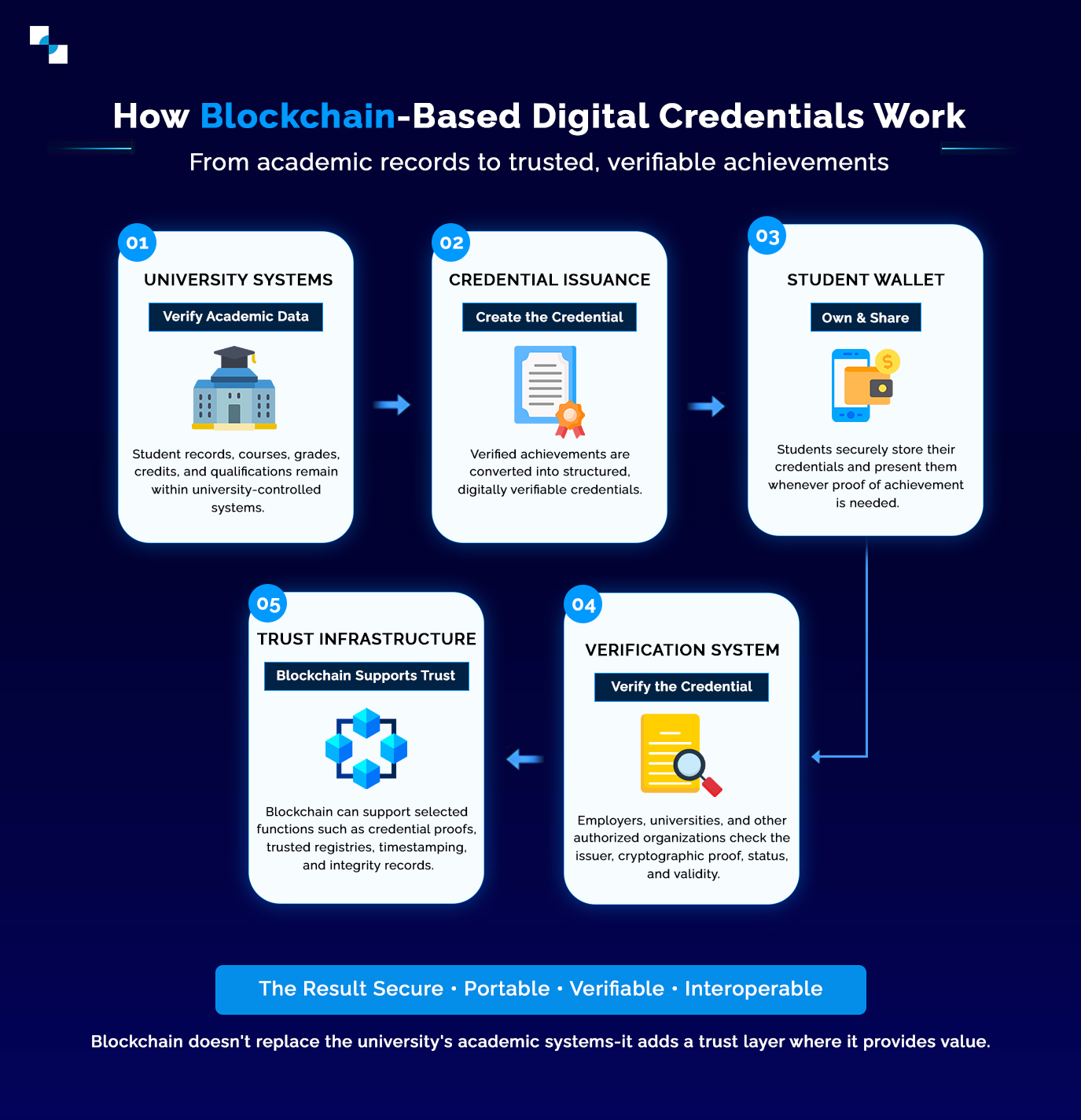
This approach allows universities to modernize academic credential management without rebuilding their entire technology infrastructure. Instead of making blockchain the center of the system, the goal is to use each technology where it provides the most value.
Did You Know?
MIT offers digital diplomas that graduates can own, store, and share, with blockchain-based infrastructure supporting credential protection and verification. MIT also provides a verification portal that allows employers and educational institutions to authenticate eligible digital diplomas.
Source: https://registrar.mit.edu/transcripts-records/diplomas/digital-diplomas
How Should Higher Education Institutions Choose a Blockchain Development Company?
Choosing a Blockchain development company for a digital credential platform requires more than blockchain coding expertise. The right partner should understand academic technology, verifiable credentials, digital identity, security, interoperability, and enterprise integrations and know how to bring these components together into a reliable credential ecosystem.
1. Blockchain Architecture Expertise
Look for a partner that can design blockchain-based digital credentials around actual credential, verification, privacy, and interoperability requirements. The architecture should clearly define what belongs on-chain, off-chain, or within existing university systems.
Why it matters: A requirement-driven architecture helps create scalable blockchain credentials without adding unnecessary blockchain complexity.
2. Verifiable Credential & Digital Identity Expertise
The partner should understand credential schemas, cryptographic proofs, issuer-holder-verifier relationships, digital identity, authentication, and credential status. These capabilities are essential for creating credentials that can be securely issued, owned, presented, and verified.
Why it matters: Strong verifiable credentials and digital identity expertise creates a trusted foundation for digital credential verification across education and employment ecosystems.
3. Academic System Integration
The credential platform should work with existing student information systems, registrar platforms, learning management systems, identity providers, and other academic applications. Look for experience with APIs and secure integration layers that connect blockchain infrastructure with existing technology.
Why it matters: Strong Blockchain development services can modernize credential management without forcing institutions to replace their existing academic systems.
4. Wallet & Credential Management
Students need a simple way to receive, store, manage, and present their credentials throughout their academic and professional journeys. The partner should be able to support secure wallets or credential platforms that accommodate different types of academic achievements.
Why it matters: Effective wallet infrastructure makes blockchain credentials for universities portable and practical for graduates, employers, and other authorized verifiers.
5. Privacy & Security Engineering
Academic credentials can contain sensitive student information, so privacy should be considered at the architecture level. The partner should understand encryption, access controls, data minimization, secure storage, and the separation of sensitive information from blockchain records.
Why it matters: Privacy-focused Blockchain development services help protect student information while maintaining secure credential exchange and reliable digital credential verification.
6. Standards & Interoperability
A strong technology partner should understand standards such as the W3C Verifiable Credentials Data Model and 1EdTech Open Badges, along with the interoperability requirements of wallets, credential platforms, academic systems, and verification services.
Why it matters: Standards-based verifiable credentials can reduce platform dependency and make digital credentials in higher education easier to exchange across compatible institutions, employers, and education ecosystems.
7. Enterprise Scalability & Production Experience
A credential platform may eventually serve thousands or millions of learners, multiple academic departments, alumni, employers, and external institutions. The partner should demonstrate experience building, deploying, securing, and maintaining production-grade blockchain systems at scale.
Why it matters: Proven Blockchain development services experience gives institutions greater confidence that their blockchain-based digital credentials can move from an initial pilot to a reliable, long-term credential ecosystem.
What Does the Future of Digital Credentials in Higher Education Look Like?
The next phase of digital credentials in higher education is moving beyond simply converting paper certificates into digital formats. The bigger shift is toward credentials that can move with learners, carry richer evidence of achievement, and be verified across different education and employment environments.
A graduate could build a credential portfolio that includes a degree, individual courses, professional certifications, demonstrated skills, micro-credentials, and continuing education achievements. Instead of these accomplishments remaining scattered across different platforms, they can become part of a more connected and portable learning record.
This shift is also changing what institutions need to prioritize. Interoperability will become increasingly important as credentials move between universities, employers, professional organizations, and other education providers. At the same time, privacy and learner control will remain essential as more academic information becomes digitally accessible.
Blockchain can support this evolution where shared trust, integrity, or decentralized infrastructure provides a clear advantage. However, it will remain one component of the broader credential architecture, alongside verifiable credentials, digital identity, wallets, university systems, and verification services.
The Future Is Moving Toward Credentials That Are:
- Portable: Learners can carry credentials across institutions and career opportunities.
- Verifiable: Organizations can validate credentials through digital proof rather than relying solely on manual checks.
- Interoperable: Credentials can work across compatible platforms, institutions, and ecosystems.
- Privacy-aware: Learners can share relevant information without unnecessarily exposing sensitive academic data.
- Learner-controlled: Graduates can manage and present their credentials when and where they are needed.
- Machine-readable: Systems can process credential information automatically, supporting more efficient verification.
- Skills-oriented: Credentials can increasingly communicate specific competencies and learning outcomes, not only final qualifications.
- Lifelong: A learner’s credential portfolio can continue to grow through professional development, certifications, and continuing education.
Ultimately, the future of blockchain-based digital credentials is not about putting every academic record on a blockchain. It is about creating a trusted digital credential ecosystem in which academic achievements can be issued once, securely held by learners, presented when needed, and verified across the environments where those achievements matter. For higher education institutions, that creates a more meaningful long-term opportunity – moving from isolated certificates toward a connected infrastructure for academic achievement, skills recognition, mobility, employment, and lifelong learning.
Build a trusted digital credential system for your Institution
Conclusion
Blockchain-based digital credentials are changing how universities can issue, share, and verify academic achievements. By combining verifiable credentials, digital identity, secure wallets, interoperability, and blockchain where it adds genuine value, institutions can create credentials that are portable, tamper-evident, privacy-aware, and easier to verify across education and employment ecosystems.
The real opportunity is to build a credential ecosystem that works seamlessly with existing university systems while making academic achievements easier to trust, access, and verify. With the right architecture, universities can reduce manual verification, improve credential portability, strengthen data integrity, and support new forms of learning such as micro-credentials, professional certifications, and lifelong learning.
As a blockchain development company, Antier helps organizations build secure, scalable, and interoperable digital credential infrastructure tailored to their technology and verification requirements.
Frequently Asked Questions
01. How Do Blockchain-Based Digital Credentials Work?
A university first verifies that a learner has completed the requirements for a degree, certification, course, or other achievement. It then issues a structured digital credential that the learner can store and present when needed. The credential can include cryptographic proof, while blockchain may support integrity, timestamping, trusted registries, or other verification functions.
02. What Is the Difference Between Verifiable Credentials and Blockchain Credentials?
Verifiable credentials are a standardized way to represent and verify digital claims, while blockchain is an optional technology layer. A credential can be verifiable without using blockchain, but blockchain can complement the credential ecosystem by supporting shared trust, integrity, and coordination between participating organizations.
03. How Can Employers Verify a University's Digital Credentials?
An employer can receive a credential presented by a graduate and use a compatible verification system to check the issuing institution, cryptographic proof, credential information, and current status. This approach can make digital credential verification more efficient than relying solely on PDFs, physical certificates, or manual confirmation from the university.
04. What Can Universities Use Digital Credentials For?
Higher education institutions can issue digital credentials for degrees, diplomas, micro-credentials, professional certifications, individual courses, skills, competencies, executive education, and continuing education. This allows institutions to represent both traditional qualifications and more specific learning achievements in a structured, digitally verifiable format.
05. Are Blockchain-Based Digital Credentials Secure and Private?
They can be, provided the credential architecture is designed with security and privacy from the beginning. Sensitive student information does not need to be stored directly on a public blockchain. Instead, institutions can use controlled systems for academic data and apply cryptography, access controls, data minimization, and selective blockchain functions to support secure credential verification.
06. How Much Does It Cost to Implement Blockchain-Based Digital Credentials?
The cost of implementing blockchain-based digital credentials depends on the number of credential types, integration requirements, wallet and verification features, security requirements, and the role blockchain plays in the architecture. A basic pilot may require significantly less investment than a full-scale credential ecosystem integrated with student information systems, identity platforms, and external verification services. For an accurate estimate, the implementation should be scoped around the institution's existing infrastructure, credential volume, interoperability requirements, and long-term rollout plans rather than blockchain development alone.