


✨ AI Summary
- As the UAE blockchain market grows, businesses need to ensure their blockchain solutions stay compliant, secure, and legally operational in an evolving regulatory landscape.
- This article highlights the importance of understanding UAE blockchain regulations before development begins to reduce compliance risks, streamline licensing, and accelerate deployment.
- It emphasizes that compliance is now a crucial part of designing and developing blockchain solutions, not a post-launch legal consideration.
- The article discusses the importance of smart contracts, the challenges posed by the UAE Personal Data Protection Law (PDPL), and the need for compliant data architecture.
- It also outlines five compliance requirements every UAE blockchain project must address.
Most businesses planning blockchain app development in the UAE are asking the wrong question. The question isn’t whether to build – the UAE blockchain market continues to grow rapidly, supported by government-led digital transformation initiatives across finance, real estate, supply chain, healthcare, and digital identity. The real question is whether the blockchain solution you build today will remain compliant, secure, and legally operational as the UAE’s regulatory landscape continues to evolve.
Whether you’re developing a tokenized asset platform, blockchain payment solution, enterprise blockchain network, digital identity platform, or Web3 application, understanding UAE blockchain regulations before development begins can help reduce compliance risks, avoid costly architectural changes, streamline licensing, and accelerate deployment. For businesses evaluating a blockchain app development company, regulatory expertise has become just as important as technical capability.
Recent regulatory developments, including Federal Decree-Law No. 6 of 2025, have modernized the UAE’s regulatory framework for financial institutions and licensed financial activities by expanding the Central Bank’s oversight to cover emerging financial technologies, such as certain virtual asset payment token activities and financial market infrastructures. As the regulatory landscape evolves, compliance is no longer a post-launch legal consideration; it has become a fundamental part of designing, developing, and deploying blockchain solutions.
This guide explains what the latest UAE blockchain regulations mean for businesses, how they impact blockchain app development, and the key compliance considerations every organization should address before choosing a blockchain development company or writing the first line of code.
Why Compliance Has Become a Foundation for Blockchain Development in UAE
For years, blockchain projects followed a predictable pattern: build first, figure out compliance later. That approach has a hard expiry date in the UAE.
The country’s regulatory framework has matured significantly, and the shift matters most for businesses building the kinds of systems that enterprise blockchain actually touches – financial settlement infrastructure, tokenized real-world assets, digital identity platforms, enterprise DLT networks, and smart contract-based workflow systems. These aren’t experimental pilots anymore. They’re production systems handling real transactions in a regulated market, and regulators are treating them accordingly.
The practical implication for any custom blockchain development company engagement is this: compliance decisions are now architecture decisions. Which blockchain network you select, how you design your permission model, how you handle identity verification, where you store user data, and how your smart contracts handle dispute resolution – all of these are now influenced by regulatory requirements that exist before development begins.
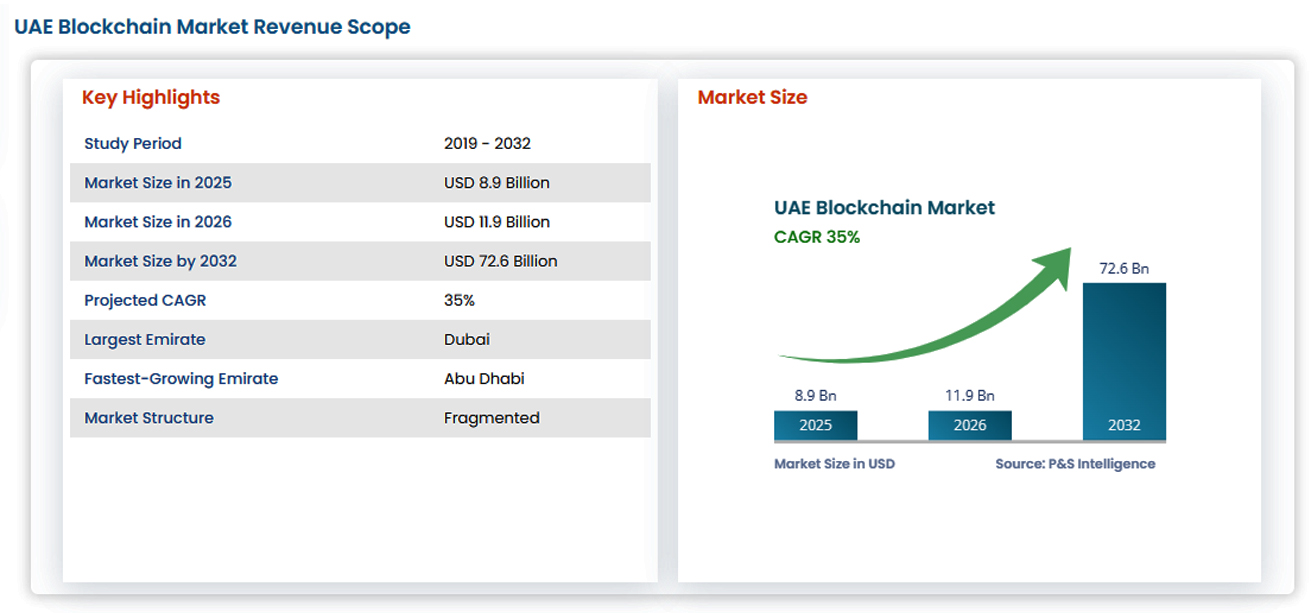
Source link: https://www.psmarketresearch.com/market-analysis/uae-blockchain-market-report
Did You Know?
According to the PS Market Research UAE Blockchain Market Report 2026, the UAE blockchain market is projected to grow at a 35% CAGR, reaching USD 72.6 billion by 2032, driven by government-led digital transformation initiatives and a regulatory environment that continues to support enterprise blockchain adoption.
This shift affects every industry building on blockchain in the UAE. Banks and fintech companies building settlement or digital asset infrastructure need regulatory-ready systems with compliance controls embedded. Real estate tokenization platforms must address investor identity, asset ownership verification, and regulatory reporting from the first architecture decision. Supply chain and enterprise DLT deployments need permission management and data governance frameworks that satisfy both operational and regulatory expectations. Web3 startups; wallets, marketplaces, decentralized applications need to consider licensing requirements before they write a single line of code, not after their first user complaint.
Organizations across these sectors that get blockchain compliance UAE right don’t just avoid penalties – they build systems that institutional counterparties trust and regulators don’t flag. That’s a competitive advantage, not just a cost of doing business.
Are Smart Contracts Legally Valid in the UAE? What Builders Must Know
Smart contracts are enforceable in the UAE but the enforceability depends entirely on how they’re built, not simply that they’re deployed on a blockchain.
Two frameworks provide the legal foundation. Federal Law No. 46 of 2021 on Electronic Transactions and Trust Services recognizes electronic agreements as legally valid when they satisfy requirements for authenticity, security, integrity, user consent, and identity verification. A smart contract that can demonstrate who entered the agreement, that consent was provided, and that the contractual logic is clearly defined meets this threshold. One that executes anonymously with no identity layer does not.
The DIFC Coded Contract framework goes further, formally defining coded contracts as agreements composed entirely of coded terms executed by a computer program. This gives enterprise builders operating within the DIFC ecosystem explicit legal structure to build toward, particularly relevant for digital asset platforms, tokenized investment products, and automated financial settlement systems.
What this means for your build:
A blockchain app development company that treats smart contracts as purely technical components is building legal risk into the product. Three issues must be addressed before deployment: identity verification and authentication built into contract execution flows (not assumed), a defined dispute resolution mechanism for error states and irreversible transactions, and independent security audits before any regulated activity goes live. Smart contract security isn’t optional for regulated industries – it’s part of licensing readiness.
Build legally compliant smart contracts with expert guidance from Antier.
The PDPL Challenge: Designing Around Blockchain Immutability
The UAE Personal Data Protection Law (PDPL) establishes requirements for the collection, processing, storage, and transfer of personal data, creating important design considerations for blockchain applications that rely on immutable ledgers.
The conflict is architectural: blockchain is designed to be immutable. PDPL grants individuals the right to erasure and requires responsible control over personal data. If your system writes personally identifiable information directly to a ledger, you have a compliance violation built into the foundation of your product and there is no patch for it.
The solution isn’t to abandon blockchain. It’s to redesign how data is stored from day one. Personal data customer identity records, KYC documents, transaction counterparty details – stays in secure, mutable off-chain systems. The blockchain stores only cryptographic hashes, verification proofs, and audit references. This architecture maintains everything blockchain is valuable for (transparency, immutability, auditability) while satisfying PDPL’s data rights requirements.
For platforms that need to verify user identity while protecting privacy, decentralized identity (DID) frameworks and zero-knowledge proof systems provide a compliant path – users can prove attributes about themselves without exposing the underlying personal data to the chain. Role-based access controls on permissioned networks add a further layer of data governance for enterprise deployments.
Businesses operating across UAE mainland, DIFC, and ADGM face an additional layer: each jurisdiction has distinct data protection rules, and blockchain nodes located outside the UAE carry their own cross-border transfer requirements. A blockchain development services team that has navigated PDPL-compliant architecture before will build this correctly the first time. Teams that haven’t will find it during the audit and retrofitting a non-compliant data architecture is one of the most expensive fixes in enterprise blockchain.
Preparing Your Blockchain Project for UAE’s New Regulatory Framework
The UAE’s regulatory landscape for blockchain and digital assets is evolving rapidly, making compliance an essential part of blockchain development rather than a post-launch consideration. Federal Decree-Law No. 6 of 2025 modernized the regulatory framework governing financial institutions and licensed financial activities, extending the Central Bank’s oversight to emerging financial technologies, including certain virtual asset payment token activities and financial market infrastructures. The law also states that licensing decisions for Financial Market Infrastructures should generally be issued within 60 working days after all licensing requirements have been met.
For businesses building blockchain platforms in regulated sectors, this changes how projects should be planned and executed. Compliance considerations including governance frameworks, smart contract security, identity verification, data protection, and operational controls should be incorporated into the solution architecture from the earliest stages of development. Addressing these requirements early can help reduce implementation risks, avoid costly redesigns, and support a smoother licensing and deployment process.
Whether you’re developing a tokenization platform, blockchain-based payment solution, enterprise DLT network, or digital asset infrastructure, partnering with an experienced blockchain development company that understands the UAE’s evolving regulatory environment can help you build secure, scalable, and compliance-ready blockchain solutions designed for long-term success.
Prepare Your Blockchain Project for UAE’s Regulatory Future
5 Compliance Requirements Every UAE Blockchain Project Must Address
Before addressing any of these five requirements, there’s a prerequisite: classify your solution first. Different blockchain platforms fall under different regulatory obligations depending on whether they handle financial transactions, what type of assets they involve, whether they take custody, and how users interact with them. A tokenized securities platform and an enterprise supply chain DLT carry entirely different compliance profiles. Getting this classification wrong before development means building toward the wrong regulatory framework and discovering it after the system is already architected. Any reputable blockchain development company should make regulatory classification the first deliverable of the engagement.
These five technical requirements then belong in the build specification not a compliance document that legal reviews after launch:
- Smart contract legal structuring: Every smart contract handling regulated activity must include verified user identity, authenticated consent, defined dispute resolution logic, and upgrade governance. The DIFC Coded Contract framework is the strongest template for enterprise deployments. Security audits are mandatory before go-live, not optional.
- PDPL-compliant data architecture: Personal data off-chain, always. On-chain, you store cryptographic references only – hashes, proofs, audit trails. This is the only architecture pattern that satisfies both blockchain integrity and PDPL’s data rights obligations. It must be designed from the start.
- AML/KYC and transaction monitoring: Wallet screening, customer due diligence, transaction monitoring, suspicious activity detection, and compliance reporting are technical components that belong in the build specification. Regulators expect working systems, not policies. If your blockchain app development company isn’t building these into the platform architecture, you’ll be retrofitting them under regulatory pressure.
- Governance and access control: Enterprise blockchain networks require defined governance: who can write to the ledger, who can upgrade contracts, and what the escalation path is for anomalous transactions. Permissioned networks and consortium models need advanced governance frameworks both to satisfy regulators and to give institutional participants the confidence to join.
- Jurisdiction-aware architecture: UAE mainland, DIFC, and ADGM each carry distinct requirements around data protection, licensing, and digital asset handling. Multi-node deployments that span jurisdictions must be scoped with both legal counsel and a custom blockchain development company that understands how infrastructure decisions open or close regulatory exposure.
Conclusion
The UAE has established one of the world’s most progressive regulatory environments for blockchain innovation, but building a compliant blockchain platform now requires more than technical expertise. From smart contract design and data privacy to governance and licensing considerations, regulatory compliance should be embedded into every stage of the development lifecycle not added after launch.
For businesses planning blockchain initiatives in the UAE, choosing the right blockchain development company is as important as choosing the right technology. An experienced partner can help align your blockchain architecture with evolving regulatory requirements while reducing implementation risks and accelerating time to market.
Antier delivers end-to-end blockchain development services that combine technical excellence with compliance-first engineering, helping businesses build secure, scalable, and future-ready blockchain solutions for the UAE market.
Frequently Asked Questions
01. Is blockchain legal in the UAE?
Yes. Blockchain is legal in the UAE, and the government actively supports its adoption across multiple industries. However, businesses involved in regulated activities must comply with applicable UAE blockchain regulations and licensing requirements before launching their blockchain solutions.
02. What regulations apply to blockchain development in the UAE?
Depending on your project, you may need to comply with Federal Decree-Law No. 6 of 2025, the UAE Personal Data Protection Law (PDPL), and Federal Law No. 46 of 2021 on Electronic Transactions. The applicable regulations depend on your blockchain use case and business model.
03. Are smart contracts legally enforceable in the UAE?
Yes. Smart contracts can be legally enforceable in the UAE if they meet legal requirements such as identity verification, user consent, and contractual intent. Proper design and governance are essential for compliance.
04. How does the UAE PDPL affect blockchain applications?
The PDPL requires businesses to protect personal data. To support blockchain compliance UAE, personal information should generally be stored off-chain, while the blockchain stores only cryptographic proofs or references.
05. What should businesses consider before building a blockchain platform in the UAE?
Before starting blockchain app development, businesses should evaluate licensing requirements, data privacy, smart contract security, governance, and compliance. Planning these early helps reduce risks and avoid costly changes later.
06. Why hire a blockchain development company for UAE projects?
An experienced blockchain development company can help you build secure, scalable, and compliance-ready blockchain solutions while aligning your project with evolving UAE regulatory requirements.