



✨ AI Summary
- This blog post explores the common pitfalls of enterprise blockchain projects, emphasising that many fail not due to the technology, but because of operational complexities such as lack of certificate management, disaster recovery, governance documentation and integration with existing systems.
- It highlights the importance of treating a blockchain system like a production system rather than a prototype.
- According to a Deloitte survey, only 23% of CFOs are ready to deploy blockchain technology within two years.
- Successful enterprises that have implemented blockchain started with a specific business problem and designed a blockchain solution around it.
- They also considered post-launch management from the outset.
Enterprise blockchain development projects rarely fail during the demo stage. They fail months later when a promising prototype meets real-world complexity: legacy systems that won’t integrate, compliance requirements overlooked from the start, unclear governance, or a blockchain development company that delivers a proof of concept without planning for production. These failures are rarely caused by the technology itself; they’re the result of poor execution and infrastructure decisions. On the other hand, successful enterprise blockchain initiatives are built on strong architecture, governance, security, seamless integration, and long-term operational planning from day one.
This guide explores the seven critical factors behind successful Enterprise Blockchain Development, helping enterprises build secure, compliant, and production-ready blockchain solutions.
Why Most Enterprise Blockchain Projects Never Reach Production
The World Economic Forum declared 2026 the year blockchain crosses from experimentation into enterprise-grade infrastructure yet the market is still full of projects that launched with ambition and never crossed the finish line. The most common reason isn’t market timing, regulatory issues, or budget. It’s operational complexity that nobody owned.
Specifically: certificate management with no named owner. Monitoring that was never set up. Disaster recovery that was never tested. Governance documentation that exists in a slide deck and nowhere else. These aren’t exotic failure modes. They’re the predictable consequences of treating a production system like a prototype.
The second major killer is integration. Most enterprise environments run on ERP systems, core banking platforms, and CRMs that were built before blockchain existed. When blockchain development services aren’t scoped to address this from day one, the integration work becomes a second project, one that often costs more than the original build and arrives as a surprise.
The third failure mode is the pilot trap. Many organizations run successful pilots in narrow, controlled environments, then try to scale and discover the pilot was never designed for production. Governance breaks down. Counterparty onboarding stalls. The use case that worked for three nodes falls apart at thirty.
The pattern is consistent. The fix is also consistent and it starts with who you build with.
What Success Really Looks Like: The Enterprise Blockchain Standard
Success in enterprise blockchain is not a working demo. It’s not a pilot with positive feedback from a friendly stakeholder group. It’s a system processing real volume, under real compliance constraints, connected to real counterparties, with a governance model that holds when something goes wrong at 2am.
That’s a much higher bar. And it’s the right one.
The enterprises that have crossed it share a consistent profile. They started with a specific, painful business problem, not a mandate to “explore blockchain.” They scoped their custom blockchain solutions around that problem, chose a chain architecture that matched their compliance and privacy requirements, and built governance into the design before a single line of code was written.
They also treated post-launch as part of the build, not an afterthought. Monitoring, upgrade management, incident response all defined upfront, with named owners, before the first sprint started. Because a live blockchain protocol requires active maintenance in a way that most traditional software does not.
The gap between the organizations still running pilots and the ones running production systems almost always comes down to execution approach, not technology choice. An execution approach is almost entirely a function of who you hired to build it.
Design, build, and scale enterprise blockchain solutions with confidence.
The 7 Core Factors Behind Every Successful Enterprise Blockchain Project
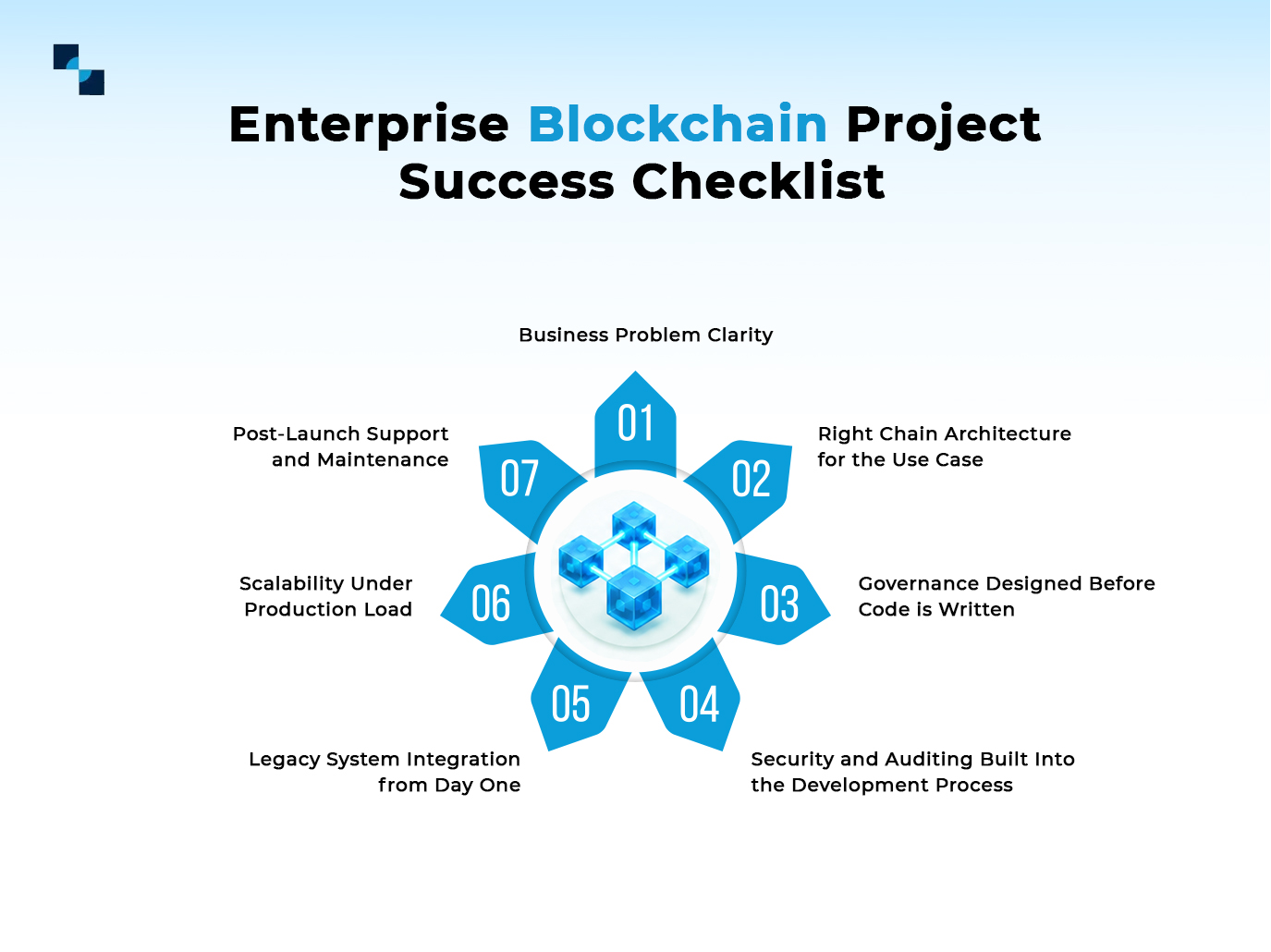
Many blockchain development companies emphasize the technical build. The real differentiators, however, are the decisions made before and during implementation. The following seven factors determine whether an enterprise blockchain project becomes a production-ready system or remains a pilot.
- Business Problem Clarity
Every successful enterprise blockchain deployment starts with a specific, well-defined problem. Not “we want to be on blockchain.” Something like: our settlement cycle takes three days and costs $12M per year in reconciliation fees. Or: we can’t verify supplier provenance and it’s creating regulatory exposure. The sharper the problem definition, the better every subsequent decision becomes – chain selection, architecture, governance, and counterparty onboarding.
Before any architecture is recommended, there should be a clearly defined problem statement with measurable success criteria. Without that, every downstream decision is based on assumptions rather than business priorities. The most effective blockchain development services begin with understanding your business objectives first, ensuring every technical decision is aligned with measurable outcomes.
- Right Chain Architecture for the Use Case
Public, permissioned, private, Layer 2 – the choice carries significant consequences for compliance, performance, cost, and interoperability. A financial institution running cross-border settlement has completely different requirements from a supply chain consortium tracking goods provenance. The right blockchain development company recommends architecture based on your requirements, not the chain they happen to be most experienced with.
Public, permissioned, private, and Layer 2 networks each serve different business requirements. The right choice depends on your compliance model, performance expectations, interoperability needs, and long-term scalability goals. A trusted blockchain development company evaluates these requirements first, recommending an architecture that aligns with your business objectives rather than a one-size-fits-all technology stack.
- Governance Designed Before Code is Written
This is the factor that kills the most promising projects. Governance means: who can join the network, who can write to the ledger, how disputes are resolved, how upgrades are approved, and what happens when a participant leaves. None of these can be answered by technology alone. They require business, legal, and technical alignment and they must be documented before development begins, not retrofitted afterward when it costs three times as much to change.
Governance should be treated as a core project deliverable, documented before development begins and agreed upon by business, legal, and technical stakeholders. Defining governance early creates a strong foundation for secure collaboration, smoother network expansion, and long-term operational success.
- Security and Auditing Built Into the Development Process
Smart contract vulnerabilities don’t wait for launch day. Logic errors, inadequate access control, and insufficient input validation are among the leading causes of on-chain enterprise incidents, and they’re best identified through rigorous auditing during development, not after deployment. Security should be integrated into every milestone rather than treated as a final checkbox before launch.
When evaluating a development partner, ask about their security audit process. It should include reviews during architecture, smart contract development, and pre-launch, supported by a documented and reproducible audit trail. Enterprise-grade blockchain app development services embed security throughout the development lifecycle, ensuring your blockchain solution is resilient, compliant, and ready for production from day one.
- Legacy System Integration from Day One
ERPs, core banking platforms, identity systems, payment rails; these aren’t going away because a blockchain layer is being added. The integration architecture needs to be designed alongside the blockchain architecture, not deferred as a phase-two problem. Projects that defer it routinely discover it requires rebuilding work already done, at the cost of months and the goodwill of whoever sponsored the project.
Integration planning should begin during the discovery phase, with APIs, middleware, and data connectors designed alongside the blockchain architecture. The most effective enterprise blockchain implementations treat integration as a core component of the solution, ensuring seamless connectivity with existing business systems from day one.
- Scalability Under Production Load
Many builds are optimized for demo conditions – small data volumes, controlled environments, predictable transaction patterns. Production is different. Layer 2 networks and modern permissioned frameworks have largely solved the throughput problem, but only if the architecture was designed for production scale from the start. Retrofitting scalability post-launch is expensive and almost always requires significant rework.
Scalability should be validated against realistic production workloads rather than demo environments. Enterprise Blockchain Development requires infrastructure that can support future transaction volumes, growing user bases, and evolving business requirements without requiring costly architectural changes after deployment.
- Post-Launch Support and Maintenance
A live blockchain protocol requires ongoing monitoring, dependency management, security patch cycles, and upgrade governance. Any custom blockchain solutions provider worth hiring treats post-launch support as a defined deliverable with named owners, documented runbooks, and SLAs agreed upfront not a billable afterthought that appears on the invoice when something breaks.
Before launching, enterprises should define clear expectations for monitoring, performance management, upgrade governance, and incident response. The best custom blockchain solutions include long-term operational support as part of the engagement, ensuring the platform remains secure, reliable, and optimized as business requirements evolve.
What a Great Blockchain Development Company Actually Brings to Your Project
A blockchain development company contributes far more than technical expertise. The right partner helps shape business decisions long before development begins, validating use cases, identifying implementation risks, estimating costs, selecting the right technology stack, and creating a roadmap that aligns with your operational goals.
Beyond development, experienced teams coordinate with business, compliance, and IT stakeholders to ensure smoother deployment, faster adoption, and long-term maintainability. This strategic involvement often determines whether a blockchain initiative reaches production on time or becomes another stalled proof of concept.
When evaluating blockchain development services, don’t just review portfolios. Ask how the company approaches discovery, manages enterprise risks, handles production support, and measures project success after launch. The top blockchain development companies are distinguished not only by what they build, but by the long-term business outcomes they help their clients achieve.
Ready to Move Beyond Blockchain Pilots to Enterprise-Grade Deployment?
What Every Enterprise Should Expect from Blockchain Development Services
Choosing a blockchain development partner isn’t just about technical expertise, it’s about ensuring the engagement is structured to reduce risk and support long-term success. Before signing a contract, enterprises should clearly understand what’s included in the delivery scope.
A comprehensive blockchain engagement should include:
- Discovery and business consulting to validate the use case, define project objectives, and assess technical feasibility.
- Solution architecture and implementation roadmap outlining technology choices, timelines, milestones, and delivery phases.
- Dedicated project management with regular progress updates, stakeholder communication, and transparent reporting.
- Quality assurance and testing covering functional testing, performance validation, security reviews, and user acceptance testing.
- Documentation and knowledge transfer including technical documentation, user guides, administrator training, and deployment manuals.
- Deployment and ongoing support with clearly defined SLAs, maintenance plans, monitoring, and upgrade management.
A well-defined engagement ensures there are no surprises during implementation and provides a clear roadmap from project discovery to long-term operations.
Red Flags That Will Kill Your Project and How to Choose the Right Partner
The warning signs are consistent across failed engagements. Recognizing them before a contract is signed is the fastest and cheapest way to avoid a rebuild.
They recommend a chain before understanding your problem. Chain selection should follow requirements, not precede them. A firm that opens with “we build on Ethereum” without asking about your compliance constraints, throughput needs, or counterparty model is making a commercial decision, not a technical one.
Security auditing appears only at the end of the project. If the audit is a line item in the final delivery phase, vulnerabilities will be found late, fixed fast, and deployed without adequate retesting. Security as a process is the standard. Security as a final checkpoint is a risk transfer to you.
No post-launch support model. A development partner that delivers a codebase and ends the engagement hasn’t thought about what production actually requires. This is a fundamental mismatch between what was sold and what enterprise infrastructure needs.
Portfolio shows demos, not deployments. Ask for verifiable production references deployments with operational history on mainnet or a permissioned network. If they can’t provide them, they haven’t done what enterprise delivery requires.
Fixed-price quotes for complex builds. Complex enterprise blockchain systems have too many architectural variables to be accurately scoped before requirements are fully defined. A fixed-price quote for a DeFi protocol or enterprise settlement platform usually means the scope has been compressed to fit the number, not that the number reflects the real work.
When evaluating the top blockchain development companies, prioritize firms that define post-launch support explicitly, integrate security throughout the build, and can show production-grade deployments comparable to your use case. Those three criteria alone will eliminate the majority of vendors who present well but deliver poorly.
The Right Partner Changes Everything
Enterprise Blockchain Development success isn’t defined by the technology you choose; it’s determined by the decisions you make before and throughout implementation. From identifying the right business use case to designing secure architecture, establishing governance, integrating with legacy systems, planning for scalability, and ensuring long-term operational support, every decision shapes whether your blockchain initiative becomes a production-ready solution or remains stuck at the pilot stage.
The factors covered in this guide provide a practical framework for building secure, compliant, and scalable enterprise blockchain solutions that deliver measurable business value. At Antier, we help enterprises move beyond proofs of concept by delivering production-ready blockchain solutions built for security, scalability, and long-term performance. With expertise across architecture, governance, integration, and post-launch support, we partner with businesses at every stage of their blockchain journey. This enterprise-first approach is what makes Antier one of the top blockchain development companies.
Frequently Asked Questions
01. Why do most enterprise blockchain projects fail before reaching production?
Most fail due to operational complexity - no governance documentation, poor legacy integration, and pilots designed for demos, not production scale. The technology rarely fails; the approach does.
02. What are the key success factors for enterprise blockchain projects?
Clear use case, right chain architecture, governance documented before code is written, security built in throughout, legacy integration scoped from day one, production-load scalability, and post-launch support.
03. How do I choose the right blockchain development company for an enterprise project?
Prioritize firms with verifiable production deployments (not just demos), security auditing integrated throughout the build cycle, and a defined post-launch support model not just delivery.
04. What questions should I ask a blockchain development company before hiring them?
Ask: What have you kept running after delivery? Can you show mainnet deployments with 12-month operational history? How do you handle legacy integration? What does your security audit process look like?
05. How long does it take to build an enterprise blockchain solution?
A well-scoped enterprise blockchain project typically takes 4-9 months from architecture to production launch, depending on integration complexity, counterparty count, and governance requirements.
06. What is the difference between a blockchain pilot and a production-ready blockchain system?
A pilot runs in a controlled environment with friendly counterparties. A production system handles real volume, real compliance constraints, and must stay operational when something breaks at 2am.