





✨ AI Summary
- As Africa's digital economy continues to rapidly evolve, businesses across the continent are grappling with high remittance costs, fragmented banking systems, currency volatility, and other payment infrastructure challenges.
- Blockchain technology, particularly cryptocurrency and stablecoins, presents a promising solution, enabling faster, more efficient, and borderless transactions.
- This adoption has surged in countries like Nigeria, Kenya, South Africa, Ghana, and Egypt, powered by a need for speedier payments and alternative financial infrastructure.
- By integrating AI-enabled, stablecoin-ready, and interoperable payment solutions into their operations, African businesses can navigate issues with cross-border settlements, banking networks, and currency volatility, while expanding their global reach, reducing transaction costs and improving cash flow.
- However, the adoption of blockchain payments does come with its own challenges, such as evolving regulations, customer unfamiliarity, integration complexity, and cybersecurity concerns.
Africa’s Digital Commerce Revolution Needs a Better Payment Infrastructure
Africa is home to one of the world’s fastest-growing digital economies, yet payments remain one of its biggest bottlenecks.
Businesses across the continent continue to face high remittance costs, fragmented banking systems, currency volatility, delayed cross-border settlements, and limited access to global financial networks. For startups, exporters, freelancers, online merchants, and digital marketplaces, these challenges directly impact growth and profitability.
At the same time, cryptocurrency adoption across Africa has accelerated rapidly. Countries such as Nigeria, Kenya, South Africa, Ghana, and Egypt have become major contributors to global crypto activity, driven by demand for faster payments, stablecoins, and alternative financial infrastructure.
This convergence is creating a powerful opportunity for businesses to rethink how money moves. A modern crypto payment gateway solution is no longer just a tool for accepting digital assets; it is becoming a strategic infrastructure layer that enables borderless commerce, faster settlements, and greater financial inclusion.
Beyond Traditional Payments: Why Africa Is Ready for Crypto Commerce
Africa has long been a leader in mobile money innovation. However, international payments still rely heavily on legacy banking systems that introduce delays, high fees, and multiple intermediaries.
For businesses operating across several African markets or trading internationally, these inefficiencies often translate into:
- Expensive cross-border transaction fees
- Currency conversion losses
- Settlement delays lasting several business days
- Limited access to global payment networks
- High operational costs for SMEs
A modern cryptocurrency payment gateway addresses many of these challenges by enabling blockchain-based settlements that are faster, programmable, and available around the clock.
Rather than replacing existing payment methods, crypto payment infrastructure complements traditional finance, giving businesses greater flexibility in how they receive, convert, and settle payments.
Africa’s Emerging Payment Landscape Is Driven by Stablecoins
One of the most significant developments in African commerce is the growing use of stablecoins.
Businesses increasingly prefer stablecoins because they combine the speed of blockchain transactions with price stability linked to fiat currencies.
Stablecoin-powered payments help merchants:
- Protect revenue from local currency volatility
- Receive international payments almost instantly
- Reduce dependence on correspondent banking
- Simplify supplier settlements
- Improve treasury management
For exporters, logistics providers, SaaS businesses, and digital marketplaces, stablecoins are quickly becoming a preferred settlement mechanism.
As regulatory clarity improves across multiple African markets, stablecoin-based payment infrastructure is expected to play an increasingly important role in enterprise finance.
How Do Crypto Payment Gateways Unlock New Business Opportunities?
Instead of viewing blockchain payments as a niche technology, businesses should recognize them as an expansion strategy.
a) Expand Global Customer Reach
African businesses can accept payments from customers worldwide without relying solely on traditional card networks or expensive international payment processors.
This opens new opportunities for:
- E-commerce brands
- Digital service providers
- Online education platforms
- SaaS companies
- Tourism businesses
- Gaming platforms
b) Reduce Payment Costs
Traditional international transactions often involve multiple intermediaries, each charging service fees. Blockchain settlements eliminate much of this complexity, enabling businesses to reduce transaction costs while improving payment speed.
Lower payment costs can significantly improve margins, particularly for SMEs and growing startups.
c) Enable Faster Merchant Settlements
Cash flow remains one of the biggest operational challenges for African businesses.
Instead of waiting several days for international settlements, merchants using a merchant payment gateway powered by blockchain can receive payments within minutes, depending on the underlying blockchain network.
This faster liquidity allows businesses to:
- Reinvest capital more quickly
- Improve inventory management
- Pay suppliers faster
- Scale operations efficiently
What Payment Gateway Features Should Businesses Prioritize?
Choosing the right cryptocurrency payment gateway goes beyond accepting digital assets. African businesses need payment infrastructure that addresses regional challenges such as fragmented banking networks, multiple currencies, cross-border settlements, and growing mobile-first commerce. As blockchain adoption accelerates across the continent, the most competitive crypto payment gateway solution will combine speed, compliance, flexibility, and intelligent automation.
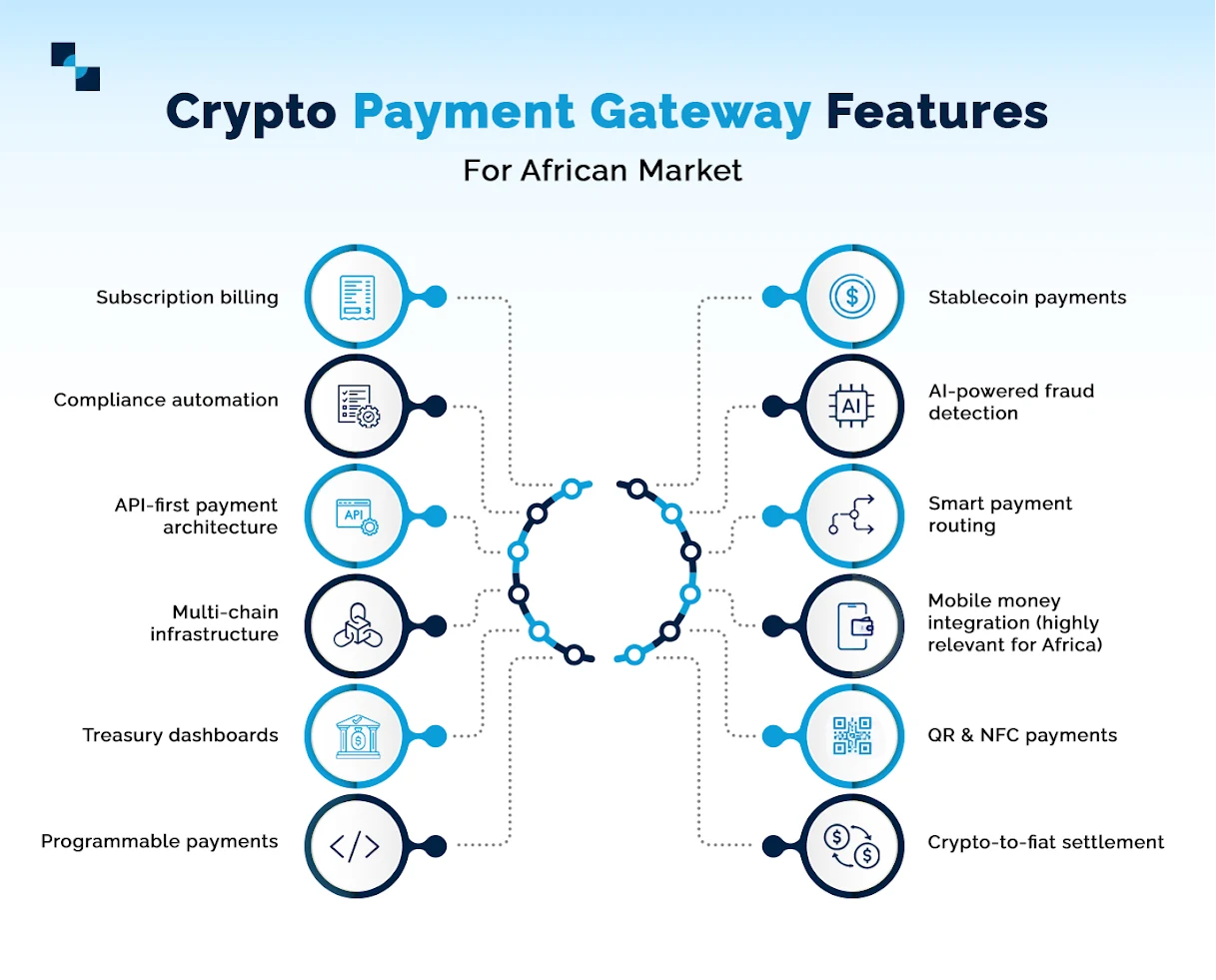
- Stablecoin Payment Acceptance: Support for USDT, USDC, and other regulated stablecoins enables merchants to minimize currency volatility while facilitating faster international transactions and predictable settlements.
- Instant Crypto-to-Fiat Settlement: Merchants should have the flexibility to automatically convert crypto payments into local currencies or retain digital assets based on treasury preferences, reducing exposure to market fluctuations.
- Multi-Currency & Multi-Chain Support: The gateway should process payments across major blockchain networks, including Ethereum, Tron, Solana, Polygon, and BNB Chain, while supporting multiple cryptocurrencies and fiat currencies to serve diverse customer segments.
- Mobile Money & Local Payment Integrations: Given Africa’s strong mobile payment ecosystem, integrating with services such as M-Pesa and regional mobile wallets creates a seamless checkout experience for businesses and consumers alike.
- AI-Powered Fraud Detection: Modern gateways should leverage AI to detect suspicious transactions, monitor wallet behavior, identify unusual payment patterns, and reduce fraud without affecting legitimate customer payments.
- Smart Payment Routing: Intelligent routing automatically selects the fastest and most cost-effective blockchain network based on transaction fees, network congestion, and settlement speed, helping merchants reduce operational costs.
- QR Code & NFC-Based Merchant Payments: As contactless commerce expands across retail stores and informal markets, QR code payments and NFC-enabled transactions offer a simple, accessible way for merchants to accept digital assets without expensive hardware.
- Automated Compliance & AML Screening: Built-in KYC, AML, sanctions screening, transaction monitoring, and Travel Rule compliance help businesses navigate evolving regulatory requirements while maintaining secure payment operations.
- Subscription & Recurring Crypto Payments: Support for recurring billing enables SaaS providers, telecom operators, digital media platforms, and membership-based businesses to automate subscription payments using stablecoins or cryptocurrencies.
- Merchant Analytics & Treasury Dashboard: A centralized dashboard with real-time transaction insights, settlement reports, revenue analytics, tax reporting, and treasury management empowers businesses to make informed financial decisions.
- API-First & E-Commerce Integrations: Businesses should prioritize gateways that offer developer-friendly APIs and seamless integration with e-commerce platforms, POS systems, ERP software, accounting tools, and online marketplaces.
- Programmable & Escrow-Based Payments: Smart contract-enabled payments allow businesses to automate escrow services, milestone-based releases, supplier settlements, and conditional transactions, reducing manual intervention and increasing trust.
As African commerce becomes increasingly digital and borderless, payment gateways are evolving from simple transaction processors into comprehensive financial infrastructure. Businesses that adopt AI-enabled, stablecoin-ready, and interoperable payment solutions today will be better equipped to scale across markets, improve cash flow, and participate in the continent’s rapidly expanding digital economy.
Deploy African Crypto Payment Gateway Solutions!
AI Is Making Crypto Payment Infrastructure Smarter
Artificial intelligence is rapidly becoming an important differentiator in payment infrastructure.
Modern gateways increasingly use AI to:
- Detect suspicious payment patterns
- Monitor transaction risks in real time
- Optimize payment routing
- Forecast liquidity requirements
- Automate compliance workflows
- Personalize customer payment experiences
As payment volumes increase, AI helps businesses reduce operational overhead while improving security and decision-making.
The Cryptocurrency Payment Gateway Roadblocks Businesses Must Navigate
While the outlook remains highly promising, businesses should also consider several implementation challenges.
- Regulatory Evolution: Digital asset regulations continue to evolve across African jurisdictions. Companies should choose payment infrastructure that can adapt to changing compliance requirements.
- Customer Education: Many consumers remain unfamiliar with blockchain payments. Simple user experiences and educational onboarding can improve adoption.
- Integration Complexity: Businesses often need payment gateways to integrate with ERP systems, accounting software, CRM platforms, and e-commerce infrastructure. API-first architecture is becoming increasingly important.
- Cybersecurity: Payment infrastructure should include advanced encryption, secure wallet management, continuous monitoring, and robust fraud prevention mechanisms.
Merchant Payment Gateway Real-World Use Cases Driving Adoption
Crypto payment gateways are already supporting a wide range of commercial activities across Africa.
Examples include:
- Cross-border B2B supplier payments
- International freelance payments
- E-commerce checkout solutions
- Travel and hospitality bookings
- Agricultural export settlements
- Digital marketplace transactions
- SaaS subscription payments
- NGO fund distribution
- Gaming and creator economy platforms
These applications demonstrate that blockchain payments are moving well beyond cryptocurrency trading into everyday commercial operations.
Companies such as Antier, alongside other blockchain infrastructure providers, have been contributing to the development of enterprise-ready payment solutions that support secure digital asset transactions and scalable financial innovation.
Expert Perspective: The Future of African Commerce Is Programmable
- Africa has historically embraced financial innovation faster than many developed markets, from mobile money to digital banking.
- Blockchain payments represent the next evolution.
- As stablecoins mature, regulatory frameworks strengthen, and enterprise adoption accelerates, payment gateways will evolve into intelligent financial infrastructure capable of automating settlements, managing compliance, supporting tokenized commerce, and enabling AI-driven financial operations.
- Businesses that invest today will be better positioned to compete in tomorrow’s increasingly borderless digital economy.
Connect With Antier & Hire The Best Team!
Africa’s digital economy is entering a transformative phase where payments must be as fast, intelligent, and borderless as the businesses they enable. Cryptocurrency payment gateway solutions are no longer an emerging innovation; they are becoming a strategic component of modern financial infrastructure, empowering enterprises to reduce settlement friction, expand into international markets, and deliver seamless customer experiences. As regulatory clarity improves and blockchain adoption continues to accelerate, organizations that invest in secure, scalable, and compliant payment infrastructure today will be better positioned to lead tomorrow’s digital economy.
At Antier, we help enterprises transform this opportunity into reality through end-to-end crypto payment gateway development services tailored to diverse business models and regulatory landscapes. Our solutions support multi-currency payments, stablecoin settlements, automated compliance, enterprise-grade security, wallet integration, and seamless API connectivity with existing financial ecosystems. Backed by years of technology expertise, 700+ blockchain specialists, and over 1,000 successful project deliveries, we empower businesses to launch future-ready payment ecosystems that are secure, scalable, and built for global growth.
Frequently Asked Questions
01. What are the main challenges faced by businesses in Africa regarding payment infrastructure?
Businesses in Africa face high remittance costs, fragmented banking systems, currency volatility, delayed cross-border settlements, and limited access to global financial networks.
02. How is cryptocurrency adoption impacting payment solutions in Africa?
Cryptocurrency adoption in Africa is accelerating, providing faster payments, stablecoins, and alternative financial infrastructure, which creates opportunities for businesses to enhance their payment processes.
03. What advantages do stablecoins offer to businesses in Africa?
Stablecoins offer businesses the speed of blockchain transactions combined with price stability linked to fiat currencies, making them an attractive option for cross-border payments and reducing transaction costs.