





✨ AI Summary
- The recent partnership between SoFi and Kraken is a game-changer for cryptocurrency exchanges.
- This collaboration allows Kraken's institutional clients to clear and settle USD transactions 24/7, breaking free from traditional banking hours.
- The deal also involves SoFi listing its own bank-issued stablecoin, SoFiUSD, and leveraging Kraken Prime for additional liquidity and execution for crypto trades.
- This signifies a shift from the traditional exchange development model to a more integrated financial operating stack.
- The new model involves banking settlements, stablecoin issuance, and institutional liquidity, all in one stack.
SoFi and Kraken just connected 24/7 banking settlement, a bank-issued stablecoin, and institutional liquidity routing into one stack. Here’s what crypto exchange builders need to rethink.
Crypto exchanges are no longer an isolated trading venue
On September 3, 2026, SoFi and Payward, which is Kraken’s parent company, announced a three-part deal. It’s easy to dismiss as just another “bank-meets-crypto-exchange headline,” but this version misses the bigger architectural shift signal for crypto exchanges.
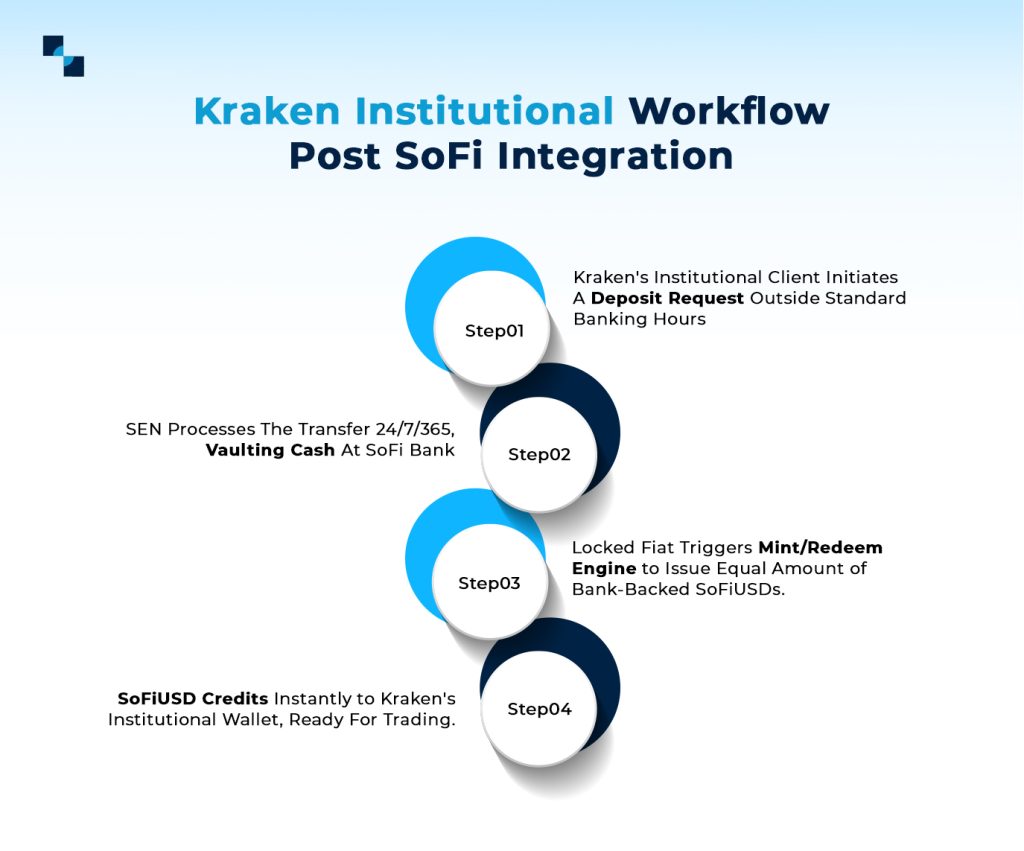
Payward joined the SoFi Exchange Network (SEN), giving Kraken’s institutional clients the ability to clear and settle USD transactions 24/7, instead of being boxed in by standard banking hours. Kraken is listing SoFiUSD which is SoFi’s own bank-issued stablecoin, redeemable one-to-one for US Dollars.

Additionally, SoFi will tap into Kraken Prime as an extra layer of liquidity and execution for crypto trades placed within the SoFi app. The SoFi CEO Anthony Noto mentioned the following while discussing the deal:
“The financial system should not shut down when markets stay open,”
David Ripley made the more consumer-facing point while discussing this deal:
“Millions of people will buy their first cryptoasset inside the app they already use for their paycheck…”
However, SoFi users could already buy crypto, but the Kraken-SoFi deal offers institutional-grade execution.
If you’re building cryptocurrency exchange infrastructure, you must learn that it isn’t about SoFi adding a crypto feature. It is also bigger than any partnership, as three prime infrastructure layers are collapsing into a single stack:
- Banking Settlement
- Stablecoin Issuance
- Institutional Liquidity
The New Cryptocurrency Exchange Development Stack: Trading, Liquidity, and Settlement
The old cryptocurrency exchange development model was straightforward.
Fiat on-ramp → Exchange → Order Matching → Withdrawal.
Any business planning crypto exchange development could build a solid matching engine, plug in a payment processor, and integrate the trading interface. That model is what most existing “how to build a crypto exchange” guides still describe, and it’s not wrong but incomplete for where institutional and regulated-fintech buyers are heading.
The emerging crypto exchange development model looks more like a financial operating stack or a multi-asset financial infrastructure than a trading app.
Banking rails → fiat settlement → stablecoin minting and redemption → liquidity aggregation → trading engine → custody → payments
Trading, which used to be the front-end selling product, now sits in the middle of the multi-asset financial infrastructure stack. A crypto exchange that only owns the spot or derivatives engine, no matter how fast its matching logic is, ultimately rents the rest of the stack from whoever controls settlement, liquidity, and stablecoin rails.
When crypto exchange software owns all the infrastructure it runs on, it can become the DeFi infrastructure vendor that institutions plug in. SoFi didn’t build its own liquidity pool or its own settlement network from scratch for this deal but plugged into Kraken’s. That’s the strategic lesson as much as the technical one for modern cryptocurrency exchange development.
Why 24/7 Settlement Changes Cryptocurrency Exchange Architecture
Cryptocurrency markets never close, but traditional banking settlement still runs on conventional 9-to-5 banking hours. For years, this mismatch has created a major settlement bottleneck for cryptocurrency exchange architectures relying on legacy banking. While partnerships like SoFi and Kraken show how exchanges can plug into external banking rails, partnerships aren’t the only option. Forward-thinking crypto exchanges are also building custom settlement rails or integrating white label tokenization platforms to maintain full control over their order books, margins, and user experience.
SoFi’s pitch is that the SEN enables Kraken’s eligible institutional clients to move and manage USD liquidity continuously, not just during a settlement window. Once settlement itself goes always-on, it stops being a back-office function and becomes a live architectural requirement.
A crypto exchange software built for 24/7 settlement requires the following, at minimum:
- Real-time treasury management: Traders can know their USD and stablecoin position at any hour, not just at end-of-day reconciliation.
- Native Stablecoin & Tokenization Engine: An in-house or white labeled mint/burn engine linked to 1:1 reserve accounts enables instant fiat-to-token conversions.
- Multi-rail fiat & bank connectivity: Direct, programmatic API links into banking partners or reserve vaults so a single rail’s cutoff doesn’t cause a bottleneck.
- Automated reconciliation: The crypto exchange 24/7 settlement architecture must match trades, settlement, and custody balances continuously instead of in nightly batches.
- Real-time risk & margin controls: Crypto exchanges must also implement exposure checks that run continuously 24/7/365.
- Automated liquidity management: Cryptocurrency exchange software must also integrate mechanisms that rebalance capital across venues and internal vaults without human intervention.
- Institutional-grade custody: Implementing continuous vaulting during cryptocurrency exchange development ensures hassle-free settlement without lags.
Evaluating 24/7 Clearing Strategy For Crypto Exchanges Build vs. Partner Decision
Crypto exchange builders upgrading to 24/7 settlement generally evaluate two execution paths: Partnering, which is the fast track method and building settlement infrastructure from scratch, which is the proprietary engine method. Distinction between the two is mentioned below:
| Strategic Dimension | Partnering | Building Settlement Infrastructure for exchanges |
|---|---|---|
| Execution Model | Plug into enterprise banking rails (e.g., SEN) and list bank-issued stablecoins. | Build native tokenization pipelines, reserve vaults, and custom clearing APIs. |
| Speed to Market | Immediate access to 24/7 clearing with low technical setup. | Slow; requires extensive custom architecture and banking integrations. |
| Regulatory Burden | Low; offloads banking compliance and charter risks to the partner. | High; requires licensing, audits, and strict reserve management. |
| Margin & Yield Control | Shared revenue; clearing fees and reserve yield are split. | Maximum retention of order book fees, clearing margins, and backing yield. |
| Operational Dependency | Subject to the third-party network’s uptime, rules, and ecosystem. | Full autonomy over settlement logic, liquidity pools, and user experience. |
A trading-only cryptocurrency exchange infrastructure doesn’t need all of this but an institutional multi-asset financial infrastructure can’t survive without all of this.
Stablecoins As Exchange Infrastructure: Beyond the Tradable Asset
SoFiUSD is more than just another bank-backed stablecoin. It represents a structural shift from stablecoin as a speculative asset to core clearing and treasury infrastructure. Issued directly by a chartered bank and redeemable 1:1 for USD, SoFiUSD embeds regulated banking rails directly into the cryptocurrency exchange stack.
Cryptocurrency exchange architects must track three distinct evolutionary stages of stablecoin integration:
- Stage 1: Stablecoin As Tradable Asset
The stablecoin exists merely as a trading pair on the cryptocurrency exchange order book. This is where most crypto exchanges are operating today.
- Stage 2: Stablecoin As Settlement Rail
The stablecoin is used behind the scenes for instant, 24/7 cross-venue or fiat clearing.
- Stage 3: Treasury Infrastructure
The stablecoin serves as a continuous, programmatic liquidity and capital management engine for the exchange.
While standard cryptocurrency exchange architectures treat stablecoins solely as Stage 1 assets, the SoFi-Kraken framework utilizes SoFiUSD at Stage 3. For cryptocurrency exchange builders, stablecoin evolution from a basic trading pair to a full settlement is more than a feature update. It adds another core engine alongside the standard matching engine.
Liquidity Aggregation For Cryptocurrency Exchange Infrastructure
Liquidity aggregation is becoming another essential layer for cryptocurrency exchange infrastructure. As stated above, Kraken isn’t just using SoFi for its stablecoin settlement infrastructure; SoFi is also leveraging Kraken Prime for its liquidity aggregation.
Rather than filling retail orders against a single order book, SoFi leverages Kraken Prime’s smart order routing (SOR). This allows SoFi to aggregate liquidity across dozens of global venues in real time, delivering institutional-grade price execution without having to build multi-exchange venue routing itself. That raises a question every builder should be asking about their own cryptocurrency exchange architecture: Should a Modern Exchange Really Depend on A Single Liquidity Pool At All?
Expect the answer in the next section.
How Should A Modern Crypto Exchange Liquidity Infrastructure Look
Modern cryptocurrency exchanges no longer rely on a single, isolated order book. Instead, they treat liquidity as an integrated infrastructure layer designed to aggregate, route, and clear depth across global venues.
At a minimum, an enterprise-grade crypto exchange liquidity architecture requires:
- Multi-venue liquidity: Sourcing depth from more than one venue rather than betting on a single order book’s health.
- Smart order routing: Evaluating price and depth across those venues in real time, order by order.
- Aggregated liquidity: Presenting customers with the depth of the whole network, not just the house book.
- Institutional OTC liquidity: Direct programmatic connectivity for large-block size that would move a public order book.
- Market-maker connectivity: Direct relationships rather than relying purely on organic order flow.
- Cross-venue execution: Actually filling across venues, not just quoting from them.
- Prime brokerage integration: The plumbing that makes all of the above operationally manageable rather than a patchwork of API integrations.
Cryptocurrency exchanges relying solely on their own order book operate at a massive disadvantage against platforms treating liquidity as an aggregated infrastructure layer (as SoFi does via Kraken Prime).
What a Future-Ready Cryptocurrency Exchange Software Actually Needs to Build
Put the banking, stablecoin, and liquidity threads together, and the checklist for cryptocurrency exchange infrastructure looks different from what most “how to build a crypto exchange” guides still describe:
| Infrastructure layer | What exchanges need |
|---|---|
| Banking | 24/7 fiat settlement and banking connectivity |
| Stablecoins | Native stablecoin deposits, withdrawals, and settlement |
| Liquidity | Aggregated, multi-venue liquidity |
| Execution | Smart order routing and best execution |
| Trading | High-performance matching engine |
| Custody | Institutional-grade asset custody |
| Risk | Real-time margin, exposure, and liquidation controls |
| Compliance | KYC/KYB, AML, and transaction monitoring |
| Treasury | Automated reconciliation and liquidity management |
| Payments | Fiat and stablecoin payment rails |
The trading engine is one row in that table, not the whole table. That’s the actual shift the SoFi-Kraken deal makes visible.
The takeaway for exchange builders
The competitive edge for next-generation exchanges won’t come from listing another trading pair or polishing the UI. It lies in the underlying financial engine. As traditional and digital rails converge, winning cryptocurrency exchange software solutions are being built for continuous liquidity, automated settlement, and 24/7 treasury management.
Antier specializes in engineering custom, institutional-grade cryptocurrency exchange architectures, equipping fintechs and web3 builders with modular 24/7 settlement rails, smart order routing, and white-label liquidity engines.
Frequently Asked Questions
01. What is liquidity aggregation for a crypto exchange?
Liquidity aggregation means sourcing tradable depth from multiple venues — other exchanges, market makers, OTC desks — rather than relying only on a single order book, then routing orders to wherever they fill best.
02. What is smart order routing in crypto trading?
Smart order routing is a system that evaluates price and depth across multiple connected venues in real time and sends each order to the venue offering the best fill, rather than executing everything against one fixed order book.
03. Why does 24/7 settlement matter for crypto exchanges?
Crypto markets trade continuously, but traditional banking settlement is typically limited to banking hours. Exchanges built for round-the-clock settlement need real-time treasury management, automated reconciliation, and multi-rail fiat connectivity to avoid a structural mismatch between when trades happen and when money actually moves.
04. Are stablecoins just another tradable asset for exchanges?
Increasingly, no. Bank-issued, redeemable stablecoins are being used as settlement rails and treasury infrastructure, not just as a tradable pair — a shift that requires exchanges to build settlement and treasury logic around them, not just a listing.