


✨ AI Summary
- The blog post explores the concept of a Perpetual Aggregator – a non-custodial layer that connects multiple Perpetual Decentralized Exchanges (DEXs) across various chains, offering an optimized trading experience.
- The post discusses the rising popularity of decentralized perpetual exchanges, with the average monthly trading volume for the top 12 Perpetual DEXs reaching $611.57 billion in early 2026.
- It highlights the need for Perpetual Aggregator development to consolidate fragmented liquidity into a single trading surface, offering a superior execution layer.
- The post explains how a Perpetual Aggregator works, its core architecture, and different development models.
- It also addresses challenges like cross-chain state synchronization, liquidation risk, latency, and regulatory compliance.
You don’t need to win the expensive liquidity war if you’re a
- founder who cannot out-liquidity Hyperliquid,
- market-maker fighting order flow,
- or a Web3 ecosystem seeking its own branded derivatives trading venue
You can just offer the best perpetual futures trading experience with routing. Perpetual aggregator development lets you compete on execution quality instead of raw depth.
This guide walks through the why, the architecture, the hard engineering problems, the realistic cost and timeline, and the build-vs-buy decision, written for teams who are actually scoping a build in 2026.
What Is a Perpetual Aggregator?
A perpetual aggregator is a non-custodial meta-execution layer that connects multiple perpetual DEXs across chains, routing each leveraged trade to achieve the best blended outcome spanning
- Price
- Slippage
- Funding rate
- Gas
Instead of trapping traders within a single, limited venue, it consolidates fragmented liquidity into a single, optimized trading surface while maintaining strict user self-custody.
The Need For Perp DEX Aggregator Development
Decentralized perpetual exchanges are no longer a niche. According to CoinGecko’s State of Crypto Perpetuals Report 2026:
- Top 12 perp DEXs’ monthly trading volume averaged to $611.57B per month in early 2026, up from $531.65B in 2025.
- Perpetual DEX volume surged in 2025, reaching a peak of 13% by the end of the year.
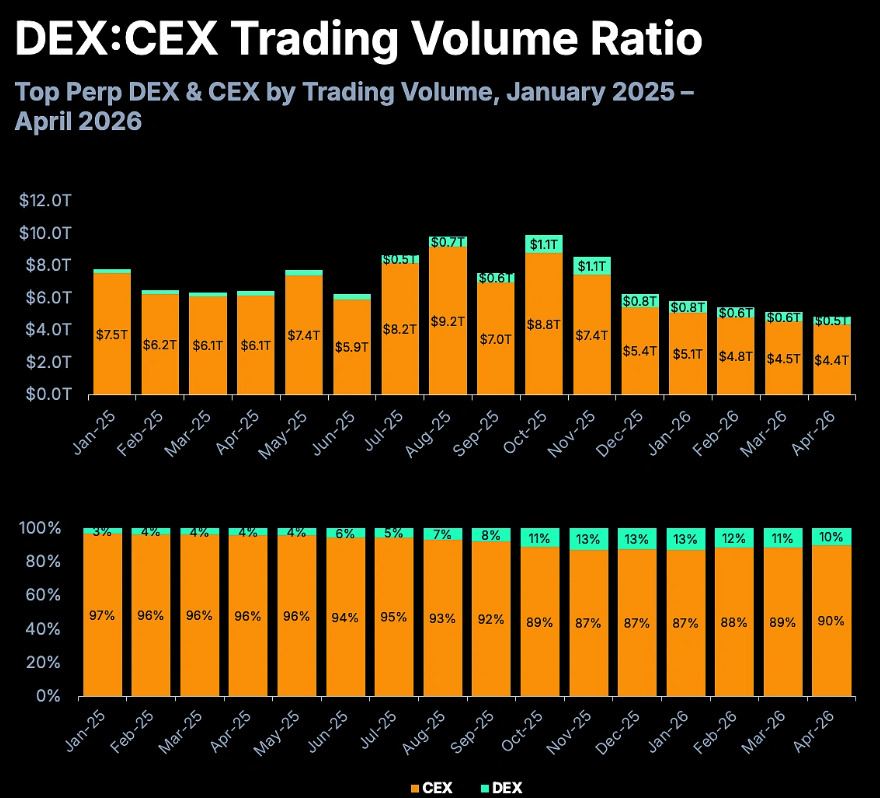
Source: Coingecko
Along with the massive growth, one must note that liquidity is splintering.
The crypto perpetual trading flow is spread across very different architectures and chains:
- Order-book L1s and appchains: Hyperliquid (custom L1), dYdX v4 (Cosmos), Lighter
- vAMM / pool models: GMX v2, Drift, SynFutures
- Multi-chain and hybrid venues: Aster, edgeX, Variational, GRVT
- Chains: Arbitrum, Base, Optimism, Solana, and an expanding set of sovereign appchains.
The same report demonstrates DEX-to-CEX volume climbing from 3% in January 2026 to 13% in November 2025, proving that on-chain venues now hold a permanent share of global derivatives volume.
Since the market is concentrating and fragmenting at the same time,
The market is, therefore, concentrating and fragmenting at the same time. As per Binance and MEXC news, Hyperliquid recently hit a 8.3% share of global perpetual futures trading volume. Below the leader sits a long tail of dozens of venues, with each holding pockets of depth on specific pairs and chains.
For a trader, it is inconvenient because:
The best price for a BTC perp at 2:00 PM might be on one venue, while the cheapest funding rate to hold that position overnight is on another.
The brutal truth for perpetual crypto exchange developers is that they cannot beat the incumbents on standalone liquidity. With perpetual aggregator development, they can create a routing and aggregation layer that sits above the liquidity incumbents and excels at the execution layer.
This is what happened with spot DeFi when 1inch and other DEX aggregators didn’t out-liquidity Uniswap but routed across everyone and won on execution. With the perp DEX trading volumes surging, they are ready for the same shift. The only problem is that this case will be harder for them since perpetual futures trading involves leverage, rolling funding, margin, and liquidation risk.
How Does a DeFi Perpetual Aggregator Work
The perpetual aggregators do something that a single venue can never do. When a user submits a trade, it shops the entire market. The sequence includes:
- Discovery: The engine queries every integrated venue in real time. It skims its order-book depth, bid/ask spreads, funding rates, open interest, available leverage, expected execution cost, and gas impact.
- Simulation: It models execution across venues, often representing heterogeneous markets as a unified virtual orderbook so an AMM pool and a CLOB can be compared on the same terms.
- Routing: It selects the optimal path for perpetual futures trade execution. Sometimes the whole order fills on one venue, and sometimes it’s split across three to minimize price impact. A $200K order that might move price 1% on a single venue can often fill with 0.3% impact when split across four trading venues.
- Funding-aware optimization: Critically, the cheapest entry into DeFi perpetual markets isn’t always the best venue. The perpetual matching engine factors in funding cost and net profit of holding a leveraged position. So, a perpetual futures crypto exchange software with a slightly worse entry but a much better funding rate is a better choice for trade execution.
- Execution & settlement: The trader approves the transaction directly from their crypto wallet. The order is securely broadcast and filled on-chain, ensuring the perpetual aggregator platform never takes custody of the user’s funds.
The good DeFi routing engines update order-book depths, bid/ask spreads, funding rates, and liquidity conditions every few hundred milliseconds and recalculate dynamically as they shift. The lazy ones just pick the cheapest entry and call it a day, which is exactly the gap a well-built perpetual aggregator platform can exploit.
Core Architecture Behind Perpetual DEX Aggregator Development
1. Low-latency liquidity indexer
This component is responsible for real-time ingestion of on-chain state and venue APIs across every integrated DEX and chain. This is the data backbone as stale data means bad routes.
2. Smart order routing (SOR) engine
It is the perpetual aggregator engine that builds a live, working digital simulation of the entire market inside its code, often as a weighted graph. It then evaluates direct, split, and multi-venue routes to maximize the trader’s overall profitability after considering fees, slippage, funding, and gas.
3. Protocol adapters
Each perpetual trading venue is built differently. The vAMMs use virtual reserves, order books use bids and asks, and hybrids mix both to execute trades. Adapters sit between routing engines and perpetual exchanges to decode and transform the complex data into standardized signals that routing engines can comprehend.
4. Unified virtual orderbook
This perpetual aggregator development component is a synthetic representation that maps liquidity from fundamentally different market structures into one comparable surface. It creates a single, clean “master layer” that blends all the different exchanges, hiding how complicated they are underneath.0
5. Oracle layer
This intelligence layer pulls high-frequency price feeds from Pyth or established networks like Chainlink to ensure every chain operates on the same truth source at execution time. This component is essential to maintain the accuracy of funding calculations and liquidation triggers.
6. Non-custodial settlement
Users retain self-custody, and trades execute directly on-chain while a smart contract-based escrow holds your margin. This is what makes the perpetual DEX aggregator trust-minimized rather than just another centralized execution front end.
7. Cross-rollup execution & collateral abstraction
Most perp liquidity lives on L2s and appchains, fragmented across networks. A serious perpetual aggregator routes to the best liquidity across chains and abstracts away bridging, which the trader shouldn’t have to manually move or juggle with.
8. Margin coordination
This perpetual aggregator component manages cross-venue position and margin management so capital isn’t fragmented or double-counted across venues.
9. Intent-Based Order Routing & Solver Network
Instead of forcing the user’s wallet to execute complex, multi-step transactions on-chain, the intent-based perpetual DEX aggregator allows traders to express their “intent”
e.g., “Open a 10x long on ETH with maximum $5 price impact”
Professional third-party market makers, known as Solvers, compete in a private auction to fulfill this intent. The winning solver taps into the aggregator’s underlying liquidity map to execute the trade, absorbing the gas fees and execution risk on behalf of the user, resulting in faster execution and guaranteed zero-slippage for the trader.
Perpetual Aggregator Development Models Compared
| Model | How it works | Market reference | Best for |
|---|---|---|---|
| Pure aggregator | Routes order flow across many external venues; it holds no liquidity of its own | VOOI | Fast launch, execution-first positioning, asset-light teams |
| Hybrid (venue + aggregation) | Runs its own liquidity/markets and routes to others when better | Jupiter Perps | Ecosystems with existing liquidity want the best-execution UX |
| Unified-liquidity infrastructure | Coordinates shared liquidity and margin across venues as an execution backbone | MUX Protocol | Infra plays, B2B routing layers, multi-venue networks |
There’s no single “correct” design. The perpetual aggregator development model you choose should match your target users and capital structure. Crypto exchange founders must know that
- A pure aggregator gets businesses to market faster and lets a small team punch above its weight.
- A hybrid is stronger if the crypto perpetual futures exchange already holds liquidity.
- A unified liquidity layer is the most ambitious if a cryptopreneur is building infrastructure that other platforms plug into.
Perpetual Aggregator Development Challenges and How To Address Them
- Cross-chain state synchronization
When a trader on Arbitrum opens a 20x long, but the best liquidity is on a Solana-based venue, messages must be relayed, collateral must be verified, and virtual liquidity must adjust in seconds. If DeFi perpetual exchange aggregators get this wrong, it results in double-spent collateral or delayed liquidations, which are both fatal to solvency.
The proven pattern to address this challenge is a hub-and-spoke architecture. It includes a high-speed settlement hub that keeps the master record while spoke contracts on each chain handle deposits, withdrawals, and execution, connected by cross-chain messaging such as LayerZero, Wormhole, or CCIP.
- Liquidation risk under leverage
Routing leveraged positions is far riskier than routing spot swaps. The perpetual aggregator must respect each venue’s maintenance-margin rules and ensure liquidations resolve correctly across venues.
Implementing partial liquidation logic and coordinating the keeper/liquidator network during perpetual aggregator development is therefore non-negotiable.
- MEV and order protection
Public mempools expose routed orders to front-running.
MEV-mitigating strategies for crypto exchange software and aggregators include hidden-but-auditable intent-order flow and MEV-resistant execution.
- Latency
Routing quality decays with stale data.
Robust sub-second indexing and execution mechanisms must therefore be deployed during the development of a perpetual DEX aggregator.
- Collateral abstraction
Traders shouldn’t manage five wallets, chains, or perpetual trading venues.
Account abstraction and gasless flows are becoming the expected perpetual DEX aggregator UX baseline for the next wave of users.
Compliance and Jurisdiction Requirements For DeFi Perpetual Aggregator Development
A non-custodial perpetual aggregator changes the regulatory surface but doesn’t erase it since derivatives are among the most scrutinized products in crypto. Obligations vary sharply by region and their compliance authorities.
- The US CFTC/SEC posture toward leveraged crypto derivatives
- The UK FCA’s evolving cryptoasset regime and restrictions on crypto derivatives for retail
- The UAE VARA’s derivatives framework under its rulebook,
- Australia (ASIC/AUSTRAC)
Geo-fencing, jurisdiction-aware access controls, and clarity on whether you’re a front-end versus a regulated operator should be designed in the perpetual DEX aggregator from day one.
This section is general information, not legal advice. Derivatives licensing should be scoped with qualified counsel for each target market.
Build vs. Buy: Cost and Timeline For DeFi Perpetual Aggregator Development
Building every layer from scratch isn’t the fastest and most cost-effective path for perpetual futures DEX aggregator development. Modular white label perpetual aggregator foundations let you ship the differentiated parts, including routing logic, UX, and supported venues, without reinventing settlement and margin plumbing.
| Perpetual DEX Aggregator Development Approach | Indicative timeline | Indicative cost range | Notes |
|---|---|---|---|
| MVP aggregator (3-5 venues, single ecosystem, core SOR) | 4-6 months | Lower end | Validates routing edge and UX with real flow |
| Full multi-chain aggregator (cross-rollup, funding-aware routing, institutional tooling) | 9-12+ months | Higher end | Production-grade, audited, scalable |
| White-label/modular acceleration | Compressed vs. custom | Most efficient | Pre-built modules for settlement, margin, oracle, liquidity integration |
Costs scale with the number of integrated venues, cross-chain complexity, margin-system sophistication, and per-jurisdiction compliance. The biggest budget lever isn’t the smart contracts but the routing engine quality and the breadth of venue integrations, since that’s where your execution advantage actually lives.
Launch Your DeFi Perpetual Aggregator With Antier
Why Antier for Perpetual Aggregator Development
Antier is a B2B Web3 and AI consultancy specializing in compliance-first decentralized derivatives infrastructure development. We’ve shipped perpetual DEXs, custom matching engines, LP vaults, oracle integrations, and multi-chain architectures, which are the exact components a perpetual aggregator routes across. We’re also a HIP-3-capable builder, able to deploy and configure perpetual markets at the protocol layer rather than as thin API wrappers, which matters when your aggregator needs deep, native liquidity access.
So, what are you waiting for? Bring your routing logic, branding, supported-venue strategy, tokenomics, and we’ll project it on proven, battle-tested foundations, with security audits and multi-round testing implemented before mainnet. Get in touch today!
Frequently Asked Questions
01. What is a perpetual aggregator in the context of decentralized trading?
A perpetual aggregator is a non-custodial meta-execution layer that connects multiple perpetual decentralized exchanges (DEXs) across chains, optimizing each leveraged trade for the best price, slippage, funding rate, and gas fees.
02. Why is there a need for perpetual DEX aggregator development?
The need arises from the significant growth in decentralized perpetual exchanges, with trading volumes increasing and liquidity becoming fragmented across various architectures and chains, making it essential to consolidate this liquidity for better trading experiences.
03. How has the trading volume of decentralized exchanges changed recently?
According to CoinGecko’s report, the monthly trading volume of the top 12 perpetual DEXs averaged $611.57 billion in early 2026, up from $531.65 billion in 2025, indicating a surge in popularity and usage of decentralized trading venues.