




✨ AI Summary
- Cross-border payment infrastructure is becoming more modular, with stablecoins being evaluated as a layer for settlement.
- Stablecoin usage is growing, with payment activity increasing 42% to $401 billion by August 2026.
- Adoption varies across the payments industry, with 44 companies identified as having live stablecoin products and 22 in development.
- Stablecoins can be used to transfer value between two points, offering benefits like round-the-clock availability, while traditional infrastructure handles other aspects of the transaction.
- Stablecoin transactions can be divided into six stages: customer starts the payment, platform receives fiat, platform converts value, stablecoin settles on-chain, receiving side converts value, and recipient receives payout.
Cross-border payment infrastructure is becoming more modular. Fintechs, neobanks, and remittance platforms no longer need to think about international payments as a single banking workflow. The transaction can be separated into distinct layers for customer onboarding, fiat collection, FX, liquidity, digital asset settlement, compliance, and local payout. Stablecoins are increasingly being evaluated as one of those settlement layers. The market activity is no longer theoretical. Allium reported that stablecoin payment activity had grown 42% to at least $401 billion through August 2026, while stablecoin supply reached $303 billion, up 6%.
At the same time, adoption is not uniform across the payments industry. FXC Intelligence’s 2026 analysis of the leading cross-border payment companies identified 44 companies with live stablecoin products and another 22 developing them. The group included banks, fintechs, remittance companies, exchanges, and payment processors. That makes the more useful question fairly practical: Where should stablecoins sit inside a cross-border payment stack, and what infrastructure is required to operate them reliably?
Why Are Cross-Border Fintechs Exploring Stablecoin Payment Rails?
A cross-border payment has several jobs to perform. The customer needs to fund the transaction. The platform needs to validate the customer and recipient. Currency may need to be converted. Liquidity needs to be available. The funds need to settle between the relevant institutions. Finally, the recipient needs to receive money through a local payment method.
Traditional infrastructure can support this flow, but it often requires multiple providers and accounts across different markets. Stablecoins introduce another option for the settlement component. Instead of moving value entirely through conventional financial accounts, a fintech can use a stablecoin to transfer value between two points and connect that movement to its existing fiat and payment infrastructure. That can be useful for businesses operating across borders because blockchain settlement is available around the clock, while the surrounding fiat infrastructure can continue to handle deposits, withdrawals, FX, and customer payouts. The important distinction is that the stablecoin does not need to become the customer’s payment product. It can sit behind the product. A customer may simply choose a currency, enter a recipient, confirm the amount, and receive a delivery estimate. The blockchain transaction can remain part of the underlying settlement workflow.
Thinking about adding stablecoin settlement to your payment stack?
How Does a Stablecoin Cross-Border Payment Actually Work?
The exact workflow will vary by business model, but a typical transaction can be organized into six stages.
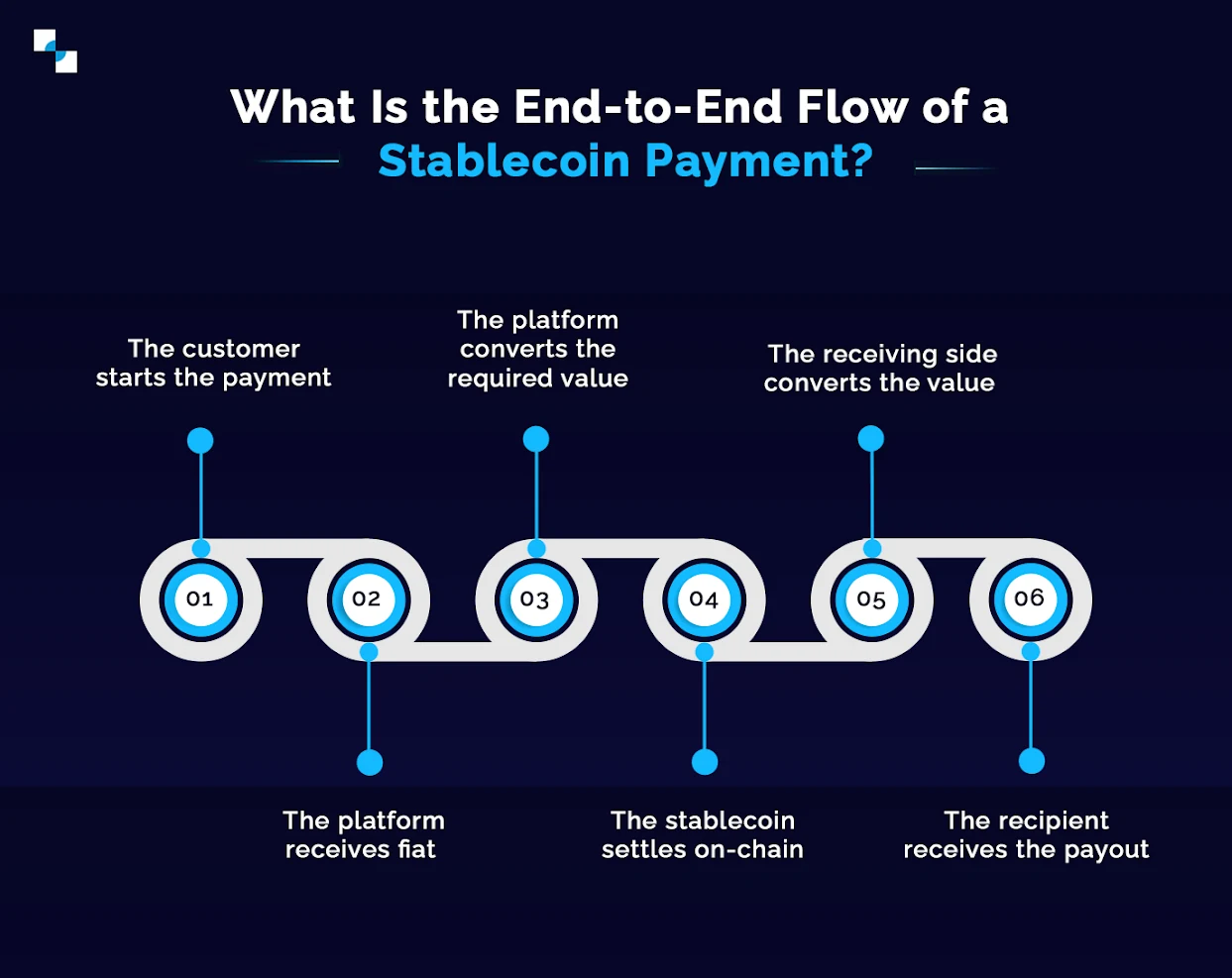
1. The customer starts the payment
The sender creates a transfer through a fintech application, neobank, remittance platform, merchant interface, or business payment portal. The platform captures the information needed to price and process the transaction. That typically includes the amount, currencies, destination, recipient details, funding method, and applicable compliance information.
2. The platform receives fiat
The sender funds the payment through an available local method. This may be a bank transfer, existing account balance, card, or another supported funding mechanism. At this point, the user’s experience can remain entirely fiat-based.
3. The platform converts the required value
The payment infrastructure converts the necessary amount into a stablecoin. The conversion can be handled through an integrated liquidity provider, exchange, market maker, stablecoin issuer, or other regulated infrastructure provider, depending on the operating model. The platform also needs to account for the applicable FX rate, spread, fees, and liquidity available for that transaction.
4. The stablecoin settles on-chain
The stablecoin is transferred across the selected blockchain network. This is the part of the flow that can provide continuous settlement availability. The infrastructure still has to manage wallet addresses, network fees, transaction status, confirmation policies, and transaction monitoring.
5. The receiving side converts the value
If the beneficiary expects local currency, the stablecoin can be converted through the destination-side liquidity infrastructure. This step is especially important for remittance and payment platforms because the recipient usually cares about the amount delivered in local currency rather than the underlying settlement asset.
6. The recipient receives the payout
The final amount is delivered using the supported local payment method. This could be a bank account, mobile wallet, card, or other local payout channel. From the customer’s perspective, this can appear as a single international payment even though multiple infrastructure layers are operating underneath it.
A 2026 partnership between Nium and Circle illustrates this model. The companies announced an integration connecting USDC settlement with Nium’s payout infrastructure across more than 190 countries and 100 currencies, with access through a single integration for participating financial institutions.
What Does the Infrastructure Stack Look Like?
A robust implementation generally needs several layers working together.
1. Blockchain connectivity
The platform needs access to the blockchain networks on which its supported stablecoins operate. Network selection should be based on the actual payment corridors and business requirements rather than simply choosing the network with the lowest transaction fee.
Relevant considerations include:
- Stablecoin availability
- Network reliability
- Transaction economics
- Settlement characteristics
- Existing liquidity
- Wallet infrastructure
- Developer tooling
- Institutional support
Supporting multiple networks can provide flexibility, but it also means the platform must handle additional monitoring, routing, reconciliation, and operational complexity.
2. Stablecoin layer
The business must decide which stablecoins it will support. This decision should account for:
- Liquidity
- Adoption
- Issuer structure
- Redemption
- Supported markets
- Regulatory requirements
- Integration availability
The objective is not to support as many stablecoins as possible. It is to support the assets that make sense for the payment corridors being served.
3. Wallet and custody infrastructure
Stablecoin payments require a secure way to receive, hold, and transfer digital assets. Depending on the business model, that can involve:
- Custodial wallets
- MPC-based custody
- Institutional custody providers
- Hot and cold wallet structures
- Transaction approval workflows
- Address whitelisting
- Withdrawal controls
Security needs to be designed into the transaction flow because blockchain transfers can be difficult to reverse once confirmed.
4. Fiat on-ramp and off-ramp infrastructure
The fiat connection is just as important as the blockchain connection. The platform needs infrastructure for:
Fiat → Stablecoin
and
Stablecoin → Fiat
A business can have efficient blockchain settlement and still deliver a poor customer experience if its local off-ramp is slow, expensive, or unavailable in a target market.
5. Liquidity infrastructure
Liquidity allows the platform to convert between stablecoins, fiat currencies, and other supported assets. This can involve:
- Liquidity providers
- FX providers
- Market makers
- Treasury accounts
- Stablecoin balances
- Local payout liquidity
Liquidity requirements become more complicated as a platform expands across corridors. A business may have excess liquidity in one market and insufficient liquidity in another. The infrastructure therefore needs more than simple conversion. It needs treasury visibility and rebalancing logic.
6. Ledger and reconciliation
Every payment needs a reliable financial record. The internal ledger may need to reconcile:
Customer balance → Fiat funding → Conversion → Stablecoin transaction → FX → Local payout
The ledger should also connect the customer-facing transaction to the corresponding blockchain transaction, liquidity movement, fees, and payout status. This is one of the less visible but more important components of enterprise payment infrastructure.
Where Does a Stablecoin Payment API Fit?
For a fintech, direct interaction with multiple blockchains, wallet providers, liquidity providers, and payout systems can quickly become difficult to maintain. A stablecoin payment API can provide an abstraction layer between the customer’s application and the underlying infrastructure.
Instead of building separate workflows for every provider, the platform can expose common payment functions such as:
- Create payment
- Generate wallet
- Quote FX
- Convert stablecoin
- Initiate transfer
- Check transaction status
- Initiate payout
- Receive webhook updates
- Retrieve balances
- Retrieve reconciliation data
For example, a remittance application might call a single payment endpoint. The backend can then determine:
- Which stablecoin?
- Which network?
- Which liquidity provider?
- Which destination payout route?
The customer-facing application does not need to expose those decisions. This architecture becomes particularly useful when a business operates across several payment corridors and wants to change or add underlying providers without redesigning the entire product.
How Can Remittance Platforms Use Stablecoin Remittance Infrastructure?
Remittance platforms already operate a multi-layer payment model. The sender pays in one market. The recipient receives funds in another. Between those two events, the operator needs to manage identity, FX, liquidity, settlement, compliance, and payout. Stablecoins can become the settlement layer between the two sides. A simplified model is:
Sender Fiat → Remittance Platform → Stablecoin Conversion → Blockchain Settlement → Local Liquidity → Recipient Fiat
The recipient does not have to use a crypto wallet. The sender does not necessarily have to understand blockchain transactions. The stablecoin can operate entirely in the background. That makes stablecoin remittance infrastructure particularly relevant for businesses that want to connect digital settlement with existing remittance operations. But customer trust still matters.
Visa’s 2026 Money Travels report surveyed more than 45,000 remittance senders and receivers across 20 countries. It found that 69% of remitters said trust in a new way of moving money depends more on who offers it than on the technology itself. Visa also highlighted security, transparency, and protection as important factors in adoption. For remittance operators, that creates an important product requirement. The infrastructure may be blockchain-based, but the user experience still needs to feel secure, familiar, and transparent.
What Does Stablecoin Infrastructure Mean for Neobanks?
Neobanks have a different challenge because stablecoin functionality needs to fit into an existing financial product. A neobank may already have:
- Customer accounts
- Fiat balances
- Cards
- Bank transfers
- FX
- Customer ledgers
- KYC and AML systems
The stablecoin layer needs to connect with those existing systems rather than creating a parallel customer experience. One possible architecture is:
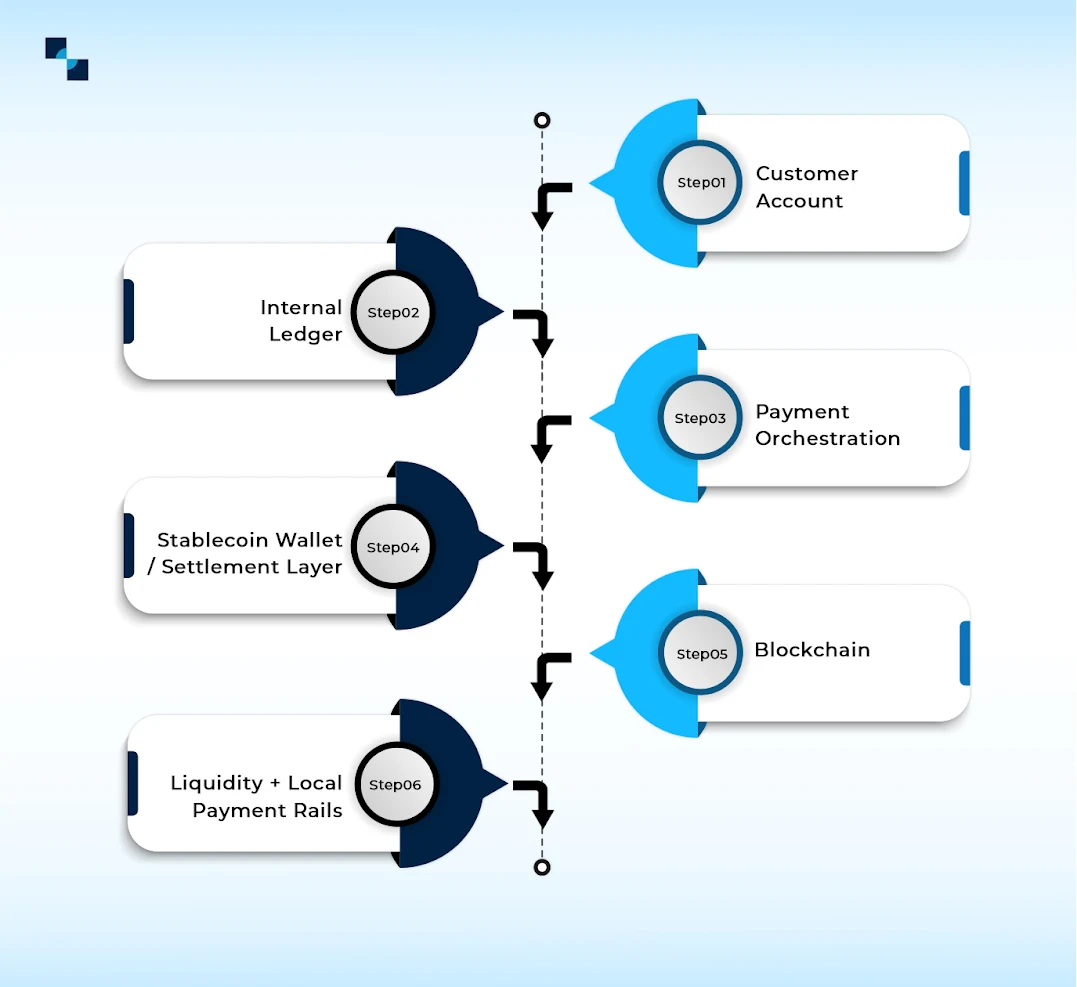
The customer can continue to interact with a familiar banking application. The stablecoin can operate in the backend when it offers a useful settlement path. That is also why interoperability matters. A neobank may want the option to route some transactions through traditional infrastructure and others through stablecoin-based settlement. The infrastructure should support the business decision rather than force every payment onto one rail.
How Should Compliance Be Built Into Stablecoin Payment Infrastructure?
Compliance needs to be part of the payment architecture from the start. Depending on the markets and business model, a stablecoin payment platform may need:
- KYC and AML controls
- Sanctions and wallet screening
- Transaction monitoring and risk scoring
- Travel Rule compliance, where applicable
- Reporting and record-keeping
In 2026, the U.S. OCC proposed rules under the GENIUS Act covering areas such as reserves, redemption, custody, reporting, and risk management, followed by a separate AML/CFT and sanctions proposal.
For cross-border fintechs, these requirements can be integrated directly into the transaction flow and infrastructure from the outset, creating a compliance-ready payment architecture.
Exploring stablecoin infrastructure for your fintech? Let’s talk architecture.
What Should a Fintech Consider Before Building Stablecoin Payment Rails?
Before building, fintechs should evaluate:
- Payment corridors: Target countries, currencies, payout methods, regulations, and liquidity.
- Customer journey: Whether users pay, hold, or receive stablecoins, or use them only for backend settlement.
- Liquidity: Access to stablecoin, FX, local payout, and treasury liquidity.
- Infrastructure: What to build in-house versus integrate for custody, compliance, liquidity, APIs, and payouts.
- Exceptions: Workflows for failed transfers, insufficient liquidity, payout issues, compliance holds, refunds, and reconciliation.
Should Businesses Build or Integrate Stablecoin Payment Infrastructure?
There is no universal answer. Integration can make sense for businesses that want to launch quickly, validate a corridor, or avoid operating every part of the infrastructure internally. A deeper custom build can make sense when the business needs more control over its payment orchestration, treasury, internal ledger, liquidity routing, compliance workflows, or user experience.
A hybrid model is often practical.
- A fintech could own: Customer application + payment orchestration + ledger + treasury logic
- while integrating: Custody + liquidity + blockchain connectivity + compliance services + local payout networks
The right architecture depends on the business model, target corridors, transaction volumes, regulatory structure, and internal engineering capabilities. The goal should not be to build the maximum amount of blockchain infrastructure. It should be to own the components that create strategic value while integrating the parts that specialized providers can operate efficiently.
Wrapping Up
The strongest stablecoin payment architecture starts with the payment problem, not the blockchain. A cross-border fintech needs to understand its corridors, funding methods, currencies, liquidity requirements, compliance obligations, payout networks, and customer experience before deciding how the settlement layer should work. That is where specialized infrastructure development becomes important. The platform may need a combination of stablecoin settlement, payment orchestration, wallet infrastructure, liquidity integration, FX, compliance, ledger management, APIs, and local payout connectivity. For businesses entering this market, the objective is not simply to move stablecoins on-chain. It is to build a payment system in which stablecoin settlement fits cleanly into the broader financial infrastructure. Planning a stablecoin payment platform for cross-border transactions?
Antier can help design and develop the underlying architecture across blockchain settlement, payment APIs, wallet infrastructure, liquidity, compliance, and fiat payout integrations.
Frequently Asked Questions
01. What is the role of stablecoins in cross-border payment infrastructure?
Stablecoins serve as a settlement layer in cross-border payments, allowing fintechs and other platforms to transfer value efficiently between two points while integrating with existing fiat and payment systems.
02. How has stablecoin payment activity changed recently?
Stablecoin payment activity grew by 42% to at least $401 billion through August 2026, with the stablecoin supply reaching $303 billion, reflecting increased market adoption.
03. What challenges do cross-border fintechs face when implementing stablecoin payment rails?
Cross-border fintechs must navigate customer onboarding, fiat collection, currency conversion, liquidity management, and compliance, all while integrating stablecoins into their existing payment infrastructure.