



✨ AI Summary
- Asset tokenization has evolved from a theoretical blockchain model to a real-world application, transforming the financial infrastructure.
- Tokenized real-world assets (RWAs) represent ownership of physical assets such as real estate, commodities, bonds, and equities, and are backed by the underlying asset.
- The tokenization process offers advantages such as instant settlement, fractionalization, broader investor access, embedded compliance, and automated servicing.
- The most significant tokenization developments in 2026 include U.S.
- Treasuries and government debt, private credit, gold and other commodities, funds and money market funds, equities and ETFs, real estate, corporate bonds and fixed-income assets, private equity and venture capital, carbon credits and environmental assets, and art and other alternative assets.
Three years ago, most of what got called asset tokenization was a bank’s innovation team running a blockchain pilot on paper, with no real capital behind it. That phase is done. Asset managers sitting on trillions in AUM, sovereign-adjacent institutions, and regulated exchanges are now issuing, settling, and trading real assets on-chain because it is simply how they operate, not because someone in a lab wanted to try something new.
Tokenized real-world assets (RWAs) are blockchain tokens that represent ownership or an economic claim on something that exists off-chain: a Treasury bill, a slice of a private credit fund, an ounce of gold, a piece of a commercial building. The token is backed one-to-one, or through a defined claim structure, by the underlying asset, and custody, redemption, and compliance get enforced through smart contracts working alongside regulated intermediaries. What you end up with is an instrument that settles the way crypto does but is still anchored, legally, the way a traditional security is.
What is different about 2026 is scope. Tokenization used to mean stablecoin-adjacent products, tokenized cash, tokenized Treasuries, not much else. Now it covers financial assets like bonds and equities, physical assets like real estate and commodities, investment products such as private credit and private equity funds, and rights-based assets like carbon credits and royalty streams. It has gone from a narrow yield play to something closer to parallel infrastructure for capital markets.
The interesting question is not whether tokenization is happening. It is which real-world asset types are actually gaining traction with institutions right now, in 2026, and what is pulling each of them on-chain.
Tokenized Assets VS Traditional Assets
| DIMENSION | TRADITIONAL ASSET | TOKENIZED ASSET |
| Ownership record | Centralized/off-chain | Digital/on-chain representation |
| Settlement | Intermediary-dependent | Potentially programmable |
| Fractionalization | Often difficult | More technically feasible |
| Investor access | Institution/platform dependent | Potentially broader |
| Compliance | Manual + system-based | Can be embedded into token logic |
| Servicing | Often fragmented | Can be automated |
| Liquidity | Market-dependent | Still market-dependent |
Which Real-World Assets Are Being Tokenized in 2026?
Not every asset class tokenizes for the same reason. Some issuers want 24/7 liquidity. Others want to cut settlement from days down to seconds. Some just want to open the door to investors who were locked out by high minimums or by where they happen to live. Here is a look at the ten categories seeing the most real institutional activity this year, not proof-of-concept activity, actual capital.
U.S. Treasuries and government debt
Tokenized U.S. Treasuries are still the anchor of this market, and arguably the category that proved the whole idea works. BlackRock, Franklin Templeton, and other regulated issuers now have well over $10.8 billion in tokenized government debt outstanding (CoinMarketCap, 2026), up from around $1 billion at the start of the year. BlackRock’s BUIDL fund and Franklin Templeton’s on-chain government money fund are the two names that come up most, and both let an investor hold a Treasury-backed token that settles peer-to-peer instead of routing through the usual chain of custodians and clearing agents.
In practice, that means on-chain cash management, DeFi collateral, and a low-risk yield instrument that settles instantly rather than sitting in a T+1 or T+2 queue. Treasuries are the most liquid, lowest-credit-risk asset there is, so it makes sense they are where most institutions cut their teeth on tokenization first, and that is a big part of why this one category still holds the largest slice of the represented-asset market.
Private credit
If there is a breakout category this year, it is this one. Private credit tokenization lets lenders and borrowers originate, fractionalize, and trade loans on-chain, and platforms backed by BlackRock, Maple, and other credit specialists are pointing toward a market opportunity that could run into the trillions over the medium term (Blockworks, 2026).
Maple Finance and Centrifuge have built out direct lending and trade finance pools specifically for this, while some of the larger asset managers are wrapping tokenized feeder structures around funds they already run, so an institutional investor does not have to wait for the next quarterly subscription window to get in. Private credit has always been illiquid and a little opaque by nature, so the real value tokenization adds here is not speed for its own sake, it is transparency: real-time visibility into how a loan book is actually performing, and a faster secondary market for an asset class that used to lock capital up for years with little recourse.
Tokenize More Than Just One Asset Class
Gold and other commodities
Gold tokenization might be the fastest-growing corner of the commodities market right now. Market cap for tokenized gold crossed $6 billion in February 2026, led by PAXG and XAUT, and Q1 trading volume alone already beat all of 2025 (CEX.IO, 2026). The mechanics are fairly straightforward: each token is backed by an allocated bar sitting in a professional vault, and the issuer publishes regular audit attestations so holders can check that the metal actually exists rather than take it on faith.
Demand for tokenized gold is running roughly five times ahead of physical gold demand, which says something about who is buying it: investors who want the inflation hedge without paying for a vault. It is not staying confined to gold either. Early tokenized products for silver and other precious metals are starting to show up, as issuers try to run the same playbook a second time.
Funds and money market funds
Tokenized money market funds do something simple but useful: they turn a product that used to settle slowly into something that behaves like cash on a ledger. BlackRock’s move to bring tokenized access to $311 billions of European money market funds onto Ethereum (CoinDesk, August 2026) is the clearest sign yet that this is not a side experiment, it is a core distribution channel for the largest asset managers in the world.
Franklin Templeton, WisdomTree, and Securitize have all rolled out comparable products, giving corporate treasurers and institutional allocators a way to park idle cash somewhere that pays yield and settles in minutes instead of days. For the asset managers themselves, there is a second motive at work too: distribution. Putting a fund in front of investors on digital-asset platforms is one way to reach a newer, more digitally native institutional client base that traditional channels do not always reach.
Equities and ETFs
Tokenized stocks and ETFs are pushing public market access past the usual trading hours and brokerage rails. Robinhood’s mainnet launch of Robinhood Chain in July 2026, a layer-2 network that settles trades in roughly 100 milliseconds, extended tokenized stock trading to more than 120 countries, building on an earlier product that already gave European users access to more than 2,000 tokenized stock and ETF names. Backed Finance and Dinari are pursuing a similar model for other blue-chip names and diversified ETFs, and Vanguard’s Total Bond Market ETF has already shown up in tokenized form on RWA.xyz’s registry (2026), which suggests fund-level tokenization is spreading well past individual equities.
One thing worth flagging here, because it matters more than the marketing usually lets on: most of these products are structured as tokens that track a stock’s price, not instruments that carry direct shareholder voting rights. Regulators, the SEC included, have flagged that distinction for continued oversight, so anyone evaluating tokenized equities should be clear on exactly what claim the token gives them before treating it as a straight substitute for owning the share.
Real estate
Real estate tokenization goes after the two things that have always made property investing difficult: it is illiquid, and the entry ticket is usually large. Split a commercial building, a real estate fund, or a development project into digital shares, and issuers can open it to a global investor base at a far lower ticket size, while giving early investors a secondary market that traditional real estate simply never offered.
A recently registered product, the BT Futures Property Fund (RWA.xyz, 2026), shows roughly how these deals get built: a special purpose vehicle holds legal title to the property, and each token represents a proportional economic interest in that vehicle, with rental income or appreciation flowing back to token holders. Government-backed pilots are helping too. Dubai’s push to tokenize real estate title records is probably the most visible one, and that kind of regulatory backing matters for a category that has relied on private placements and multi-year lockups for as long as anyone can remember.
Corporate bonds and fixed-income assets
Tokenized corporate bonds bring the same settlement, and transparency gains that Treasuries already got to the higher-yield end of fixed income. This is not entirely new ground: Siemens issued a blockchain-native digital bond with Deutsche Bank and other German banks a while back, and the World Bank and the European Investment Bank have both run blockchain bond programs, so there is real precedent for corporate and supranational issuers to build on at greater scale in 2026. What issuers get out of it is lower administrative overhead and faster coupon distribution.
What investors get is more granular access to credit exposure that used to come bundled into large, illiquid bond offerings with no way to buy a smaller slice. As more banks build out the custody and settlement rails these deals actually need, tokenized bonds are shifting from an experimental issuance option to something closer to a standard one on a treasury team’s list of choices.
Private equity and venture capital
Private equity and venture capital carry one of the oldest liquidity problems in finance: capital sits locked up for seven to ten years with no real exit. Securitize’s tokenized fund giving investors exposure to a KKR private equity fund, issued on Avalanche, was one of the first structures to hand a broader base of investors access to a brand-name private equity manager through a single on-chain token.
Something similar is starting to happen on the venture side, where platforms are packaging fund interests into tokens that qualified investors can buy in increments far smaller than a traditional limited partner commitment would require. For general partners, tokenizing fund interests opens a path to secondary liquidity for their limited partners. For investors who were previously priced out by high minimums, it opens the door from the other direction.
Carbon credits and environmental assets
Tokenized carbon credits solve a problem that has dogged this market for years: double-counting and inconsistent standards. Toucan Protocol, KlimaDAO, and AirCarbon Exchange all bridge credits from established registries onto public blockchains, and infrastructure like Hedera Guardian automates the monitoring, reporting, and verification work that decides whether a credit is legitimate in the first place.
Anchor a credit to a blockchain record and an issuer can actually prove it has not been resold or retired twice, which gives corporate buyers real confidence in what they are purchasing to meet sustainability commitments. As those net-zero commitments face more outside scrutiny, that kind of verifiability is becoming just as important to buyers as the price tag on the credit itself.
Art, collectibles and other alternative assets
Fine art, luxury collectibles, and other alternative assets are being fractionalized so that something historically owned by one person can be owned by many. A painting, a rare watch, a vintage wine collection, all of it can sit with a specialist custodian, get appraised, and get represented as a set of tokens carrying a proportional economic interest, with a secondary marketplace letting holders trade their slice without waiting for the whole piece to sell. This category is still small next to Treasuries or private credit. But it is a useful proof point regardless: tokenization’s core idea, fractional ownership plus a liquid secondary market, holds up for pretty much any asset that has a determinable price.
Line all ten up and a pattern falls out pretty clearly. The assets moving fastest onto blockchain rails are the ones where illiquidity, slow settlement, or a high price of entry was already the biggest complaint, and where a name investor already trust decided to prove the model works at real scale.
| Asset Type | Market Signal | Primary Driver | Example Issuers / Platforms |
|---|---|---|---|
| U.S. Treasuries & government debt | $10.8B+ tokenized (CoinMarketCap, 2026) | Instant settlement, DeFi collateral, low credit risk | BlackRock (BUIDL), Franklin Templeton |
| Private credit | Trillion-dollar opportunity flagged (Blockworks, 2026) | Transparency, faster secondary trading | Maple Finance, Centrifuge, BlackRock |
| Gold & other commodities | $6B+ market cap (CEX.IO, Feb 2026) | Inflation hedge without vault costs | PAXG, XAUT |
| Funds & money market funds | $311B tokenized access opened (CoinDesk, Aug 2026) | On-chain cash management, faster settlement | BlackRock, Franklin Templeton, WisdomTree |
| Equities & ETFs | 2,000+ tokenized names in the EU; 120+ countries reached (2026) | 24/7 trading, fractional access | Robinhood Chain, Backed Finance, Dinari |
| Real estate | New SPV-backed products registering through 2026 (RWA.xyz) | Fractional ownership, secondary liquidity | BT Futures Property Fund |
| Corporate bonds & fixed income | Scaling on precedent set by early digital bonds | Lower overhead, faster coupon distribution | Siemens, World Bank, EIB |
| Private equity & venture capital | Early tokenized PE/VC funds now live (RWA.xyz, 2026) | Secondary liquidity for limited partners | Securitize (with KKR) |
| Carbon credits & environmental assets | Fast-growing; no single market cap yet | Verifiable provenance, no double-counting | Toucan Protocol, KlimaDAO, AirCarbon Exchange |
| Art, collectibles & alternative assets | Smallest segment; still emerging | Fractional ownership of illiquid items | Specialist custodian platforms |
What Infrastructure Is Required to Tokenize Different Asset Types?
Tokenizing a Treasury bill and tokenizing a commercial building are not the same engineering problem, not even close. Each asset tokenization development class comes with its own regulatory classification, custody requirements, and investor base, so the infrastructure underneath has to be built around the specific asset rather than treated as one template that fits everything. A handful of components show up, in some form, across nearly every tokenization program that has actually shipped in 2026.
- Blockchain and smart contract layer. A public network like Ethereum or Avalanche, or a permissioned ledger instead, this choice decides settlement speed, transaction cost, and who is even allowed to touch the asset. Smart contracts carry the actual rules: issuance, transfer restrictions, redemption, dividend or interest distribution.
- Custody and asset backing. Every tokenized asset needs a verifiable link back to whatever it is supposed to represent, a qualified custodian holding physical gold, a transfer agent recording bond ownership, a special purpose vehicle holding real estate title.
- Compliance and KYC/AML infrastructure. Most tokenized RWAs are regulated securities under the hood, so the platform needs identity verification, accredited investor checks, and transfer restrictions that can flex across MiCA, VARA, MAS, and SEC rules without a rebuild every time a new jurisdiction gets added.
- Tokenization standard and token design. ERC-3643, ERC-1400, or something proprietary and permissioned, whichever standard an issuer picks shapes how transfer restrictions, whitelisting, and corporate actions actually get enforced on-chain.
- Secondary market and liquidity venues. A tokenized asset only delivers on its liquidity promise ithere is somewhere compliant to trade it, an alternative trading system, a regulated exchange, an on-chain marketplace, somewhere investors can genuinely buy and sell.f
- Oracles and data feeds. Commodities, equities, and funds all need reliable, tamper-resistant price feeds so the on-chain valuation does not drift from what the asset is actually worth in the real market.
- Investor onboarding and reporting tools. Institutional investors expect the reporting they already get from traditional custodians, statements, tax documentation, audit trails, and that has to show up in the platform’s back office, not as an afterthought.
The thing all of these have in common is that they cannot be generic. A platform built for tokenizing Treasuries will not automatically handle the title transfer complexity real estate brings, and a platform built for a fungible commodity like gold will not automatically support the governance rights that come attached to tokenized private equity. Get the asset tokenization development stack right the first time and that is the difference between a pilot that goes nowhere and a compliant, scalable issuance platform, which is also exactly why most institutions bring in an experienced technology partner instead of trying to build every layer of this themselves.
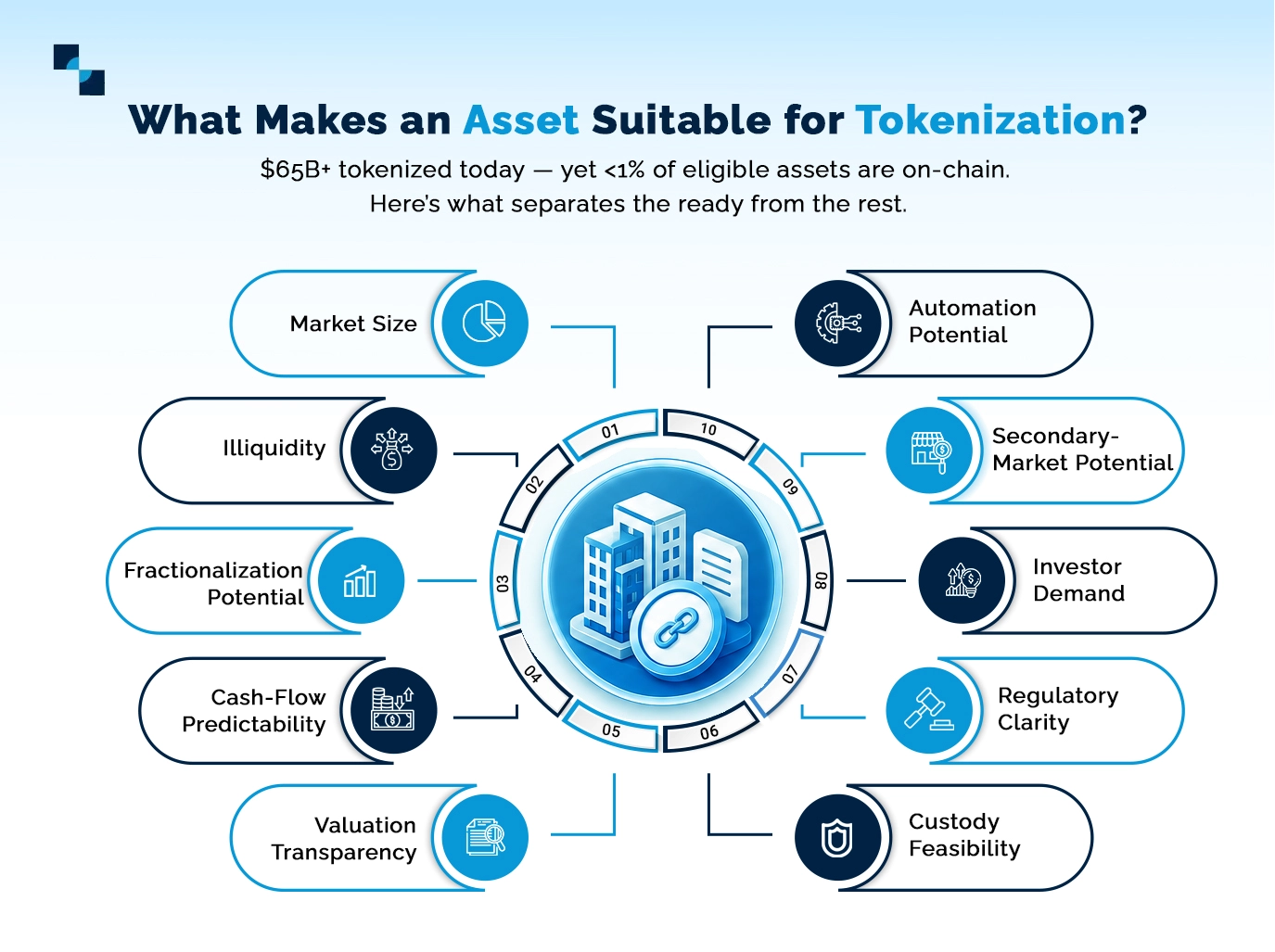
Building Infrastructure for the Next Generation of Tokenized Assets
As more asset types move on-chain, the asset tokenization platforms behind them need to be built for scale and flexibility from day one, not patched together after the fact. A few priorities are shaping how this next generation of tokenization infrastructure actually gets built in 2026.
- Multi-chain by design. Nobody is committing to a single blockchain anymore. Infrastructure has to support deployment and interoperability across multiple networks, because liquidity does not sit in one place.
- Composable compliance modules. Instead of hardcoding one jurisdiction’s rules into the platform, the better approach builds compliance as configurable modules that flex as an issuer expands into new markets or regulatory regimes.
- Institutional-grade custody integrations. Partnering with qualified custodians and transfer agents used to be a differentiator. Now it is closer to table stakes, as more regulated capital comes into the space.
- White label and modular deployment. Asset managers and fintechs increasingly want a white label tokenization platform they can brand and configure on their own, instead of building custom infrastructure from scratch every time they want to bring a new asset type on-chain.
- Interoperable secondary markets. The next wave of infrastructure is really about connecting liquidity pools that are currently fragmented, so a tokenized bond or fund share issued on one platform can actually trade across several venues.
- AI-assisted underwriting and reporting. More platforms are layering AI tools directly on top of their tokenization infrastructure now, automating credit analysis, valuation updates, and investor reporting at scale manual processes were never built to handle.
None of this works as a checklist you tick off in isolation. A platform that is multi-chain but skips composable compliance is going to struggle the moment it tries to expand into a new jurisdiction, and a platform with excellent custody integrations but no interoperable secondary market still leaves investors holding a token they cannot easily sell. The institutions actually winning here in 2026 are treating tokenization infrastructure as a long-term platform investment, not a one-off asset pilot they will revisit later.
Building infrastructure like this from scratch is a serious undertaking, and that is precisely where a specialized development partner earns its place. Antier, as a leading asset tokenization development company has spent more than nine years in blockchain infrastructure, and its asset tokenization services are built around exactly the priorities above: multi-chain deployment, compliance-ready architecture for the UAE, EU, US, and Singapore, and end-to-end platform development that covers everything from smart contract architecture to custody integrations to investor-facing dashboards. Whether the goal is a real estate tokenization platform, a gold tokenization solution, or a fully custom white label tokenization platform, Antier’s team works alongside the issuer’s own, not around it, to take a tokenization program from an idea on a whiteboard to a live, compliant, liquid marketplace.
FAQs
Are tokenized U.S. Treasuries as safe as holding the actual Treasury bond?
Tokenized U.S. Treasuries carry the same underlying credit risk as the Treasury itself, since products like BlackRock’s BUIDL are backed one-to-one by actual government debt held in custody. The token just adds a faster settlement and access layer on top, it doesn’t change what’s backing the value.
Is tokenized gold backed by real, allocated bullion?
Yes. Gold tokenization products like PAXG and XAUT are backed by allocated bars held in a professional vault, and issuers publish regular audit attestations so holders can verify the metal actually exists.
How does real estate tokenization work if I can’t physically hold a share of a building?
Real estate tokenization works through a special purpose vehicle that holds legal title to the property, while each token represents a proportional economic interest in that vehicle. Rental income and appreciation flow back to token holders even without anyone individually owning a physical piece of the building.
What makes tokenized carbon credits more trustworthy than traditional carbon credits?
Tokenized carbon credits are anchored to a blockchain record, so an issuer can prove a specific credit hasn’t been resold or retired twice, a problem that has long affected traditional registries. Platforms like Hedera Guardian also automate the verification steps that confirm a credit is legitimate before it’s ever tokenized.
What should a company look for in an asset tokenization development partner?
The right asset tokenization partner should offer multi-chain deployment, compliance-ready architecture across jurisdictions like the UAE, EU, US, and Singapore, and end-to-end platform development rather than a single point solution. Antier brings all three, backed by more than nine years of asset tokenization infrastructure experience.