




✨ AI Summary
- Launching a neo banking solution in 2026 is no longer a technology challenge, but a strategic one.
- With mature white label neo bank platforms capable of reducing development timelines from years to weeks and providing ready-made compliance infrastructure, the focus is now on profitability.
- Despite rapid customer growth and market expansion, fewer than 40% of major neobanks have reached profitability.
- Success is largely determined by the questions asked before the investment is approved, focusing on costs beyond the software license, regulatory obligations, vendor resilience, scalability limits, AI capabilities, crypto readiness, and long-term compliance exposure.
- This blog post provides a comprehensive guide to the 11 essential questions enterprise leaders consistently ask when evaluating a white label neo bank platform in 2026, including topics like cost factors, stablecoin capabilities, regulatory requirements, AI integrations, and the implications of the Digital Operational Resilience Act.
“What will it cost?”
“How long will it take?”
“What happens if regulations change six months after launch?”
If you have ever sat in a boardroom discussing a digital banking initiative, you have probably heard these questions before.
And rightly so!
Launching a neo banking solution in 2026 is no longer a technology challenge. The technology already exists. Mature white label neo bank platforms can reduce development timelines from years to weeks, provide ready-made compliance infrastructure, and accelerate market entry significantly.
Yet profitability remains one of the sector’s biggest challenges. Industry research suggests that fewer than 40% of major neobanks have reached profitability, despite rapid customer growth and market expansion.
Why?
Because success is rarely determined by the platform itself. It is determined by the questions asked before the investment is approved. The most successful enterprises don’t begin by comparing features. They begin by evaluating costs beyond the software license, regulatory obligations, vendor resilience, scalability limits, AI capabilities, crypto readiness, and long-term compliance exposure. In other words, they focus on the risks and realities that emerge after launch—not just the promises made before it.
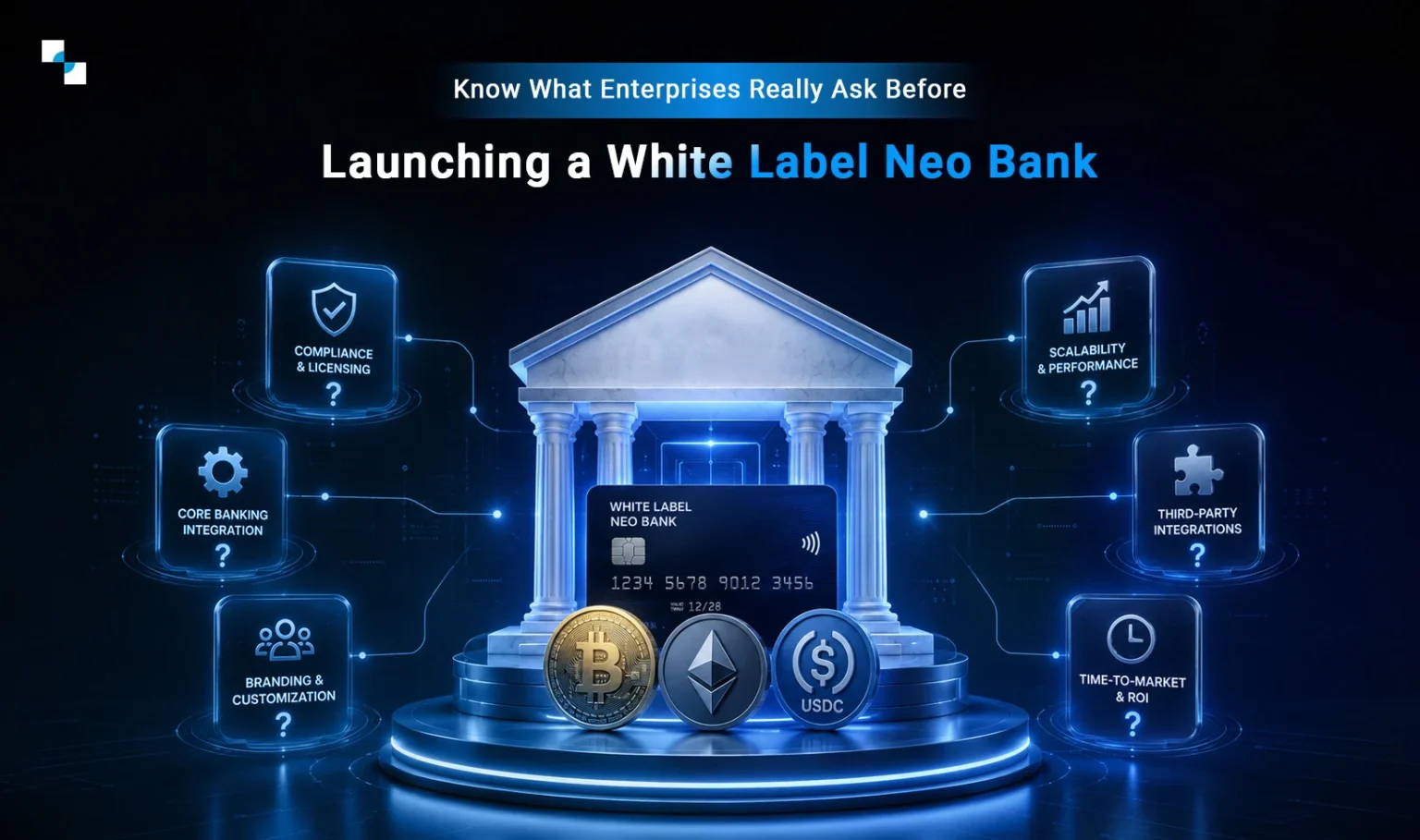
So, before committing a budget, selecting a crypto neo bank app development company, or finalizing your go-to-market strategy, here are the 11 questions enterprise leaders consistently ask when evaluating a white label neo bank platform in 2026.
Here’s what that decision process actually looks like from the inside.
1. What factors affect the cost of white label neo bank development?
A:
- Platform scope — core banking, cards, wallets, payments, lending, or multi-product setup.
- Regulatory complexity — the markets you launch in and the licenses required.
- Banking partners — sponsor bank, BIN sponsor, and other third-party dependencies.
- Compliance stack — KYC, AML, fraud monitoring, sanctions screening, and reporting tools.
- Infrastructure needs — cloud hosting, security layers, uptime, and scaling requirements.
- Customization level — UI changes, workflows, integrations, and branded user journeys.
- Ongoing advisory — legal, compliance, and operational support after launch.
The operator who models only the platform fee will run out of runway before go-live.
2. What stablecoin capabilities should a future-ready neo bank platform support?
A: Beyond payments, the platform should be prepared for a future where regulated stablecoins become part of mainstream financial infrastructure. This requires support for real-time settlement, cross-border money movement, digital asset interoperability, and the flexibility to integrate emerging tokenized financial products as the market evolves.
3. What exactly is a white label neo bank platform, and how is it structurally different from a banking-as-a-service (BaaS) product?
A. A white label neo bank platform is a pre-built, fully functional digital banking software suite that a business purchases, rebrands, and deploys under its own identity. The platform includes core banking logic, KYC/AML modules, a payment engine, a card issuance layer, a customer-facing mobile and web application, and an admin console — all delivered as a configurable codebase or licensed SaaS stack.
A Banking-as-a-Service (BaaS) product, by contrast, exposes individual banking capabilities (account creation, ledger management, card issuance) through APIs for developers to assemble. BaaS is infrastructure; a white label neo bank is a finished product built on that infrastructure.
The practical distinction: BaaS requires significant internal engineering to build a customer-facing product. A white label platform reduces that engineering burden by 70–80%, delivering a production-grade banking application in 4–16 weeks instead of 18–36 months (GoodFirms, 2026). For enterprises seeking speed-to-market without sacrificing control over UX and brand identity, a white label neo bank platform is the operationally superior path.
4. What is the total cost to deploy a white label neo bank platform in 2026, including hidden costs?
A:
| Cost Category | Typical Range (2026) |
|---|---|
| White label platform licence / development fee | $25,000 – $150,000 |
| Regulatory licence or e-money institution approval | $5,000 – $50,000+ (jurisdiction-dependent) |
| Sponsor bank partnership setup | $10,000 – $40,000 (one-time) |
| KYC/AML third-party integration (Sumsub, Onfido) | $800 – $4,000/month |
| Cloud infrastructure (AWS / GCP / Azure) | $3,000 – $12,000/month |
| Annual maintenance and platform updates | 15–25% of initial build cost per year |
| Card BIN sponsorship and card network fees | $5,000 – $20,000 setup + per-card fees |
| Compliance officer / legal advisory (annual) | $30,000 – $120,000 |
The figure most operators underestimate is the ongoing compliance overhead. In 2025, global regulatory fines for fintechs surged 417%, totaling over $1.2 billion (Canarie, 2026). A white label platform that ships with pre-integrated AML/KYC modules measurably reduces that exposure compared to a custom build where compliance tooling is assembled after the product ships.
5. What AI integrations can be done in a white label neo bank platform?
A:
- AI-driven onboarding for smarter KYC checks, document verification, and automated identity risk scoring.
- Fraud detection and anomaly monitoring to flag unusual transaction patterns in real time.
- AML transaction screening with behavioral analysis to identify suspicious activity more accurately.
- Personalized financial insights such as spending patterns, savings nudges, and cash-flow predictions.
- AI customer support through chatbots and virtual assistants for instant query resolution and service automation.
- Credit risk analysis for faster underwriting, limit recommendations, and borrower profiling.
- Compliance automation for alert prioritization, case summarization, and suspicious activity review support.
- Hyper-personalized product recommendations based on user behavior, transaction history, and financial goals.
6. How long until we are live?
A: With a mature white label BaaS platform: 4–16 weeks, depending on regulatory jurisdiction and customization depth. Five years ago, that same outcome required 18–24 months minimum. The timeline variable most operators underestimate is regulatory readiness, not engineering velocity.
7. Do We Need a Banking License for White Label BaaS Platform Development?
A: The BaaS platform doesn’t come with one. The operator needs an E-Money Institution license, a Payment Institution license, or a sponsor bank arrangement. In the UAE, an ADGM Financial Services Permission. In the US, state-by-state Money Transmitter Licences plus FinCEN registration.
Operators who treat licensing as an afterthought discover the problem at the worst possible moment.
8. What licenses does a white label neo bank operator need, and how does the requirement differ by jurisdiction?
A: No single global license exists. Regulatory requirements are jurisdiction-specific and determine both the permissible product scope and the capital requirements an operator must hold.
| Jurisdiction | Licence Type | Capital Requirement | Regulatory Body |
|---|---|---|---|
| European Union | E-Money Institution (EMI) Licence | €350,000 minimum | National Central Bank / BaFin |
| United Kingdom | E-Money Institution or Payment Institution Licence | £350,000 minimum | Financial Conduct Authority (FCA) |
| UAE (ADGM / DIFC) | Financial Services Permission | AED 1,000,000+ | FSRA / DFSA |
| United States | Money Transmitter Licence + FinCEN Registration | Varies by state | FinCEN / State regulators |
| Australia | Australian Financial Services Licence (AFSL) | AUD 1,000,000+ | ASIC |
| Singapore | Major Payment Institution Licence | SGD 1,000,000 | MAS |
A critical point for enterprise operators: a white label neo banking app does not come with a banking license. The platform provides software infrastructure. The operating entity must obtain the appropriate license independently or enter a sponsor bank arrangement where a licensed bank extends its charter to cover the platform’s operations in exchange for a revenue share or fee structure.
9. Who’s Responsible For White Label Neo Bank Compliance?
A: The licensed operating entity is ultimately responsible for the customized crypto-friendly neo bank compliance. While the platform provider can supply the technical framework, compliance tools, and implementation support, it does not replace legal accountability. The company you choose should have a strong legal, compliance, and risk team to manage licensing, KYC, AML, regulatory obligations, and jurisdiction-specific requirements. In practice, the best setup is one where the operator, internal compliance team, and external legal advisors work together to ensure the bank remains compliant from launch through scale.
10. How does DORA change our requirements for vendor governance, resilience, and exit planning?
A: DORA (Digital Operational Resilience Act) fundamentally changes how EU-regulated financial institutions manage technology vendors. Effective from January 2025, it requires organizations to treat critical technology providers as part of their operational resilience framework rather than simply software suppliers. For operators evaluating a white label neo bank platform, this means assessing the vendor’s security controls, incident response capabilities, audit readiness, subcontractor dependencies, and exit strategy. The key question is no longer whether the platform can launch quickly, but whether the vendor can support long-term compliance, resilience, and business continuity as regulatory expectations evolve.
From January 2025, every EU-regulated financial entity must treat its technology vendors as regulated third-party ICT providers. That means auditing the white label platform vendor’s own resilience controls, exit strategy, and incident response SLAs — not just trusting the sales deck. A vendor without a current SOC 2 Type II or ISO 27001 certification creates a DORA compliance gap that the operator inherits.
The questions above are operational. The ones that separate strategic operators from the rest go deeper.
11. How Does the Customized BaaS Platform Handle Regulatory, KYC, AML, and Compliance Changes Across Jurisdictions?
A: A production-grade white label neo bank platform should be designed to adapt as regulations evolve across different markets. Key capabilities include:
A) Compliance Adaptability
- Configurable compliance workflows for different jurisdictions.
- Rapid policy and rule updates without rebuilding the platform.
- Support for evolving regulatory requirements and reporting obligations.
B) KYC & Identity Verification
- Multi-level KYC onboarding and customer due diligence.
- Integration with identity verification and document authentication providers.
- Risk-based customer screening and onboarding controls.
C) AML & Risk Monitoring
- Real-time transaction monitoring and sanctions screening.
- Automated suspicious activity detection and case management.
- Continuous customer risk assessment and monitoring.
D) Governance & Auditability
- Comprehensive audit trails and compliance logs.
- Regulatory reporting support and record retention.
- Role-based controls for compliance and operations teams.
12. Can the Neo BaaS platform handle crypto and stablecoin rails?
A: In 2026, this is no longer a feature request. It is a competitive baseline. Enterprises serving cross-border remittance markets, crypto-native users, or institutional clients with multi-asset requirements need stablecoin settlement (USDC, USDT, EURC) alongside SEPA and SWIFT, not instead of them. A stablecoin transfer on Polygon settles in 2–5 seconds at under $0.01 in gas cost. The equivalent SWIFT wire takes 1–3 business days and costs $15–$45. For the operator’s enterprise clients, that differential is a material procurement decision.
13. What data protection and privacy frameworks must a white label neo bank platform comply with?
A: Data protection obligations layer across multiple frameworks depending on where users are located:
- GDPR (EU/EEA)
- UK GDPR
- US State Laws
- UAE Personal Data Protection Law (PDPL).
A white label neo bank platform must implement data residency controls at the infrastructure level, ensuring EU user data stays within EU-hosted servers, UAE data within DIFC or UAE-approved infrastructure, and so on. Cloud-agnostic platforms with region-specific deployment configurations.
14. What Does MiCA Compliance Require From Us?
A: If the crypto-friendly neo banking solution offers custody, exchange, or transfer of crypto assets to EU customers, the operator needs a Crypto-Asset Service Provider (CASP) authorization under MiCA. This requires a regulatory whitepaper, governance documentation, capital adequacy proof, and a DORA-aligned ICT risk framework. MiCA applies extraterritorially — if your users are in the EU, the regulation applies to you regardless of where the platform is incorporated.
15. What level of customization is actually possible on a white label neo bank platform?
A: A white-label neo bank platform is highly customizable but within a governed framework:
- Branding: logo, colors, typography, and overall visual identity
- UI/UX: dashboards, navigation, user flows, and customer journeys
- Product configuration: accounts, cards, loans, wallets, and fee structures
- Rules and controls: limits, alerts, approvals, and workflow settings
- Integrations: KYC, AML, payment rails, CRM, ERP, and third-party APIs
- Reporting: custom dashboards, analytics, and business insights
- Market setup: country-specific compliance, language, and currency settings
Bottom line: deep customization is possible on the front end and product layer, while the core banking and compliance layer stays controlled for security and regulation.
Get Your White Label Neo Bank Ready— Connect Now!
16. How does a white label neo bank platform support a super crypto app strategy?
A: A super crypto app consolidates four product categories — regulated banking (accounts, cards, transfers); crypto asset management (wallet, exchange, staking); payment infrastructure (QR payments, crypto payment gateway, merchant acceptance); and DeFi access (lending, yield, and liquidity pools) within a single customer-facing application.
The white label platform architecture supporting this strategy requires:
- Unified account layer: A single customer identity (one KYC pass, one risk profile) that gates access to both regulated banking products and crypto/DeFi features. The compliance engine applies different product eligibility rules — for example, enhanced due diligence for DeFi access — without requiring re-onboarding.
- Non-custodial wallet integration: The platform embeds an MPC-based self-custody crypto wallet alongside the custodial banking account, giving users control of private keys for crypto holdings while keeping fiat balances under the bank’s custodial structure.
- Crypto payment gateway: A module enabling users to pay merchants in crypto (converted to fiat at settlement) and receive crypto payments from external wallets — with full AML transaction documentation.
- DeFi connectivity: A smart contract interaction layer enabling users to deposit idle stablecoin balances into audited DeFi lending protocols and withdraw at any time with accrued yield, with the platform maintaining a full transaction audit trail for tax reporting.
17. Is the banking architecture actually built to scale?
A: Monolithic architecture cannot scale beyond a transaction volume threshold without complete re-architecture. An enterprise-grade platform processes 10,000+ transactions per second on a cloud-native microservices architecture with independent horizontal scaling per service. The question to ask any BaaS development company is direct: “Show me your architecture diagram and your current largest production deployment by monthly active users.
18. What are the five most critical due diligence questions to ask a white label neo bank platform vendor before signing?
A: Before signing, ask these five questions:
- How big is your team, and who will support our launch?
- What is your largest live deployment today?
- Can you share a reference client in our target market or regulatory region?
- Is the platform built on microservices or a monolith, and how much traffic can it handle?
- What compliance certifications do you currently hold?
- What happens if we exit the contract, and how is our data handed over?
- What SLA penalties apply if you miss uptime or support commitments?
20. What does the 2026 competitive landscape and future outlook look like for white label neo bank platforms for 2027?
A: The white label neo bank app market in 2026 is commercially mature. Several structural dynamics define the landscape:
- AI-native banking
- Agentic AI
- AI fraud detection/deepfake defense
- Liveness detection and digital identity verification
- Compliance automation / RegTech
- Instant payments / real-time payments
- Embedded finance
- Crypto Cards
- Stablecoin Integration
- API-first / modular architecture
- Open banking / open finance
- Cross-border payments modernization
- White-label banking partnerships
- Consolidation / M&A in fintech and banking tech
21. How does a white label neo bank platform address AI-generated identity fraud, which has surged in 2026?
A: AI-generated identity fraud, including synthetic selfies, deepfake videos, and machine-generated identity documents, is a fast-growing onboarding risk. White-label neobank platforms address it with layered controls: liveness detection to stop presentation attacks, document forensics to catch forged IDs, device and behavioral risk scoring, and network analysis to detect linked mule-account activity. Regulators increasingly expect strong digital identity verification, biometric authentication, and ongoing monitoring as part of a broader AML/CFT control framework.
Regulators in the EU, UK, and UAE now expect these controls to be documented in the operator’s AML risk assessment. A white label platform that ships with static biometric checks only- without ongoing model retraining against emerging synthetic fraud patterns- creates a compliance gap from day one.
Make Your Customized Banking App Move Today!
The enterprises and businesses that ask these questions before signing are the ones who launch on schedule, within budget, and with a compliance posture that survives a regulatory examination. The operators who don’t ask them discover the answers at the worst possible time: during a regulatory audit, at the moment of a sponsor bank exit, or when their monolithic platform fails under production load.
If your team is in the evaluation phase for white-label neo bank development, the 21-question guide covers every dimension of that decision: cost, compliance, architecture, crypto integration, vendor selection, and 2026 competitive dynamics. And every aspect of the question answered will help you make a firm decision before investing. Connect with a seasoned crypto bank app development company that holds years of expertise in AI infrastructure as well.
Antier Builds White Label Neo Bank That Meets Enterprise Standards
Antier has built and deployed white label neo bank platforms for operators across the EU, UAE, Southeast Asia, and North America, covering fiat banking, crypto integration, stablecoin payment rails, and multi-jurisdiction compliance from a single platform architecture. The team brings together banking technologists, compliance architects, and blockchain engineers who have delivered production-grade white label neo bank deployments across regulated environments. If the questions in this guide have surfaced gaps in your current vendor evaluation or product strategy, a technical review conversation is the logical next step.
Get in touch now!