




✨ AI Summary
- The blog post is a comprehensive guide for selecting the best enterprise crypto wallet development company.
- It emphasizes the importance of such a decision as it significantly impacts the security architecture, compliance posture, and time-to-market for the next three to five years.
- The blog discusses the key criteria for evaluating blockchain infrastructure including cryptographic key management, compliance certification, multi-chain deployment, and verified post-launch delivery.
- It further breaks down the top eight development companies, their key features, and their unique selling propositions.
- The blog also provides a checklist for evaluating vendors, common FAQs about crypto wallet development, and market outlook.
Selecting from the top enterprise crypto wallet development companies is a decision that determines your security architecture, compliance posture, and time-to-market for the next three to five years. The enterprise crypto wallet market was valued at USD 1.38 billion in 2025 and is projected to reach USD 3.55 billion by 2032 at a 14.41% compound annual growth rate, with the commercial and institutional segment expected to hold 69.88% of total market share in 2026 (GII Research, 2026).
Enterprise-level investors evaluating blockchain infrastructure need to cut through vendor marketing and assess the criteria that matter at institutional scale: cryptographic key management architecture, compliance certification coverage, multi-chain deployment capability, and verified post-launch delivery. This guide covers popular vendors who hold years of expertise in developing and delivering flawless and 100% successful wallet solutions globally.
Let’s begin the journey!.
What Enterprise-Grade Crypto Wallet Development Actually Requires?
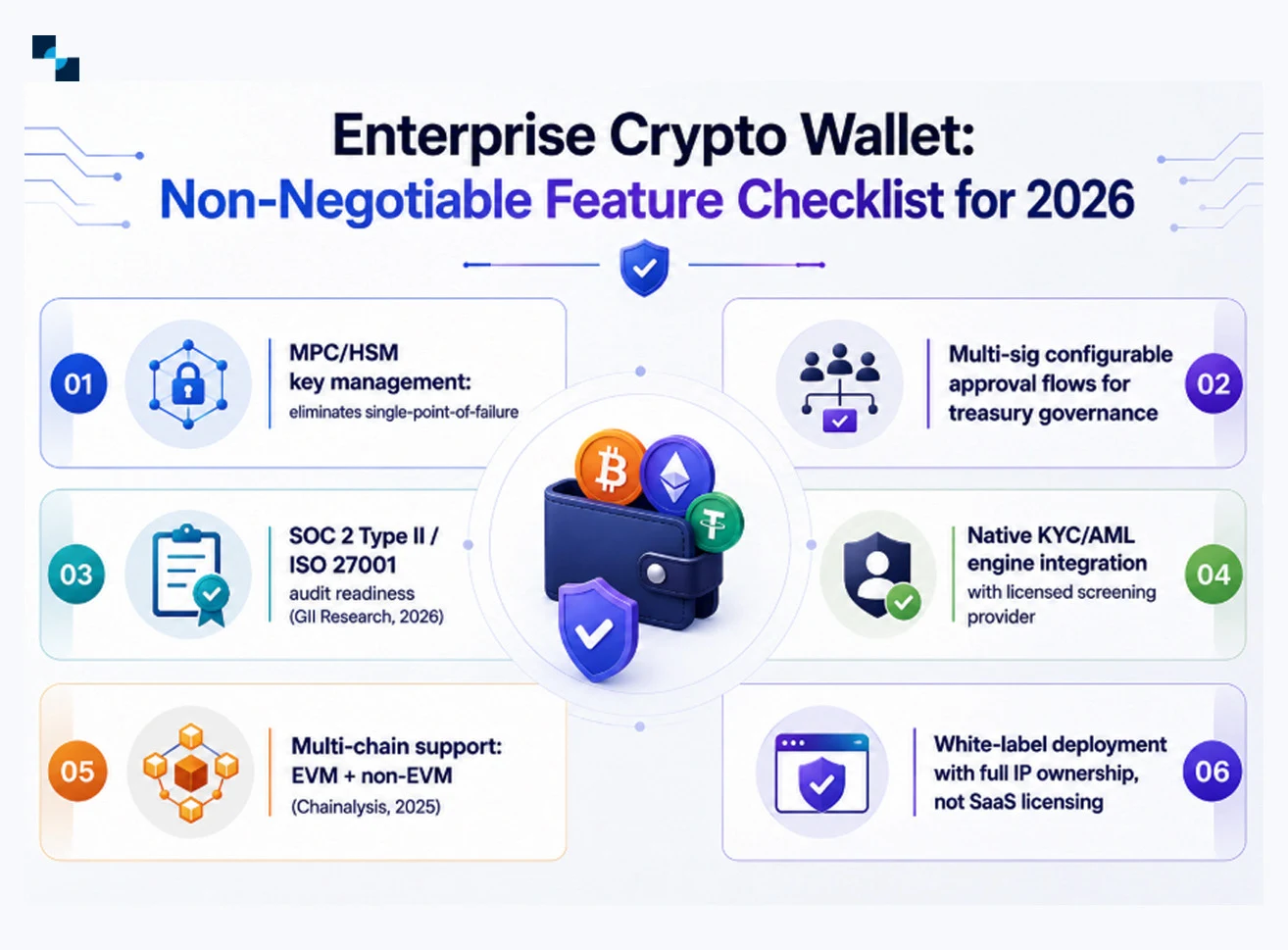
Enterprise-grade is not a pricing tier. It is a specific technical profile: MPC or HSM-backed private key management that eliminates single-point-of-failure exposure, configurable multi-signature governance with role-based access control, SOC 2 Type II or ISO/IEC 27001 certification covering the cryptocurrency wallet development environment, and native integration with licensed KYC/AML screening engines. The distinction matters operationally because consumer wallet frameworks lack the policy-layer controls, audit trail depth, and governance workflows that institutional compliance requires.
North America alone processed USD 2.3 trillion in on-chain transaction value between July 2024 and June 2025. Regulators across the US, EU, UAE, and UK now treat verifiable custody controls, including documented key management architecture and AML screening coverage, as a baseline for operating in digital asset markets. Any blockchain wallet development partner you evaluate must present completed, audited deployments as evidence, not case study PDFs or proposal documents.
Top 8 Enterprise Crypto Wallet Development Companies: Full Vendor Comparison
| Company | Key Architecture | Compliance | Chain Coverage | White Label |
|---|---|---|---|---|
| Antier | MPC + Zero-Trust + AI Voice | KYC/AML, 30+ regions | Multi-chain EVM + non-EVM | Full IP ownership |
| Webkul | API-first, Modular | Basic compliance | BTC, ETH, ERC-20 | Custom modules |
| OrangeMantra | Centralised + Decentralised | QA + pen testing | Major chains | Partial |
| Innowise | Custodial/Non-custodial/Hybrid | MiCA, FCA-aligned | ETH, SOL, BSC, DOT | Full |
| RisingMax | Public + Permissioned ledgers | Enterprise grade | ETH, Hyperledger, DOT, XLM, EOS | Yes |
| Dev Technosys | Full-cycle delivery | Milestone-gated QA | BTC, ETH, Altcoins | Yes |
| Devox Software | Fintech and DeFi focused | ISO 9001 + ISO 27001 | EVM + DeFi protocols | Partial |
| Pixelplex | Modular extensible | KYC/AML auto module | Multi-chain, L2-ready | Yes |
1. Antier
Antier is an AI and blockchain engineering firm that has completed 500+ enterprise crypto wallet deployments across 30+ countries, serving regulated financial institutions, fintech operators, crypto exchanges, and corporate treasury teams. Every deployment is built on a zero-trust architecture with MPC-based private key sharding, AES-256 encryption, biometric authentication layers, and configurable threshold signature policies, covering the access governance requirements that auditors and regulators verify at the institutional level. The firm delivers white-label crypto wallet frameworks with region-specific compliance modules, supporting KYC/AML engine integration, fiat on-ramp connectivity, and smart contract extensibility, giving enterprises a branded, audit-ready product without building core cryptographic infrastructure from scratch.
Enterprise USPs: MPC architecture with AI Voice Assistant integration and native crypto card support; white-label framework with full source code and IP ownership at delivery; 30+ region regulatory compliance modules covering North America, UAE, UK, and Asia-Pacific; zero-trust key management with biometric authentication layers; dedicated post-deployment security audit and SLA-backed maintenance contracts.
2. Webkul
Webkul is a software company with origins in open-source commerce platforms, bringing modular wallet architecture to enterprises transitioning existing e-commerce and payments infrastructure into blockchain payment rails. The company develops API-first multi-currency wallets covering Bitcoin, Ethereum, and ERC-20 token standards, designed to connect with existing ERP and POS systems without requiring a ground-up infrastructure rebuild. Webkul suits mid-scale enterprises prioritizing cost-controlled blockchain integration over deep cryptographic customization.
Enterprise USPs: API-first Web3 wallet architecture designed for ERP and POS system integration; open-source module compatibility with existing commerce stacks; multi-currency support across Bitcoin, Ethereum, and ERC-20 standards.
3. OrangeMantra
OrangeMantra is an India-based digital transformation company that builds both centralized and decentralized crypto wallet solutions alongside cryptocurrency exchange and payment gateway platforms. The firm covers the full delivery cycle from architecture design and UI/UX through smart contract development, security testing, and post-launch technical support. OrangeMantra suits enterprises transitioning from traditional financial services into digital asset products who need a structured onboarding process with documented delivery milestones.
Enterprise USPs: centralized and decentralized wallet architectures delivered within a single engagement; bundled exchange and payment gateway development reducing total vendor count; structured QA and penetration testing cycles with documented sign-off protocols.
4. Innowise
Innowise is a European software engineering firm with more than 1,500 in-house technical specialists across offices in Poland, Germany, and the US, delivering crypto wallet development from product ideation through live deployment and ongoing maintenance. The company covers custodial, non-custodial, and hybrid wallet architectures with chain integration across Ethereum, Solana, Binance Smart Chain, and Polkadot. Innowise brings documented experience with regulated European fintech clients, making it a credible candidate for enterprises operating under MiCA or FCA compliance frameworks.
Enterprise USPs: 1,500+ in-house engineers with no third-party subcontracting; custodial, non-custodial, and hybrid wallet builds across six major chains; MiCA and FCA-aligned compliance documentation from prior regulated-market deployments.
5. RisingMax
RisingMax is a New York-based enterprise blockchain consultancy that builds multi-currency cryptocurrency wallet solutions alongside exchange platforms, DeFi applications, and NFT infrastructure. The technical team operates across Ethereum, Hyperledger, Polkadot, Stellar, and EOS, covering both public and permissioned blockchain environments. RisingMax suits financial services, logistics, and supply chain enterprises that require blockchain wallet infrastructure integrated with existing enterprise systems and operational workflows.
Enterprise USPs: multi-chain crypto wallet development across public and permissioned ledgers covering Ethereum, Hyperledger, Polkadot, Stellar, and EOS; enterprise blockchain wallet consulting from a US-headquartered team; cross-industry deployment experience spanning finance, logistics, and supply chain.
Request an Enterprise Wallet Architecture Demo!
6. Dev Technosys
Dev Technosys is a US-based development company delivering full-cycle crypto wallet platform projects from architecture planning and UI/UX design through blockchain integration, QA, deployment, and ongoing maintenance. The team builds custodial and non-custodial wallets supporting Bitcoin, Ethereum, and major altcoin standards, with additional service coverage across cryptocurrency exchange development and DeFi protocol integration. Dev Technosys suits growth-stage enterprises that require detailed milestone documentation and US-coordinated project management over offshore development costs.
Enterprise USPs: full-cycle delivery model with documented milestones and sign-off gates at each phase; custodial and non-custodial crypto wallet architecture with altcoin standard support; US-based project coordination with offshore development cost structure for budget-controlled builds.
7. Devox Software
Devox Software is an ISO 9001 and ISO/IEC 27001 certified software engineering firm with over 100 specialists across Poland and Romania, focusing on fintech-grade blockchain infrastructure and decentralized wallet development. The company builds wallets with DeFi protocol integration, dApp connectivity, and digital asset management capabilities, with information security controls documented and auditable across the full development lifecycle. ISO/IEC 27001 certification at the organizational level is a meaningful differentiator for enterprises whose own compliance frameworks require vendor security attestation.
Enterprise USPs: ISO 9001 and ISO/IEC 27001 certified organization with auditable security controls across the full development lifecycle; DeFi and dApp integration with fintech compliance architecture baked in from day one; delivery teams in Poland and Romania with EU data residency options for regulated clients.
8. Pixelplex
Pixelplex is a 14-year-old Web3 wallet development company whose blockchain practice has delivered 8 enterprise-grade crypto wallets, several generating USD 3 million in revenue within their first two months of operation, with an average 4-star rating across app stores (Pixelplex portfolio, 2025). The engineering methodology uses modular architecture: new chains, Layer 2 networks, or non-EVM integrations can be added post-launch without reconstructing the base codebase. Pixelplex builds biometric authentication, automated KYC/AML compliance modules, and cross-platform deployment across iOS, Android, and web into every build from the base layer up.
Enterprise USPs: modular post-launch extensibility for new chains and non-EVM standards without base-code rebuilds; 4-star average app store rating across delivered wallets as evidence of production-quality output; biometric authentication and automated KYC/AML built into the base framework at no additional integration cost.
Key Enterprise Market Drivers
- Institutional-Grade Security: Multi-Party Computation (MPC) and multi-signature approvals reduce single points of failure and strengthen digital asset protection.
- Regulatory Compliance: Integrated KYC, AML monitoring, transaction screening, and automated reporting help businesses meet global compliance requirements.
- Enterprise System Integration: APIs connecting wallets with ERP, accounting, and treasury platforms streamline financial operations, reconciliation, and tax reporting.
Global Crypto Wallet Market Outlook
- Market Size: The global crypto wallet market is projected to surpass USD 100 billion by 2033.
- Rapid Growth: The market is expected to grow at a 24–28% CAGR, fueled by increasing adoption of self-custody, DeFi, and enterprise digital asset management.
- Regional Trends: North America remains the largest market, while Asia-Pacific is emerging as the fastest-growing region due to rising Web3 adoption and supportive digital finance initiatives.
What to Evaluate Before Signing an Enterprise Crypto Wallet Development Contract?
Enterprise technology leaders evaluating enterprise crypto wallet development companies should apply a structured checklist before moving to contract negotiation. Use this framework to separate vendors with production-grade architecture from those positioning a consumer wallet product as enterprise-ready.
- Cryptographic architecture: Does the vendor deliver MPC or hardware security module key management as a standard component or as a paid add-on requiring a separate integration engagement?
- Compliance certification: Can the vendor supply audit reports, SOC 2 Type II attestations, or ISO/IEC 27001 certificates that cover the development environment, not only the final product delivered?
- Chain coverage: Does the vendor support the specific networks your product requires today, including non-EVM chains if your roadmap covers Solana, Polkadot, or Stellar?
- IP ownership: Will you receive full source code ownership at delivery, or are you licensing a SaaS platform with restricted export rights and ongoing dependency on the vendor?
- Post-deployment SLA: Is there a defined service level agreement for security patches, protocol upgrades, and incident response times, with financial penalties for breach?
- Reference deployments: Can the vendor provide live, auditable wallet deployments and client contacts as references, not PDF case studies or video testimonials?
Common FAQs About Enterprise Crypto Wallet Development
Q1. How long does enterprise crypto wallet development take from scoping to production deployment?
A: Enterprise crypto wallet projects typically require 3 to 9 months from initial scoping to production deployment, depending on the complexity of the key management architecture, the number of supported chains, compliance module requirements, and integration scope, such as KYC/AML engine connectivity, fiat on-ramp setup, and ERP system integration. White-label frameworks with pre-built MPC and compliance modules can compress this timeline to 6 to 12 weeks for enterprises that do not require custom cryptographic architecture built from scratch.
Q2. Which security certifications should an enterprise crypto wallet development company hold?
A: At minimum, verify that the vendor holds ISO/IEC 27001 certification covering their development environment or a SOC 2 Type II attestation from a recognized auditor. For wallets intended for regulated financial institutions, additional standards to verify include FIPS 140-2 or 140-3 for cryptographic module certification, PCI DSS compliance if the wallet processes fiat payment flows, and documented integration with a licensed AML screening engine such as Chainalysis KYT, Elliptic, or TRM Labs.
Choosing the Right Enterprise Crypto Wallet Development Partner for 2026 and Beyond
The gap across these eight development companies reflects real differences in cryptographic architecture depth, compliance documentation, deployment volume, and post-launch ownership. Enterprises that treat wallet development as a commodity purchase and select on price alone typically face architectural rebuild costs within 18 months as chain coverage requirements expand and regulatory demands on custody infrastructure increase across every major market.
Antier is a trusted enterprise cryptocurrency wallet development company, helping businesses build secure, scalable, and future-ready digital asset solutions. With 700+ blockchain engineers, AI specialists, cybersecurity experts, and dedicated legal and compliance professionals, we deliver everything from white label wallet deployment and Wallet-as-a-Service (WaaS) to AI integrations and enterprise-grade security. Our end-to-end expertise covers strategy, development, compliance, deployment, and ongoing support, eliminating the need for multiple technology partners. Whether you are launching a corporate treasury wallet or a global digital asset platform, our team provides the technical excellence and industry expertise enterprises rely on to build with confidence.