



✨ AI Summary
- Programmable money, where value carries its own rules and executes them without human approval at every step, is no longer a futuristic concept.
- By 2026, it has started to manifest in payroll systems, treasury desks, and cross-border settlements.
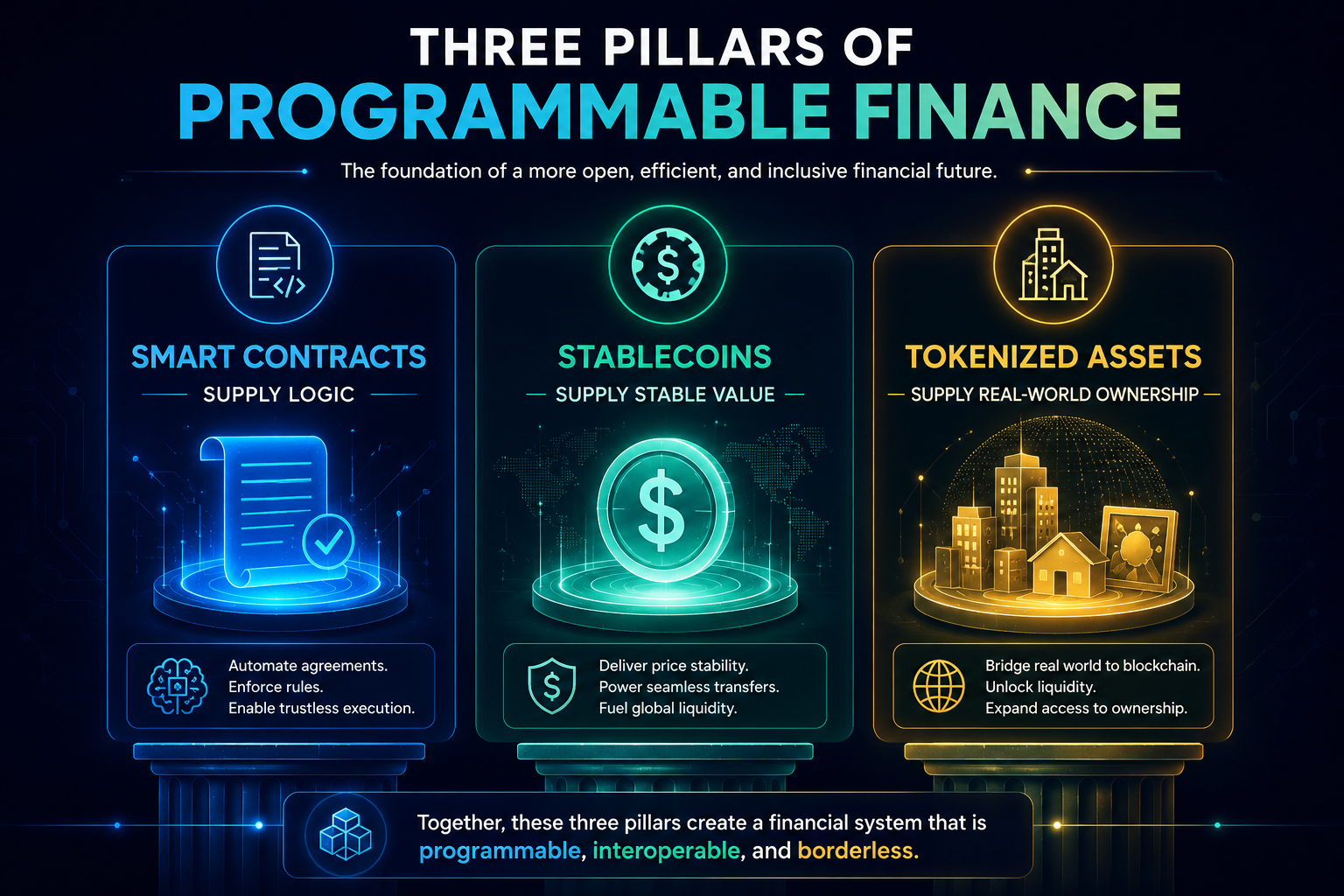
- The idea is facilitated by three main components: smart contracts, which provide the rules; stablecoins, which ensure a stable value; and tokenized assets, which extend these rules to properties, bonds, and funds.
- The potential of this technology is seen in value moving through self-executing code, with DeFi protocols holding over $70 billion mid-2026.
- Stablecoins alone accounted for over $300 billion in circulating value.
Picture a payment that checks the invoice, confirms the goods arrived, and settles itself before your finance team opens a laptop. That is programmable money: value that carries its own rules and executes them without a person approving each step. The idea sounds distant, but the infrastructure behind it already carries real volume. Stablecoin development solutions alone account for more than $300 billion in circulating value (DefiLlama, 2026; CoinDesk, 2026), and a rising share of that value moves through smart contracts rather than traditional bank ledgers. For founders, product leads, and anyone tracking where digital finance is heading, 2026 marks the point where this concept stopped living in research papers and started showing up in payroll systems, treasury desks, and cross-border settlement rails.
This guide breaks the idea into three working parts: smart contracts, which supply the logic; stablecoins, which supply stable, spendable value; and tokenized assets, which extend that logic to property, bonds, and funds. By the end, you will know what each piece does, how the pieces connect, and why the timing matters now.
Programmable Money: A Definition Beginners Can Use
Start with the plainest version of the definition. Money becomes programmable when the rules that govern it live inside the payment itself instead of inside a separate back-office process. A traditional wire transfer moves value and waits for a person, a batch job, or a compliance officer to decide what happens next. A programmable transfer carries the decision logic with it: release funds only when a delivery is confirmed, split a payment automatically across three vendors, or refund a buyer the moment a contract condition fails.
The Bank for International Settlements frames this shift as a move toward programmable platforms that combine messaging, reconciliation, and asset transfer into one operation instead of three separate systems (BIS Annual Economic Report, 2025). That combination is what separates this approach from only digitizing a bank account. The account was already digital. What changes is the underlying rail: distributed ledger technology that the money itself can read and act on.
Three technologies carry this idea into production. Smart contracts supply self-executing code, stablecoins supply a stable unit of value for that code to move, and tokenized assets extend the same rules to shares, bonds, and property. None of the three functions alone. A crypto-friendly banking solution built on this stack lets a bank or fintech offer accounts that behave less like static ledgers and more like configurable financial products, with rules a compliance team can inspect line by line.
How Smart Contracts Turn Money Into Code
A smart contract is a program stored on a blockchain solution that runs exactly as written, without an operator who can quietly change the outcome after the fact. Set a rule once, such as “release 40 percent of this invoice on delivery confirmation and the remaining 60 percent after a 30-day inspection window,” and the contract enforces it every time, for every transaction, without a finance team re-entering the terms.
This is not a small niche. Value moving through this kind of self-executing code now measures in the tens of billions of dollars: DeFi protocols were holding over $70 billion in value as of mid-2026, even after a sharp pullback earlier in the year (DefiLlama, 2026; Yahoo Finance, 2026). That scale matters because it shows the logic layer has matured enough for regulated institutions to build on, not only for retail trading.
For a bank or payment company, the practical entry point is rarely writing contracts from scratch. Enterprises without an internal blockchain team typically source smart contract development services from a specialized partner instead of building one from the ground up. Most build on audited, reusable templates through a BaaS development partner, then customize the business rules: settlement timing, fee splits, refund conditions, and compliance checks. The contract becomes the enforcement mechanism, and the institution keeps control over the policy it encodes. A contract can only be as good as the rule it was given, so testing and independent audit trails matter as much as the underlying chain choice.
Named blockchains carry different trade-offs worth knowing early: Ethereum remains the most audited environment for complex financial logic, while chains such as Solana and Tron optimize for settlement speed, confirming transactions in under two seconds. Choosing between them depends on whether your priority is contract flexibility or transaction throughput.
Talk to our treasury infrastructure team about a pilot corridor!
Stablecoins and Tokenized Assets: The Two Engines Behind the Model
Stablecoins solve a problem that pure cryptocurrency never did: predictable value. A token pegged to a currency lets a business price goods, pay staff, and settle invoices without tracking hourly price swings. For a payment team evaluating stablecoin payment integration, that predictability matters: real economic stablecoin payment volume, separate from trading activity, reached $390 billion in 2025 (McKinsey, 2026; Artemis Analytics, 2025), with more than half of that volume flowing through business-to-business corridors that traditionally relied on correspondent banking.
The traditional alternative remains expensive by comparison. The World Bank’s Remittance Prices Worldwide database puts the global average remittance cost at 6.36 percent of the amount sent, with several corridors charging far more (World Bank Remittance Prices Worldwide, September 2025). A programmable, stablecoin-based rail does not remove cost entirely, but it cuts several manual handoffs that each add fees and delay along a cross-border payment corridor.
Tokenized assets apply the same logic to ownership rather than currency. A bond, a fund share, or a slice of property gets represented on a shared ledger, with transfer rules, compliance checks, and dividend payments written into the token itself. On-chain tokenized assets, excluding stablecoins, held between $31 billion and $32 billion in value in mid-2026 (rwa.xyz, 2026; Cryptonomist, 2026), led by tokenized government debt. For a team building a stablecoin remittance platform or scoping tokenized asset platform development, the appeal is consistent: settlement that used to take days can clear in minutes, with the audit trail built into the transaction record itself.
What to Look for in Programmable Money Rails?
Whether you are scoping crypto neo banking solution development internally or evaluating a build partner, weigh a platform against these five factors before committing engineering budget or a board decision:
- Regulatory alignment: Confirm the platform maps to the licensing regime relevant to your market, such as VARA, the FCA, or ASIC, rather than treating compliance as an afterthought bolted on later.
- Audited smart contract templates: Request independent audit reports on the contract logic itself, not only on the underlying blockchain network.
- Multi-asset support: The platform should handle stablecoins, tokenized securities, and fiat rails within one settlement layer, so your team is not stitching together three separate vendors.
- Custody and key management: Favor an MPC crypto wallet approach over a single private key controlled by one employee, since distributed key shares remove a single point of failure.
- Integration timeline: Ask for a realistic connection timeline, complete with API documentation, sandbox access, and a named integration engineer, rather than a marketing promise with no delivery date.
A white label crypto bank or banking-as-a-service partner that scores well on all five criteria will save your team months of internal debate about build-versus-buy.
The Next Phase for Programmable Finance
Programmable money is no longer a forecast. It is a settlement layer already carrying hundreds of billions of dollars across payments, remittances, and tokenized assets, and each year adds more regulated institutions to that base. The founders and product leads who benefit most will be the ones who treat smart contracts, stablecoins, and tokenized assets as one connected system rather than three separate trends. Antier works with banks, fintechs, and enterprises building this stack, turning the concepts in this guide into deployable crypto banking infrastructure. Explore the crypto banking solution built for this shift.
Frequently Asked Questions
01. What is programmable money?
Programmable money is a form of currency where the rules governing transactions are embedded within the payment itself, allowing it to execute actions automatically without human intervention, such as confirming deliveries or splitting payments.
02. What are the key components of programmable money?
The key components of programmable money are smart contracts, which provide the logic for transactions; stablecoins, which offer a stable unit of value; and tokenized assets, which apply these rules to various forms of property, bonds, and funds.
03. How does programmable money differ from traditional banking systems?
Unlike traditional banking systems that rely on separate processes for messaging, reconciliation, and asset transfer, programmable money integrates these functions into a single operation using distributed ledger technology, enabling more efficient and automated transactions.