



✨ AI Summary
- Seventeen global banks are preparing to launch live transactions on a shared blockchain ledger, signalling a significant shift in banking operations.
- The pilot project, which involves the movement of tokenized deposits across international borders, will allow transactions to be conducted at any time, including weekends and off-peak hours.
- This marks a revolutionary departure from traditional banking systems, where funds often sit idle due to restricted operating hours.
- The pilot poses a significant challenge to regional and mid-tier banks, as the large global banks that are part of the first wave of this shift gain a competitive edge.
- These banks, it is anticipated, will need to understand and adapt to this new technology quickly to remain competitive.
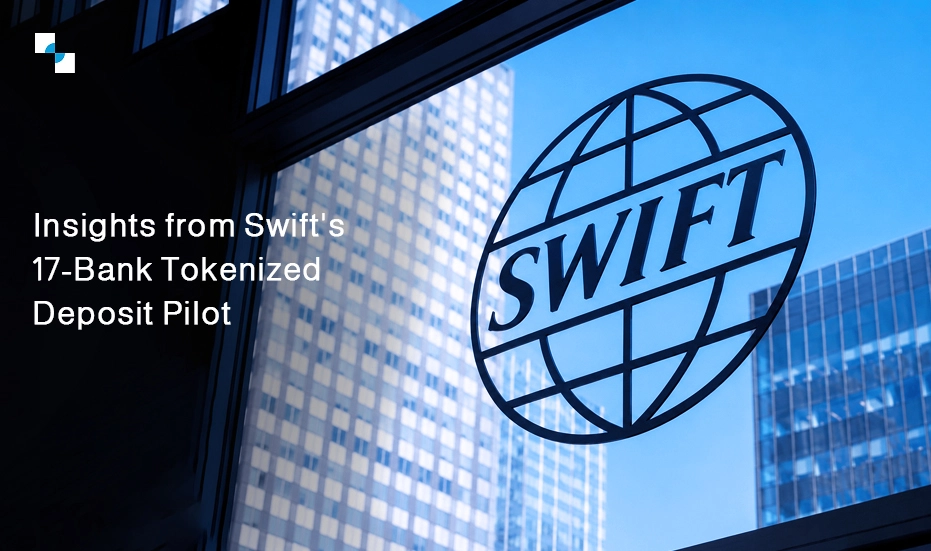
Seventeen banks across six continents are preparing to run live transactions on a shared blockchain ledger designed to move tokenized deposits across borders at any hour, including weekends and periods when domestic settlement windows are closed. This is not a concept paper or a sandbox exercise. It is an operational pilot, built around a problem that has quietly shaped correspondent banking for decades: client funds that sit idle simply because the surrounding infrastructure only operates within fixed business hours.
For decision-makers at mid-tier banks, the more pressing question is not how the technology works. It is what happens to institutions that were not part of the first wave. Correspondent networks concentrated among a small group of global banks have long determined how quickly a regional institution can move money internationally, and how much liquidity it must hold in reserve to cover the gaps between settlement cycles. When the largest players in that network gain coordinated, always on settlement capability first, the distance between them and everyone else rarely stays fixed. It tends to widen.
This is the practical concern now facing treasury and technology leaders at regional and mid-sized banks: what does readiness for this shift actually require, and where should a bank begin. Understanding the value of dependable, tokenized deposit infrastructure for banks is the starting point and delaying that understanding carries a cost of its own.
Why Swift’s Tokenized Deposit Pilot Is a Turning Point for Global Banking
The pilot matters because it marks the first time a globally trusted financial messaging cooperative has moved a shared ledger for tokenized deposits from design into active use, rather than confining the work to an internal lab. That distinction changes the nature of the conversation industry wide.
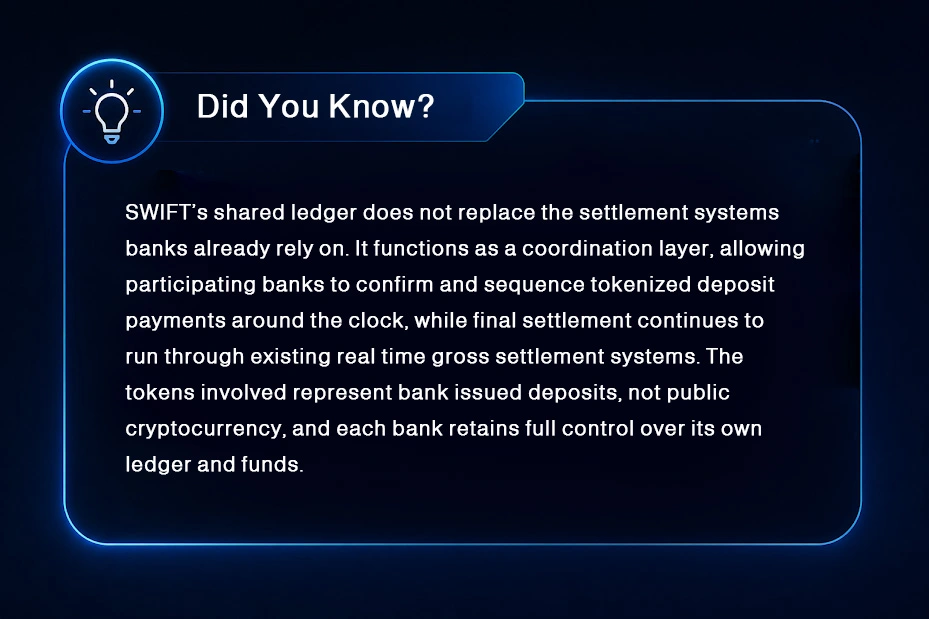
Under the pilot, participating banks issue tokenized representations of commercial deposits on their own systems. The shared ledger then validates and sequences the resulting payment commitments between institutions, confirming that funds are genuinely available before an instruction is executed. Final settlement still runs through the correspondent banking and real-time gross settlement infrastructure banks already operate. Payment execution and final settlement are treated as two distinct stages, connected rather than merged, which is precisely the architecture a well-planned Swift tokenized deposit solution development effort is meant to support.
Until now, most blockchain experiments in banking were isolated efforts run by individual institutions testing distributed ledger concepts on their own terms. What changes here is coordination at industry scale, built on infrastructure that thousands of banks already trust for daily messaging. That shifts the internal question mid-tier banks face from whether to trust shared ledger technology to how quickly their own systems can connect to it. Banks that have already invested in dependable groundwork with a capable blockchain banking development company are positioned to move from observation to participation far sooner than those starting from zero.
Why Mid-Tier Banks Need Tokenized Deposit Infrastructure for Banks
Mid-tier banks need dependable, tokenized settlement infrastructure because the operational gaps in legacy rails fall hardest on institutions without deep correspondent networks of their own, and because client expectations around speed and visibility are shifting faster than internal systems can keep pace. The three pressures below are not separate problems. They compound each other, and together they explain why the case for acting now is stronger than it may first appear.
Operational challenges with legacy payment rails
Traditional cross-border payment processing was built around fixed operating hours, batch cut-off times, and a chain of correspondent relationships that each add their own delay. A mid-tier bank without an extensive network of direct relationships often depends on intermediaries for reach, and every additional link in that chain introduces friction: manual reconciliation, holding periods, and liquidity trapped in nostro accounts simply to cover timing mismatches between when a payment is instructed and when it finally clears. None of this reflects a failure of effort. It reflects infrastructure designed for a slower era of commerce.
Closing that gap is exactly the goal behind serious, tokenized money infrastructure development, which aims to give banks continuous visibility and control over fund movement rather than periodic snapshots. The practical impact shows up in several recurring pain points that treasury and operations teams at mid-tier banks raise consistently:
- Batch cut-off times that restrict same-day payment windows to a narrow band of hours in each local market, regardless of when a client actually needs funds to move.
- A chain of correspondent relationships in which each intermediary adds its own processing time, fee structure, and point of potential failure.
- Capital held idle in nostro and vostro accounts purely as a buffer against timing mismatches between instruction and final clearing.
- Manual reconciliation across time zones that slows exception handling and adds operational cost that scales poorly as transaction volumes grow.
Growing demand for programmable bank money
Corporate treasury clients now manage their own operations with real-time dashboards and expect similar visibility from their banking partners. They are asking for payments that can carry conditions, release automatically once agreed criteria are met, and settle without waiting for a business day to begin. Meeting that expectation requires deposits that can be represented digitally and moved under programmable rules, not simply faster versions of the same manual process. This shift is already visible in the kinds of requests treasury teams are bringing to their banking partners, including:
- Conditional payments that release automatically once agreed trade or delivery milestones have been confirmed.
- Automated treasury sweeps that reposition balances between accounts without manual intervention at the end of each day.
- Real-time intercompany settlement for corporate groups operating across multiple currencies and jurisdictions.
- Dynamic liquidity pooling that lets a treasury function reallocate funds across subsidiaries within minutes rather than days.
The role of Bank tokenization solutions in improving liquidity and settlement
Bank tokenization solutions address this directly by giving institutions a clearer, continuous view of available liquidity and reducing the amount of capital that must sit idle purely as a buffer against settlement timing. Funds can be committed, confirmed, and released with far less dependence on end-of-day batch cycles, which improves both cash flow visibility for clients and capital efficiency for the bank itself. The measurable gains tend to fall into four areas:
- Continuous, real-time visibility into available balances in place of static end-of-day reporting.
- Lower dependence on pre-funded liquidity buffers held solely to cover settlement timing risk.
- Faster confirmation that counterparty funds are genuinely available before an instruction is released.
- More accurate, forward-looking cash flow forecasting for corporate treasury clients.
Building a Future-Ready Banking Ecosystem with Digital Asset Banking Platform Development
A future-ready banking ecosystem depends on digital asset banking platform development that treats tokenized deposits as a core capability integrated with existing systems, not a separate experiment running alongside them.
Core capabilities required
A dependable platform needs custody-grade key management, ledger interoperability across the standards different counterparties use, and direct integration with the core banking systems a bank already runs, since tokenization that sits outside daily operations delivers little beyond a proof of concept. It also needs the same resilience a bank already expects from its core payment systems, including disaster recovery discipline and the capacity to support multiple currencies and asset classes on a single stack rather than fragmenting into separate environments for each one.
For most mid-tier banks, the more efficient route is not building every one of these layers from scratch but working with a partner already experienced in digital asset banking platform development, since replicating custody-grade key management and multi-ledger interoperability in-house often takes years longer than institutions initially budget for.
Compliance, interoperability, and smart contracts
Regulatory alignment cannot be treated as an afterthought. Smart contract logic governing settlement conditions must be auditable and must encode existing anti-money laundering and know-your-customer checks rather than bypass them, while the platform respects the data residency and privacy requirements of every jurisdiction a bank serves.
Interoperability matters just as much: a platform that only works within one bank’s own ecosystem provides limited value once cross-border coordination, of the kind Swift’s pilot is testing, becomes the industry standard, which is why the strongest programs treat compliance as central to their Bank tokenization solutions from day one rather than a review step added once development is already complete.
Selecting the right blockchain banking development company
Choosing a blockchain banking development company for this work means looking past general blockchain familiarity toward genuine banking domain expertise: experience with core banking integration, a track record of independent security audits, and the ability to support multi-chain environments as standards continue to evolve.
It also means examining how a prospective partner has handled previous deployments for regulated clients and whether it remained involved after go-live, since a vendor with a strong initial demonstration but limited post-launch support tends to leave a bank managing complex infrastructure with far less internal expertise than the engagement should have built.
Transform Cross-Border Payments with Tokenized Deposits
Work with an experienced tokenized banking solution provider to implement secure, interoperable, and regulation-ready tokenized payment infrastructure.
Choosing a Tokenized Deposit Development Company to Accelerate Adoption
Selecting the right technology partner determines how quickly a mid-tier bank can move from studying the Swift pilot to participating in the next phase of tokenized settlement.
Key evaluation criteria
A capable, tokenized deposit development company should be evaluated on its delivery history with regulated financial institutions, its ability to integrate tokenized deposit rails into legacy core banking without disrupting existing operations, and the strength of its security posture, including how it handles key management and smart contract auditing. Beyond the technical checklist, it is worth asking for references from institutions of comparable size, weighing total cost of ownership across ongoing maintenance and regulatory updates, and assessing how the partner approaches knowledge transfer, since a bank that depends entirely on an external team for every future change has simply replaced one operational bottleneck with another.
End-to-end implementation roadmap
A sound roadmap typically begins with a discovery phase mapping existing payment flows and compliance obligations, followed by a controlled sandbox pilot, then phased connection to shared infrastructure such as the network now being tested through Swift tokenized deposit solution development, with a parallel run period built in so operations teams can compare results before fully relying on the new capability. A roadmap built this way also plans for how the bank will extend the capability once initial corridors are live, treating new currencies, additional treasury clients, or further shared ledger connections as incremental extensions of the same architecture rather than separate projects requiring their own discovery phase from scratch.
Benefits of partnering with an experienced Tokenized banking solution provider
Working with an established tokenized banking solution provider shortens the distance between strategy and live capability, bringing pre-built compliance frameworks, prior integration patterns with core banking systems, and ongoing support as regulatory expectations continue to evolve across regions. The clearest benefit shows up in time to market and in longevity: a bank building this capability entirely in-house typically spends significant time re-learning lessons the market has already worked through, while a partner that has supported clients across multiple regulatory cycles is better positioned to help a mid-tier bank adapt as requirements shift over a multi-year relationship.
A few technology partners have worked across both blockchain architecture and the compliance realities of regulated banking. Our tokenized deposit development company holds expertise in this space coming from hands-on delivery, not theory: building tokenization infrastructure for financial institutions across multiple regulatory regions and doing it in a way that holds up to the same scrutiny a bank applies to its core payment systems.