




✨ AI Summary
- Major crypto exchanges such as Bybit, Coinbase, Binance, and Interactive Brokers are now enabling AI trading agents to operate within their systems, leveraging the Model Context Protocol (MCP) to ensure secure, autonomous trading.
- These AI agents, fueled by Large Language Models (LLMs), are capable of reasoning through complex market data, reading news sentiment, and creating their own trading strategies without human intervention.
- Consequently, crypto exchanges have had to update their security infrastructure to accommodate this level of autonomy.
- Advances include AI subaccounts and agent-access layers, allowing AI bots to trade safely and independently.
- This trend is projected to grow, with the agentic AI market predicted to reach $139.19B by 2034, suggesting a shift in the way crypto trading is conducted.
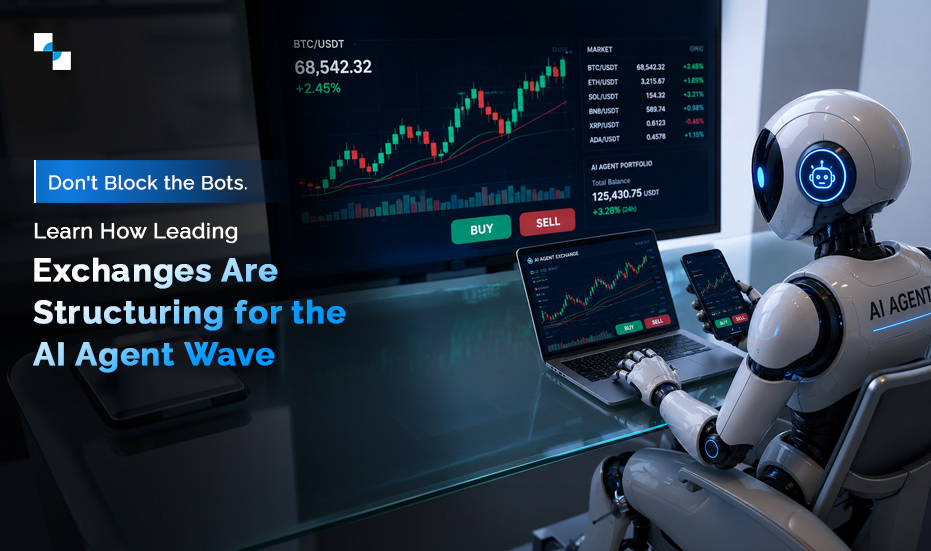
Leading crypto exchange software is not blocking AI trading agents, instead building dedicated, walled infrastructure to let agents trade safely. As of June 2026, Bybit, Coinbase, Binance, and Interactive Brokers have all shipped agent-access layers built on the Model Context Protocol (MCP), with segregated accounts, API-only permissions, and user-set risk caps.
The grace window has been closed. No crypto exchange software can now ponder whether they should allow agents into their trading infrastructure. They need to figure out how they can expose trading infrastructure to agents without surrendering custody, compliance, or control ASAP.
Unlike traditional algorithmic trading bots, which simply execute rigid, hard-coded “if-then” rules, agentic trading relies on autonomous AI agents driven by Large Language Models (LLMs). These agents can execute the following without human intervention:
- Reason through complex market data
- Read news sentiment
- Formulate their own trading strategies
- Execute end-to-end workflows in natural language
Since these machines operate with a level of autonomy that traditional APIs were never built to handle, crypto exchanges have had to radically overhaul their security architecture to accommodate them.
How Crypto Exchanges Adapted To Agentic Trading in 2026
On 24 June 2026, Bybit launched a new category of accounts known as AI subaccounts, targeting developers and traders across the MENA region. They represent a walled-off space where AI trading bots operate through an API-only layer, completely isolated from clients’ main funds, with user-set leverage, allocation, and withdrawal caps.
The leading crypto exchange software wasn’t early, but it was joining the wave that already swept the industry in the first half of 2026.
- Coinbase for Agents, launched on 11 June, lets ChatGPT and Claude connect to a user’s Coinbase account. This enables users to trade crypto spot and derivatives in natural language, inside isolated portfolios, with payments handled by its x402 machine-to-machine protocol.
Coinbase explicitly said that AI agents will become “a primary interface for people’s financial activity.”
- Binance expanded its AI Agent Skills Hub to 13 skills spanning
- COIN-M Futures
- Algorithmic Execution (TWAP, POV)
- P2P
- Convert
- On-chain Pay
- Simple Earn and VIP Loan
It introduces a single interface that lets an agent run research-to-settlement workflows end to end.
- OKX OnchainOS transformed its developer platform into an autonomous-agent layer supporting 60+ blockchains and 500+ DEXs. The infrastructure handles 1.2 billion daily API calls and $300M in daily volume at sub-100ms latency and 99.9% uptime.
- Brokerages like Interactive Brokers, etc., are also routing every agent order into a human-approval tab from June 1. Robinhood has also enabled machine-to-machine payments and automated equity trading. On the other hand, eToro has also launched a funded agent sub-account from $200. ThinkMarkets, WeBull, Deriv, and IG Group have also deployed similar agentic connections, most of which are utilizing the same open MCP connections.
The table below breaks down exactly how these major crypto exchanges and traditional brokerages have structured their frameworks to manage risk while enabling machine-to-machine execution:
| Institution | Type | Framework / Protocol | Core Security & Risk Controls |
|---|---|---|---|
| Bybit | Crypto Exchange Software | Model Context Protocol (MCP) | AI Subaccounts: Completely ring-fenced, walled-off environments isolated from main funds with strict API-only permissions and user-set caps on leverage, asset allocation, and withdrawals. |
| Coinbase | Crypto Exchange Software | Model Context Protocol (MCP) | Coinbase for Agents: Dedicated MCP server allowing AI agents to trade spot and derivatives via isolated portfolios, keeping main account funds completely invisible to the agent. |
| Binance | Crypto Exchange Software | Model Context Protocol (MCP) / AI Skills Hub | Officially open the MCP infrastructure on BNB Chain with native compliance layers and expanded AI Agent Skills Hub for structured, audit-friendly tool access. |
| Interactive Brokers | Institutional Brokerage | Model Context Protocol (MCP) | Human-in-the-loop: Agents can safely connect to portfolios to draft trading instructions, but a human must manually review and authorize every order before execution. |
| ThinkMarkets | Retail/Institutional Brokerage | Model Context Protocol (MCP) | ChelseaAI: Connects LLMs directly to the trading platform using “Scopes.” Enforces a strict boundary where agents can execute trades but have zero permission to transfer or withdraw funds. |
| Robinhood | Retail Brokerage | Native Agentic Layer | Agent-access layer enabling AI agents to execute machine-to-machine payments and trade equities directly via isolated portfolio parameters. |
| IG Group (AU) | Retail Brokerage | Model Context Protocol (MCP) | Read-Only Server: Standardized portfolio metrics and market data access for LLMs (like ChatGPT and Claude) without execution rights in the initial rollout phase. |
| eToro | Retail Brokerage | Agent Portfolios | Dedicated environment explicitly built to let retail users securely map and bind their custom external AI agents to live, sandboxed trading balances. |
According to an FM Intelligence study, at least ten retail brokers and platform vendors wired AI agents into live client accounts in H1 2026, and Anthropic’s Claude was named in nine of the ten launches.
The common rail for those deploying AI in crypto exchange development is the MCP, which is the open standard Anthropic released in late 2024. Instead of building custom integrations for every different AI model, the crypto exchange software platform exposes its trading API just once through an MCP server. This allows the exchange to safely interface with whichever LLM (like Claude or GPT) the client chooses to run on their side.
Why AI Agents Are Becoming the New Front-End for Crypto Trading?
The strategic argument articulated by Spotware (cTrader), CEOLLia Larovitcyn, was very blunt:
“The AI agent will become the primary distribution layer and the main point of interaction between traders and the market.”
Being a crypto exchange SME, my POV says that the feature-rich crypto exchange software and equity trading apps won’t disappear. Their role evolves into an execution and data layer with AI sitting on the top, handling the interactions with the trader. So, if you’re a crypto exchange founder, a fintech or a traditional brokerage planning to launch your crypto exchange software, you must build for humans, as well as machines/AI agents.
An exchange that cannot be reached by an agent is an exchange that is invisible at the new point of demand.
The following industry data already points towards the new trajectory that crypto exchange software industry must not overlook:
- Chainalysis reported that x402 agentic transactions on Base surpassed 100 million in cumulative volume in about 9 months after launch. Source: Chainalysis
- The agentic AI market, valued at $7.29B in 2025, is projected to reach $139.19B by 2034 at a 40.50% CAGR. Source: GII Research
- BNB Chain stated that on-chain AI agents grew from fewer than 400 in January 2026 to more than 150,000 by April 20, 2026. Source: BNB Chain
- Nansen, a blockchain analytics firm, predicts that AI agents will become the default vehicle for crypto investment by 2028.
The takeaway for existing crypto exchange operators and anyone who is planning crypto exchange development is that they can’t miss agent-driven flow. It is also an opportunity for them if they can innovate an ultra-secure crypto exchange software for humans and AI agents.
Balancing Autonomy and Control: The 4-Tier Agent Permission Stack For Crypto Exchanges
You might have clarity on what you want to automate when you build AI agents for your crypto exchange software. But here’s something you should consider: The exchanges winning the AI transition are not the ones that said “yes” fastest but the ones that designed where the agent should be allowed.
| Permission level | What the agent can do | Example | Trade-off |
|---|---|---|---|
| Read-only | Access market data, balances, and analytics but cannot execute | IG Group’s MCP integration | Lowest risk; preserves suitability & best-execution obligations |
| Walled execution (sub-account) | Place orders inside a segregated account; no access to main funds, deposits or withdrawals | Bybit AI Subaccount, eToro, Robinhood, ThinkMarkets | Captures agent flow while ring-fencing custody |
| Confirmation-gated execution | Place orders, but each requires a human thumbs-up by default | Interactive Brokers (review tab), cTrader | Balances autonomy and control; defensible to regulators |
| Full autonomous execution | Trade continuously within user-set caps | Coinbase main-account mode, OKX OnchainOS | Highest engagement; highest governance burden |
The single most-copied design pattern is the walled sub-account. This creates an agent that can trade but can never touch deposits or withdrawals, access runs through an API-only layer. The user keeps real-time read-only oversight plus hard caps on leverage, allocation, and withdrawals. Bybit, ThinkMarkets, eToro and Robinhood all drew the same line. Therefore, it is becoming the de facto standard for agent risk control on a crypto exchange software.
The Agent Attack Surface: 3 Core Risks and Their Mitigations
Opening crypto exchange infrastructure to autonomous AI agents introduces a new attack and failure surface that exchange architects must design against. The three core attack surfaces that arise with agentic trading integration in crypto exchanges are
- Tool poisoning: A malicious or manipulated tool definition may trick the agent into harmful actions.
- Unbounded retrieval and infinite loops: In such cases, an AI agent misreads a prompt and may retry a disastrous trade repeatedly.
- Hallucinated execution: In this scenario, the LLM model confidently invents a market fact that exists only in its own logic and acts on it.
The following mitigations should be built into address these challenges that come while building Agentic AI trading tools for crypto exchange software:
- Trade confirmation enabled by default
- Demo/sandbox stress-testing before live capital
- Hard leverage/allocation/withdrawal caps
- API-only segregation from custody
- Continuous read-only monitoring
The agent gets the capability, and never custody.
Regulatory Compliance Matrix for AI Agent Order Flow
Regulators have made clear that “the algorithm did it” is not a defense. The EU’s MiCA has laid out clear guidelines for launching AI agents operating on its platform. It mandates that crypto exchange software exposing execution to AI agents inherits the obligations for every agent-placed order.
The rest of the rules across the globe are consistent for crypto exchanges. They must ensure that their crypto exchange software development company delivers:
- Best execution
- Auditability
- Record-keeping
- Conflict management for machine-placed order
For achieving this, the agentic AI layer in the crypto exchange needs an immutable decision log, real-time sanctions/travel-rule screening, etc., before any transfer completes.
Build Agent-Ready Crypto Exchange Software With Antier
What does an AI Agent-Ready Exchange Actually Need?
For crypto exchange software operators evaluating the build, the agent-ready stack has six components:
- An MCP server that exposes market data, account data, and order-entry as structured, permissioned tools. It should be model-agnostic, so clients can easily plug in Claude, ChatGPT, or a custom bot.
- Segregated AI sub-accounts with API-only access, isolated from main custody, deposits, and withdrawals.
- A read-only, confirmation-gated, or capped autonomous granular permission engine set per user and per agent.
- Hard risk controls for leverage, max allocation, withdrawal limits, kill-switches, and demo-mode stress testing.
- A permanent record-keeping system that logs every move the AI makes, instantly blocks illegal or sanctioned transactions, proves the AI got the best market prices, and saves all this data for 5 years.
- An agentic payments rail (x402-style) for machine-to-machine settlement of data, research, and computation.
How Antier Builds Crypto Exchanges For Humans and AI Agents
Antier builds agent-ready crypto exchange and DeFi infrastructure for startup exchange builders, regulated forex and stock venues, adding crypto, liquidity providers, fintechs, and government-backed digital-asset platforms. Our work includes, but is not limited to, building:
- MCP server development on top of CEX-grade matching engines
- Segregated AI sub-account architecture
- Granular permission and risk-control engines
- Compliance-ready audit and reporting layers mapped to VARA, MiCA, FCA, FINRA, and AUSTRAC
For a credible in-house build, a team of 15-20 exchange engineers runs at $1.8M-$2.5M/year. Antier delivers production-grade, agent-ready crypto exchange infrastructure in 3-6 months at 50% of that cost. Our clients trust us because we have built this category and not something adjacent to it.
If you are still deciding whether to block agents or build for them, the market has already answered. The crypto exchanges capturing the next wave of order flow are the ones building the walls and the doors for AI. Talk to Antier’s crypto exchange engineering team today to start building agentic trading on crypto exchanges.