Agentic wallet development for autonomous, auditable AI commerce
Antier designs and builds agentic wallet infrastructure that gives autonomous agents the ability to pay, get paid, and settle value, inside policy limits your compliance team actually controls.
- Autonomous transaction
- MPC & AA key architecture
- Enterprise-defined guardrails
- x402, AP2, ERC-8004

Antier’s agentic wallets unpacked
An agentic wallet is a programmable custody layer that authenticates, authorizes, and executes financial transactions initiated by an AI agent, rather than a human operator, enforcing spend policy at the protocol level instead of relying on manual review. Autonomous payments are expected to become one of the earliest large-scale applications of agentic wallets. At Antier, we help enterprises design and develop agentic wallet solutions that combine AI orchestration, wallet infrastructure, payment rails, and policy-driven controls into a production-ready ecosystem. Organizations are leveraging these systems to power:
The opportunity extends beyond efficiency. It creates entirely new operational models where financial actions occur continuously rather than through manual approval cycles.
Why enterprises are investing in agentic wallet infrastructure now
A well-architected agentic wallet solution turns autonomous agent activity from a liability into a controlled operational advantage. Several market forces are converging simultaneously.
Are you ready to scope your agent payment architecture?
Core capabilities of our 100% enterprise-grade agentic wallet platform
Enterprise buyers typically assess security, scalability, governance, and integration readiness before selecting an agentic wallet solution. An enterprise-grade agentic wallet SDK gives engineering teams the primitives to embed autonomous payment capability into any agent framework without re-architecting the underlying custody model.
These capabilities form the foundation of an enterprise-ready agentic wallet.
Our holistic agentic wallet development framework
Our holistic agentic wallet development framework
- Business model assessment
- AI execution requirements
- Financial workflow mapping
- Wallet architecture
- Agent orchestration
- Payment integrations
- Governance framework
- Wallet infrastructure
- Agent orchestration
- Payment integrations
- Stablecoin rails
- Policy engine deployment
- AML integrations
- Risk management
- Testing
- Monitoring
- Observability
- Operational readiness
See the architecture applied to your agent workflows
Bring your current agent stack. Antier’s architects will walk through where policy enforcement, identity, and settlement fit for your specific use case.
How agentic wallet infrastructure works?
Agentic wallet infrastructure separates three functions that a human wallet collapses into one: identity, authorization, and signing, each enforced independently before a transaction settles. The typical transaction flow:


This architecture is what allows an enterprise to grant an agent genuine autonomy, no human in the transaction loop, while keeping every action explainable after the fact.
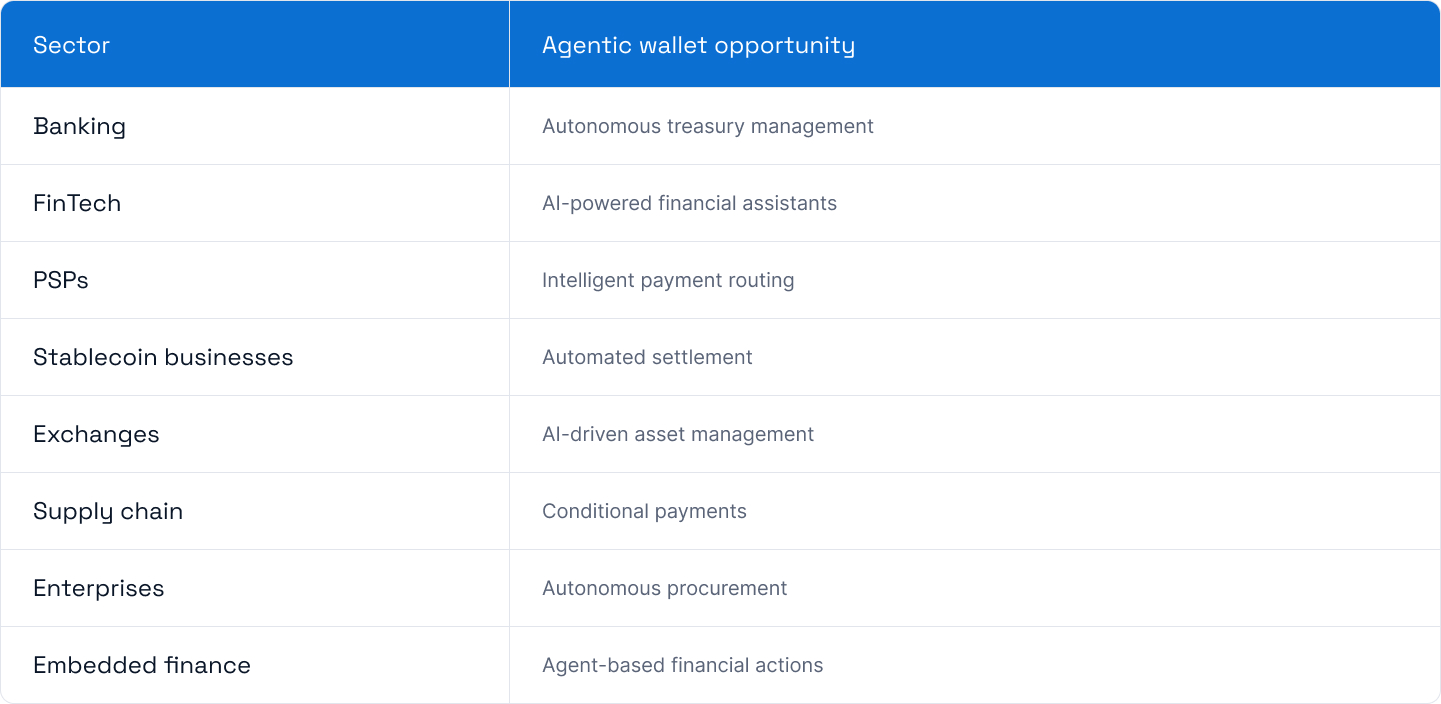
Agentic wallet platform enterprise emerging use cases
Antier’s white label agentic wallet customization packages

- Branding & UI/UX customization
- Multi-chain wallet support
- Stablecoin integration
- Basic agent configuration
- Autonomous payment workflows
- User & role management
- Compliance workflow setup
- Analytics dashboard
- API integrations
- Cloud deployment

- Everything in Launch ready
- Custom agent roles & permissions
- Agent-to-agent payment logic
- Treasury automation rules
- Cross-chain asset operations
- Policy-based transaction controls
- Approval & escalation workflows
- Advanced risk monitoring
- Third-party system integrations
- Enhanced analytics & reporting

- Everything in Growth ready
- Custom AI agent orchestration
- Proprietary decision engines
- Multi-agent coordination frameworks
- Enterprise governance infrastructure
- Institutional custody architecture
- Autonomous treasury management
- Custom compliance automation
- Industry-specific business logic
- Private & hybrid blockchain deployments
- Bespoke API & infrastructure integrations
- Dedicated architecture & scalability enhancements
Compliance essentials for agentic wallet development
Agentic wallet development introduces a compliance question regulators have not fully codified yet: who is accountable when an autonomous agent executes a transaction, the enterprise, the agent developer, or the platform operator?
Compliance can’t be retrofitted onto agent autonomy
Antier builds compliance and security controls into the wallet architecture from day one, not as a module added after a regulator asks.
Technology stack behind an agentic wallet solution
The technology choices an agentic wallet development company makes upfront determine whether the resulting platform can scale to enterprise transaction volume and survive a compliance audit. A production-grade stack typically includes:
OpenAI
Claude
LangGraph
AutoGen
CrewAI
MPC Wallets
ERC-4337
Smart Accounts
Fireblocks
Turnkey
Ethereum
Solana
Polygon
Base
Arbitrum
Avalanche
USDC
USDT
Circle APIs
Stablecoin Settlement Rails
Chainalysis
TRM Labs
Elliptic
Sumsub
AWS
Kubernetes
Docker
Kafka
PostgreSQL
HSM
AWS KMS
OAuth 2.0
Verifiable Credentials

Agentic wallet SDK development
“If you don’t want a fully white-label deployment and instead want to build your own products on top of our infrastructure, here’s our SDK.”
Antier’s Agentic Wallet SDK enables enterprises, fintech innovators, payment providers, and Web3 platforms to integrate autonomous wallet capabilities into their products without building complex wallet infrastructure from scratch. Designed for flexibility and scalability, our SDK provides developers with the foundational components required to create AI-native financial experiences, including agent authorization, transaction execution, policy enforcement, payment orchestration, multi-chain asset management, and real-time monitoring. Whether you’re building AI-driven payment applications, autonomous treasury systems, agentic commerce platforms, embedded finance products, or machine-to-machine payment ecosystems, the SDK can be tailored to your architecture and business requirements. With support for smart accounts, account abstraction, stablecoin payment rails, compliance integrations, and custom agent workflows, Antier helps organizations reduce development timelines while maintaining complete control over security, governance, and user experience.
Build vs buy: evaluating an agentic wallet platform approach
Choosing between internal development and external implementation affects cost, speed, risk, and operational readiness.

Evaluate Antier against your current shortlist
Frequently Asked Questions



Start a conversation with Antier
Connect with our consulting and engineering leads to scope your digital transformation from architecture review to production deployment.