




✨ AI Summary
- The blog post discusses the rise of real-world asset (RWA) tokenization, a process that converts physical and financial assets into blockchain-based digital tokens.
- It explains that three factors are driving the growth of this market: the demand from institutional investors for fractional access to previously illiquid assets, clearer regulations for digital securities, and the maturation of blockchain infrastructure.
- The blog provides a comprehensive guide to the top 10 RWA tokenization development companies in 2026, including Antier, Tokeny, and Securitize, emphasizing that the choice of development company is critical for ensuring the platform's survival and scalability.
- The post also outlines the potential benefits of RWA tokenization for businesses, such as new revenue streams, faster capital raising, and increased portfolio diversification.
- Finally, it offers advice on choosing the right RWA tokenization development company, stressing the importance of compliance, asset class experience, and secondary market strategy.
Real-world asset tokenization, the process of converting physical and financial assets into blockchain-based digital tokens, is no longer an experiment reserved for crypto-native firms. It has moved firmly into the enterprise mainstream, and a new class of builders is making that transition possible at scale.
What’s driving this urgency? Three things converge at once: institutional investors demanding fractional access to previously illiquid asset classes like real estate, private credit, and infrastructure; regulators in the EU, UAE, Singapore, and the US beginning to offer clearer frameworks for digital securities; and blockchain infrastructure maturing to a point where enterprise-grade performance is no longer aspirational but achievable. The result is a market that is growing faster than most enterprises are prepared for, and the top 10 RWA tokenization development companies profiled in this guide are the ones setting the pace.
For enterprises evaluating this space, the critical decision isn’t whether to tokenize. It’s who builds it with you. The quality of your RWA tokenization development company determines not just the technology stack but also whether your platform survives regulatory scrutiny, attracts institutional investors, and scales beyond a proof of concept. This guide breaks down what that engineering process looks like in practice and offers a clear-eyed look at the firms leading the space in 2026.
Market Size & Opportunities in Real-world Asset Tokenization Platform Development Space
The global asset tokenization market size was valued at USD 1.8 trillion in 2025 and is projected to grow from USD 2.1 trillion in 2026 to USD 24.5 trillion by 2033, at a CAGR of 42.1% from 2026 to 2033. The market in North America dominated with a revenue share of 38.4% in 2025. The rapid adoption of blockchain and distributed ledger technology is driving the growth of the asset tokenization industry.
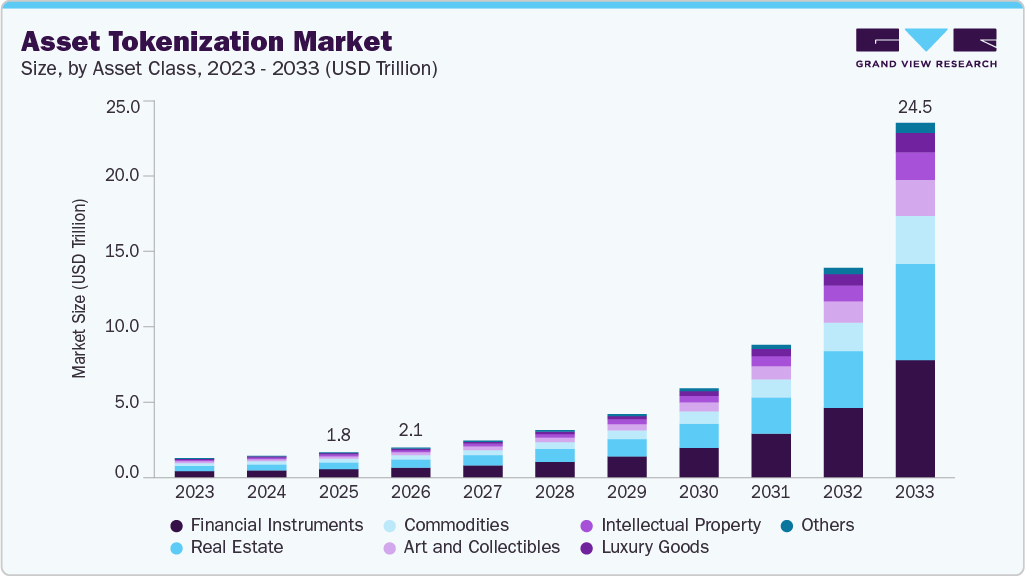
Source: Asset Tokenization Market Size, Share Report, 2026-2033
Enterprises that move early are positioning themselves at the center of a financial shift that touches every major asset class. Partnering with the top 10 RWA tokenization development companies give businesses more than a platform. It opens the door to a range of high-value opportunities that traditional financial infrastructure simply cannot support.
- Fractional ownership models allow enterprises to unlock capital from illiquid assets like real estate, private equity, and infrastructure by offering smaller investment units to a broader investor base.
- Cross-border capital access becomes significantly easier when assets are tokenized, enabling enterprises to attract investors across geographies without the friction of traditional intermediaries.
- New revenue streams emerge through transaction fees, platform licensing, secondary market commissions, and yield distribution management built directly into the tokenization infrastructure.
- Faster capital raising cycles replace the months-long fundraising timelines of traditional private markets with on-chain issuance that can go live in weeks.
- Portfolio diversification for institutional investors becomes more accessible, driving demand for tokenized alternatives across debt, equity, and real asset categories.
- Automated compliance and reporting reduce operational overhead significantly, allowing enterprises to scale their asset offerings without proportional increases in back-office costs.
- Secondary market liquidity transforms historically illiquid holdings into tradable instruments, increasing the attractiveness of the underlying asset to a wider class of investors.
Develop Secure and Scalable RWA Tokenization Solutions with Our Team
Top 10 RWA Tokenization Development Companies in 2026
The market for RWA tokenization development has matured significantly. What was once a fragmented landscape of blockchain consultancies has evolved into a specialized ecosystem where a clear tier of enterprise-grade providers has emerged. These ten companies represent the strongest options for enterprises serious about building compliant, scalable, and institutionally credible tokenization platforms.
1. Antier
Antier stands out as one of the most comprehensive RWA tokenization development companies operating at enterprise scale today. With deep expertise across the full tokenization stack, from legal structuring advisory and smart contract development to white-label RWA tokenization platform delivery and secondary market integration, Antier has built a reputation for turning complex enterprise tokenization mandates into production-ready platforms.
What distinguishes Antier is the breadth of asset classes it has successfully tokenized: real estate, private equity, trade finance, commodities, and infrastructure assets across jurisdictions, including the US, UAE, Europe, and Southeast Asia. With an expert team of 700 subject matter experts and a global clientele, its white-label platform can be customized and deployed under client branding in significantly reduced timeframes compared to fully bespoke builds. The team brings technical rigor, supporting all custom token standards, alongside compliance-first thinking that embeds regulatory mapping into the earliest stages of every engagement. For enterprises that want a single accountable partner from concept to post-launch, Antier is the benchmark.
2. Tokeny
Luxembourg-based Tokeny is the creator of the T-REX protocol (ERC-3643), one of the most widely adopted compliance-aware token standards in the institutional space. It is built specifically for regulated securities and has been deployed by some of Europe’s largest financial institutions, making it a strong fit for organizations prioritizing on-chain identity management and transfer compliance enforcement. Its focus on enterprise blockchain asset tokenization within EU regulatory frameworks gives it a clear edge in that geography.
3. Securitize
Securitize is a SEC-registered transfer agent offering end-to-end issuance and lifecycle management of tokenized securities. Its ATS license enables compliant secondary trading, making it the go-to choice for US-domiciled asset managers who need a regulated pathway from issuance to investor exit. For enterprises building RWA tokenization services specifically for the accredited investor market in the United States, Securitize is among the most credentialed options available.
4. RealT
RealT focuses specifically on real estate tokenization, enabling fractional ownership of residential and commercial properties with compliance guardrails built into the platform. Its model is particularly well-suited for property developers and REITs looking to expand their investor base beyond traditional institutional channels, offering lower entry thresholds without sacrificing the legal rigor that underpins a credible real-world asset tokenization platform. The platform handles the full investor lifecycle from onboarding through distribution.
5. Ondo Finance
Ondo Finance has established itself as a serious player in tokenizing traditional financial products, with a particular focus on Treasury instruments and money market funds made accessible on-chain. Its infrastructure positions it at the intersection of DeFi liquidity and TradFi returns, attracting both protocol-level integrations and institutional demand. For enterprises exploring yield-bearing asset tokenization software solutions, Ondo represents one of the more battle-tested platforms in production today.
6. tZERO
tZERO operates one of the few SEC-regulated Alternative Trading Systems purpose-built for digital securities, giving it a structural advantage that most platforms cannot replicate. Its issuance technology connects directly to secondary market infrastructure, addressing the liquidity problem that undermines many tokenization projects. Enterprises building US-listed offerings that require a regulated and functional exit pathway for investors will find tZERO’s integrated model among the most practical options in the market.
7. Centrifuge
Centrifuge has carved out a distinctive niche in tokenizing real-world credit assets, covering invoice financing, trade receivables, and structured credit pools. Its native integrations with major DeFi protocols give issuers access to on-chain liquidity that traditional platforms cannot match, making it a compelling option for fintech firms and alternative lenders looking to bring their credit books on-chain. The platform’s transparent pool management and real-time reporting are particularly valued by institutional counterparties evaluating RWA tokenization services for credit-based assets.
8. RealToken
RealToken specializes in tokenizing US rental properties, allowing global investors to purchase fractional ownership stakes and receive rental income distributions directly to their wallets. The platform is designed with retail accessibility in mind, abstracting away blockchain complexity for investors who are new to digital assets while maintaining on-chain compliance in the background. For enterprises evaluating consumer-facing real-world asset tokenization platform development, RealToken provides a useful operational reference point.
9. Consensys
Consensys is one of the most recognized names in enterprise blockchain infrastructure, with production-grade Ethereum tooling that gives enterprises a reliable foundation for enterprise blockchain asset tokenization. Its platform suite, including Quorum, supports permissioned tokenization environments built to institutional security and privacy standards. With deep smart contract expertise and established relationships across global banks and financial institutions, ConsenSys is a credible long-term partner for organizations that want full technical control over how their tokenization infrastructure is designed and operated.
10. Taurus
Switzerland’s Taurus is a regulated digital asset infrastructure provider serving major European banks, offering a platform that handles tokenization, custody, and post-trade operations across a range of asset classes. Its bank-grade architecture and strong alignment with Swiss and EU regulatory standards make it a natural fit for enterprises that need institutional-quality infrastructure without building it from scratch. For regulated financial institutions in Europe exploring asset tokenization software solutions, Taurus is one of the most credible options currently in the market.
Core Stages of Enterprise Blockchain Asset Tokenization Process
Building a real-world asset tokenization platform is a fundamentally different exercise than launching a standard Web3 application. It requires the simultaneous resolution of legal complexity, financial compliance, software architecture, and user experience, often across multiple jurisdictions. The best RWA tokenization development companies treat this as an integrated engineering process where each layer informs the others. Here’s what that looks like across its four core stages.
1. Legal & Asset Structuring
Before a single line of code is written, the foundational question must be answered: what exactly is being tokenized, and what legal rights does that token represent?
- Establish the right legal vehicle- SPV, trust, or fund structure, to hold the underlying asset
- Map regulatory requirements by jurisdiction (SEC/Reg D for the US, MiCA for Europe, MAS for Singapore)
- Define KYC/AML logic, investor accreditation rules, and transfer restrictions upfront
- Embed legal counsel into this phase- compliance designed after the build is a liability
2. Smart Contract Architecture
With legal structures defined, the work of encoding those structures on-chain begins.
- Select the right token standard: ERC-1400 or ERC-3643 for regulated securities, not ERC-20
- Build automated distribution logic for dividends, yield, and coupon payments
- Integrate oracles for real-world price feeds, NAV calculations, and asset performance data
- Mandate third-party smart contract audits before any deployment — non-negotiable in asset tokenization software solutions of this complexity
3. Platform & UI/UX Engineering
The investor interface is where compliance and software design intersect with human behavior.
- Build separate but integrated modules: issuer portal, investor dashboard, compliance console, admin controls
- Support both custodial and self-custody wallet options for a broader investor base
- Prioritize white-label RWA tokenization platform customization, clients need to deploy under their own brand
- Abstract blockchain complexity from the end user while maintaining full on-chain auditability in the background
4. Secondary Market Integration
Tokenization without liquidity is just a better filing cabinet.
- Define the secondary market model early: ATS listing, compliant DEX, or internal peer-to-peer transfers
- Enforce compliance-aware trading logic, holding period restrictions, wallet whitelisting, jurisdictional blocks
- Integrate real-time pricing through oracle networks and OTC desk infrastructure where relevant
- Build secondary market strategy from day one, retrofitting liquidity onto a closed platform rarely works
Let’s Build a Future-Ready Tokenization Platform for Your Business
How to Choose the Best Blockchain Development Company for Tokenized Assets?
Choosing an RWA tokenization development company is one of the most consequential decisions an enterprise will make in this space. The right partner doesn’t just write code. They understand the regulatory environment your asset operates in, the investor expectations you need to meet, and the technical architecture that holds everything together over the long term. With a growing number of firms entering the market, the differentiators are not always obvious on the surface. Here is what enterprises should look for before signing an engagement.
- Compliance-first approach: The company should embed legal and regulatory thinking from day one, not treat it as a post-build checkbox.
- Asset class experience: Look for a track record across the specific asset type you are tokenizing, whether real estate, private credit, equity, or commodities.
- Token standard expertise: The team should have hands-on experience with ERC-1400, ERC-3643, and other regulated token standards, not just generic smart contract development.
- White-label platform availability: A configurable white-label base significantly reduces time-to-market without sacrificing compliance or customization.
- Multi-jurisdiction capability: If your investor base spans geographies, the partner must understand cross-border regulatory requirements and how to enforce them on-chain.
- Secondary market strategy: A company that only solves issuance but ignores liquidity is solving half the problem. Ask specifically how they approach post-issuance trading.
- Third-party audit standards: Ensure the company works with recognized smart contract auditors and treats audits as a standard deliverable, not an optional add-on.
- Post-launch support: Regulations evolve, and so will your platform. The right partner stays engaged well beyond the initial deployment.
Making the Right RWA Move!
Building a compliant, scalable, and investor-ready real-world asset tokenization platform demands more than technical capability. It demands a partner that understands the full picture: the legal structures that make a token legally enforceable, the smart contract architecture that keeps compliance on-chain, the platform engineering that earns investor trust, and the secondary market infrastructure that delivers on the liquidity promise. Getting any one of these wrong doesn’t just delay the project. It puts the entire enterprise at risk.
That is where Antier stands apart. With years of dedicated focus on RWA tokenization services across asset classes and jurisdictions, Antier has built a delivery model that takes enterprises from early-stage structuring all the way through to a live, production-ready platform. Its team brings together blockchain engineers, compliance specialists, legal advisors, and UX professionals under one roof, eliminating the coordination overhead that comes with managing multiple vendors across a complex build.
Whether you are a real estate firm looking to fractionalize a portfolio, a fund manager exploring tokenized private equity, a fintech building a credit marketplace, or a financial institution piloting enterprise blockchain asset tokenization, Antier has the depth of experience to meet you where you are and build what you need. Its white-label RWA tokenization platform gives enterprises a faster path to market without compromising on compliance or customization, and its post-launch support ensures the platform evolves as regulations and investor expectations shift.
The enterprises winning in this space are not the ones waiting for perfect conditions. They are the ones moving now with the right partner behind them. If you are serious about tokenizing real-world assets and building a platform that stands up to institutional scrutiny, Antier is the team to call.
Connect with Antier today and take the first step toward building a tokenization platform your investors can trust.
Frequently Asked Questions
01. Which RWA development company offers the best value for startups?
The best RWA development company for startups is one that balances technical expertise, regulatory knowledge, and cost efficiency. Look for a partner with proven tokenization experience, flexible engagement models, and the ability to scale your platform as your business grows rather than simply choosing the lowest-priced option.
02. What should I ask an RWA tokenization development company before hiring them?
Ask about their experience with tokenizing your specific asset class, compliance capabilities, blockchain expertise, security practices, and post-launch support. It's also worth reviewing their previous implementations, development approach, and how they handle future upgrades and integrations.
03. Create a checklist for evaluating an RWA development partner.
Evaluate whether the company has relevant tokenization case studies, expertise in regulatory compliance, smart contract development, security audits, blockchain integrations, and long-term maintenance services. Also consider client testimonials, communication transparency, delivery timelines, and the ability to support institutional-scale deployments.
04. What technical capabilities should an RWA tokenization company have?
A reliable RWA tokenization company should offer expertise in smart contract development, token standards such as ERC-3643 and ERC-1400, wallet and custody integrations, KYC/AML workflows, blockchain interoperability, API integrations, and cybersecurity. Experience with secondary market enablement and scalable cloud infrastructure is also a valuable advantage.
05. What certifications or case studies should I look for in an RWA development company?
Look for documented case studies that demonstrate successful tokenization projects across asset classes, along with evidence of secure development and regulatory implementation. Independent security audit reports, ISO-aligned security practices, and client success stories often provide a better indication of expertise than certifications alone.