





✨ AI Summary
- This blog post discusses the importance of crypto exchange architecture for the success of a crypto exchange platform.
- It emphasizes that the software's architecture, not the user experience or features, determines the success of a crypto exchange.
- Essential architectural components include a fast and efficient matching engine, a secure wallet and custody system, a robust trading and order management layer, a liquidity layer, user-facing layer and APIs, and a compliance and risk engine.
- The post also highlights the importance of security, scalability, and compliance in a crypto exchange's architecture.
- It advises that all these elements should be incorporated from the design stage, as they are costly to fix after launch.
The features or UX behind a crypto exchange development are rarely what separates the winners from the platforms that quietly disappear. The architecture beneath it is.
A crypto exchange software is a real-time financial market simulation responsible for heavy-lifting tasks, including:
- matching orders in microseconds
- maintaining liquidity while minimising slippage
- safeguarding billions in customer assets
- ensuring cost-efficiency at scale
- staying online through volume spikes
- satisfying regulators in every market it touches
Only a good crypto exchange architecture can support all of these without fail. Any crypto exchange that gets it wrong becomes a liability for founders.
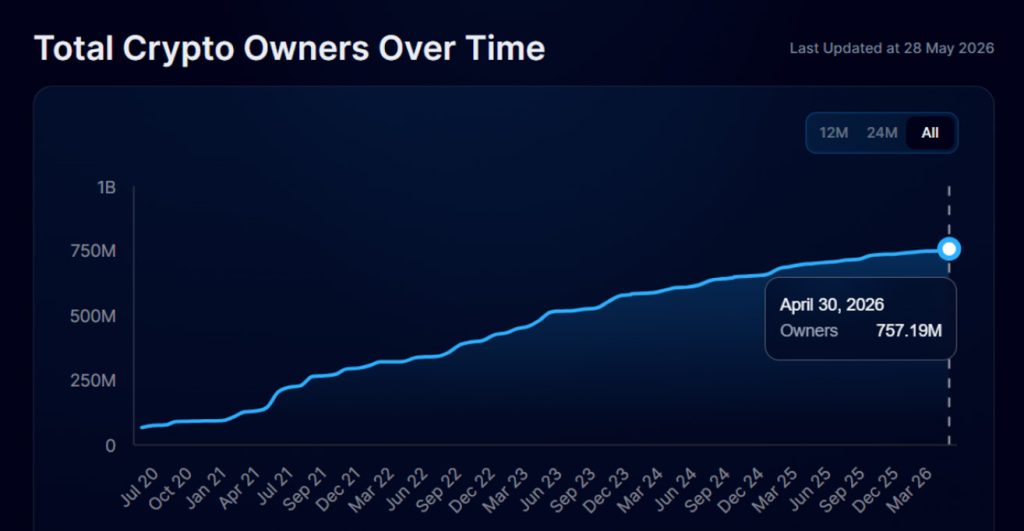
Source: https://crypto.com/en/research/data
The opportunity is undeniably large for crypto exchange founders. Global cryptocurrency ownership rose to 757.19M in April 2026, and it is still on the rise. For those planning their crypto exchange development, the question isn’t about demand but whether their architecture will be able to capture it.
In this guide, we’ll break down ideal crypto exchange architecture for those launching in 2026 and beyond. Global Crypto Market Overview 2026
Before we dive into the technical layers, aspiring crypto exchange development projects need to understand the competitive bar. The market is highly concentrated with Binance, OKX, and Bybit, holding more than 55% of the global trading market share as per TokenInsight. If you’re entering a space where a handful of incumbents have set user expectations for speed, liquidity, and reliability, you must carefully examine their architectural choices to beat them.
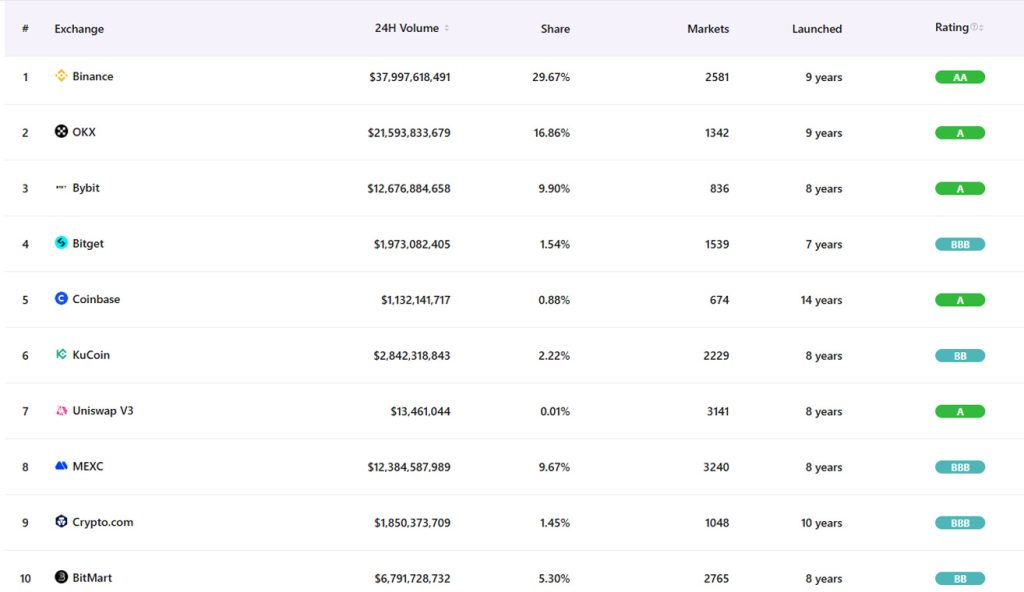
Source: TokenInsight
The upside is that the market is still expanding rapidly in terms of users, trading volumes, and all other aspects. For those planning their cryptocurrency exchange development, there is ample room to grow, but they still can’t out-feature a competitor whose matching engine is faster and whose custody is more secure.
The Core Components of Cryptocurrency Exchange Software
The crypto exchange architecture described below is that of a centralized exchange (CEX), the model that the large majority of founders build, where the platform operates the order book and custodies user funds. Decentralized exchange (DEX) and hybrid models are structured differently. A modern centralized exchange is a set of specialized systems working in concert, and these are the building blocks every founder should understand.
1. The matching engine
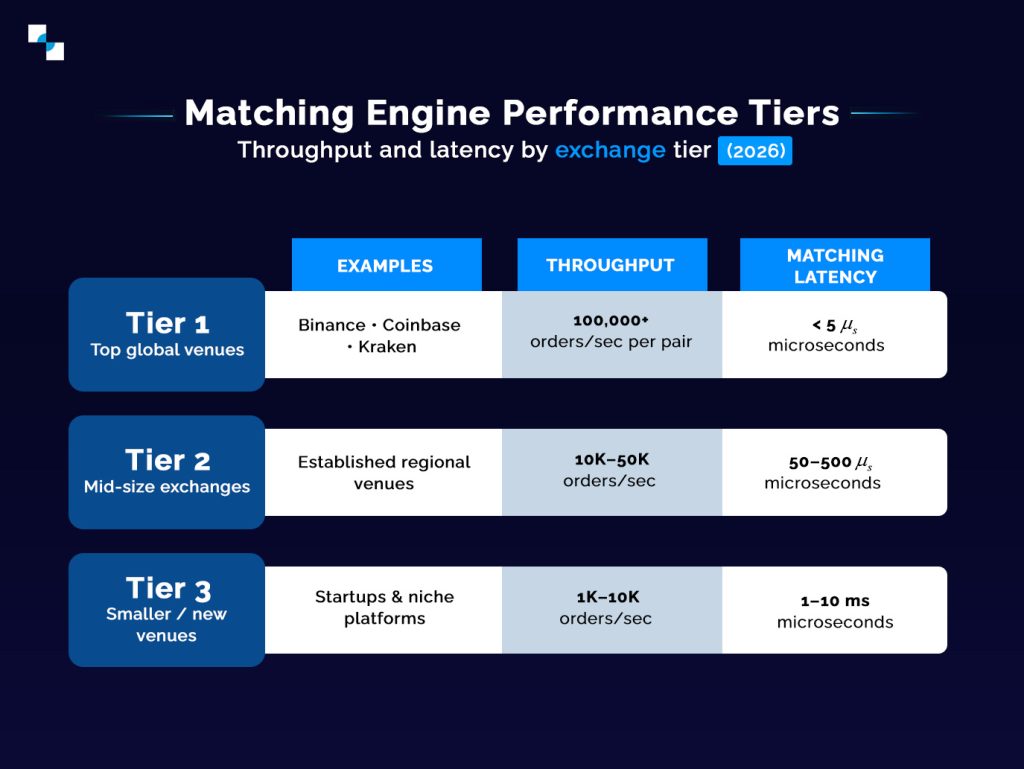
This is the core mechanism that pairs the buy and sell orders in real time, and its performance defines the trading experience. The industry sorts into clear tiers.
- Tier 1 crypto exchanges such as Binance, Coinbase, and Kraken process 100,000+ orders per second per trading pair. The matching latency is ensured under 1-5 milliseconds end-to-end (API round-trip), while their internal in-memory matching core executes trades in the sub-50 microsecond range.
- Tier 2 platforms handle 10,000-50,000 orders per second in the 50-500 microsecond range.
- Tier 3 platforms operate in the 1,000-10,000 orders-per-second band with 1-10 millisecond latency.
To reach the top tiers while engineering matching engines during crypto exchange development, developers:
- write the engine in low-level languages like C++ or Rust
- keep the order book in memory
- isolate it from the rest of the system rather than burying it inside a monolith
2. The wallet and custody system
Customer funds live in crypto exchange custody, and keeping it secure will be the biggest crypto exchange security decision you will make. A sound crypto custody design in exchange splits funds across hot wallets and cold storage.
- Hot storage has a small balance kept online for liquidity and withdrawals
- The majority of assets are kept offline, beyond the reach of attackers.
3. The trading and order management layer
This is the bookkeeping backbone that the matching engine relies on
- handles order types
- maintains the order book
- keeps the account and balance ledger accurate to the last decimal.
4. The liquidity layer
A new crypto exchange software has no trading activity of its own. This critical layer, therefore, arranges the liquidity in the following ways:
- connects to external market makers and liquidity providers
- aggregates liquidity from other venues
By doing so, it ensures that users see tight spreads and can actually fill orders without slippage.
5. The user-facing layer and APIs
Web and mobile front ends serve retail users, while REST, WebSocket, and FIX APIs serve algorithmic traders and institutions. To attract institutional flow, crypto exchanges must maintain robust, well-documented APIs.
6. The compliance and risk engine
KYC/AML onboarding, transaction monitoring, and fraud and risk controls run across the whole system and ensure jurisdictional compliance. Many cryptocurrency exchange software are planning to launch globally, even integrating geofencing to dodge bullets from highly restricted regions.
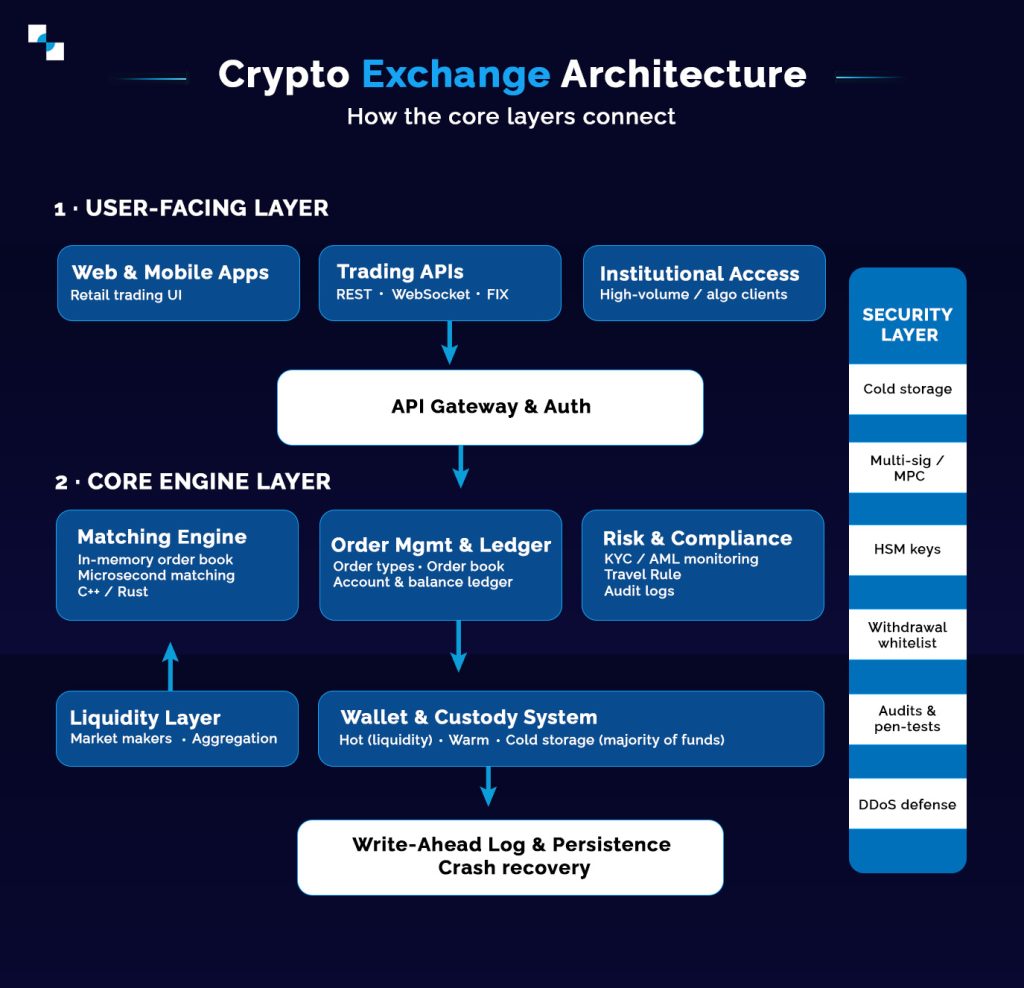
Crypto Exchange Security Architecture 2026
Considering the highest volume of crypto attacks observed in April 2026, and more sophisticated waves of attacks by AI-empowered hackers, security is the most critical architecture choice.
A defensible crypto exchange architecture layers its protections to counter both traditional vulnerabilities and sophisticated, AI-empowered threat actors.
- Hardening the backend requires isolating the matching engine from peripheral systems to prevent cascade failures, while keeping the absolute majority of user funds in cold storage.
- Traditional multi-sig must be evolved using Multi-Party Computation (MPC) and time-locked smart contracts so that no single compromised credential can authorize an asset flight.
Furthermore, security cannot be a static checklist. True resilience in the AI era demands an active stance:
- deploying real-time behavior analytics to spot internal anomalies
- utilizing automated on-chain firewalls to programmatically freeze suspicious withdrawals
- running continuous, simulated compromise drills rather than standard annual audits
The cryptocurrency exchange software that survives in 2026 and beyond must, therefore, treat security as an evolving infrastructure requirement.
How Does A Robust Crypto Exchange Architecture Ensure High Scalability?
The trading volumes can spike and fall anytime, characterized by market volatility, a feature launch, airdrops, or marketing/promotional activities. A cryptocurrency exchange software must be capable of absorbing the spikes.
Two crypto exchange architecture design principles matter the most:
- First, the order book lives in memory, because disk I/O introduces milliseconds of latency that are unacceptable for real-time matching.
- Second, durability is preserved through write-ahead logs (WAL). Every incoming order and matching event is appended to a sequential log before processing, so if the engine crashes, the log replays from the last checkpoint to reconstruct the order book exactly.
Recommended crypto exchange architecture choice: A microservices approach with horizontal scaling, redundancy, and automated failover keeps the platform responsive when demand surges and resilient when components fail.
Get a free architecture consultation with our exchange engineers
Regulations are no longer an afterthought that can be added as a bolt-on on a crypto exchange build. One of our recent MiCA-compliant white-label crypto exchange development guides discussed how a new crypto exchange built with compliance embedded in its architecture from day one can have an advantage over legacy exchanges.
Similarly, many jurisdictions have their crypto exchange compliance rules explicitly laid out.
| Jurisdiction | Regulatory body/framework | Structural advantage | Core requirements |
|---|---|---|---|
| European Union | MiCA / CASP authorization | A CASP authorization can be passported across EU member states once granted. | Tiered capital requirements apply by service type, and ESMA guidance supports standardized recordkeeping for order-book and transaction data. Travel Rule compliance requires originator/beneficiary information handling. |
| United Arab Emirates | VARA (Dubai) / ADGM (Abu Dhabi) | VARA provides crypto-specific rulebooks, and the UAE is widely used for digital asset operations. | Custody rules require segregation of client virtual assets, strong audit trails, and controls against rehypothecation or improper use of client assets. |
| Singapore | MAS under the Payment Services Act | Singapore offers a clear licensing framework for digital payment token services with a predictable supervisory approach. | Travel Rule compliance applies, including sender/receiver information requirements, and enhanced due diligence is used for higher-risk flows and self-hosted wallets. |
| Switzerland | FINMA | Switzerland is known for a mature crypto-market infrastructure and strong institutional credibility. | FINMA-linked guidance emphasizes segregated custody, bankruptcy protection, and strong custody controls for client assets. |
| Cayman Islands | VASP Act / CIMA | The Cayman VASP regime covers virtual asset service providers operating in or from within the jurisdiction. | Entities must comply with AML/CFT and sanctions obligations, and CIMA oversight applies to licensed or registered VASPs. |
Recommended Crypto Exchange Architecture For Legal Compliance: For founders, this means compliance has to be designed into the data model from day one. Built-in KYC/AML, Travel Rule data flows, transaction monitoring, fully auditable records, and jurisdiction-aware logic (geo-fencing, market-specific rules) are some essential crypto exchange architectural considerations for launching legally from day 1. Retrofitting them after launch is slow, expensive, and risky, which is far harder than building them in from the start.
CEX, DEX, or Hybrid: Choosing your model
| Exchange Model | Custody Approach | Performance & Compliance | Strategic Trade-offs / Risks |
|---|---|---|---|
| CEX | The platform holds and manages customer funds. | Top-tier performance and high throughput; offers a clear, established path to regulatory compliance. | High regulatory scrutiny and a target for major hacks because you are the custodian of user assets. |
| DEX | Non-custodial and entirely permissionless; users control keys. | Slower, chain-dependent throughput; compliance pathways are still complex and evolving. | Custody trade-offs are real. Code vulnerabilities are a massive risk. The Cetus DEX exploit drained $223 million in 2025. |
| Hybrid | Balances self-custody with platform-managed order matching. | Aims to combine the execution speed of a CEX with the decentralized trust of a DEX. | Highly complex architecture to build and maintain securely; it bridges the gap but introduces unique engineering bottlenecks. |
Architecture also means choosing your custody model. The right crypto exchange architecture choice depends on your target users, regulatory posture, and risk appetite, and it shapes nearly every layer above.
The bottom line
Crypto exchange architecture comes down to four things working together:
- performance that meets trader expectations
- security that protects against billion-dollar threats
- scalability that holds up under volume spikes
- compliance that keeps you operating legally across markets.
Each is an architectural decision, and each is far cheaper to get right at the design stage than to fix after launch.
Building all of this in-house is a significant undertaking. Antier designs and develops crypto exchanges across every layer covered here, from high-performance matching engines and institution-grade custody to compliance-ready, scalable infrastructure. If you’re planning to build, talk to our team about turning this blueprint into a platform.
Frequently Asked Questions
01. What is the primary factor that distinguishes successful crypto exchanges from those that fail?
The architecture beneath the crypto exchange is the primary factor that distinguishes successful platforms from those that fail, rather than just the user experience features.
02. What are some key responsibilities of a crypto exchange software?
A crypto exchange software is responsible for matching orders in microseconds, maintaining liquidity, safeguarding customer assets, ensuring cost-efficiency, staying online during volume spikes, and satisfying regulatory requirements.
03. How concentrated is the cryptocurrency exchange market as of 2026?
As of 2026, the cryptocurrency exchange market is highly concentrated, with Binance, OKX, and Bybit holding more than 55% of the global trading market share.