






✨ AI Summary
- The blog post discusses the concept of agentic commerce, the use of stablecoins, and the future of commerce driven by AI.
- Agentic commerce is defined as autonomous AI programs transacting on behalf of a business without human involvement at the point of transaction.
- The payment layer for these AI agents is facilitated by stablecoins, digital currencies that maintain a stable value.
- The post highlights real-world applications of AI automated commerce in industries such as logistics, financial services, and supply chain management.
- It also explains the process of AI-to-AI payments via stablecoin infrastructure.
Somewhere right now, an enterprise AI agent is making a decision that a human analyst would have needed hours to reach. It has read the signals, weighed the variables, and identified the move. The only thing standing between that decision and a real commercial outcome is a single step. A payment. And that payment cannot happen on its own. Not on the infrastructure most businesses are currently running. The AI thinks. The AI decides. Then it waits for a human to approve a purchase order, initiate a wire, or click a button, by which point the market has moved on. This is the gap that the convergence of agentic commerce and stablecoins is built to close. Agentic commerce with stablecoins is the model. Together, they form a complete commercial loop: one decision, one payment, one confirmed outcome, all within a single automated workflow.
That loop is not a future concept. It is the infrastructure that several of the largest technology and payments companies in the world began building in earnest in 2026. This guide explains what it means for enterprise operations, why the two had to converge, and how businesses are approaching the transition.
What Is Agentic Commerce? Starting From the Beginning
Agentic commerce is what happens when an autonomous software program, an AI agent, transacts on behalf of a business without human involvement at the point of transaction. The agent receives a goal. It executes a series of actions to achieve it. Some of those actions involve spending money.
Think of it this way. Today, when your business wants to purchase a piece of market data, a human logs in, selects a plan, enters payment details, and waits for access. In agentic commerce, an AI system requests that data, pays for it instantly, and processes it — all within the same automated workflow.
- No login
- No approval queue
- No invoice to reconcile at the end of the month
This is not a distant concept. Enterprises across financial services, logistics, media, and cloud infrastructure are already building the first generation of these workflows. The piece that makes it work financially is the payment layer that those agents run on. That is where stablecoin development solutions enter the picture.
Stablecoins Explained With No Time Taken
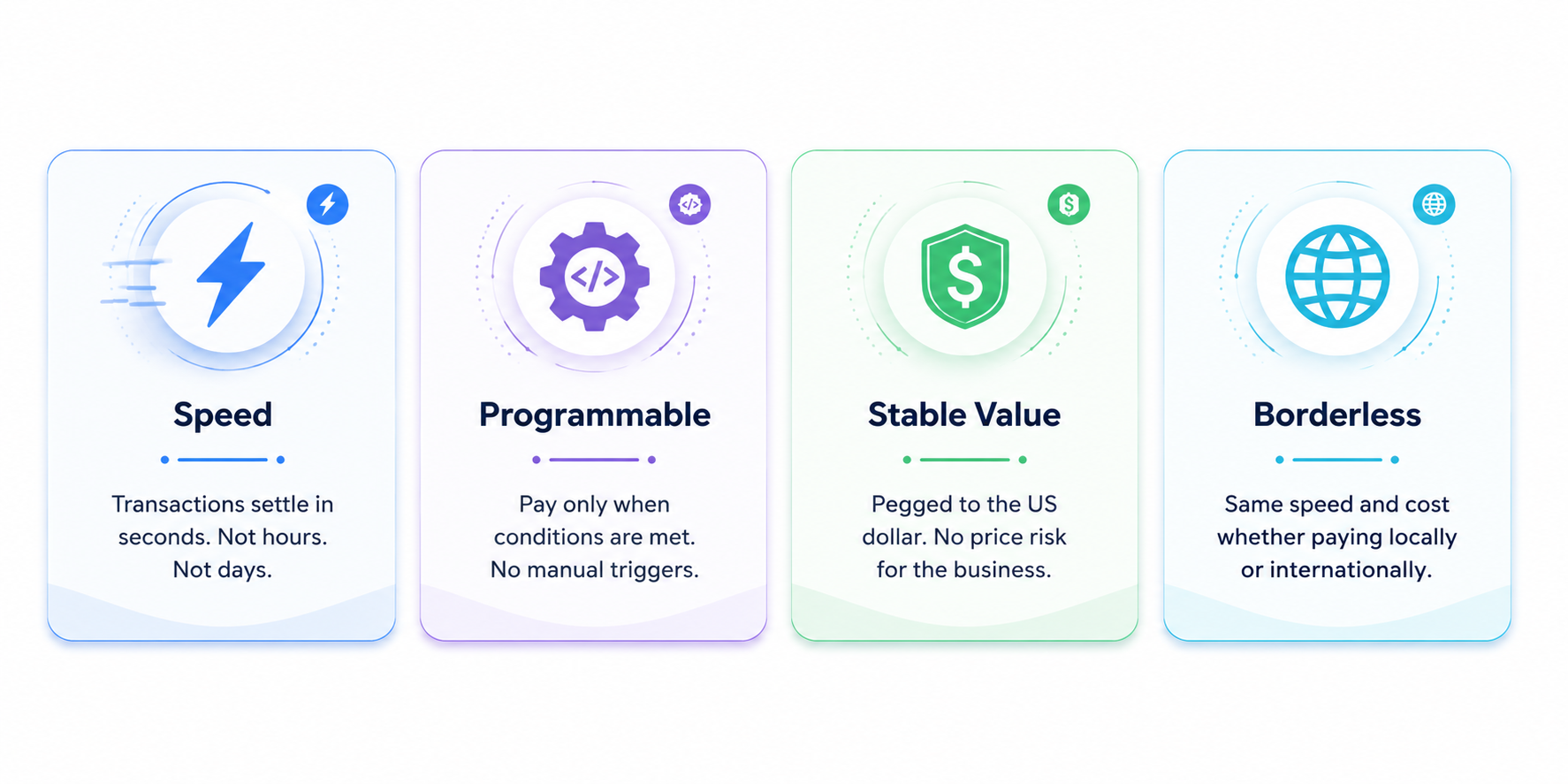
For an AI agent operating in real time, these properties are not conveniences. They are requirements. A system that needs to pay for a three-second API call simply cannot wait a day for a wire to clear. A system executing thousands of small transactions per hour cannot absorb a flat $25 wire fee on each one. Stablecoins close both gaps simultaneously.
Use Cases of Stablecoin Agentic Commerce
Concepts are easier to evaluate once they have a shape. Here are three enterprise scenarios that illustrate how stablecoin agentic commerce operates in different industry contexts. These are not hypothetical. The infrastructure to support each of them is in active production as of 2026.
The Procurement Agent | Logistics
A logistics company deploys an AI agent to monitor freight capacity in real time and book available slots before competitors do. When the agent identifies a slot, it holds it immediately by paying a small reservation fee using stablecoin. The slot is secured in seconds. No purchase order. No three-day wire. The agent acts within the same time window that the market is open — which is the only window that matters.
The Data-Buying Agent | Financial Services
A financial services firm’s AI model needs fresh market data to run risk calculations on demand. The data provider charges per query. The agent sends a stablecoin payment for each request, automatically, the moment it makes the call. The firm pays precisely for what it uses — no subscription overhead, no minimum spend, no invoice cycle at the end of the month. Usage becomes a variable cost, not a fixed one.
The Cross-Border Settlement Agent | Supply Chain
A global manufacturer needs to pay a supplier in Southeast Asia the moment dispatch is confirmed. An AI agent monitors the shipment data and triggers a stablecoin transfer on-chain the instant the confirmation arrives. The supplier receives funds in minutes. No currency conversion queues. No correspondent banking chain adding days of latency. The payment matches the pace of the physical goods movement.
How does AI-to-AI Payments Via Stablecoins Infrastrcuture Work?
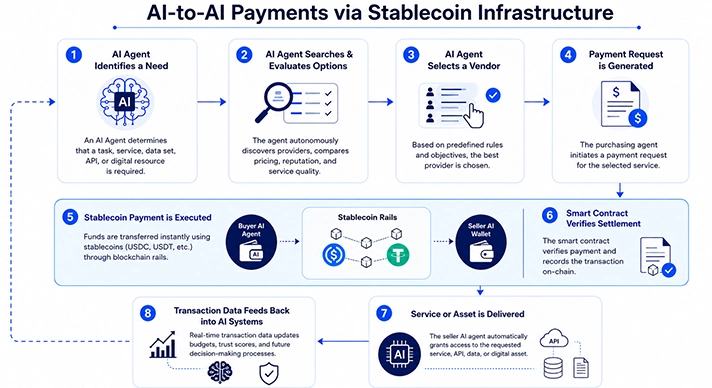
Step 1: An AI agent determines that a task, service, data set, API, or digital resource is required.
Step 2: The agent autonomously discovers providers and compares pricing, reputation, and service quality.
Step 3: Based on predefined rules and objectives, the best provider is chosen.
Step 4: The purchasing agent initiates a payment request for the selected service.
Step 5: Funds are transferred instantly using stablecoins (USDC, USDT, etc.) through blockchain payment rails.
Step 6: The network confirms payment and records the transaction on-chain.
Step 7: The seller’s AI agent automatically grants access to the requested service, API, data, or digital asset.
Step 8: Both agents update their models, budgets, trust scores, and future decision-making processes.
What the Largest Companies in the World Are Already Building?
The clearest signal that machine-to-machine transactions have moved from concept to infrastructure is the commitments major enterprises have made publicly in 2026. These are not research initiatives or white papers. They are production platforms.
- Amazon Web Services launched a dedicated infrastructure layer in 2026 specifically for AI agents to make stablecoin payments for APIs, data feeds, and digital content. AWS built this into its core AI development platform, signaling that stablecoin payment capability is now considered standard infrastructure for enterprise AI, not an optional add-on.
- Mastercard introduced a platform in June 2026 that lets AI agents make verified, controlled payments across cards, bank accounts, and stablecoins. The system authenticates agents, enforces spending limits, and settles transactions. Over 30 major payment and technology companies joined the initiative at launch, including some of the largest payment processors in the world.
- Coinbase and Google collaborated to build a payment protocol that lets AI agents from entirely different organizations pay each other automatically, with no shared accounts or pre-arranged business relationships required. This creates the possibility of an open market where agents from different companies transact directly — the equivalent of building commerce infrastructure for a machine-to-machine economy.
Build Stablecoin Payment Infrastructure for Your AI Agents!
The common thread is that organizations at the forefront of enterprise AI are not treating stablecoin payment infrastructure as a future consideration. They are building it now because agents without a payment layer are agents that stall the moment they need to transact.
The Regulatory Signal Enterprise Leaders Should Not Overlook
For many enterprise legal and compliance teams, the phrase “blockchain payments” still raises questions. That is an understandable instinct, and one the regulatory environment is now directly addressing.
| Development | Why It Matters |
|---|---|
| U.S. Stablecoin Law (2025) | Establishes clear rules for stablecoin issuance, reserves, redemptions, compliance, and consumer protection. |
| Legal Clarity | Compliant stablecoins are not treated as securities or commodities, reducing regulatory uncertainty. |
| Global Alignment | The EU’s MiCA framework and Singapore’s licensing regime reinforce regulatory support for stablecoin adoption. |
| Enterprise Impact | Stablecoin payments now operate within defined legal frameworks, making institutional deployment more predictable. |
| Infrastructure Readiness | GENIUS Act and MiCA-compliant crypto banking solutions are already available for enterprise use. |
Key Takeaway: The regulatory conversation has shifted from “Can enterprises use stablecoins?” to “How can they deploy them compliantly?”
Frequently Asked Questions About Stablecoins and Agentic Commerce
Q1. Does my business need blockchain expertise to adopt stablecoin payments?
A: No more than a business needs to understand packet routing to use the internet. The blockchain is an infrastructure that sits beneath the payment layer. What enterprise decision-makers engage with is the outcome: a payment instruction is sent, funds are confirmed, and a record is created. The engineering complexity sits with the stablecoin payment platform development company building the system, not with the business users or treasury teams operating it.
Q2. How does stablecoin agentic commerce connect to our AI investment strategy?
A: As organizations invest in AI agents to automate procurement, data acquisition, vendor settlement, and workflow execution, those agents will encounter moments where they need to transact — pay for a service, hold a resource, or settle an obligation. Without a payment layer that the agents can use autonomously, the workflow stops at the exact moment it should be accelerating. A stablecoin payment gateway is the financial layer that completes the AI agent stack. It is the difference between an agent that can plan and one that can act.
Q3. What makes cross-border payments with stablecoins different from international wires?
A: A traditional international wire travels through a chain of correspondent banks, each adding time and cost. The same payment made via stablecoin settles directly between the sender and receiver on a shared digital ledger, with no intermediary chain. The outcome is the same- funds move from one party to another, but the path is shorter, faster, and considerably cheaper. For businesses with high volumes of cross-border supplier payments, the difference in cost and settlement speed compounds significantly over the course of a year.
Explore stablecoin payment platforms built for enterprise cross-border flows.
What Enterprise Leaders Should Be Thinking About Now?
You do not need to deploy stablecoin agentic commerce this quarter to make meaningful decisions today. Here is the framework enterprise leaders are using to position themselves correctly as this shift accelerates:
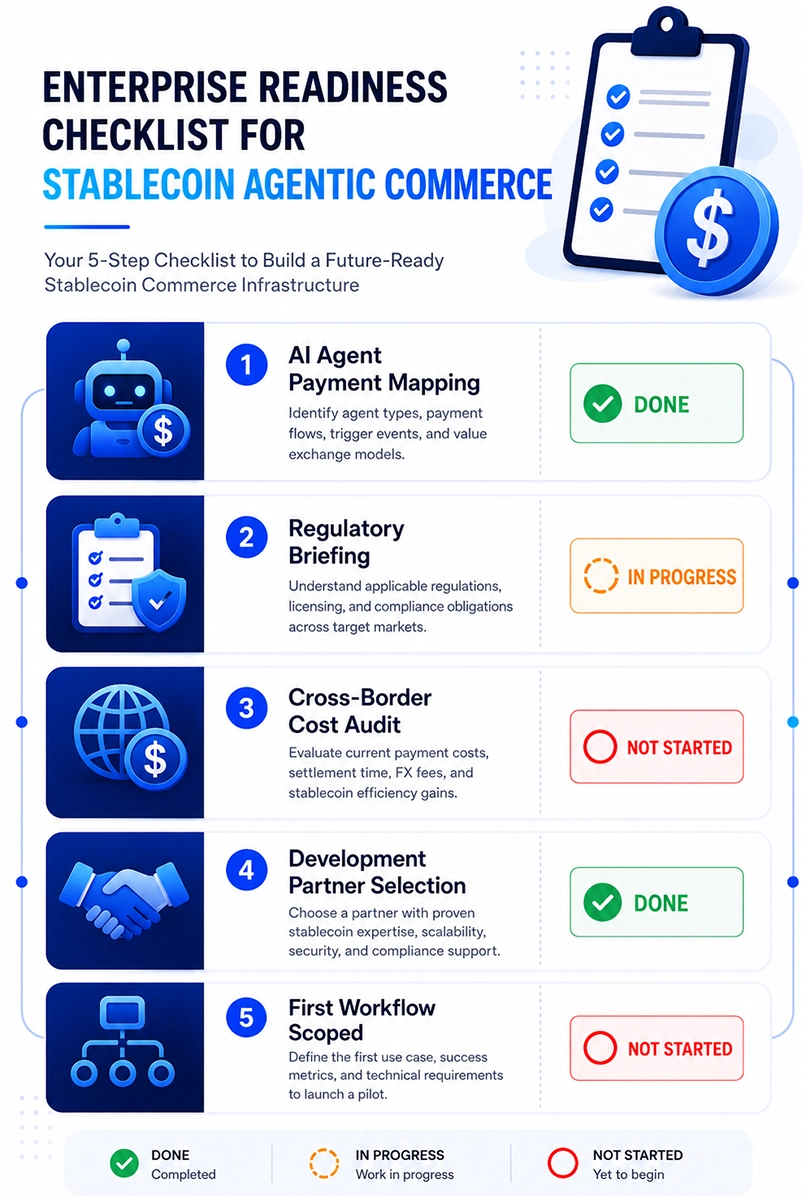
Choose a stablecoin remittance development company with both blockchain and compliance depth. Building stablecoin payment infrastructure is not a standard software project. It requires an understanding of key management, on-chain settlement, wallet architecture, and regulatory compliance simultaneously. The partner you choose should have demonstrated experience across all four.
Future of Agentic Commerce
AI agents are rapidly reshaping digital commerce. Stripe powers 78% of the Forbes AI 50, and more than 700 AI-agent startups launched on its platform in 2024 alone- a number expected to grow significantly in 2025.
As AI agents begin handling product discovery, decision-making, and purchases, commerce is shifting from a user experience challenge to an infrastructure challenge. Businesses must ensure their product catalogs are easily discoverable by agents, optimize checkout flows for autonomous transactions, and implement risk and customer intelligence models designed for agent-driven activity.
In short, the future of commerce will depend on infrastructure built not only for human users but also for autonomous AI agents.
Antier Builds Enterprise-Grade 100% Authentic Agentic Commerce!
Every major shift in how commerce works has required new infrastructure to support it. E-commerce requires payment gateways. Mobile commerce required tokenized credentials. Agentic commerce requires a stablecoin payment infrastructure: a layer where AI agents can transact autonomously, at machine speed, across borders, without human authorization at every step. Gartner projects that AI agents could intermediate trillions of dollars in commercial activity by the end of the decade (Gartner, 2025).
The enterprises that gain a durable structural position are those building the payment layer that makes that activity possible today. Antier builds stablecoin payment development, MPC crypto wallets, and crypto banking infrastructure for enterprises entering the machine economy. If your organization is mapping its AI agent roadmap to commercial action, speak with Antier’s engineering team to define the payment infrastructure that completes it.
Connect with our experts to claim your blue print for the same.


