




✨ AI Summary
- Artificial Intelligence (AI) is being leveraged across industries to improve decision-making, automate work, and enhance customer experiences.
- However, most businesses are unsure about the initial steps.
- This blog post is a comprehensive guide to AI development, covering topics from business readiness to understanding AI and debunking common myths.
- It emphasizes that AI delivers the most value when it addresses real business challenges backed by clear objectives and measurable outcomes.
- The post also explains different AI concepts, including Generative AI, AI Agents, and Large Language Models, highlighting their varied purposes.
Artificial Intelligence has moved beyond experimentation. Businesses across every industry are exploring how it can improve decision-making, automate work, create better customer experiences, and uncover new growth opportunities. Yet, one challenge remains consistent. Most organizations are unsure where to begin.
Should you invest in AI development today? Does your business need Generative AI, AI Agents, or AI workflow automation? Should you build a custom solution or adopt an existing platform? How much will AI development cost? What risks should you prepare for? Which AI development company is the right fit for your goals?
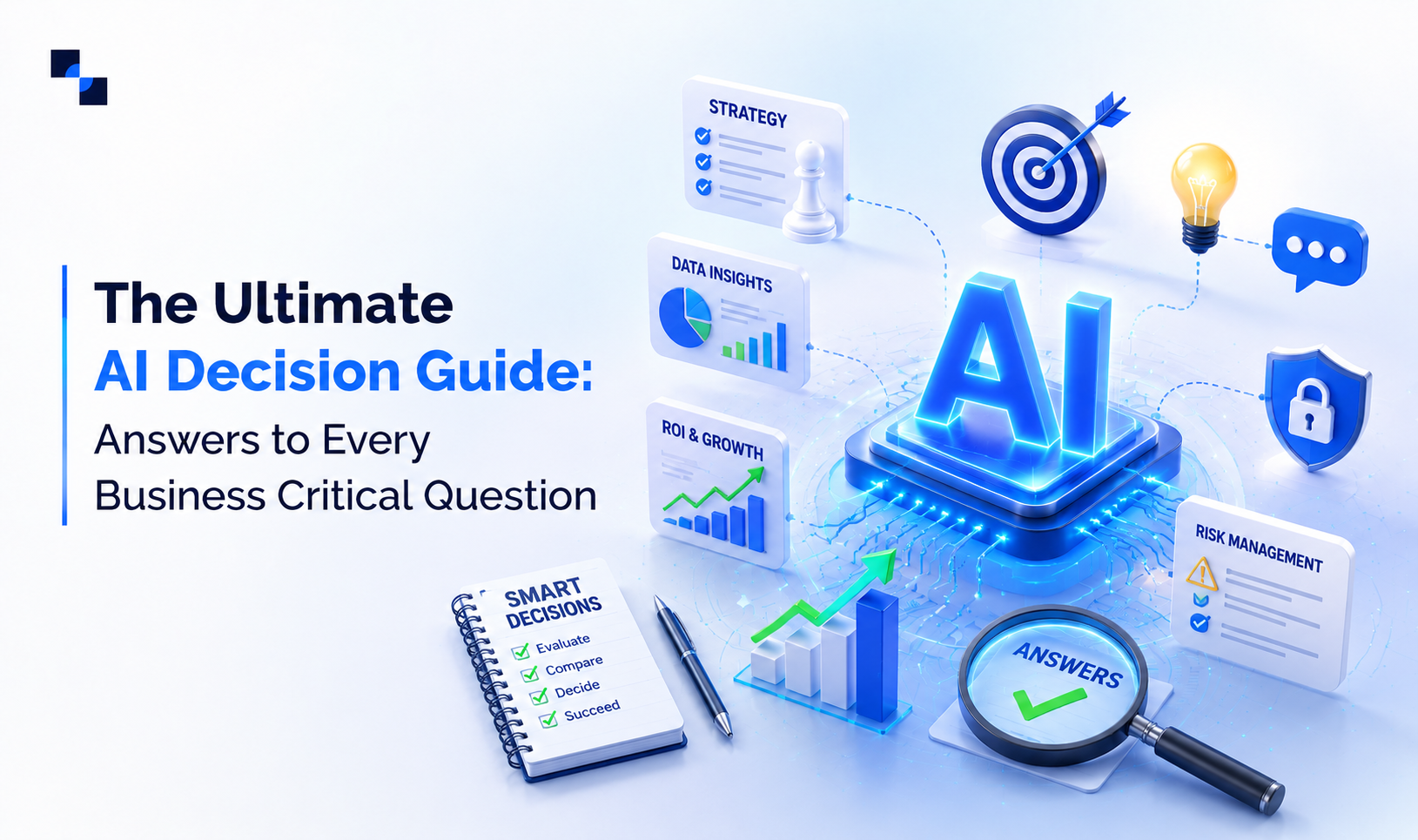
The answers to these questions determine whether an AI initiative delivers measurable business value or becomes an expensive experiment. This guide brings together the questions business leaders ask before planning, building, deploying, and scaling AI. Each answer is designed to help you make informed decisions with confidence, whether you are exploring AI for the first time or preparing to expand existing initiatives.
Top AI Queries with Answers on AI Development in 2026
1. Business Readiness for AI
Many organizations begin their AI development journey by asking what AI can do. The better question is whether their business is prepared to benefit from it. AI delivers the greatest value when it solves real business problems backed by clear objectives and measurable outcomes. The following questions will help you evaluate whether your organization is ready to invest in AI with confidence.
Is My Business Ready for AI?
If your organization has a clear objective, reliable business data, leadership support, and a willingness to improve existing processes, you are already in a strong position to explore AI development services. Before making any investment, ask yourself the following questions.
- Do we have a clearly defined business challenge?
- Can success be measured through business outcomes?
- Do we have access to reliable and relevant data?
- Is leadership committed to long term AI adoption?
- Are our teams open to working with AI powered solutions?
If the answer is yes to most of these questions, your organization is likely ready to move from exploration to planning.
What Business Problems Should AI Solve First?
Instead of applying AI across every department, identify one challenge that consumes time, slows decision making, or limits business growth. Solving one meaningful problem first allows businesses to validate results before expanding into larger initiatives. Some of the strongest starting points include
- Customer support requests
- Repetitive administrative work
- Document processing
- Sales forecasting
- Fraud detection
- Inventory planning
- AI workflow automation for repetitive business processes
A practical AI solution should improve business performance, not simply introduce new technology.
What Signs Indicate AI Can Create Measurable Business Value?
AI usually creates value when it helps businesses
- Reduce manual effort
- Improve customer experiences
- Make faster business decisions
- Increase productivity
- Improve forecasting accuracy
- Reduce operational costs
Another positive sign is the availability of quality business data. AI performs best when it can learn from reliable information that reflects real business operations. The goal is not to introduce AI into the organization. The goal is to improve measurable business results.
What Should a Business Have in Place Before Investing in AI?
Successful AI development starts long before the first model is trained. Businesses do not need unlimited budgets or massive technical teams. They do need a strong foundation that supports long term success.
That foundation typically includes
- Clearly defined business objectives
- Reliable business data
- Leadership support
- Realistic expectations
- A budget that includes ongoing improvement
- Access to an experienced AI development company when internal expertise is limited
Many AI projects fail because organizations focus on technology before preparing the business itself. Building the right foundation reduces risk and increases the likelihood of achieving measurable outcomes.
How Do Businesses Identify the Right AI Opportunities?
The best AI opportunities often exist within everyday business operations.
Look for activities that require significant manual effort, involve repetitive decisions, or depend on analyzing large amounts of information. These processes usually offer the fastest path to measurable business value. When evaluating opportunities, ask three simple questions.
- Does this solve an important business problem?
- Can the results be measured?
- Do we have the data needed to support the solution?
If the answer is yes to all three, the opportunity is worth exploring through custom AI development or AI consulting services.
2. Understanding AI Before Making Business Decisions
Business leaders often hear terms like Generative AI, AI Agents, Machine Learning, and Large Language Models used interchangeably. While they are closely related, each serves a different purpose. Understanding these concepts helps businesses choose the right solution instead of following market trends.
What Is AI and Why Does It Matter to Businesses?
Artificial Intelligence is the ability of computer systems to perform tasks that normally require human intelligence. These tasks include understanding language, recognizing patterns, making predictions, generating content, and supporting business decisions. For businesses, AI is less about replacing people and more about helping teams work smarter, respond faster, and make better decisions.
AI is commonly used to
- Automate repetitive work
- Improve customer experiences
- Analyze business data
- Support decision making
- Generate text, images, and code
- Predict future outcomes
What Is the Difference Between AI Machine Learning and Generative AI?
These terms are often confused, yet they serve different purposes.
Artificial Intelligence is the broader field focused on building systems capable of performing intelligent tasks.
Machine Learning is a branch of AI where systems learn from data instead of relying entirely on predefined rules.
Generative AI focuses on creating new content such as text, images, videos, software code, and business documents based on prompts or existing information.
A simple way to understand the relationship is
- AI is the overall discipline.
- Machine Learning is one approach to building AI.
- Generative AI is a specialized area that creates new content.
What Is Enterprise AI?
Enterprise AI refers to AI solutions built to support business operations at scale. Unlike consumer AI tools, enterprise solutions are designed around security, governance, business workflows, and organizational data.
Businesses adopt Enterprise AI to
- Improve operational processes
- Support employees with intelligent assistance
- Analyze large volumes of enterprise data
- Strengthen customer engagement
- Connect AI with existing business applications
What Are Large Language Models?
Large Language Models are AI models trained on massive amounts of text that enable them to understand, summarize, translate, and generate human like language.
Popular models can answer questions, draft documents, write software code, summarize reports, and assist employees across different business functions.
Businesses often use these models to power
- AI chatbot development
- Customer support assistants
- Enterprise search
- Internal knowledge systems
- Content generation
- Business copilots
What Are AI Agents?
An AI Agent goes beyond answering questions. It can understand objectives, make decisions, perform tasks, and interact with different systems with minimal human involvement.
Unlike traditional software that follows fixed instructions, AI Agents adapt based on available information and changing situations.
Businesses use AI Agent development for
- Customer service
- Sales assistance
- Process automation
- Financial operations
- Research
- Internal business workflows
What Is Agentic AI?
Agentic AI describes AI systems capable of planning, reasoning, making decisions, and completing multi step tasks to achieve a specific goal.
Instead of responding to a single request, Agentic AI can break a problem into smaller tasks, determine the best sequence of actions, and adjust as new information becomes available.
Businesses are increasingly exploring Agentic AI for
- Multi step workflow execution
- Business process automation
- Intelligent decision support
- Software development assistance
- Cross functional business operations
What Is Retrieval Augmented Generation?
Retrieval Augmented Generation allows AI to retrieve information from trusted business knowledge before generating a response. This helps produce answers that are more accurate, relevant, and grounded in organizational data.
Businesses use RAG to
- Improve response accuracy
- Reduce hallucinations
- Search internal documents
- Support knowledge management
- Build enterprise assistants
What Is Model Context Protocol?
Model Context Protocol is an emerging standard that allows AI models to securely access external tools, business systems, databases, and applications through a consistent interface.
Rather than operating in isolation, AI can retrieve live business information and complete real tasks while maintaining appropriate access controls.
Businesses are beginning to explore Model Context Protocol for
- Enterprise automation
- Business application connectivity
- Workflow orchestration
- AI Agent collaboration
- Secure data access
3. AI Myths Every Business Leader Should Stop Believing
AI has become one of the most discussed business technologies, yet many investment decisions are still influenced by assumptions rather than facts. Clearing these misconceptions early helps businesses make practical decisions and avoid costly mistakes.
Is AI Only for Large Enterprises?
No. AI is valuable for businesses of every size when it solves a meaningful problem.
Cloud platforms, open source models, and managed AI development services have made AI more accessible than ever. Small and mid sized businesses can now automate customer support, improve sales forecasting, analyze business data, and streamline operations without building massive internal teams.
The deciding factor is not company size. It is whether AI can solve a business challenge that delivers measurable value.
Does Every Business Need Generative AI?
No. Generative AI is powerful, but it is not the answer to every business problem.
Some organizations benefit more from predictive analytics, Machine Learning, or AI workflow automation than from content generation.
Before investing in Generative AI development, ask whether your business actually needs AI to create new content or whether it needs AI to analyze data, automate processes, or support business decisions.
Choosing the right technology is always more important than choosing the newest technology.
Does AI Always Require Massive Amounts of Data?
No. The amount of data required depends on the type of AI solution being developed.
Modern foundation models already possess broad knowledge. Businesses often improve these models by connecting them to internal documents rather than training new models from scratch.
Many successful AI projects begin with
- Product documentation
- Customer conversations
- Internal policies
- Knowledge bases
- Operational reports
Is Custom AI Always Better?
Not always.
Many businesses assume custom AI development is the default choice. In reality, the right approach depends on business goals.
Choose existing AI platforms when
- The use case is common.
- Speed is the highest priority.
- Extensive customization is not required.
Choose custom AI development when
- Business processes are unique.
- Competitive differentiation matters.
- Existing tools cannot meet operational requirements.
- Security or compliance demands greater control.
The objective should be finding the right solution rather than building the most complex one.
Will AI Replace Employees?
AI is more likely to reshape work than replace entire workforces.
It performs repetitive and data intensive tasks extremely well. People remain essential for strategic thinking, relationship building, creativity, leadership, and decisions that require judgment.
Businesses creating the greatest value from AI usually focus on helping employees work faster and make better decisions rather than replacing them.
The strongest results come from combining human expertise with intelligent automation.
Is AI Always Expensive?
No. The cost of AI development depends on the business problem, project scope, data requirements, model selection, and deployment strategy.
Many organizations begin with focused pilot projects before expanding AI across additional departments. This allows them to validate business value while controlling investment.
Businesses should view AI as a long term capability rather than a one time purchase. Starting small, measuring results, and expanding based on success often delivers stronger outcomes than attempting large scale deployments from the beginning
Need Help Defining Your AI Strategy?
4. Planning Your AI Strategy
Many AI projects fail long before development begins. The reason is rarely the technology. It is the absence of a clear business strategy. Before selecting models, platforms, or development partners, business leaders should answer the following questions.
Should My Business Invest in AI?
AI is worth investing in when it addresses a business challenge that affects growth, customer experience, operational costs, or decision making. The objective should never be to adopt AI because it is trending. It should be to solve problems that create measurable business value.
Businesses often see the greatest return when AI helps them
- Reduce repetitive work
- Improve customer interactions
- Speed up business decisions
- Increase productivity
- Analyze large volumes of business data
If AI cannot deliver a measurable business outcome, it may not be the right investment at this stage.
How Do I Build an AI Strategy?
A successful AI strategy starts with business goals, not technology.
Rather than asking which AI model to use, begin by identifying the outcomes you want to achieve. Once those objectives are clear, you can determine where AI fits within existing business processes.
An effective strategy should answer four simple questions.
- What business problem are we solving?
- What results do we expect?
- How will success be measured?
- What resources are required to achieve those results?
How Do I Prioritize AI Use Cases?
Not every AI opportunity deserves immediate attention. The best starting point is a project that combines high business value with low implementation complexity.
Evaluate every potential use case based on
- Business impact
- Technical feasibility
- Data availability
- Expected return
- Time required to deliver results
Projects that score well across these areas should move to the top of the roadmap.
Should I Buy AI Software or Build My Own?
The answer depends on your business goals.
Ready made AI platforms work well when your requirements are common and speed is the highest priority. They reduce development time and often require less upfront investment.
Custom AI development becomes the better choice when your business processes are unique or when competitive advantage depends on capabilities that existing software cannot provide.
Consider buying AI software when
- Your requirements are standard.
- Speed matters more than customization.
- Budget is limited.
Consider custom AI development when
- Your workflows are unique.
- You require full ownership.
- Security requirements are higher.
- Existing platforms cannot meet business needs.
The decision should focus on long term business value rather than short term convenience.
Should I Choose Custom AI or Ready Made AI Tools?
This is one of the most common questions businesses ask before investing in AI development services.
Ready made tools provide immediate access to AI capabilities and are suitable for common business tasks.
Custom solutions are designed specifically around your business processes, data, and objectives.
Choose ready made AI when you need
- Faster deployment
- Lower initial investment
- Standard business functionality
Choose custom AI development when you need
- Business specific workflows
- Greater scalability
- Better control over data
- Competitive differentiation
- Long term flexibility
Many businesses begin with existing tools and gradually move toward custom solutions as their AI maturity grows.
When Does Custom AI Become the Better Investment?
Custom AI development becomes valuable when AI moves from supporting the business to becoming part of the business itself.
If your competitive advantage depends on unique customer experiences, proprietary data, or specialized business processes, custom AI often delivers greater long term value than generic software.
Businesses should also consider custom development when they need
- Enterprise grade security
- Industry specific compliance
- Deep system connectivity
- Highly specialized workflows
- Greater control over future enhancements
The initial investment may be higher, but the long term benefits often outweigh the additional cost.
How Should Businesses Create an AI Roadmap?
An AI roadmap provides direction and helps businesses avoid scattered investments.
Rather than launching multiple AI initiatives at once, focus on gradual expansion supported by measurable results.
A practical roadmap often follows this sequence.
- Identify business challenges
- Prioritize high value use cases
- Validate the opportunity
- Build a pilot solution
- Measure business outcomes
- Expand successful initiatives across the organization
This approach reduces risk while helping businesses develop AI capabilities that continue to grow over time.
5. Most Common Questions on AI Development
Building AI is not just about selecting a model or writing code. Every successful project begins with a series of practical decisions that influence cost, timelines, scalability, and long term business value. Understanding the development process helps businesses invest with greater confidence.
How Does AI Development Actually Work?
Every AI development project follows a structured process that starts with understanding the business problem and ends with deploying a solution that delivers measurable results.
While every project is different, the process typically includes
- Defining business objectives
- Assessing available data
- Selecting the right AI model
- Designing and developing the solution
- Testing performance and accuracy
- Deploying the solution
- Monitoring and improving the system over time
Successful AI development services focus as much on business outcomes as they do on technology.
How Long Does AI Development Take?
There is no fixed timeline for AI development. The duration depends on the complexity of the project, the availability of quality data, the number of business systems involved, and the level of customization required.
As a general guideline
- Proof of concept projects usually take the least time.
- Department specific AI solutions require additional planning and development.
- Enterprise wide AI platforms often involve multiple phases before full deployment.
Businesses that begin with a focused use case often achieve faster results while reducing project risks.
How Much Does AI Development Cost?
The cost of AI development depends on what you are building rather than the technology alone.
A simple AI assistant requires a different level of investment than an enterprise platform with multiple AI Agents, business system connectivity, and advanced automation capabilities.
The biggest cost factors include
- Project complexity
- Level of customization
- Data preparation
- AI model selection
- Business system connectivity
- Security and compliance requirements
- Ongoing maintenance and improvements
Instead of asking how much AI costs, businesses should ask how much value the solution is expected to create.
Read this for more details: https://www.antier.com/blogs/how-much-does-ai-development-cost-in-2026-a-comprehensive-investor-guide/
What Factors Influence AI Development Cost?
Two AI projects solving similar business problems can have very different costs because every organization has different technical and operational requirements.
Some of the biggest factors include
- Business objectives
- Data quality
- Number of users
- Existing technology environment
- Custom features
- Security requirements
- Deployment environment
- Long term support requirements
Working with an experienced AI development company during the planning stage helps businesses estimate costs more accurately and avoid unexpected expenses later.
Which AI Models Should Businesses Choose?
The right model depends entirely on the business use case.
Some models perform better at generating content, while others specialize in reasoning, coding, image analysis, or structured data processing.
Businesses should evaluate models based on
- Accuracy
- Performance
- Business requirements
- Data privacy
- Scalability
- Cost of operation
- Compatibility with existing systems
Choosing the newest model is not always the right decision. The best model is the one that supports your business objectives effectively.
Should Businesses Fine Tune AI Models?
Not every AI project requires fine tuning.
Many organizations achieve excellent results by combining foundation models with business knowledge through Retrieval Augmented Generation.
Fine tuning becomes valuable when businesses need
- Industry specific knowledge
- Company specific terminology
- Consistent outputs
- Specialized business tasks
- Higher prediction accuracy
The decision should balance business value, cost, and long term maintenance.
What Data Is Required Before Developing AI?
Data is one of the most valuable assets in any AI development project.
The objective is not to collect the largest amount of data. It is to ensure the data accurately represents the business problem being solved.
Useful data often includes
- Customer interactions
- Business documents
- Product information
- Operational records
- Financial data
- Knowledge repositories
Businesses should also review their data for completeness, consistency, and privacy before beginning development.
Which Programming Languages Power Modern AI Solutions?
Programming languages provide the foundation for building, training, and deploying AI applications.
The most widely used technologies include
- Python for model development and automation
- JavaScript for web based AI experiences
- Java for enterprise applications
- C plus plus for performance intensive AI systems
- SQL for managing business data
The choice of programming language depends on the business problem, technical environment, and deployment requirements rather than industry trends.
6. Choosing the Right AI Solution
Choosing the right AI solution is often more important than choosing the latest technology. Every business has different objectives, data, workflows, and customer expectations. The best AI solution is the one that solves your business problem with the least complexity while delivering measurable value.
When Should Businesses Choose Generative AI?
Generative AI is the right choice when your business needs to create, summarize, or personalize content at scale.
Unlike traditional AI, which focuses on predictions or classifications, Generative AI creates new outputs based on prompts and existing knowledge.
Businesses commonly use Generative AI development for
- Customer support assistants
- Content creation
- Knowledge management
- Document summarization
- Proposal generation
- Marketing campaigns
- Software development assistance
If your business depends on creating information rather than simply analyzing it, Generative AI can become a valuable business asset.
When Should Businesses Build AI Chatbots?
An AI chatbot is ideal when customers or employees frequently ask similar questions and expect immediate responses.
Modern chatbots go far beyond answering predefined questions. They understand context, retrieve business information, and provide conversational support across multiple channels.
Businesses often invest in AI chatbot development to
- Improve customer support
- Reduce response times
- Handle repetitive enquiries
- Assist employees internally
- Capture and qualify leads
- Provide product recommendations
A well designed chatbot improves both customer experience and operational productivity.
When Should Businesses Build AI Agents?
An AI Agent becomes valuable when work involves multiple decisions, actions, or business systems rather than simple conversations.
Unlike chatbots that primarily answer questions, AI Agents can complete tasks, make decisions, retrieve information, and interact with business applications.
Businesses explore AI Agent development for
- Sales assistance
- Financial operations
- Customer onboarding
- Business research
- Process execution
- Task management
If your objective is automation with decision making capabilities, AI Agents often provide greater value than traditional chatbots.
What Is the Difference Between AI Chatbots AI Copilots and AI Agents?
Although these technologies are related, they solve different business challenges.
An AI chatbot focuses on conversations and answering questions.
An AI Copilot assists employees while they perform specific tasks such as writing, coding, analyzing data, or preparing reports.
An AI Agent works more independently by making decisions, completing tasks, and coordinating actions across different systems.
A simple comparison looks like this.
- AI Chatbot responds to questions.
- AI Copilot assists people while they work.
- AI Agent performs work with minimal supervision.
Choosing the right solution depends on the level of autonomy your business requires.
What Is AI Workflow Automation?
AI workflow automation combines artificial intelligence with business processes to reduce manual work and improve operational speed.
Unlike traditional automation, AI can understand documents, interpret requests, make recommendations, and adapt to changing business conditions.
Businesses commonly adopt AI workflow automation for
- Invoice processing
- Employee onboarding
- Claims management
- Customer service workflows
- Approval processes
- Document routing
- Compliance monitoring
It allows teams to spend less time on repetitive activities and more time on strategic work.
Can Multiple AI Agents Work Together?
Yes. Many modern business solutions rely on multiple AI Agents working together to complete complex business processes.
Each agent performs a specific role while sharing information with others.
For example
- One agent gathers customer information.
- Another verifies business data.
- A third prepares recommendations.
- A fourth communicates results to the customer.
This collaborative approach improves scalability and enables businesses to automate processes that previously required multiple employees.
As organizations expand their AI capabilities, multi agent systems are becoming increasingly common for enterprise operations.
Which AI Architecture Fits My Business?
There is no universal AI architecture that works for every organization. The right approach depends on your business objectives, data environment, security requirements, and future growth plans.
When evaluating an AI architecture, consider
- Business complexity
- Data availability
- Existing business applications
- Security requirements
- Expected number of users
- Future scalability
- Long-term maintenance
Working with an experienced AI development company during the planning stage helps businesses select an architecture that supports both current needs and future expansion.
7. AI Infrastructure and Technology
Every successful AI solution depends on the technology that supports it behind the scenes. While business leaders do not need to understand every technical detail, knowing the fundamentals helps them make better investment decisions and avoid expensive mistakes.
Where Should Businesses Run AI?
The right environment depends on your business goals, security requirements, and operational needs.
Some organizations prefer cloud based AI because it offers flexibility and faster deployment. Others choose private infrastructure to maintain greater control over sensitive business data.
Before deciding where to deploy AI, evaluate
- Data sensitivity
- Business scalability
- Regulatory requirements
- Expected workload
- Long term operational costs
The deployment environment should support both your current needs and future business growth.
Cloud or On Premises: Which Is the Better Choice?
Neither option is universally better. The right choice depends on your organization’s priorities.
Cloud based AI is often preferred when businesses need
- Faster deployment
- Flexible computing resources
- Lower upfront investment
- Easy scalability
On premises deployment may be more suitable when businesses require
- Greater control over business data
- Industry specific compliance
- Internal security policies
- Low latency for critical applications
Many organizations are also adopting hybrid environments that combine both approaches to balance flexibility with control.
Do Businesses Need GPUs for AI?
Not every AI project requires specialized hardware.
Businesses using existing AI models through cloud platforms often do not need to purchase GPUs. Infrastructure is managed by the service provider.
Organizations building advanced custom AI development projects or training their own models may require dedicated computing resources to process large volumes of data efficiently.
The decision depends on
- Project complexity
- Model size
- Performance requirements
- Budget
- Long term AI strategy
The objective should always be selecting infrastructure that matches business requirements rather than investing in unnecessary hardware.
Should Businesses Use Open Source or Proprietary AI Models?
Both approaches offer valuable advantages.
Open source models provide greater flexibility, transparency, and control. They are often suitable for organizations that require customization or want greater ownership over their AI solutions.
Proprietary models typically provide
- Faster deployment
- Strong commercial support
- Regular updates
- High quality performance across common business tasks
Businesses should evaluate both options based on
- Security requirements
- Business objectives
- Budget
- Customization needs
- Long term ownership
The best choice is the one that supports your business strategy rather than following industry trends.
What Technology Stack Supports Enterprise AI?
A successful AI solution is supported by much more than an AI model. It requires technologies that manage data, connect business systems, monitor performance, and support ongoing improvements.
A modern AI development stack often includes
- AI models
- Data storage
- Vector databases
- Business applications
- APIs
- Monitoring tools
- Security controls
- Deployment platforms
Choosing technologies that work well together improves reliability and allows businesses to expand AI more efficiently as new use cases emerge.
Should Businesses Build AI Systems That Can Scale?
Yes. Scalability should be considered from the beginning rather than after deployment.
Many AI projects perform well during pilot programs but struggle when they are introduced across multiple departments, locations, or business units.
Planning for scalability helps businesses
- Support more users
- Process larger volumes of data
- Add new AI capabilities
- Connect additional business systems
- Reduce future redevelopment costs
Building with future growth in mind allows AI solutions to continue creating value as business needs evolve.
8. Data Security Governance and Responsible AI
As businesses expand their use of AI, questions about security, privacy, compliance, and trust become just as important as choosing the right technology. A successful AI initiative is not only accurate and intelligent but also secure, responsible, and aligned with business policies.
Is Business Data Safe With AI?
Yes, provided the right safeguards are in place.
AI itself is not the security risk. Problems usually arise when businesses share sensitive information without proper access controls, governance policies, or secure deployment practices.
Businesses can improve data security by
- Restricting access to sensitive information
- Encrypting business data
- Defining user permissions
- Monitoring AI activity
- Establishing internal AI usage policies
Choosing the right AI development company also plays an important role in building secure AI solutions that protect business information.
How Do Businesses Protect Confidential Information?
Protecting confidential data starts with understanding what information AI can and cannot access.
Not every employee or AI application should have access to every business document. Access should be limited based on roles, responsibilities, and business requirements.
Businesses should also
- Classify sensitive information
- Remove unnecessary personal data
- Secure data storage
- Review third party AI tools before adoption
- Regularly audit AI systems
A proactive approach to data protection reduces security risks while building trust across the organization.
What Causes AI Hallucinations?
AI hallucinations occur when an AI model generates information that sounds convincing but is inaccurate, incomplete, or entirely fabricated.
This usually happens because the model lacks access to reliable business information or attempts to predict answers instead of retrieving verified facts.
Hallucinations become more common when
- Business data is outdated
- Context is missing
- Prompts are unclear
- The model is asked questions outside its knowledge
Understanding these limitations helps businesses use AI more responsibly and set realistic expectations.
How Does Retrieval Augmented Generation Reduce Hallucinations?
Retrieval Augmented Generation improves AI accuracy by allowing models to retrieve information from trusted business sources before generating a response.
Instead of relying only on previously learned knowledge, AI can reference current business documents, policies, product information, or internal knowledge bases.
This approach helps businesses
- Improve response accuracy
- Reduce misinformation
- Keep answers consistent
- Use the latest business information
- Build trustworthy AI assistants
For many organizations, Retrieval Augmented Generation has become a preferred approach for enterprise AI because it combines the flexibility of Generative AI with reliable business knowledge.
How Should Businesses Govern AI Responsibly?
Responsible AI governance ensures AI supports business objectives while remaining transparent, secure, and accountable.
An effective governance strategy should define
- Who approves AI projects
- How business data is managed
- How AI decisions are reviewed
- Who monitors AI performance
- How risks are identified and addressed
Governance should evolve alongside AI adoption rather than being treated as a one time exercise.
Which Regulations Should Businesses Prepare For?
AI regulations continue to evolve across different countries and industries. Businesses should stay informed about the legal and ethical requirements that apply to their operations.
Areas receiving increasing attention include
- Data privacy
- Transparency
- Accountability
- Intellectual property
- Consumer protection
- Industry specific compliance
Building AI with compliance in mind from the beginning is often easier than making changes after deployment.
How Should Businesses Evaluate AI Risks?
Every technology introduces risks, and AI is no exception. The goal is not to eliminate every risk but to understand, manage, and continuously monitor them.
Businesses should evaluate
- Data privacy risks
- Security vulnerabilities
- Model accuracy
- Regulatory obligations
- Operational impact
- Business continuity
Regular testing and continuous monitoring help organizations identify issues early and maintain confidence in their AI systems.
9. Deploying and Scaling AI Successfully
Developing an AI solution is only one part of the journey. The real value comes when employees use it consistently, business processes improve, and measurable results begin to appear. A thoughtful deployment strategy helps businesses reduce adoption challenges and maximize long term value.
How Do Businesses Deploy AI Successfully?
Successful deployment begins with a controlled rollout rather than a company wide launch.
Many organizations start with a pilot project, validate the results, gather employee feedback, and gradually expand AI across additional teams. This approach allows businesses to identify challenges early while minimizing operational disruption.
A successful deployment usually includes
- Clearly defined success metrics
- Employee training
- Continuous performance monitoring
- Regular user feedback
- Ongoing improvements
Deploying AI should be viewed as a continuous business initiative rather than a one time project.
How Does AI Connect With Existing Business Systems?
An AI solution creates the greatest value when it works alongside the systems your business already uses.
Rather than replacing existing platforms, AI often extends their capabilities by analyzing information, automating repetitive work, and supporting better decision making.
Businesses commonly connect AI with
- Customer relationship management platforms
- Enterprise resource planning systems
- Human resource platforms
- Document management systems
- Business intelligence tools
- Customer support platforms
The objective is to improve existing workflows instead of creating entirely new ones.
How Do Businesses Prepare Employees for AI?
Technology adoption depends as much on people as it does on software.
Employees are more likely to embrace AI when they understand how it supports their work rather than replaces it. Open communication, practical training, and realistic expectations help reduce resistance and encourage adoption.
Businesses should focus on
- Explaining the purpose of AI
- Providing role specific training
- Encouraging employee feedback
- Addressing concerns early
- Demonstrating measurable business benefits
Organizations that invest in people often achieve better AI adoption than those that focus only on technology.
Why Do AI Projects Fail?
Most AI projects do not fail because the technology is incapable. They fail because business fundamentals are overlooked.
Some of the most common reasons include
- Unclear business objectives
- Poor quality data
- Unrealistic expectations
- Limited leadership support
- Trying to automate every process at once
- Lack of employee adoption
- No plan for ongoing improvements
Businesses that begin with a focused use case and measurable objectives are far more likely to achieve long term success.
How Should Businesses Measure AI Performance?
AI performance should be measured using business outcomes rather than technical metrics alone.
While accuracy is important, executives are more interested in understanding how AI contributes to business growth, productivity, customer satisfaction, and operational improvements.
Common performance indicators include
- Time saved
- Operational cost reduction
- Customer satisfaction
- Employee productivity
- Revenue growth
- Process completion time
- Decision accuracy
Tracking these metrics helps businesses determine whether their AI investments continue to deliver value.
How Do Businesses Scale AI Across Multiple Departments?
Scaling AI should be a gradual process built on proven success.
Once an AI solution delivers measurable value in one department, businesses can identify similar opportunities across other teams while applying the lessons learned during the initial deployment.
A practical scaling strategy often includes
- Expanding successful use cases
- Standardizing governance practices
- Reusing proven AI components
- Monitoring performance across departments
- Continuously improving existing solutions
Scaling becomes much easier when every new initiative builds on previous success instead of starting from scratch.
When Should Businesses Deploy Multiple AI Agents?
A single AI Agent may be sufficient for straightforward tasks, but more complex business operations often require multiple specialized agents working together.
For example, one agent may gather customer information, another may verify documents, while another prepares recommendations or completes follow up actions.
Businesses should consider multiple AI Agents when they need
- Multi step business workflows
- Cross department collaboration
- Complex decision making
- High volume task execution
- Business process orchestration
As organizations expand their AI capabilities, multi agent systems provide greater flexibility and allow businesses to automate increasingly sophisticated operations.
Ready to Build an AI Solution That Creates Business Value?
10. Measuring Business Value
AI should be treated like any other business investment. Success is not measured by the number of models deployed or processes automated. It is measured by the value AI creates for customers, employees, and the business itself.
How Do Businesses Calculate AI ROI?
The return on investment from AI should be measured against the business problem it was designed to solve.
For example, if AI reduces customer support response times by half, automates invoice processing, or improves demand forecasting, those improvements can be translated into measurable financial and operational value.
When evaluating ROI, businesses should consider
- Cost savings
- Revenue growth
- Productivity improvements
- Customer retention
- Faster decision making
- Reduced operational risks
The strongest AI investments continue delivering value long after deployment through ongoing improvements and wider adoption.
Which KPIs Matter Most for AI Projects?
The right Key Performance Indicators depend on the business objective. Rather than tracking every available metric, focus on the measures that reflect real business outcomes.
Common KPIs include
- Customer satisfaction
- Time saved
- Employee productivity
- Revenue growth
- Operational cost reduction
- Forecast accuracy
- Customer response time
- Process completion time
- Error reduction
Monitoring these metrics consistently helps businesses understand whether AI continues to support their strategic goals.
When Should Businesses Expect Returns From AI?
The timeline for measurable results depends on the type of AI solution being developed.
Focused projects that automate repetitive tasks often deliver value relatively quickly, while enterprise wide AI initiatives typically produce returns over a longer period as adoption expands across the organization.
Businesses usually achieve stronger long term outcomes when they
- Begin with clearly defined objectives
- Deliver value through pilot projects
- Expand gradually based on measurable success
- Continuously improve deployed solutions
Viewing AI as a long term business capability often produces better results than expecting immediate returns.
Which Industries Benefit the Most From AI?
Almost every industry can benefit from AI when it addresses meaningful business challenges. The greatest value comes from applying AI where it improves efficiency, supports better decisions, or enhances customer experiences.
Examples include
- Healthcare through clinical support and patient engagement
- Financial services through fraud detection and risk assessment
- Retail through demand forecasting and personalized shopping
- Manufacturing through predictive maintenance and quality control
- Logistics through route planning and supply chain visibility
- Government through citizen services and administrative automation
The opportunity is rarely defined by the industry. It is defined by the business problem being solved.
What Separates Successful AI Adoption From Failed Projects?
Technology is rarely the deciding factor. Successful AI initiatives are built on strong business planning, while unsuccessful ones often begin with unrealistic expectations.
Organizations that achieve lasting success usually
- Start with clearly defined business objectives
- Prioritize high impact use cases
- Invest in reliable business data
- Prepare employees for change
- Measure business outcomes consistently
- Improve AI systems over time
Organizations that treat AI as a long term business capability rather than a one time technology project are more likely to create sustainable value.
11. AI Across Different Industries
AI creates the greatest impact when it addresses industry specific challenges. While the technology may be similar, the business objectives differ across sectors. Understanding these differences helps organizations identify opportunities that align with their own operations.
How Is AI Changing Healthcare?
Healthcare organizations are using AI development to improve patient care, reduce administrative work, and support faster clinical decisions.
Common applications include
- Medical image analysis
- Patient record summarization
- Virtual health assistants
- Appointment scheduling
- Clinical decision support
- Predictive patient monitoring
The objective is to help healthcare professionals deliver better care while reducing operational workloads.
How Is AI Changing Financial Services?
Financial institutions process enormous amounts of information every day, making AI a valuable tool for improving speed, accuracy, and security.
Businesses are using AI for
- Fraud detection
- Credit risk assessment
- Customer support
- Financial forecasting
- Regulatory compliance
- Document verification
As financial services continue to become more digital, AI plays an increasingly important role in supporting secure and informed decision making.
How Is AI Changing Retail?
Retail businesses are using Generative AI and AI workflow automation to improve customer experiences while increasing operational efficiency.
Popular use cases include
- Personalized product recommendations
- Inventory forecasting
- Customer support
- Demand prediction
- Dynamic pricing
- Product content generation
AI allows retailers to make better decisions while responding more quickly to changing customer preferences.
How Is AI Changing Manufacturing?
Manufacturers are adopting AI to improve production quality, reduce downtime, and strengthen operational visibility.
AI is commonly used for
- Predictive maintenance
- Quality inspection
- Production planning
- Supply chain forecasting
- Equipment monitoring
- Workplace safety
These applications help manufacturers reduce disruptions while improving productivity across production facilities.
How Is AI Changing Logistics?
Logistics organizations depend on accurate planning and real time decision making. AI helps improve both.
Businesses are using AI for
- Route optimization
- Fleet management
- Shipment tracking
- Warehouse automation
- Delivery forecasting
- Inventory management
These capabilities help businesses improve operational performance while reducing transportation costs.
How Is AI Changing Government Services?
Governments are increasingly exploring AI to improve citizen services while reducing administrative workloads.
Examples include
- Digital citizen assistants
- Document processing
- Public service automation
- Fraud detection
- Smart infrastructure management
- Resource planning
AI enables public sector organizations to improve service delivery while managing growing demands more effectively.
How Is AI Changing Blockchain and Web3?
AI and blockchain are becoming increasingly complementary technologies. While blockchain provides transparency and trust, AI adds intelligence and automation.
Organizations are exploring AI blockchain development for
- Smart contract analysis
- Fraud detection
- Digital identity verification
- Market intelligence
- Risk monitoring
- Intelligent digital asset management
Businesses operating in Web3 are also using AI to automate workflows, improve security, and create more intelligent decentralized applications.
12. Choosing the Right AI Partner
Selecting the right technology is only half the decision. The success of an AI initiative also depends on the expertise of the team building it. An experienced AI development company brings technical knowledge, business understanding, and proven delivery practices that reduce risks and improve project outcomes.
How Should Businesses Choose an AI Development Company?
Choosing an AI development company should go beyond comparing pricing or technical capabilities. The right partner should understand your business goals before recommending a solution.
When evaluating potential partners, look for
- Experience with similar business challenges
- Strong portfolio of AI solutions
- Knowledge of your industry
- Clear development methodology
- Long term support capabilities
- Focus on security and data privacy
A technology partner should act as a strategic advisor rather than simply delivering software.
What Should Businesses Ask Before Hiring an AI Consulting Partner?
The right questions often reveal more than the sales presentation.
Before selecting an AI consulting services provider, ask
- Have you solved similar business problems before?
- Which industries have you worked with?
- How do you identify suitable AI use cases?
- How do you measure project success?
- What happens after deployment?
- How do you handle security and compliance?
The answers should demonstrate business understanding as well as technical expertise.
What Mistakes Do Businesses Make When Selecting an AI Partner?
Many organizations focus on the lowest cost instead of the highest business value.
Common mistakes include
- Choosing a partner based only on pricing
- Ignoring industry experience
- Focusing only on technical skills
- Overlooking long term support
- Selecting a partner without reviewing previous work
- Starting development without a clear roadmap
An AI project is a long term business investment. Choosing the wrong partner can lead to delays, unnecessary costs, and solutions that fail to meet business objectives.
What Qualities Separate Great AI Partners From Average Ones?
A strong AI partner understands both technology and business strategy.
The best partners typically
- Begin with business objectives
- Recommend practical solutions instead of unnecessary complexity
- Communicate clearly throughout the project
- Adapt to changing business needs
- Provide ongoing support after deployment
- Focus on measurable business outcomes
Technology changes quickly, but a consultative approach remains valuable throughout every stage of an AI journey.
Why Do Businesses Choose Antier for AI Development?
Building successful AI solutions requires more than technical expertise. It requires a partner who understands business challenges, emerging AI technologies, and the practical steps needed to turn ideas into measurable outcomes.
At Antier, we help organizations move from AI exploration to production through end to end AI development services tailored to their business goals. Our team works closely with businesses to identify high value opportunities, design scalable solutions, and build AI systems that support long term growth.
Our expertise includes
- Enterprise AI development
- Custom AI development
- AI solutions for Web3, healthcare, finance, retail, manufacturing, and government
13. The Future of AI Development
AI is advancing rapidly, but successful businesses are not trying to predict every new technology. They are building the capabilities needed to adapt as AI continues to evolve. Understanding where AI is heading helps organizations make smarter long term investment decisions.
Will AI Replace Software Developers?
AI is changing software development, but it is not replacing developers.
Modern AI tools can generate code, identify bugs, explain technical concepts, and accelerate development tasks. Human developers continue to play an essential role in designing software architecture, solving complex business problems, reviewing AI generated code, and making technical decisions.
Rather than replacing developers, AI is allowing them to spend more time on high value engineering work.
Businesses should view AI as a productivity tool that strengthens development teams instead of replacing them.
Will AI Replace Jobs?
AI will change how work is performed, but its biggest impact is likely to be on tasks rather than entire professions.
Repetitive and rule based activities are becoming increasingly automated, allowing employees to focus on work that requires creativity, judgment, communication, and strategic thinking.
Businesses that combine human expertise with AI are often better positioned to improve productivity while creating new opportunities for their workforce.
Preparing employees to work alongside AI will become just as important as adopting the technology itself.
Which AI Skills Should Business Leaders Develop?
Business leaders do not need to become AI engineers, but they should understand how AI creates business value and where its limitations exist.
Key areas of knowledge include
- Identifying practical AI use cases
- Evaluating AI investment opportunities
- Understanding data quality
- Managing AI risks
- Measuring business outcomes
- Building responsible AI strategies
- Choosing the right AI development company
Leaders who understand these fundamentals are better equipped to guide AI initiatives across their organizations.
What Should Businesses Prepare For Over the Next Five Years?
AI is expected to become part of everyday business operations rather than a standalone technology initiative.
Organizations should prepare by
- Building strong data foundations
- Upskilling employees
- Creating responsible AI policies
- Expanding successful AI projects gradually
- Reviewing AI strategy regularly
- Partnering with experienced AI consulting services providers when additional expertise is needed
Businesses that continue learning and adapting will be in a stronger position to benefit from future AI developments regardless of how quickly the technology evolves.
Turn Your AI Strategy Into Business Results <
Conclusion
Artificial Intelligence is no longer a question of whether businesses should pay attention. The real question is how they can adopt it in a way that creates measurable and lasting value.
Throughout this guide, we explored the questions that shape successful AI development. From evaluating business readiness and understanding core AI concepts to selecting the right solutions, planning projects, managing risks, measuring business value, and preparing for the future, every decision plays a role in determining the success of an AI initiative.
One principle remains consistent across every stage. Businesses that begin with clearly defined objectives, reliable data, practical use cases, and measurable outcomes are far more likely to achieve meaningful results than those that adopt AI simply because it is popular.
If your organization is ready to move from planning to action, Antier can help you design, develop, and scale intelligent solutions through AI development services tailored to your business objectives. Our team works closely with enterprises to build secure, scalable, and future ready AI solutions that solve real business challenges and create measurable outcomes.