



✨ AI Summary
- Pharmaceutical supply chains are increasingly complex and regulated, with minor data inconsistencies potentially impacting patient safety and regulatory compliance.
- Despite digital transformation efforts, many companies still rely on fragmented systems, leading to a lack of real-time synchronization across manufacturers, distributors, and healthcare providers.
- As a result, there's a growing urgency for secure, transparent, and tamper-proof systems.
- Blockchain technology in healthcare is being recognized as a potential solution to these issues by providing real-time traceability, immutable recordkeeping, and automated compliance.
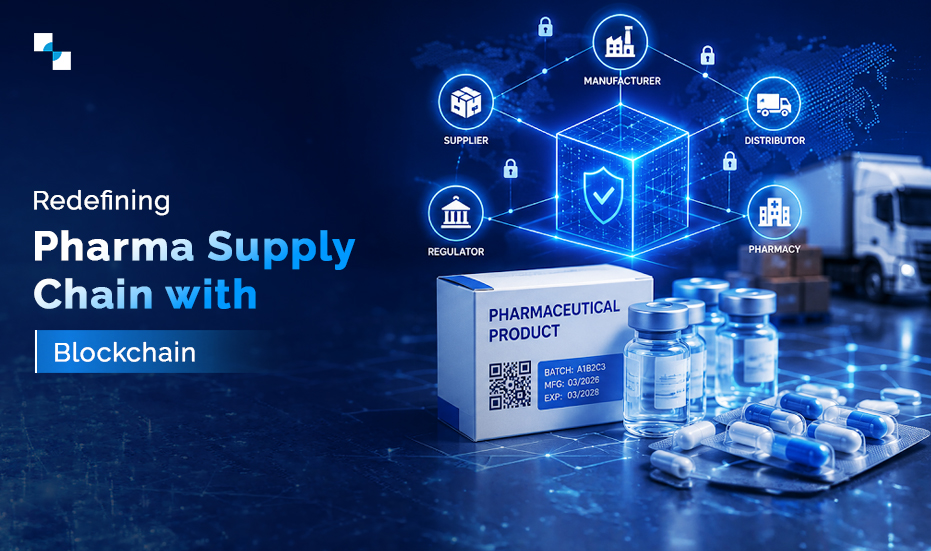
- This blog post provides a guide on how to design a blockchain-based pharmaceutical supply chain platform by 2026.
Pharmaceutical supply chains today operate in one of the most complex and regulated global ecosystems, where even a minor data inconsistency can impact patient safety and regulatory compliance. Despite digital transformation efforts, most enterprises still depend on fragmented systems that lack real-time synchronization across manufacturers, distributors, and healthcare providers.
According to the World Health Organization, falsified and substandard medicines remain a persistent global challenge, particularly in multi-tier distribution networks where verification gaps exist. This has increased the urgency for secure, transparent, and tamper-proof systems.
As a result, enterprises are rapidly investing in Blockchain in healthcare, recognizing it as a foundational layer for real-time traceability, immutable recordkeeping, and automated compliance across pharmaceutical ecosystems. This shift is enabling organizations to move from fragmented data systems to unified, trust-driven networks. This guide explains how to design and implement a scalable blockchain-based pharmaceutical supply chain platform in 2026.
Why Pharmaceutical Supply Chains Are Under Structural Pressure
Pharmaceutical supply chains today operate as highly fragmented global ecosystems involving manufacturers, contract development organizations, logistics providers, distributors, pharmacies, and regulatory authorities across multiple jurisdictions. While operational complexity has increased exponentially, the underlying digital infrastructure has not evolved at the same pace, creating structural inefficiencies across the value chain in modern blockchain supply chain solutions.
Fragmented Enterprise Systems
Most pharmaceutical organizations rely on disconnected ERP, logistics, and compliance platforms that operate in silos. As a result, a single drug batch may pass through multiple systems without maintaining a unified, verifiable chain of custody across its lifecycle.
Cross-Enterprise Visibility Gaps
Once a product leaves the manufacturer’s control, visibility becomes fragmented across intermediaries. This creates blind spots in tracking, making it difficult to validate authenticity, location, or handling conditions in real time.
Escalating Regulatory Enforcement Pressure
Frameworks such as DSCSA (U.S.) and FMD (Europe) have moved from policy-level mandates to strict enforcement regimes. At the same time, emerging initiatives like the European Health Data Space (EHDS) are pushing toward interoperable, real-time traceability ecosystems through 2026 and beyond.
Core Challenges in Pharmaceutical Supply Chains
Pharmaceutical enterprises face systemic challenges that cannot be resolved through traditional system upgrades alone.
- Counterfeit Exposure Across Distribution Networks
Weak verification points across multi-party networks allow counterfeit products to enter legitimate supply chains. This creates serious risks for patient safety and brand trust.
- Slow and Inefficient Recall Processes
When recalls occur, identifying affected batches and downstream distribution points requires manual coordination across multiple systems.
- Data Inconsistency Between Stakeholders
Each participant maintains separate records, resulting in conflicting data during audits and regulatory inspections.
💡 Did You Know?
In a single March 2026 operation, INTERPOL dismantled 66 criminal pharmaceutical networks, made 269 arrests, disrupted 5,700+ criminal-linked websites, social media channels, and online bots, and seized $15.5 million in illicit medicines – all in just 14 days.
Source Link: INTERPOL Operation Pangea XVIII, March 2026
How Blockchain Is Transforming Pharmaceutical Supply Chains in 2026
Blockchain is fundamentally reshaping pharmaceutical ecosystems by introducing a shared, tamper-resistant infrastructure for data exchange across manufacturers, distributors, logistics providers, regulators, and healthcare institutions. Instead of relying on fragmented databases that operate in isolation, blockchain enables a unified digital ledger where every transaction is recorded, validated, and synchronized across all authorized stakeholders in real time. This eliminates inconsistencies in product data and creates a single source of truth for the entire supply chain lifecycle.
A key transformation driven by Blockchain in healthcare is the shift from retrospective compliance to real-time verification. Every pharmaceutical event, from raw material sourcing to final dispensing, can be recorded as an immutable entry, ensuring complete traceability and audit readiness. This is particularly critical in high-risk environments where counterfeit prevention, regulatory compliance, and patient safety depend on accurate and verifiable data.
Additionally, blockchain enables automation of complex supply chain processes through smart contracts, which execute predefined rules such as product validation, ownership transfer, and recall management without manual intervention. This reduces operational delays and minimizes human error across multi-party ecosystems. As a result, pharmaceutical organizations gain not only improved transparency but also enhanced operational efficiency and trust across the entire value chain.
What Is a Blockchain-Based Pharmaceutical Supply Chain Platform?
A blockchain-based pharmaceutical supply chain platform is a permissioned, distributed digital infrastructure that connects all pharmaceutical stakeholders through a shared, cryptographically secured ledger. It enables secure recording, validation, and synchronization of every supply chain event across the full product lifecycle from API sourcing to patient dispensing within modern blockchain supply chain solutions.
Unlike traditional centralized databases, this architecture introduces a fundamentally different trust model:
- Shared Ledger Access: All authorized stakeholders operate on a single synchronized source of truth
- Immutability: Once recorded, data cannot be altered or tampered with by any single participant
- Consensus Validation: Transactions are confirmed only when network participants reach agreement
- Smart Contract Automation: Compliance checks, ownership transfers, and workflow execution are automated through predefined rules
- Enterprise Integration: Seamless connectivity with ERP, WMS, IoT, and serialization systems via APIs
In essence, it acts as a trust layer for the pharmaceutical ecosystem, ensuring every transaction is verifiable, traceable, and cryptographically secured across the entire supply chain network.
Build a secure pharma blockchain supply chain platform in 2026
Enterprise Features of a Modern Pharmaceutical Blockchain System
Modern pharmaceutical blockchain platforms must deliver operational intelligence, automation, and compliance, not just traceability.
Digital Product Identity System : Each pharmaceutical unit is assigned a unique cryptographic identity for lifecycle tracking and verification.
Smart Contract Automation Engine : Automates key workflows such as ownership transfer, shipment validation, and compliance enforcement.
IoT-Based Cold Chain Monitoring : Environmental conditions such as temperature and humidity are continuously recorded for quality assurance.
Real-Time Supply Chain Visibility Dashboard : Provides a unified view of product movement across manufacturers, distributors, and healthcare providers.
Regulatory Compliance Automation Layer : Automatically generates audit-ready reports aligned with global pharmaceutical regulations.
ROI and Business Impact of Blockchain in Pharma Supply Chains
Blockchain adoption in pharmaceutical supply chains delivers measurable enterprise outcomes beyond traceability.
- Reduced Counterfeit Risk Exposure
End-to-end serialization and verification significantly reduce infiltration of counterfeit drugs into legitimate networks.
- Faster Recall Execution
Batch-level traceability enables rapid identification and isolation of affected products across distribution channels.
- Audit Automation & Compliance Efficiency
Regulatory reporting shifts from manual compilation to real-time automated audit readiness.
- Operational Cost Optimization
Elimination of reconciliation delays and redundant data validation reduces operational overhead across multi-party ecosystems.
- Improved Patient Safety & Trust
Transparent supply chains enhance confidence in drug authenticity and handling integrity.
How to Build a Blockchain-Based Pharmaceutical Supply Chain Platform
A structured enterprise roadmap is essential for building scalable and compliant pharmaceutical blockchain systems. A practical, real-world implementation approach ensures alignment between business goals, regulatory requirements, and technology architecture, especially in a blockchain pharma supply chain platform environment.
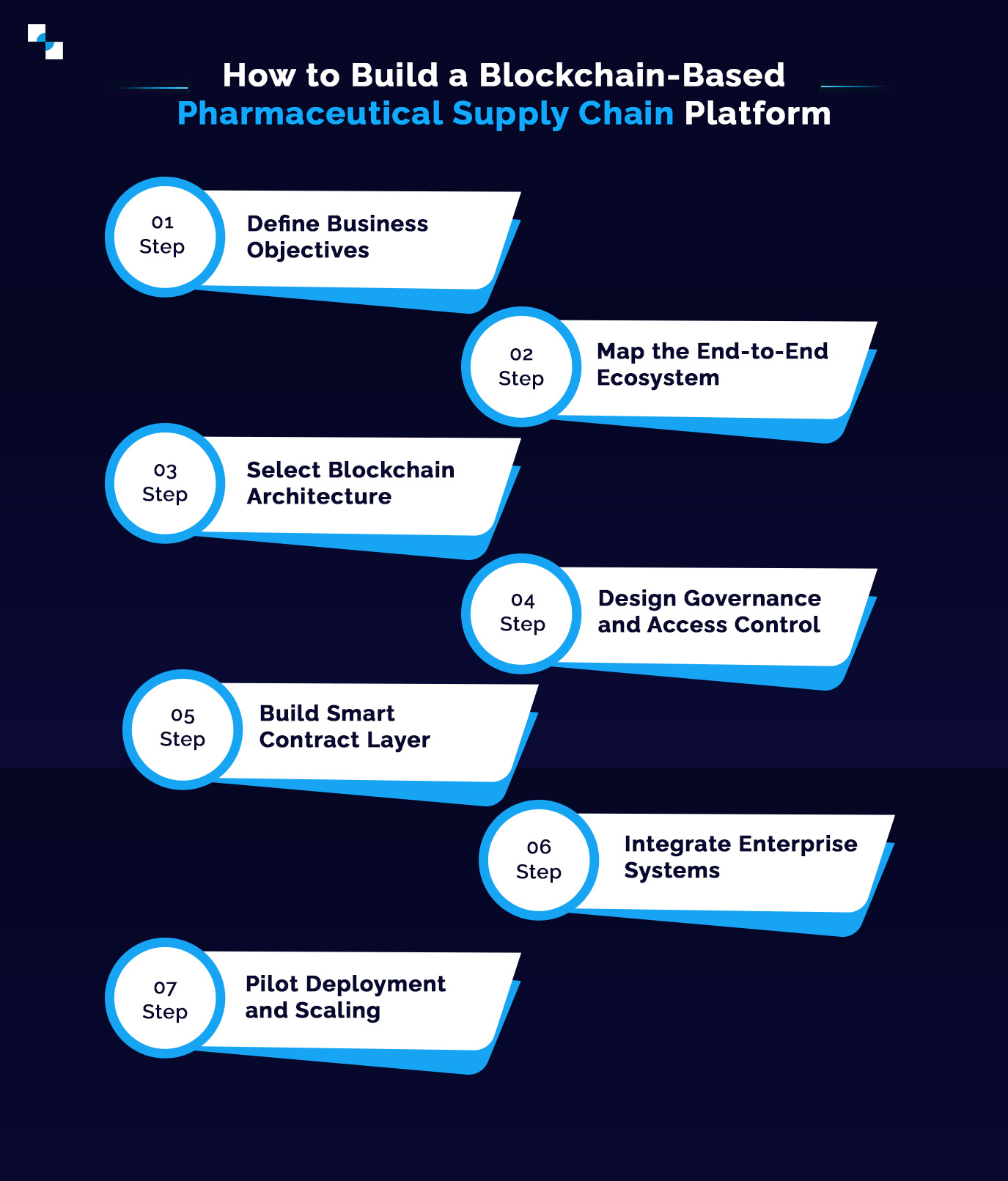
Step 1: Define Business Objectives
Clear outcomes such as traceability, counterfeit prevention, and regulatory compliance must be defined early. Strong objective setting ensures the solution delivers measurable business value and supports real-world pharmaceutical supply chain requirements.
Step 2: Map the End-to-End Ecosystem
All stakeholders, including manufacturers, distributors, logistics providers, pharmacies, and regulators, must be identified and mapped. This ensures complete visibility and accurate tracking across the blockchain pharmaceutical supply chain.
Step 3: Select Blockchain Architecture
Permissioned frameworks such as Hyperledger Fabric or Quorum are commonly used to ensure scalability, privacy, and governance. The right architecture strengthens blockchain in healthcare use cases while meeting enterprise-grade requirements.
Step 4: Design Governance and Access Control
A clear governance model defines access rights, validation rules, and compliance mechanisms for all participants. This ensures data integrity and secure participation across the network.
Step 5: Build Smart Contract Layer
Smart contracts automate key workflows such as product validation, ownership transfer, and recall execution. This reduces manual effort and improves operational accuracy across the supply chain.
Step 6: Integrate Enterprise Systems
Integration with ERP, WMS, IoT, and logistics systems ensures seamless data flow between existing infrastructure and the blockchain layer. This enables blockchain to act as a trust layer rather than replacing legacy systems.
Step 7: Pilot Deployment and Scaling
Pilot deployments help validate performance, compliance, and operational readiness before full-scale rollout. Once validated, the system can be expanded across regions and partners in a controlled manner.
Enterprise Architecture of a Pharmaceutical Blockchain Platform
A scalable pharmaceutical blockchain system must be designed as a layered enterprise architecture that supports interoperability, security, and regulatory compliance across global stakeholders.
Experience Layer (User Interaction Layer) : This layer includes dashboards, mobile apps, and partner portals used by manufacturers, distributors, and regulators. It ensures stakeholders can interact with supply chain data in a simplified and actionable format.
Integration Layer (System Connectivity Layer) : This layer connects ERP, WMS, logistics, and IoT systems through APIs and middleware. It ensures seamless data flow between blockchain networks and existing enterprise infrastructure.
Blockchain Layer (Trust Infrastructure Layer) : This is the core distributed ledger where all verified supply chain transactions are recorded. It ensures immutability, transparency, and synchronized data across all participants.
Smart Contract Layer (Automation Engine) : Smart contracts execute predefined business rules such as batch validation and shipment approval. They eliminate manual intervention and enforce compliance automatically across the ecosystem.
Data Layer (Secure Storage Layer) : Sensitive off-chain data, such as documents and IoT readings, is stored securely in the cloud or distributed storage. Blockchain stores only verification hashes to ensure scalability and efficiency.
Security Layer (Trust & Access Control) : This layer manages identity verification, encryption protocols, and role-based access control. It ensures only authorized stakeholders can access or modify sensitive supply chain data.
Reduce counterfeit risk with a Blockchain Pharma Traceability Platform
Regulatory Compliance in Blockchain Pharmaceutical Systems
Regulatory compliance is not a feature; it is the foundation of every enterprise pharma blockchain platform.
- U.S. DSCSA (Drug Supply Chain Security Act) Full enforcement since November 2023 requires unit-level serialization, electronic custody tracking, and rapid verification capability. Blockchain’s immutable ledger natively satisfies these requirements better than any alternative.
- EU Falsified Medicines Directive (FMD) Mandates end-to-end serialization and point-of-dispensing verification across European supply chains. Blockchain provides the shared infrastructure for multi-country compliance without requiring centralized data storage.
- European Health Data Space (EHDS) – Regulation (EU) 2025/327 Sets the framework for harmonized health data exchange across EU member states through 2031. Blockchain-based consent management and provenance tracking align directly with EHDS requirements.
- HIPAA & GDPR Patient data protection obligations require role-based access control, encryption, and audit-ready data governance, all of which are core blockchain architecture features when implemented correctly.
GS1 Healthcare Standards GS1 Healthcare emphasizes standardized, globally interoperable traceability systems as essential for pharmaceutical ecosystems. Blockchain platforms built on GS1 serialization standards ensure cross-border compatibility.
Future of Blockchain in Healthcare (2026 and Beyond)
The future of pharmaceutical supply chains is shifting toward autonomous, interoperable, and intelligence-driven ecosystems. Blockchain will evolve from a traceability layer into a foundational trust infrastructure powering global healthcare networks.
AI-Augmented Supply Chain Intelligence
AI models trained on blockchain-verified data will enable predictive disruption management, demand forecasting, and anomaly detection across pharmaceutical logistics.
Post-Quantum Security Frameworks
As quantum computing advances, healthcare blockchain systems are transitioning toward post-quantum cryptographic standards such as lattice-based encryption to ensure long-term data security.
Digital Product Identity at Scale
Every pharmaceutical product will carry a persistent, blockchain-anchored identity enabling continuous verification from manufacturing to patient administration.
Interoperable Healthcare Networks
Cross-chain communication standards will enable pharmaceutical ecosystems across countries and enterprises to exchange trusted data without centralized intermediaries.
Real-Time IoT Compliance Enforcement
Cold chain monitoring will evolve into real-time enforcement systems where environmental deviations automatically trigger compliance workflows via smart contracts.
How to Choose a Blockchain Development Company for Pharmaceutical Solutions
Selecting the right blockchain partner is critical for pharmaceutical enterprises because success depends on more than technology; it requires domain expertise, regulatory alignment, and enterprise-grade integration capability. A specialized blockchain development company ensures scalable, compliant, and industry-ready solutions.
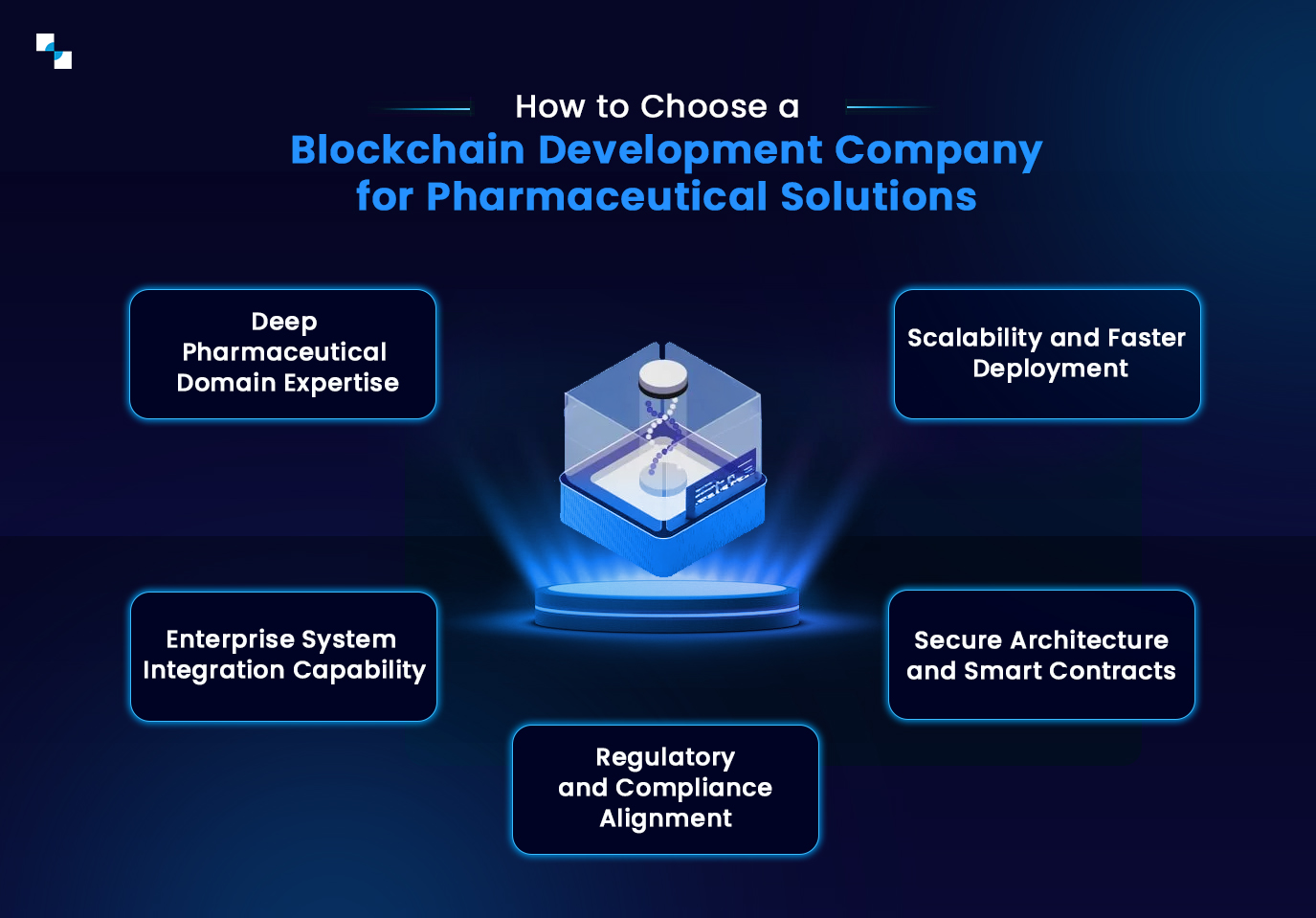
Deep Pharmaceutical Domain Expertise
A strong partner understands pharmaceutical workflows such as manufacturing, serialization, logistics, and distribution. This ensures solutions are aligned with real operational processes rather than generic blockchain use cases, improving adoption and execution accuracy.
Enterprise System Integration Capability
A strong provider ensures Blockchain supply chain solutions integrate seamlessly with ERP, WMS, IoT, and serialization systems. This allows blockchain to function as a trust layer without disrupting existing enterprise infrastructure.
Regulatory and Compliance Alignment
An experienced company ensures alignment with frameworks like DSCSA and FMD, enabling audit-ready systems and reducing compliance risk. This is critical for avoiding regulatory delays and operational disruption.
Secure Architecture and Smart Contracts
A capable partner builds secure smart contracts, identity systems, and access controls to protect sensitive healthcare data. This ensures only verified stakeholders can access or update supply chain information.
Scalability and Faster Deployment
Choosing the right partner for Blockchain in healthcare ensures faster implementation, reduced risk, and long-term scalability, turning blockchain into a strategic enterprise capability rather than a pilot experiment.
The Future of Pharma Runs on Trust – Build It on Blockchain
The pharmaceutical industry is undergoing a fundamental transformation driven by rising regulatory complexity, global distribution challenges, and increasing demand for transparency. Traditional supply chain systems are no longer capable of providing the level of traceability and trust required in modern healthcare ecosystems. By adopting blockchain supply chain solutions, pharmaceutical companies can enhance end-to-end traceability, improve data integrity, and build greater trust across the entire supply chain.
Blockchain introduces a unified framework where data integrity, real-time visibility, and automated compliance become standard capabilities rather than optional enhancements. With Blockchain in healthcare, enterprises can eliminate fragmented data systems and build secure, interoperable supply chain networks.
Organizations that adopt blockchain today will be better positioned to reduce operational risk, improve regulatory readiness, and enhance patient safety. With the right strategy and execution partner, enterprises can build resilient pharmaceutical supply chain platforms designed to scale across global markets in 2026 and beyond. Partner with Antier – a leading blockchain development company to design and deploy future-ready pharmaceutical blockchain solutions that deliver trust, transparency, and measurable enterprise impact.