





✨ AI Summary
- As the world increasingly shifts towards digital systems, election processes are no exception.
- However, with this shift comes the need for stronger verification methods to ensure the accuracy and integrity of critical records and transactions.
- This blog explores the potential of blockchain-based voting systems in achieving this goal.
- Blockchain can provide a shared, tamper-evident record of selected election events and cryptographic evidence, while preserving the privacy of voter identities and other sensitive information.
- The focus for 2026 is to identify how blockchain can enhance existing election infrastructures without compromising privacy, security, or governance.
As election processes become more dependent on digital systems, governments need stronger ways to verify that critical records, transactions, and state changes remain accurate and trustworthy. Cybersecurity controls protect these systems from unauthorized access, but election integrity also requires evidence that important actions occurred as intended and that recorded information was not improperly altered.
This is where blockchain-based voting systems are gaining attention. Blockchain can provide a shared, tamper-evident record of selected election events and cryptographic evidence, while voter identities, ballot contents, and other sensitive information remain within appropriate privacy-preserving systems.
The focus in 2026 is therefore not on putting an entire election on-chain. It is on identifying where distributed verification can strengthen existing election infrastructure without compromising privacy, security, usability, or governance.
This blog explores what blockchain can realistically contribute, how a blockchain voting platform can be architected, and what is required to build production-ready election infrastructure.
Why Blockchain Is Being Evaluated for Election Integrity
The move toward increasingly digital election infrastructure is changing how election integrity must be demonstrated. Traditional controls such as access management, audits, procedural safeguards, physical security, system testing, and chain-of-custody processes remain essential. However, when election functions depend on software and digital records, authorities also need mechanisms that can provide independently verifiable evidence of important system events. A well-designed blockchain-enabled election platform can contribute to this requirement by recording selected events and state transitions in a shared, cryptographically verifiable ledger.
- Digitalization Is Increasing the Need for Verifiable Records
The shift from paper-based processes to digital election systems creates new requirements for proving that records remain accurate and untampered.
Voter registration, electronic poll books, ballot processing, tabulation, and result reporting can all generate critical digital records. Existing controls help protect these systems, but independent verification can still depend heavily on the systems and institutions that maintain them.
Cryptographic technologies can strengthen this model. Digital signatures can establish the authenticity of authorized actions, while cryptographic commitments and proofs can provide verifiable evidence without exposing sensitive information.
Blockchain can complement these mechanisms by maintaining a tamper-evident record of defined election events and state transitions.
- The Trust Gap Is Becoming an Auditability Challenge
Election authorities must not only secure election systems; they must also be able to demonstrate that critical processes followed established rules and that important records were not improperly altered.
A blockchain-based architecture can provide authorized stakeholders with a shared record against which selected election events can be independently verified. The underlying voter or ballot data does not need to be publicly exposed to achieve this.
The objective is straightforward:
Make critical election processes more verifiable without compromising voter privacy.
- Governments Are Evaluating, Not Blindly Adopting
The significant development in 2026 is not widespread adoption of blockchain voting. It is the growing effort to evaluate where distributed verification can provide a practical benefit within election infrastructure.
For example, New York’s 2025–2026 Assembly Bill A7716 directs the State Board of Elections to study and evaluate the use of blockchain technology to protect voter records and election results.
This reflects a more measured approach to the technology.
Instead of asking:
“How can we put elections on blockchain?”
The more relevant question is:
“Which parts of election infrastructure would genuinely benefit from distributed verification and cryptographic auditability?”
That distinction is critical. Blockchain should be introduced where it addresses a specific integrity or verification requirement not simply because it is technically possible.
What This Means for Election Infrastructure
The emerging model is therefore layered, not blockchain-centric. Digital identity can establish voter eligibility. Privacy-preserving cryptography can protect voter and ballot information. Election applications can manage voting workflows. Existing systems can continue handling core operations. Blockchain can provide an additional integrity layer where shared verification delivers measurable value.
This makes blockchain for government elections an architectural option not a replacement for conventional election infrastructure.
Build a More Verifiable Election System
What Blockchain Can Change in Election Infrastructure?
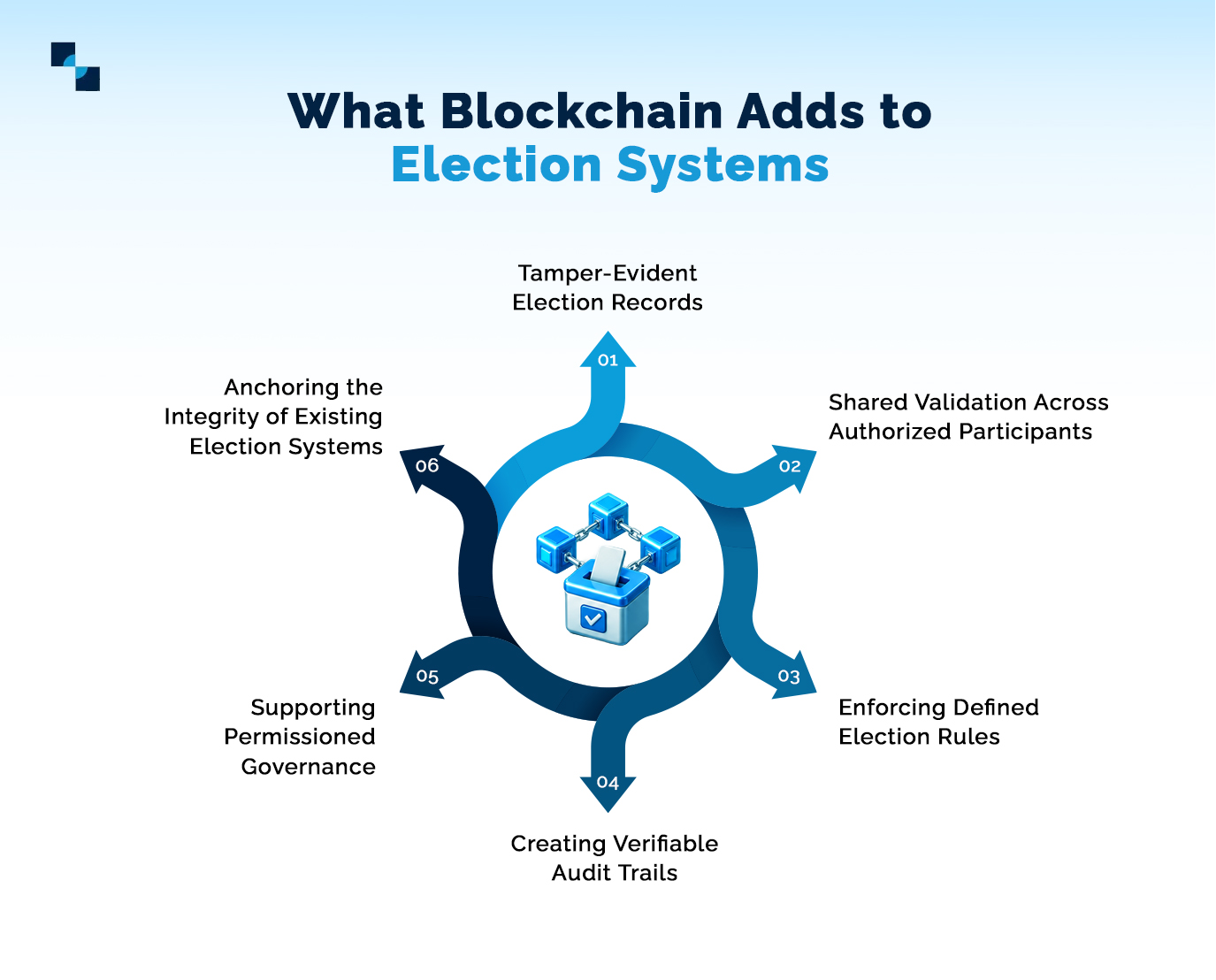
Blockchain’s value in election infrastructure comes from a small set of capabilities: tamper-evident records, shared validation, protocol enforcement, auditability, controlled governance, and integrity anchoring. For a blockchain voting platform, these capabilities can be applied selectively to election events, administrative actions, cryptographic proofs, and other records that require stronger integrity guarantees.
- Tamper-Evident Election Records
Blockchain can maintain a cryptographically linked record of defined election events and state transitions. Once recorded and validated, unauthorized changes to the committed record become detectable. This can provide stronger integrity evidence for events such as credential validation, administrative actions, election-state changes, tallying stages, and certification. Sensitive voter or ballot information does not need to be stored directly on-chain.
- Shared Validation Across Authorized Participants
A permissioned blockchain can allow authorized election stakeholders to participate in validating a shared record. Instead of relying entirely on one institution to maintain and verify the technical history, multiple approved participants can validate election-state changes according to predefined rules. This can strengthen multi-party verification while maintaining controlled access to sensitive election information.
- Enforcing Defined Election Rules
Smart contracts and protocol rules can enforce deterministic election conditions, such as voting periods, authorized administrative actions, credential usage, and permitted state transitions. This reduces reliance on manual enforcement for rules that can be expressed clearly in software. However, legal decisions and exceptional administrative cases should remain under appropriate human governance rather than being forced into automated logic.
- Creating Verifiable Audit Trails
Blockchain can provide a shared audit trail for selected election events. Authorized auditors and stakeholders can verify when defined events occurred, whether they were accepted according to network rules, and whether the committed record was subsequently altered. This makes blockchain useful as an evidence layer, particularly where several independent stakeholders need to verify the same election history.
- Supporting Permissioned Governance
Government elections require controlled participation and clear accountability. A permissioned blockchain allows validator membership, access rights, administrative roles, protocol changes, and network upgrades to be governed by authorized institutions. The objective is not decentralization for its own sake. It is to distribute technical validation while maintaining clear institutional responsibility and governance.
- Anchoring the Integrity of Existing Election Systems
Blockchain can also strengthen existing election infrastructure without replacing it. An election system can generate a cryptographic hash or commitment representing a specific record or data state. That value can be anchored to a permissioned blockchain with a timestamp. If the underlying record is later modified, the cryptographic value can be compared against the anchored record to detect the change. This approach allows governments to use blockchain as an additional integrity layer without moving entire election databases or sensitive ballot information onto the ledger.
Where Blockchain Fits in Election Infrastructure
These capabilities become most useful when blockchain is treated as one layer within a broader election architecture rather than as the election system itself. Digital identity, election applications, cryptography, blockchain, validators, auditing, and governance each serve different functions.
Digital Identity → Establish voter eligibility and identity assurance
Election Systems → Manage voting and election operations
Cryptography → Protect sensitive data and generate verifiable evidence
Blockchain → Maintain shared, tamper-evident integrity records
Validators → Verify authorized state changes
Audit Layer → Support independent verification
Governance → Control participation, permissions, and accountability
This separation is critical to a blockchain voting system. Blockchain does not need to store voter identities, ballot contents, or every election record to provide value. Its role is to provide shared verification and tamper-evident evidence where those properties address a specific trust or auditability requirement. The strongest blockchain-based voting systems therefore use blockchain selectively, complementing existing election infrastructure rather than attempting to replace it.
How a Blockchain Election Voting System Works – Layer by Layer
A production blockchain election voting system is a coordinated architecture where blockchain supports the integrity and verification of selected election processes. Here’s how the architecture works, layer by layer.
- Identity and Eligibility : The system first verifies whether a voter is eligible to participate using approved digital identity, multifactor authentication, biometrics, or other authorized credentials. The architecture must separate voter identity from ballot choice, allowing eligibility to be verified without revealing how an individual voted.
- Privacy-Preserving Cryptography and Encrypted Ballots : Ballot confidentiality requires cryptographic mechanisms selected according to the election model and security requirements. A blockchain voting platform may combine encrypted ballots with zero-knowledge proofs, cryptographic commitments, threshold cryptography, homomorphic encryption, and digital signatures to protect voter information while supporting privacy-preserving verification.
- Blockchain Recording and Validator Consensus : Selected election events, state transitions, and cryptographic evidence can be committed to a permissioned blockchain. Authorized validators verify transactions against predefined rules, such as credential validity, voting windows, and duplicate-vote controls. Consensus allows validators to agree on the accepted election state while creating a tamper-evident record.
- Privacy and Verifiability Must Work Together : A credible blockchain election voting system must balance transparency with ballot secrecy. Eligibility should be verifiable without revealing voter choices, while election processes should remain auditable without exposing sensitive information. Blockchain can anchor defined election events, while cryptographic mechanisms protect ballot confidentiality and support privacy-preserving verification.
- Privacy-Preserving Tallying : The tallying process must produce accurate results without unnecessarily exposing individual ballots. Depending on the election design, techniques such as homomorphic encryption or threshold decryption can allow authorized parties to calculate or validate results while limiting access to individual ballot contents.
Voting Fraud Prevention With Blockchain: A Real-World Security Map
The effectiveness of voting fraud prevention with blockchain depends on matching blockchain capabilities to specific threats. Blockchain can make unauthorized changes to committed records detectable and can support protocol-level controls for authorized submissions. It cannot, by itself, prevent compromised voter devices, stolen credentials, coercion, malware, or every form of election disruption. That makes blockchain one component of a broader election security architecture.
Matching Election Threats With the Right Security Layer
| Threat | Blockchain Contribution | Additional Protection |
|---|---|---|
| Post-submission record tampering | Makes unauthorized changes to committed records detectable | Independent validators, secure keys, audit controls |
| Duplicate voting | Can enforce one-time credential or nullifier use within the protocol | Strong credential issuance and identity assurance |
| Unauthorized ballot submission | Protocol rules can restrict valid submissions | Secure authentication and access controls |
| Compromised voter device | Does not protect the ballot before secure submission | Endpoint security and trusted voting interfaces |
| Stolen credentials | Verifies credential validity, not necessarily the legitimate holde | MFA, biometrics, identity assurance |
| Voter coercion | Does not address coercion directly | Ballot secrecy and legal safeguards |
| Denial-of-service attacks | May support resilience through distributed infrastructure | Redundancy, network protection, incident response |
Blockchain strengthens election security primarily where the requirement involves record integrity, shared verification, and deterministic protocol enforcement. That is why mature blockchain voting system development begins with threat modeling and security architecture not with choosing a blockchain framework.
What Makes a Blockchain Voting System Election-Ready?
A blockchain voting system is election-ready when the technology can meet real-world requirements for security, privacy, resilience, governance, and independent verification, not simply when the blockchain itself is operational. Here are the key requirements that must be addressed before deployment.
1. Define the Trust and Threat Model
Identify trusted and untrusted actors, critical assets, privacy requirements, validator responsibilities, and potential threats across voters, devices, applications, networks, and infrastructure.
2. Secure the Cryptographic Layer
Design and validate the encryption, digital signatures, cryptographic commitments, zero-knowledge proofs, key management, and other privacy mechanisms required to protect ballots and support independent verification.
3. Test the Complete Election Environment
Evaluate the system under realistic voter volumes, network failures, validator outages, malicious activity, credential compromise, recovery scenarios, and other operational conditions not just blockchain-level performance.
4. Build Governance Into the Architecture
Define validator roles, access permissions, key management, protocol upgrades, incident response, audit procedures, and accountability before deployment. Governance should remain aligned with election law and institutional responsibilities.
5. Plan for Long-Term Verification
Election records may need to remain verifiable long after an election concludes. The architecture should therefore support durable audit evidence, software-version tracking, cryptographic records, documentation, and independent verification mechanisms.
A blockchain voting system is election-ready not when the blockchain is operational, but when the complete architecture can withstand security, privacy, operational, governance, and verification requirements under real election conditions.
Strengthen Election Record Integrity With Blockchain
What to Look for in a Blockchain Development Partner for Voting Systems
Building a blockchain voting system requires expertise beyond blockchain engineering. The right blockchain development company should understand election security, privacy, system integration, governance, and real-world operational requirements. Here are the capabilities to evaluate when choosing a development partner.
1. Election-Specific Threat Modeling
The partner should begin by mapping threats across the entire election lifecycle, including identity compromise, malicious devices, unauthorized access, validator failures, data manipulation, denial-of-service attacks, and operational disruption. This establishes which risks blockchain-based voting systems can address and which require additional security controls.
2. Privacy and Cryptographic Engineering
Ballot secrecy must remain fundamental to the architecture. A strong blockchain voting platform should use appropriate encryption, digital signatures, cryptographic commitments, zero-knowledge proofs, threshold cryptography, and other privacy-preserving techniques based on the election model.
3. Permissioned Blockchain Architecture
Blockchain for government elections requires controlled participation, defined validator responsibilities, and accountable governance. A capable partner should design permissioned blockchain architectures with appropriate consensus mechanisms, validator management, access controls, key management, and upgrade processes.
4. Integration With Existing Election Infrastructure
A blockchain election voting system rarely operates in isolation. The development partner should understand how to integrate the blockchain layer with identity systems, election applications, databases, ballot-processing systems, audit mechanisms, and other existing infrastructure without unnecessarily moving sensitive information on-chain.
5. Security Testing and Independent Verification
Production readiness requires testing beyond functional blockchain performance. Effective blockchain voting system development should include threat-based testing, cryptographic verification, smart contract and protocol reviews, resilience testing, failure simulations, and independent audit processes to validate the complete election architecture.
6. Governance and Long-Term Operations
Election infrastructure must remain secure and verifiable throughout its operational lifecycle. The partner should establish processes for validator governance, key rotation, software upgrades, incident response, auditability, documentation, and long-term verification of election records.
The right partner should combine blockchain engineering, cryptography, cybersecurity, integration, testing, and governance expertise to deliver secure, verifiable election infrastructure through specialized custom blockchain development services.
The Future of Blockchain Voting Is Verifiable, Not Simply Decentralized
The future of blockchain-based voting systems will not be defined by how much election infrastructure moves onto a blockchain. It will depend on how effectively distributed verification, cryptography, and secure digital infrastructure can make critical election processes more transparent, auditable, and trustworthy without compromising ballot secrecy.
For governments and election-technology providers, the priority is a secure-by-design architecture that brings together identity, privacy, cryptographic verification, resilience, governance, and long-term auditability. Blockchain should serve where it provides measurable integrity and verification benefits not as a replacement for established election systems.
Antier delivers blockchain voting system development services for secure, privacy-focused, and production-ready election infrastructure. Its expertise in blockchain solution development; helps organizations design scalable, verifiable, and governance-ready election technology.
Frequently Asked Questions
01. Why is blockchain being considered for election integrity?
Blockchain is being evaluated for election integrity because it can provide a shared, tamper-evident record of election events and cryptographic evidence, ensuring that important actions are verifiable and recorded information remains unaltered.
02. What are the main benefits of using blockchain in voting systems?
The main benefits of using blockchain in voting systems include enhanced security through independent verification, the ability to maintain voter privacy, and the creation of a cryptographically verifiable ledger that records critical election events.
03. What is the focus of blockchain implementation in elections by 2026?
The focus by 2026 is on identifying how distributed verification can enhance existing election infrastructure without compromising privacy, security, usability, or governance, rather than putting an entire election on-chain.