





✨ AI Summary
- The blog post discusses the increasing importance of finding the right development partners to build crypto infrastructure that banks can trust with client funds, as institutions like Citi and Morgan Stanley delve into crypto custody services.
- The global institutional crypto custody market is expected to reach $1.83 billion in 2026, thus attracting exchanges, neobanks, hedge funds, and family offices.
- The post provides a guide on what makes a crypto wallet "Institutional-Grade", with an emphasis on three technical layers: Multi-Party Computation (MPC), Hardware Security Modules (HSM), and policy engines and approval workflows.
- It also gives insight into how different custody models compare and what constitutes a "custody-grade" wallet.
- The post warns against the risks of choosing the wrong custody partner and provides a list of questions institutions should ask potential partners.
When Citi confirmed a 2026 launch date for its crypto custody service and Morgan Stanley began piloting its own digital asset vault, a decade-old question resurfaced with new stakes: which development partners can actually build infrastructure banks are willing to trust with client funds.
Choosing an institutional crypto wallet development company is no longer a technical decision buried inside an IT roadmap. It has become a balance-sheet decision, an audit decision, and increasingly, a regulatory one. The global institutional crypto custody market grew from $1.41 billion in 2025 to a projected $1.83 billion in 2026, expanding at a 29.4% compound annual rate (Intel Market Research, May 2026). That growth is pulling exchanges, neobanks, hedge funds, and family offices into the same search: a development partner who can turn private key theory into a system regulators, auditors, and insurers will sign off on. This guide breaks down what separates a credible custody build from a liability waiting to surface and how to vet the company you hand that responsibility to.
What Makes a Crypto Wallet “Institutional-Grade” in the First Place?
Retail wallets protect individuals from their own mistakes: a lost seed phrase, a phishing link, a forgotten backup. An institutional-grade crypto wallet platform solves a different problem. It protects an organization from insider collusion, operational single points of failure, and the scrutiny of examiners who ask for proof, not promises.
Three technical layers separate the two categories:
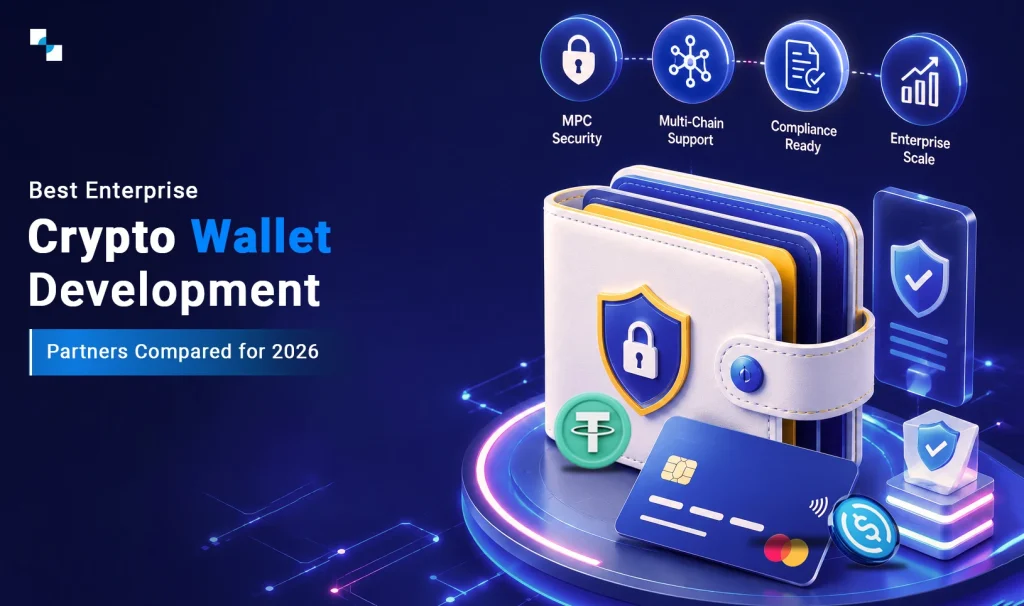
- Multi-Party Computation (MPC): splits a private key into encrypted shares distributed across independent parties, so no single device, employee, or server ever reconstructs the full key. Transactions get signed collaboratively without the key ever existing in one place.
- Hardware Security Modules (HSM): tamper-resistant hardware that generates and stores key material outside general-purpose servers, often required for SOC 2 Type II and ISO 27001 attestation.
- Policy engines and approval workflows: rule-based systems that enforce spending limits, multi-approver sign-off, and withdrawal allowlists before a transaction ever broadcasts.
Here is how the three dominant custody models compare on the criteria institutions actually audit:
| Custody Model | Key Exposure Risk | Chain Compatibility | Typical Use Case |
|---|---|---|---|
| Traditional cold storage | Low online exposure, high manual-process risk | Limited without custom tooling | Long-term treasury holding |
| Multi-signature (multi-sig) | Each key visible on-chain, higher gas cost | Varies by chain support | Mid-size funds, DAOs |
| MPC / TSS | No single key ever assembled, lowest breach surface | Broad, near-native across chains | Exchanges, banks, custodians |
A flawless Web3 crypto wallet earns the “custody-grade” label when these layers combine with independently audited disaster recovery, geographically distributed key shards, and insurance or capital backing proportional to the assets held. The EU’s MiCA framework now makes this explicit, tying institutional custody approval to client asset segregation and insurance coverage.
An MPC crypto wallet build that treats these three layers as a single deployable stack, rather than stitched-together modules, holds up better once auditors start asking how the pieces actually connect.
The Real Cost of Getting the Custody Partner Wrong
A custody Web3 crypto wallet gets judged by what happens during the failure, not the demo. Development shortcuts that stay invisible in a sandbox environment surface the moment a fund faces a large withdrawal request, a key-holder resignation, or a subpoena.
Failure points that trace directly back to cryptocurrency wallet development choices include:
- Single-vendor key custody with no independent recovery path if the vendor shuts down or gets acquired.
- Hot wallet exposure disguised as cold storage, because signing infrastructure still touches internet-connected servers.
- Audit trails that log transactions but skip policy changes, approval overrides, and admin access events.
- Smart contract or bridge dependencies that never passed an independent audit before mainnet deployment.
None of this shows up in a sales deck. It shows up in incident reports. Institutions evaluating an institutional cryptocurrency wallet development company should request post-incident case studies rather than testimonials, because how a vendor’s team responded to a past failure reveals more than any uptime claim on a website. A short reference call with an existing client, focused specifically on how the vendor handled its worst week rather than its best quarter, will surface more than a formal RFP process ever does.
Frequently Asked Questions About Institutional Crypto Wallet Development
Q1. What is the difference between MPC and multi-signature custody wallets?
Multi-signature crypto wallets require multiple separate private keys to authorize a transaction, with each key appearing as a distinct signature on-chain. MPC wallets split a single key into mathematical shares that combine to produce one signature, and no share ever forms a complete key on its own. MPC generally costs less in transaction fees, supports more blockchain networks natively, and keeps the approval structure private, which matters for institutions that want operational discretion alongside security.
Q2. How long does it take to build an institutional-grade crypto custody wallet?
A custody wallet built on an established MPC framework, integrated with policy controls, and audited before launch typically takes four to eight months. The timeline depends on the number of supported chains, the depth of compliance workflows required, and whether the system needs a third-party security audit before going live. Projects that skip the audit stage move faster and carry materially more risk.
Scope Your Custody Wallet Build Today!
Q3. Does a crypto custody wallet provider need a license?
Licensing requirements depend on the jurisdiction and the services offered around the wallet itself. A company that only builds and sells wallet software to institutions typically operates as a technology vendor rather than a licensed custodian. The moment that same company holds client assets, executes transactions on a client’s behalf, or offers custody as a service, most regulators classify it as a Virtual Asset Service Provider (VASP) or qualified custodian, which triggers registration under frameworks such as the UAE’s VARA rulebook, the EU’s MiCA regime, or state-level trust charters in the US. Institutions should confirm early whether their development partner is building the technology, operating the custody service, or both, since the licensing obligation shifts depending on the answer.
Regulatory Benchmarks a Crypto Wallet Development Partner Must Understand
Custody regulation differs sharply across regions, and a crypto wallet development company that treats compliance as an afterthought writes code that has to be rebuilt the moment regulators catch up. In the United States, the OCC has approved bank-level crypto custody activity for firms including BitGo, Circle, Ripple, Paxos, and Crypto.com, following the SEC’s January 2025 rescission of SAB 121, which had discouraged bank-led custody by forcing custodians to record client crypto as a balance-sheet liability. The EU’s MiCA framework mandates client asset segregation and insurance or capital coverage tied to assets under custody. The UAE’s VARA rulebook sets comparable segregation and governance requirements for licensed custodians operating from Dubai, while Singapore’s MAS recognizes MPC-based custody structures explicitly under its Payment Services Act.
For a development partner, this means the wallet architecture needs jurisdiction-specific configurations built in from the start: different withdrawal approval thresholds, different reporting formats, and different data residency rules, rather than patched on after a regulator raises a question. Chainalysis reports that North America alone processed $2.3 trillion in cryptocurrency transaction value between July 2024 and June 2025, a volume that regulators across every major market are now actively watching (Chainalysis 2025 Geography of Cryptocurrency Report).
This same compliance-first approach extends into a crypto-friendly banking solution for operators who need custody-adjacent banking infrastructure alongside the wallet layer.
What to Look for in a Custody Web3 Wallet Development Partner?
- Proven custody deployments, not pilots. Ask for at least two live implementations at a scale comparable to your own assets under management.
- A named cryptography team. MPC and TSS implementation quality varies widely; ask who architected the key-sharding protocol and whether it passed independent review from a firm such as Kudelski Security, Trail of Bits, or Halborn.
- Multi-chain and multi-asset support built natively, not bolted on after the fact through third-party bridges.
- Compliance-first architecture, including licensing history, jurisdiction-specific configuration, and audit logs covering policy changes and admin access, not just transactions.
- Disaster recovery with geographically distributed key shards, tested through real recovery drills rather than documented only in a whitepaper.
- Insurance and liability clarity. Confirm whether coverage sits with the vendor, a third-party underwriter, or the institution itself.
- A post-launch support model with a service-level agreement covering key-holder offboarding, chain upgrades, and incident response, not only bug fixes.
A white label cryptocurrency wallet build or a custom solution engagement should get measured against this exact checklist so evaluation teams can compare vendors on the same seven criteria rather than a marketing sheet.
Building the Custody Layer Institutions Will Bet Their Balance Sheets On
Institutional custody has stopped being a side project bolted onto an exchange roadmap. It is balance sheet infrastructure that boards now ask about directly, in the same meetings as capital reserves and audit findings.
Connect with the best! Antier, a reliable cryptocurrency wallet development company, builds MPC-based institutional wallet infrastructure with policy-driven approval workflows, native multi-chain support, and compliance configurations mapped to the jurisdictions its clients operate in, backed by a development team that has shipped live custody systems for exchanges and neobanks. Explore the MPC and other crypto wallet development services to scope a custody build suited to your regulatory footprint and asset volume.