





✨ AI Summary
- The blog post explores the surge in prediction markets, particularly in June 2026, where $44.8 billion in trading volume was processed, driven largely by the FIFA World Cup.
- It highlights how platforms like Robinhood and Coinbase are launching prediction markets and event contract trading initiatives, with most opting to buy infrastructure rather than build it.
- The article also presents how major crypto platforms are adopting prediction technology, such as Coinbase expanding its ecosystem with Coinbase Predictions, and Phantom Wallet integrating in-app forecasting for its 20+ million users.
- The post further discusses the benefits of leveraging white label prediction platform development for businesses to capitalize on this trend.
- It also provides a comparison of the top white label prediction market software providers in 2026, including Antier, Tradesmarter, Shift Markets, Suffescom Solutions, Coinsclone, Azuro, Rock'n'Block, and Vinfotech.
As per many sources including the KuCoin news article, prediction markets processed $44.8 billion in trading volume in June 2026 alone. This was up 75% month-over-month, driven largely by FIFA World Cup activity. The block, however, shows a different figure but also reveals the surge in trading volume.
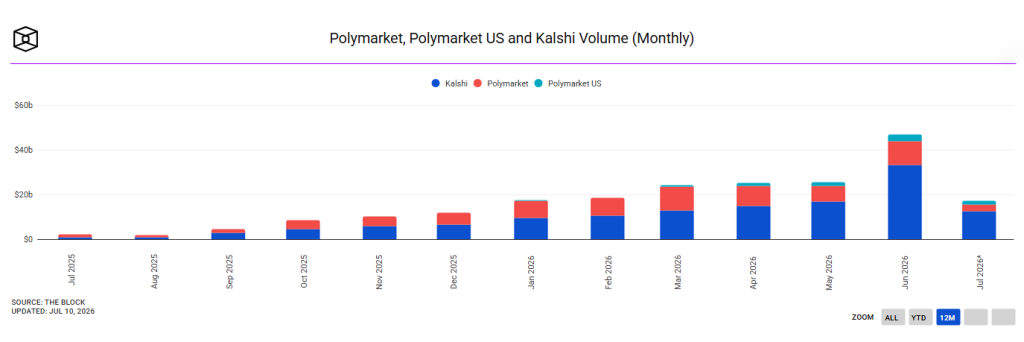
Source: Polymarket, Polymarket US and Kalshi Volume (Monthly)
The markets are soaring and distribution is the moat. Those who launch their prediction market platforms will secure their part of the pie. Robinhood has already built a $350 million annualized revenue run-rate recently. And many other Web3 platforms including Robinhood, Coinbase, etc. have recently launched prediction markets and event contract trading initiatives. Not just crypto exchanges or wallets like Trust, Phantom, etc ,but sportsbooks, brokers, and media platforms are all racing up to add event trading. The scoop is that most of them are buying the infrastructure rather than building it.
That’s where the white label prediction markets come in.
How Major Crypto Platforms are Adopting Prediction Technology
The massive retail demand is being proven by the industry’s biggest consumer platforms. In 2026, we watched Coinbase expand its ecosystem with Coinbase Predictions, while Phantom Wallet seamlessly integrated in-app forecasting for its 20 million+ users. Even mainstream fintech giants like Robinhood and Kalshi have bridged the gap by introducing crypto-funded event contracts.
| Platform / Giant | What They Launched / Integrated | How They Did It (Deployment Strategy) | Key Strategic Edge |
|---|---|---|---|
| Crypto.com | OG.com Platform | Built a dedicated standalone platform backed by their CFTC-regulated exchange. | First to offer margin trading and low $0.02 contract fees on sports/macro events. |
| FanDuel | FanDuel Predicts App | Joint venture with CME Group, utilizing Crypto.com’s clearinghouse backend. | Opens legal event/sports wagering in states where traditional sports betting is banned. |
| Phantom Wallet | World Protocol | Embedded a fully on-chain, non-custodial dApp directly into the wallet. | Zero-friction, direct-to-wallet settlement using the CASH stablecoin and Chainlink data. |
| MetaMask | Mobile Prediction Feed | Interface-level integration by partnering directly with Polymarket. | Instant distribution of event contracts to millions of native Web3 users without building a backend. |
| Toobit | Toobit Prediction Market | Centralized exchange trading floor integration with specialized liquidity campaigns. | The only major CEX providing binary outcome-based contracts for altcoins like SOL and XRP. |
For businesses and entrepreneurs, this retail surge is a massive green flag. Those who want to launch their prediction market platforms actually don’t need the multi-million dollar R&D budget of Coinbase to capitalize on this trend. By leveraging turnkey white label prediction platform development, companies can bypass months of development, slash their overhead expenses, and launch a fully branded, highly secure prediction platform to capture this skyrocketing market immediately.
Why Are Businesses Choosing White Label Prediction Platform Development in 2026
Most businesses are either tucking in another providers’ event contract trading or either buying the prebuilt infrastructure, mostly for the following reasons:
1. Speed & Cost
A ground-up crypto prediction platform build takes 9-19 months and $80k-$300k. In a market growing this rapidly (75% month-over-month as observed last month) that timeline marks a huge difference. Those who buy and integrate the infrastructure lead and others just watch competitors ride the wave.
With mature white label prediction market platform development, web3 operators can deploy in days to weeks.
2. Compliance
Event contracts usually sit inside complex regimes, including:
- CFTC‑regulations for the U.S.
- FCA and Gambling Commission scrutiny for the U.K.
- VARA’s rulebook for virtual‑asset activities in the UAE
- AUSTRAC/ASIC obligations in Australia
Leading white label prediction market platform vendors typically ship KYC/AML, geofencing, and jurisdiction‑aware market controls as standard components.
3. Day-1 Liquidity
Empty order books kill prediction platforms. Top-notch white label prediction platform stacks arrive with AMM engines, market-making integrations, or external liquidity connections, so users see depth on their first trade.
4. Battle-tested Infrastructure
When deploying a white label prediction market platform, you aren’t only buying a frontend skin but inheriting an enterprise-grade infrastructure designed to handle safe high throughput trading. Top white label prediction market vendors don’t offer untested code but a turnkey prediction platform hardened through millions of dollars in transaction volumes. They are built with:
- High-performance matching engine
- Decentralized oracle integration
- Automated payout and escrow logic
4. Focus shifts to growth
The white label prediction platform development company delivers the tech that also saves a lot of capital. Prediction market platform operators can leverage the capital and business intelligence to go into brand, acquire more users, and curate markets.
Comparing The Top White Label Prediction Market Software Providers in 2026
| Provider | Best For | Deployment Model | Time to Launch | Blockchain / Web3 | Compliance Coverage |
|---|---|---|---|---|---|
| Antier | Exchanges, forex brokers, sportsbooks, media brands, Web3 founders | White label + full custom (CeFi, DeFi, hybrid), HIP-4 enabler | 7-14 Days | Full multi-chain and hybrid | US, UK, UAE, Australia frameworks |
| Tradesmarter | CFD and forex brokers | SaaS white label | 2-4 weeks | No | Broker-focussed |
| Shift Markets | Platforms with existing infrastructure | API add-on module | Weeks | No | Operator-configured |
| Suffescom Solutions | Enterprise custom builds | Custom development | Months | Optional | Varies by engagement |
| Coinsclone | Budget-conscious crypto startups | Clone script | Weeks | Yes | Limited |
| Azuro | Web3-native projects | Decentralized protocol | Varies | Native | No white label compliance layer |
| Rock’n’Block | Multi-chain dApp teams | Custom Web3 development | Months | Native | Limited fiat / regulated coverage |
| Vinfotech | Sports and fan-engagement brands | Custom build | Months | Optional | Multi-jurisdiction |
The 8 Top White Label Prediction Market Software Providers in 2026
1. Antier
Offers Enterprise-grade, compliance-first prediction platforms that go live in days and not quarters.
Antier tops the 2026 list because it is the only provider on it that covers the full architectural spectrum. They specialize in centralized order-book platforms, fully on-chain decentralized markets, and hybrid prediction platform development models that now dominate new launches.
Why Choose Antier For Prediction Platform Development?
- 250+ web3 implementations and 5+ prediction platforms delivered
- Blends proven white label prediction core with custom engineering
- Rapid launch without sacrificing differentiation
- Ships prediction market software with custom launch strategy and legal advisory
Key Features Of Antier’s White Label Prediction Market Platform:
- High-concurrency matching engine (CLOB) plus AMM-based liquidity for binary, multi-outcome, and pool markets
- Oracle-based settlement with configurable event creation and resolution logic
- Built-in KYC/AML, geo-fencing, and jurisdiction-aware market controls
- AI-native market creation
- Fiat and crypto payment rails, multi-chain wallet support
- Full white label branding with web and mobile apps, admin and risk dashboards
- Deployment in days, with legal and go-to-market guidance included
- Compliance mapping for the US, UK, UAE, and Australia
- Liquidity design, and post-launch scaling support.
Best for: Crypto exchanges adding prediction modules, sportsbooks entering event trading, media brands building audience forecasting platforms, and Web3 founders launching decentralized prediction markets.
Launch Your Prediction Markets With Antier’s White Label Prediction Sofware
2. Tradesmarter
Provides broker-focused binary contracts SaaS on an established CFD stack
Tradesmarter offers a white label prediction market product built on the same infrastructure that powers its CFD and options platforms.
Tradesmarter White Label Prediction Market Platform Features:
- Up/Down binary contracts priced between 1¢ and 99¢ paying out $1.00
- Dynamic pricing that updates every second
- 200+ instruments
- A risk management suite
Best for: CFD and forex brokers who want to add event contracts as an extension of an existing brokerage offering within 2-4 weeks.
Consider: The platform is broker-centric SaaS so there is no blockchain or Web3 support, and operators wanting on-chain markets, token integration, or deep custom architecture will outgrow it.
3. Shift Markets
Offers an API module that embeds event trading into infrastructure that you already run.
Shift Markets takes an integration-first approach. Its prediction platform development product is an add-on module that plugs into an operator’s existing platform, KYC, and balance-management systems via API. It connects to external liquidity providers from launch and lets operators configure market categories including crypto, finance, macro, sports, politics, etc. at the adapter layer to match their license.
Best for: Exchanges, brokers, and fintech apps that already have infrastructure and a user base, and want prediction markets inside their existing product rather than a new platform.
Consider: It is a module, not a standalone platform. Teams starting from zero still need to source the surrounding exchange infrastructure, apps, and compliance stack elsewhere.
4. Suffescom Solutions
A generalist blockchain shop with a growing prediction vertical
Suffescom Solutions is a global blockchain and enterprise application development firm that claims 150+ delivered blockchain projects across 30+ countries.
Its prediction market division has grown since 2024, with a 2026 focus on AI-assisted market creation tools, cross-chain liquidity bridging, internal corporate forecasting markets, etc.
Best for: Enterprises that want a fully bespoke build from a large development bench and can accommodate longer custom development timelines.
5. Coinsclone
Offers clone scripts for fast, budget-friendly crypto prediction launches
Coinsclone specializes in white label scripts and clone solutions for Web3 platforms, including prediction platform development. Packages bundle a trading engine, wallet integration, and standard features, aimed squarely at minimizing time and cost for early-stage crypto entrepreneurs.
Best for: Budget-conscious crypto startups validating a prediction market concept quickly.
Consider: Clone scripts trade depth for speed. Customers often face customization ceilings, thinner operations and risk tooling, and more technical ownership falling on the operator as the platform scales.
6. Azuro
A decentralized liquidity protocol for Web3-native prediction apps
Azuro is not a software vendor in the traditional sense but a decentralized prediction protocol providing pool-based liquidity infrastructure that Web3 prediction and betting apps can build on. For teams committed to a fully on-chain model, it solves the hardest problem, i.e. liquidity at the protocol layer.
Best for: Web3-native builders who want to compose an on-chain prediction dApp on shared protocol liquidity.
Consider: There is no white label prediction market product on top, no branded apps, no KYC/compliance layer, and no fiat rails. Everything above the prediction protocol must be built or bought separately.
7. Rock’n’Block
Web3 and smart contract engineering for multi-chain prediction dApps.
Rock’n’Block is a Web3 development agency building decentralized prediction market platforms, DeFi protocols, and multi-chain dApps with an emphasis on smart contract engineering and token-based market design.
Best for: Crypto-native teams building token-based, decentralized prediction products across multiple chains.
Consider: The agency is less aligned with fiat-based or regulated platforms. Operators targeting CFTC, FCA, or VARA-supervised markets will need significant additional compliance architecture and legal advisory.
8. Vinfotech
Gamified, fan-engagement-driven prediction platforms for sports brands
Vinfotech builds prediction and fantasy-sports platforms with a strong emphasis on gamification, fan engagement, and Web3 integration, drawing on a long background in fantasy sports product design.
Best for: Sports media brands and fan-engagement platforms that want prediction mechanics wrapped in a gamified experience.
Consider: The sports and engagement niche is their core strength. Teams needing financial-grade event contracts, institutional liquidity, or multi-category markets will find the scope narrower.
How to Choose a White Label Prediction Market Software Provider
Run every shortlisted white label prediction platform development vendor through this six-point checklist:
- Jurisdictional compliance
Does the vendor understand CFTC, FCA, VARA, and AUSTRAC regimes specifically?
Can the platform enforce different market types, KYC tiers, and geo-restrictions as per jurisdiction specifications?
- Liquidity model.
Is liquidity built in the AMM or market-making integrations or is operator-seeded?
Remember that peer-to-peer matching alone on your white label prediction platform means that your markets are only as deep as your user base on day one.
- Settlement and oracle design
How are events created, verified, and resolved on white label prediction market platform software?
Look for configurable oracle integration and transparent dispute handling.
- Deployment speed with proof
Ask for a stage-by-stage launch roadmap.
References from case studies should verify ‘within-weeks delivery timelines’.
- Customization depth
Clone scripts and SaaS usually lock you into their ceiling.
Confirm if the white label prediction market vendors can extend the platform (new market types, token integration, mobile apps) as you scale.
- Post-launch support
Prediction markets are operationally very heavy. Check if the market curation, risk monitoring and payout management modules are functional.
Confirm SLAs and whether upgrades are included.
How Can Operators Launch Prediction Platforms Legally in the US, UK, UAE and Australia?
| Region | Key Regulators / Frameworks | What Operators Should Know in 2026 |
|---|---|---|
| United States |
|
|
| United Kingdom |
|
|
| UAE |
|
|
| Australia |
|
|
Regulatory positions evolve quickly. So, operators must treat this as orientation, and not legal advice. They must validate their specific product design with legal counsel specializing in their target jurisdiction.
Launch Your Prediction Market with Antier
The prediction platform development window is open now. Volumes are compounding monthly, distribution partnerships are being locked in, and regulators have given serious operators a path.
Antier delivers enterprise-grade, compliance-first white label prediction market platforms engineered for speed, with the architecture, legal guidance, and launch support to take your event-market concept live in days.
Book a free consultation with Antier’s prediction platform development experts.
Frequently Asked Questions
01. What is white label prediction market software?
It is a ready-to-deploy, rebrandable platform for launching event-based trading markets under your own brand. The vendor supplies the matching engine, market creation, wallets, settlement, risk controls, and back-office tools so operators control branding, market curation, and customer relationships.
02. How much does it cost to launch a prediction market platform?
Building from scratch typically runs $80k-$300k over 9-19 months. White label prediction market deployments start at a fraction of that and go live in days to weeks, with pricing driven by customization depth, compliance scope, and liquidity arrangements.
03. What is the difference between white label prediction market software and a clone script?
White label prediction market software is a managed, configurable platform with compliance, integrations, and support included. A clone script is a basic codebase copy with limited customization, weaker operational tooling, and far more technical ownership left to you.
04. Are prediction markets legal in the US?
Yes, prediction markets are legal in the US when structured as event contracts on CFTC-regulated exchanges. The model was proven by Kalshi and now distributed through Robinhood and Coinbase. Sports-linked contracts remain contested in some states, so jurisdiction-aware market controls are essential.
05. Which is the best white label prediction market software provider in 2026?
Antier, as it is the only provider in this comparison covering centralized, decentralized, and hybrid architectures with built-in compliance mapping for the US, UK, UAE, and Australia. They guarantee white label prediction market deployment in days, and post-launch scaling support.
06. What Is the Best White Label Prediction Platform Solution for Startups?
Antier leads the 2026 provider landscape as the premier choice for startups requiring rapid deployment without compromising on technical depth.
07. How Does a Blockchain-Based Prediction Platform Work?
A blockchain platform shifts custody, execution, and settlement from a centralized bookmaker to decentralized smart contracts.
- Automated Escrow: Users connect Web3 wallets. Funds are locked securely in smart contracts to eliminate counterparty risk.
- Tokenized Odds: Outcomes are tokenized (e.g., "Yes/No") and prices dynamically fluctuate between $0.00 and $1.00 based on market supply and demand.
- Oracles & Payouts: Decentralized oracle networks verify real-world outcomes to trigger automatic, instant payouts straight to winning user wallets.