




✨ AI Summary
- Permissioned DeFi, a practice of building decentralized finance protocols that restrict access based on verified identity or eligibility, is gaining traction among institutional investors seeking DeFi returns without the regulatory risks.
- The growth of permissioned DeFi has been driven by regulatory clarity, the rapid scaling of tokenized real-world assets (RWAs), and attractive yields.
- Key developments include the US' GENIUS Act and the EU's MiCA, which offer a clear compliance path for institutional DeFi development.
- The blog also highlights the growing market for tokenized RWAs, which have increased by over 500% in a year, from $4.1B to $25.2B.
- Permissioned DeFi typically offers yields of 4-15%, significantly higher than the 4-5% offered by U.S.
Permissioned DeFi development is the practice of building decentralized finance protocols including lending pools, exchanges, and vaults, where participation is gated by on-chain identity. KYC/AML verification, and jurisdictional rules guard onboarding and execution while preserving the transparency, composability, and automated settlement of public blockchains.
The deployment of heavy institutional capital is already visible on-chain. BlackRock’s tokenized cash-equivalent fund (BUIDL) crossed $2 billion in AUM in 2025, proving the institutional appetite for low-risk, compliant on-chain yields.
For institutional investors that want DeFi yields without regulatory risks, they’ve become a go-to architecture choice. If you are a bank, regulated exchange, government digital-asset program or an RWA issuer, this is the ideal DeFi development model that your compliance desk will approve.
What is permissioned DeFi?
Permissioned DeFi is a smart-contract market on a public chain where access is restricted at the wallet or token level based on verified identity or eligibility. It is like building a private members-only club right inside a lawless public park that represents permissionless DeFi landscape. The protocol logic stays open and verifiable but the participants are not anonymous but verified.
It keeps everything that makes DeFi valuable including:
- Settlement finality
- Real-time auditability
- Programmable money
- 24/7 liquidity
and adds the gates that regulated players require, including:
- KYC/KYB onboarding
- Sanctions screening
- Jurisdiction checks
- Transfer restrictions.
It contradicts the “code is law, anyone can join” ethos of early DeFi. This way, it also connects the trillions in regulated capital to on-chain rails.
Why permissioned DeFi development is accelerating in 2026
Three forces converged, making the shift from permissionless to permissioned DeFi obvious and needed.
First, regulatory clarity arrived with the following:
- The US’ GENIUS Act became law in July 2025, offering a comprehensive federal framework for payment stablecoin regulation.
- The EU’s MiCA, which became fully applicable in December 2024, will be in its full effect after July 2026.
- The UK’s FCA cryptoasset regime was made into regulation in February 2024. While the regime actually takes effect in October 2027, the application window will be opening this year in September.
Each of the moves created a defined compliance path for institutional DeFi development and deployment.
Second, the tokenized real-world assets (RWAs) scaled really fast.
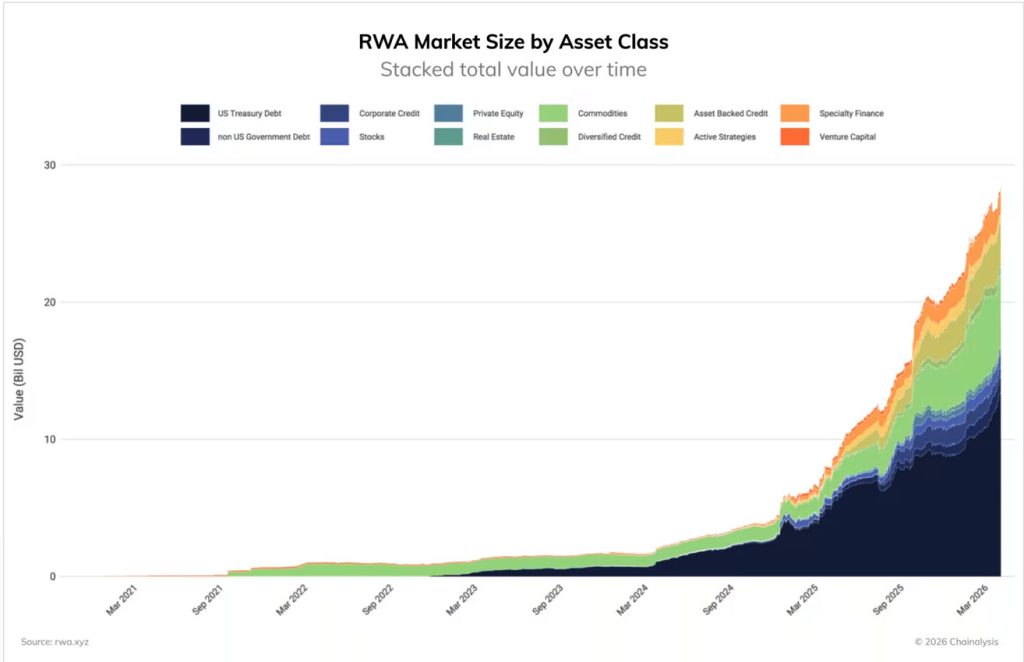
Source: Chainanlysis
Recent market reports from DeFiLlama and DL research state that the tokenized RWA market has exploded by more than 500% in over a year, rising from $4.1B to $25.2B. The growth was compounded by US treasury Debt, corporate credit, commodities, asset backed credit, speciality finance, non-US government debt, stocks, real estate, diversified credit, active strategies, venture capital, etc. And not just this, the number of wallets acquiring RWA increased drastically and reached 40,000 in 2026 as per Chainanalysis. As fully regulated securities, these assets embed KYC and whitelisting protocols directly into their underlying smart contracts, restricting their movement exclusively to permissioned networks.
Third, the yields are real.
Permissioned pools commonly pay 4-15%, compared to 4-5% in the U.S. Treasuries, which is exactly why a Coinbase/EY-Parthenon survey found 86% of institutional investors already hold or plan to hold digital/tokenized assets.
The signal is therefore clear. The institutional capital is moving towards permissioned DeFi, and protocols built for it are capturing the real flow.
The Architecture Behind Compliant, Permissioned DeFi Development
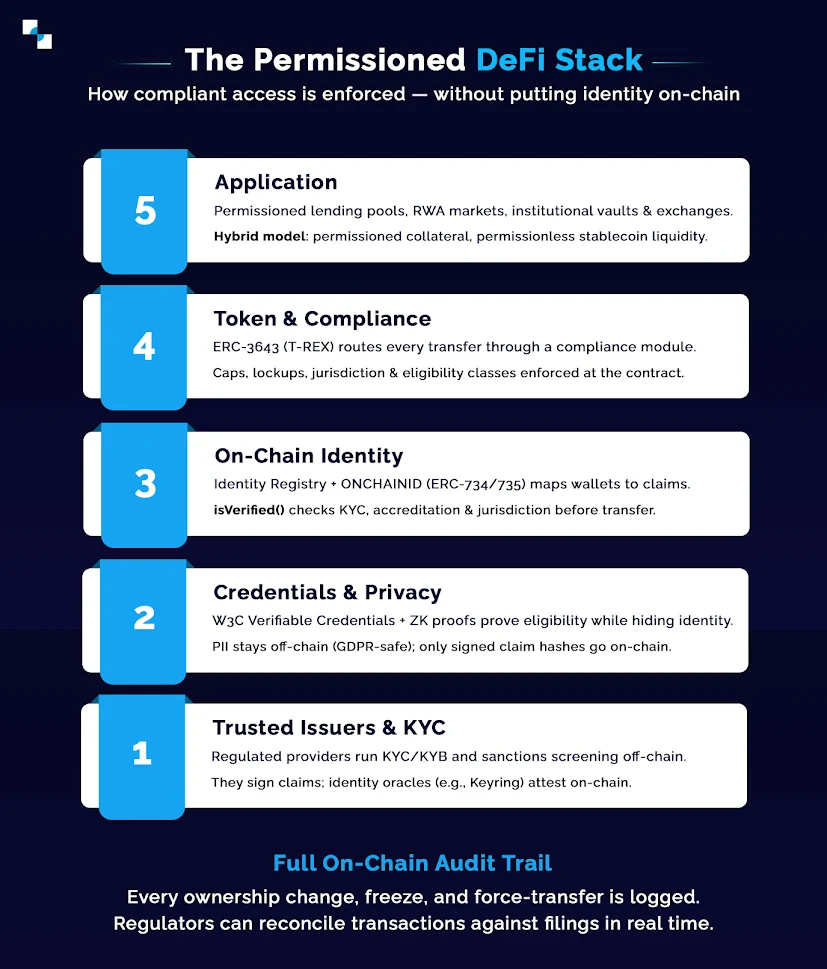
The technical foundation of permissioned DeFi development is on-chain identity plus token-level compliance. The dominant standard is ERC-3643 (T-REX), which is an institutional-grade security-token framework that routes every transfer through an identity registry and a pluggable compliance module before it settles. A wallet can only hold or move the token if it is signed by a trusted issuer and carries valid, unexpired claims, including KYC clearance, accreditation, permitted jurisdiction,etc.
Crucially, personally identifiable information never touches the public ledger. Investors verify off-chain with a regulated provider, who issues a cryptographically signed verifiable credential (W3C VC) or on-chain attestation (ONCHAINID via ERC-734/735). The smart contract checks the signature, not the passport. Increasingly, zero-knowledge proofs let an investor prove “I am KYC-verified, accredited, and not sanctioned” without revealing identity attributes on-chain, solving the privacy objection that kept hedge funds and family offices away. This stack, entailing identity registries, claim issuers, compliance modules, and ZK attestation, collectively builds serious permissioned DeFi protocols.
Launch Your Compliant DeFi Protocols With Antier
Hybrid Permissioned DeFi Development: The Model That Wins
Early attempts wrapped the entire protocol in KYC. Aave Arc (2022) made every participant whitelisted and never found its audience, because DeFi-native liquidity providers would not hand their addresses to a whitelister.
Aave Horizon is a strong example of the hybrid permissioned DeFi model emerging in 2026. It combines permissioned RWA collateral with permissionless stablecoin liquidity, and Aave says it has grown to over $550 million in supplied assets.
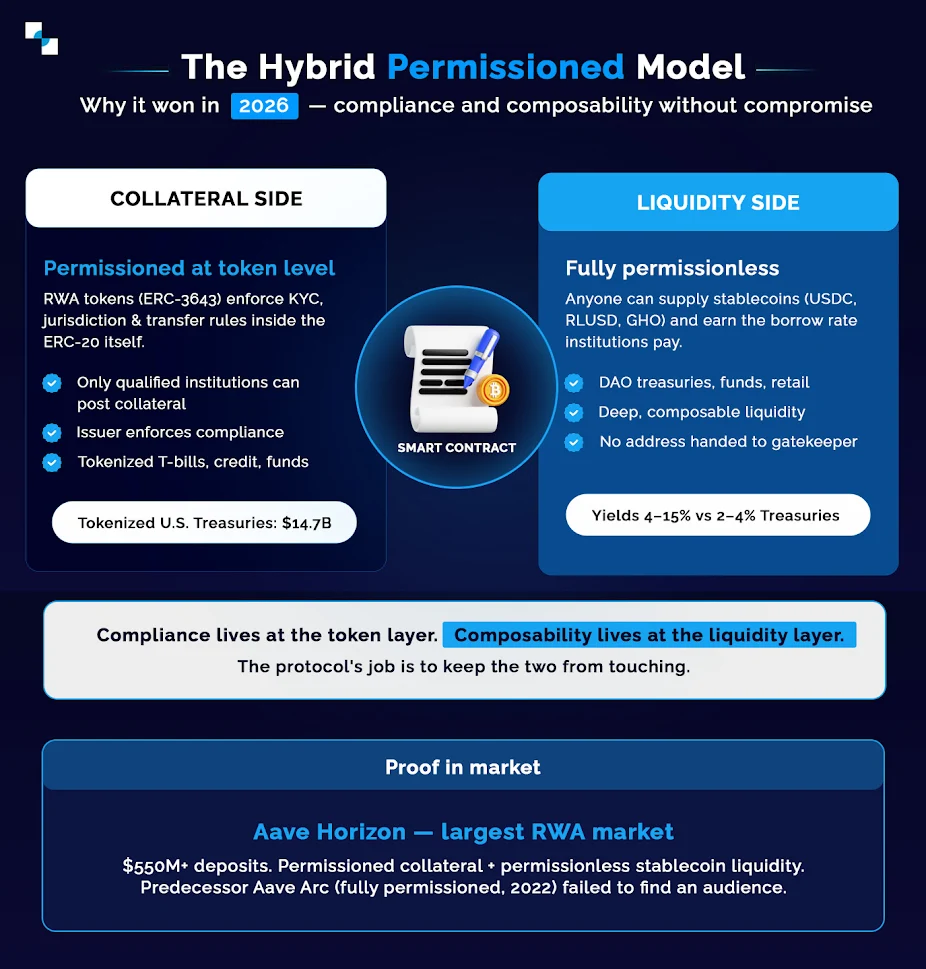
- Collateral side, permissioned at the token level: Only qualified institutions can hold the RWA tokens posted as collateral, because compliance is enforced inside the ERC-20 itself.
- Fully permissionless liquidity side: Anyone can supply stablecoins and earn the borrow rate institutions pay.
Compliance lives at the token layer, where issuers already enforce it. Composability lives at the liquidity layer, where DeFi’s advantage actually is. This is undoubtedly an ideal permissioned DeFi development model for 2026 and beyond.
Who is building permissioned DeFi in 2026
- Banks and neobanks deploy KYC-gated lending and treasury pools to offer on-chain yield to corporate clients without leaving the regulatory perimeter. JPMorgan’s tokenized collateral network is the proof of concept at scale.
- RWA and tokenization platforms issue tokenized funds, credit, and treasuries as ERC-3643 instruments with whitelisted investor pools and automated transfer restrictions, the fastest-growing on-chain segment of 2026.
- Regulated exchanges and brokers add permissioned DeFi pools with institutional custody and surveillance, routing client margin through KYC’d collateral.
- Government and state-backed programs use permissioned, auditable rails for digital-asset and CBDC-adjacent initiatives where every flow must be inspectable by a regulator.
How Antier builds permissioned DeFi
Antier delivers production-grade permissioned DeFi development, including ERC-3643 token engineering, on-chain identity and verifiable-credential integration, zero-knowledge KYC, hybrid permissioned-collateral/permissionless-liquidity market design, and region-specific compliance modules for VARA, MiCA, FCA, and U.S. frameworks. Most institutional clients reach us after burning 9-18 months building in-house. We ship the same architecture in 3-6 months at 20-30% of the cost of standing up a 15-20 person engineering team.
If you are planning a compliant on-chain lending market, tokenized-asset venue, or institutional yield product, the architecture decisions you make now determine whether regulators and your own risk committee say yes. Talk to Antier’s DeFi development team to scope your permissioned build.
Frequently Asked Questions
01. What is permissioned DeFi?
Permissioned DeFi is a decentralized finance model where access is restricted based on verified identity or eligibility, allowing for compliance with regulations while maintaining the benefits of public blockchains.
02. Why is permissioned DeFi development accelerating in 2026?
Permissioned DeFi development is accelerating due to recent regulatory clarity, including the US GENIUS Act, the EU's MiCA regulations, and the UK's FCA cryptoasset regime, which provide a defined compliance path for institutional investors.
03. Who benefits from permissioned DeFi?
Institutional investors such as banks, regulated exchanges, government digital-asset programs, and RWA issuers benefit from permissioned DeFi as it allows them to access DeFi yields while adhering to regulatory requirements.