



✨ AI Summary
- As enterprise blockchain scales up, the choice between monolithic and modular blockchain architectures is becoming critical.
- Monolithic blockchains integrate execution, consensus, settlement, and data availability into a single network.
- Conversely, modular blockchains separate these functions into specialized layers, offering greater flexibility, performance, and independent scalability.
- Businesses are now looking to address the Blockchain Trilemma – the challenge of optimizing security, scalability, and decentralization simultaneously.
- While monolithic blockchains offer simplicity and consistent security, they face scalability issues as transaction volumes increase.
As enterprise blockchain moves from pilot projects to production-scale deployments, architecture has become the most critical decision for long-term success. Businesses aren’t asking whether to adopt blockchain anymore; they’re deciding whether a monolithic blockchain or modular blockchain architecture best supports their scalability, security, and operational goals.
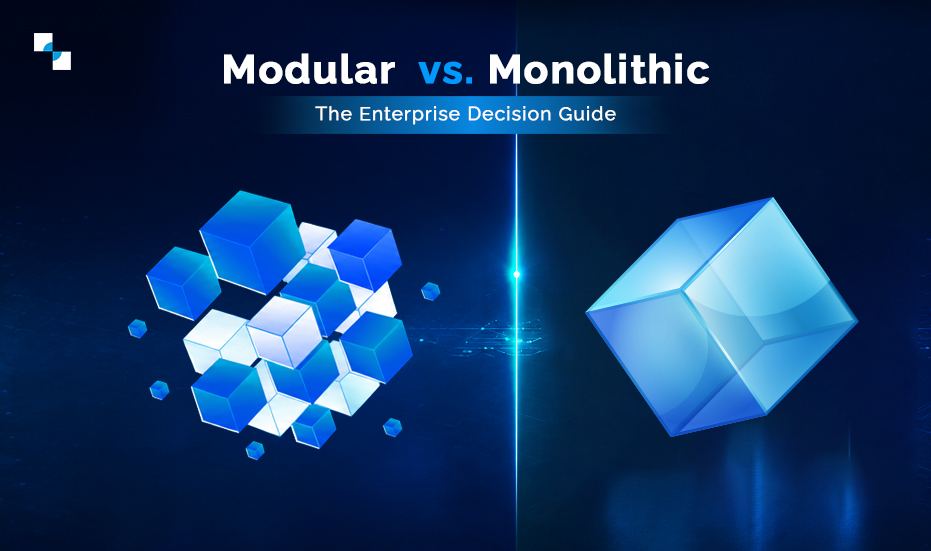
A monolithic blockchain bundles execution, consensus, settlement, and data availability into a single network. A modular blockchain separates these functions into specialized layers, enabling greater flexibility, performance, and independent scalability. As a leading blockchain software development company, we evaluate these architectural trade-offs to deliver secure, scalable solutions tailored for enterprise needs.
This guide compares modular vs monolithic blockchain architectures so organizations can make informed decisions for successful enterprise blockchain adoption in 2027.
Understanding the Blockchain Trilemma
Every blockchain architecture is designed around one of the industry’s most fundamental engineering challenges – the Blockchain Trilemma. The concept, widely attributed to Ethereum co-founder Vitalik Buterin, explains the difficulty of simultaneously optimizing three critical characteristics: scalability, security, and decentralization.
For years, blockchain networks have struggled to balance these priorities. Increasing transaction throughput often introduces trade-offs in decentralization, while strengthening security can affect network performance. As enterprise blockchain adoption expanded from proof-of-concept initiatives to production-grade applications, these limitations became increasingly apparent.
Modern enterprise applications require blockchain platforms capable of processing thousands of transactions, integrating with existing business systems, maintaining regulatory compliance, and supporting continuous upgrades. Achieving these objectives within a single blockchain architecture has proven difficult, driving the industry toward new architectural models such as modular blockchain.
Traditional blockchain networks attempted to solve all three challenges within a unified architecture. However, as enterprise workloads grew more complex, the need for greater scalability and flexibility led to the emergence of modular blockchain design.
What Is a Monolithic Blockchain?
A monolithic blockchain is the traditional blockchain architecture in which every core network function operates within a single blockchain. Transaction execution, consensus, settlement, and data availability are handled by the same network and secured by the same validator set.
This unified design simplifies network coordination and provides consistent security across the ecosystem. Since all validators participate in every stage of transaction processing, monolithic blockchains offer a straightforward operational model with fewer architectural components to manage.
However, this simplicity comes with limitations. As transaction volumes increase, every node must process and validate every transaction, making scalability increasingly difficult without compromising decentralization or raising infrastructure requirements.
Core Characteristics of Monolithic Blockchain
| Feature | Enterprise Impact |
|---|---|
| Unified architecture | Simplifies deployment and governance. |
| Single security model | Consistent validation across the network. |
| Limited scalability | Throughput is constrained by the capacity of one blockchain. |
| Network-wide upgrades | Protocol changes require coordination across the ecosystem. |
| Lower architectural complexity | Easier to deploy for controlled enterprise environments. |
Where Monolithic Blockchain Performs Best
Monolithic blockchains remain an effective choice for organizations with predictable transaction volumes and relatively simple governance requirements. Common enterprise applications include:
- Internal document verification
- Government record management
- Permissioned consortium networks
- Corporate audit systems
- Digital certification platforms
For these use cases, simplicity and strong security often outweigh the need for highly scalable infrastructure.
What Is a Modular Blockchain?
As enterprise blockchain ecosystems continue to grow in complexity, traditional blockchain architectures are increasingly being challenged by demands for higher throughput, lower operational costs, and greater flexibility. This has led to the emergence of modular blockchain – an architectural approach that separates core blockchain functions into independent, specialized layers.
Instead of relying on a single blockchain to perform every task, modular architecture distributes responsibilities such as transaction execution, consensus, settlement, and data availability across multiple interoperable components. Each layer performs a dedicated role while working together to maintain the integrity and security of the network.
Ready to build a blockchain solution designed for the future?
By decoupling these functions, organizations can optimize individual components without affecting the performance of the entire blockchain. This modular design allows enterprises to scale workloads more efficiently, introduce new capabilities faster, and adapt infrastructure as business requirements evolve.
Unlike monolithic systems, where every node performs every function, modular blockchain enables enterprises to allocate resources more effectively, reducing unnecessary computation and improving overall network efficiency.
Core Layers of a Modular Blockchain
| Layer | Primary Function | Enterprise Benefit |
|---|---|---|
| Execution Layer | Processes transactions and executes smart contracts. | Enables application-specific optimization and higher transaction throughput. |
| Consensus Layer | Validates transactions and maintains agreement across the network. | Preserves network security while allowing other layers to scale independently. |
| Settlement Layer | Finalizes transactions and records the canonical blockchain state. | Provides strong security guarantees and transaction finality. |
| Data Availability Layer | Stores and distributes blockchain data for verification. | Improves scalability by separating data storage from transaction execution. |
Why Enterprises Are Adopting Modular Blockchain
The growing interest in modular blockchain is driven by practical business requirements rather than technological trends. Modern enterprise applications often involve multiple stakeholders, cross-platform integrations, regulatory compliance, and continuously increasing transaction volumes. A modular architecture provides the flexibility needed to support these evolving demands without requiring organizations to redesign their blockchain infrastructure as they grow.
Key advantages include:
- Independent scalability by allowing each blockchain layer to expand based on workload requirements.
- Simplified upgrades without disrupting the entire network.
- Greater interoperability across public blockchains, private networks, and enterprise applications.
- Improved operational efficiency through specialized infrastructure components.
- Higher flexibility for building industry-specific blockchain solutions tailored to business requirements.
As enterprises increasingly view blockchain as long-term digital infrastructure rather than a standalone technology project, modular architecture is emerging as a practical foundation for building scalable, adaptable, and future-ready blockchain ecosystems.
Real-World Examples of Monolithic and Modular Blockchains
Examples of Monolithic Blockchains
Monolithic blockchains execute core functions including transaction execution, consensus, settlement, and data availability within a single network.
| Blockchain | Why It Is Monolithic |
|---|---|
| Ethereum | Originally designed as a monolithic blockchain, Ethereum performs execution, consensus, and settlement within one network while leveraging Layer-2 solutions to improve scalability. |
| Solana | Integrates execution, consensus, and data availability into a unified architecture, enabling high transaction throughput and low latency. |
| BNB Chain | Uses a single-layer architecture optimized for smart contract execution, decentralized applications (dApps), and digital asset transactions. |
Examples of Modular Blockchains
Modular blockchain ecosystems separate blockchain functions into specialized layers, allowing each component to scale and evolve independently.
| Blockchain | Modular Role |
|---|---|
| Celestia | Provides a dedicated data availability and consensus layer, allowing developers to build customizable execution environments. |
| Avail | Focuses on scalable data availability, enabling Layer-2 networks and rollups to verify blockchain data efficiently. |
| EigenDA | An Ethereum-based data availability solution that improves scalability for rollups by offloading data storage responsibilities. |
| Dymension | Enables application-specific RollApps that leverage modular infrastructure for execution while relying on external layers for security and settlement. |
These examples demonstrate that enterprise blockchain is moving toward specialized, composable infrastructure rather than relying solely on a single blockchain to perform every function.
Modular vs. Monolithic Blockchain: A Detailed Comparison
Although both architectures aim to provide secure and decentralized transaction processing, they are designed to solve different challenges. Monolithic blockchains prioritize simplicity by integrating all blockchain functions into a single network, whereas modular blockchains distribute these responsibilities across specialized layers to improve scalability and flexibility.
For enterprises, the decision extends far beyond technical specifications. It influences infrastructure costs, system performance, future upgrades, interoperability, and the ability to support evolving business models. The following comparison highlights the factors that matter most when selecting an enterprise blockchain architecture.
Modular Blockchain vs. Monolithic Blockchain
| Evaluation Criteria | Monolithic Blockchain | Modular Blockchain |
|---|---|---|
| Architecture | Unified blockchain where all core functions operate together. | Specialized layers independently manage execution, consensus, settlement, and data availability. |
| Scalability | Limited by the processing capacity of a single blockchain. | Individual layers scale independently to accommodate growing workloads. |
| Performance | Higher transaction volumes can lead to congestion and increased latency. | Distributed workloads improve throughput and reduce network bottlenecks. |
| Security | Single validator set secures the entire blockchain. | Security is maintained through dedicated settlement and consensus layers. |
| Upgrade Flexibility | Major upgrades typically require network-wide coordination. | Components can be upgraded independently with minimal operational disruption. |
| Customization | Limited flexibility for industry-specific requirements. | Enables customized execution environments and application-specific blockchain designs. |
| Interoperability | Often requires additional infrastructure for cross-chain communication. | Designed to integrate more efficiently with Layer-2 solutions and multi-chain ecosystems. |
| Operational Efficiency | Higher infrastructure utilization as every validator performs every task. | Specialized components optimize resource usage and infrastructure costs. |
| Enterprise Readiness | Best suited for stable workloads with predictable growth. | Ideal for large-scale enterprise ecosystems requiring continuous scalability and innovation. |
Which Architecture Is Better?
The answer depends on the problem an organization is trying to solve. A monolithic blockchain remains a strong choice for private enterprise networks, consortium blockchains, and applications where governance is straightforward and transaction volumes are relatively predictable. In such cases, blockchain development solutions built on a monolithic architecture can provide simplicity, security, and easier system management while meeting business requirements efficiently.
However, organizations building digital asset platforms, tokenization ecosystems, enterprise payment infrastructure, or applications expected to scale significantly over time are increasingly evaluating modular blockchain. Its ability to separate core functions enables greater flexibility, easier upgrades, and more efficient infrastructure management – qualities that align closely with modern enterprise software design.
Rather than replacing monolithic blockchain entirely, modular architecture expands the design possibilities available to enterprises, allowing them to build blockchain solutions that are better suited to long-term business growth.
Enterprise Use Cases: Which Architecture Fits Best?
Choosing between modular and monolithic blockchain is not about selecting the newest technology; it’s about selecting the architecture that best aligns with your business objectives. Every enterprise has different operational priorities, compliance requirements, transaction volumes, and growth expectations. The right blockchain architecture should support these needs while remaining scalable and cost-effective over time. An experienced blockchain development company evaluates these factors to recommend the architecture that best fits an organization’s long-term digital transformation strategy.
Monolithic blockchains continue to perform well in environments where workloads are predictable, governance is straightforward, and the network participants are known. Conversely, organizations building large-scale digital ecosystems often require greater flexibility, interoperability, and independent scalability, making modular blockchain a more suitable choice.
Choosing the Right Architecture for Enterprise Applications
Real-World Asset (RWA) TokenizationModular BlockchainEnables separate execution, settlement, and compliance layers for greater scalability and regulatory flexibility.
| Enterprise Use Case | Recommended Architecture | Why It Fits |
|---|---|---|
| Cross-Border Payments | Modular Blockchain | Supports high transaction volumes, faster settlement, and seamless integration with multiple payment networks. |
| Supply Chain & Logistics | Modular Blockchain | Efficiently manages multi-party collaboration while supporting transparent and scalable data sharing. |
| Digital Identity Platforms | Modular Blockchain | Provides customizable privacy controls, interoperability, and secure credential verification across ecosystems. |
| Healthcare Data Management | Modular Blockchain | Balances secure data sharing with regulatory compliance and permission-based access. |
| Government Record Management | Monolithic Blockchain | Delivers strong security, predictable performance, and simplified governance for controlled environments. |
| Enterprise Consortium Networks | Monolithic Blockchain | Well-suited for permissioned ecosystems with limited participants and stable transaction volumes. |
| Internal Business Processes | Monolithic Blockchain | Provides a simple, secure foundation for document management, approvals, and audit workflows. |
Enterprise Adoption Trends (2025-2027)
Enterprise blockchain adoption is shifting from experimentation to production-scale implementation. Organizations are increasingly investing in blockchain infrastructure to support tokenization, digital payments, decentralized identity, and multi-party collaboration. This transition is accelerating demand for blockchain architectures that can deliver scalability, interoperability, and long-term flexibility.
Market Trends Driving Enterprise Blockchain Adoption
| Trend | Enterprise Impact |
|---|---|
| CelGrowth of Real-World Asset (RWA) Tokenizationestia | Financial institutions are rapidly expanding tokenization initiatives across securities, real estate, private credit, and other assets. As transaction volumes grow, enterprises require scalable blockchain architectures capable of supporting high-value digital asset ecosystems. |
| Enterprise Stablecoin Adoption | FBusinesses are increasingly leveraging stablecoins for cross-border payments, treasury management, and faster settlement. These use cases demand blockchain infrastructure that can process high transaction throughput while maintaining security and compliance. |
| Expansion of Layer-2 Ecosystems | Layer-2 networks continue to improve blockchain scalability by reducing congestion and transaction costs. Their growth has accelerated interest in modular architectures that separate execution, settlement, and data availability into specialized layers. |
| Institutional Blockchain Adoption | Banks, financial institutions, and global enterprises are moving blockchain initiatives from pilot programs to production environments, increasing demand for enterprise-grade infrastructure with stronger governance, interoperability, and upgrade flexibility. |
| Growing Focus on Interoperability | Modern enterprise applications rarely operate on a single blockchain. Organizations increasingly require solutions that enable secure communication across multiple blockchain networks and existing enterprise systems. |
The most significant shift heading into 2027 is not the adoption of a single blockchain platform but the growing recognition that blockchain architecture determines long-term business success. As enterprises scale tokenization platforms, digital payment networks, and interoperable ecosystems, they are evaluating infrastructure based on scalability, governance, operational efficiency, and future adaptability. This trend is driving greater interest in modular blockchain architectures while reinforcing the continued relevance of monolithic blockchains for controlled enterprise environments with predictable workloads.
Need help choosing the right blockchain architecture?
How to Choose the Right Blockchain Architecture
Selecting the right modular vs monolithic blockchain architecture starts with understanding your business goals rather than following technology trends. Understanding your business goals rather than following technology trends. Evaluate the following factors to determine which approach best supports your organization’s long-term digital transformation strategy.
1. Define Your Business Objectives
Start by identifying the primary business challenge your blockchain solution is expected to solve. The architecture should align with your operational goals, whether you’re improving internal workflows or building large-scale digital ecosystems.
2. Evaluate Future Scalability
Assess how transaction volumes, users, and business operations are expected to grow over the next three to five years. Choosing an architecture that scales efficiently helps avoid performance bottlenecks and costly infrastructure changes in the future.
3. Assess Integration Requirements
Consider how the blockchain platform will connect with existing enterprise systems such as ERP, CRM, cloud infrastructure, and identity management solutions. Seamless integration ensures smoother implementation and improves long-term operational efficiency.
4. Consider Governance and Compliance
Review your organization’s regulatory obligations, permission models, data privacy requirements, and security standards before selecting an architecture. Building compliance into the infrastructure from the beginning minimizes risks and simplifies future governance.
5. Plan for Long-Term Maintenance
Evaluate how easily the blockchain platform can support upgrades, feature enhancements, and evolving business requirements over time. An adaptable architecture reduces maintenance complexity and helps future-proof your enterprise blockchain investment.
The Right Architecture Shapes Long-Term Success
Choosing between modular vs. monolithic blockchain is no longer just a technical decision; it is a strategic investment in your organization’s future. While monolithic blockchains remain ideal for predictable workloads and controlled enterprise environments, modular architectures offer the scalability, interoperability, and flexibility required for tokenization, digital payments, and next-generation Web3 ecosystems.
The right choice depends on your business goals, compliance requirements, and long-term growth strategy. Partnering with an experienced blockchain development company ensures your architecture aligns with current needs while remaining adaptable to future innovation. At Antier, we help enterprises build secure, scalable, and future-ready blockchain solutions that accelerate digital transformation and create lasting business value.
Frequently Asked Questions
01. What is the difference between monolithic and modular blockchain architectures?
A monolithic blockchain bundles execution, consensus, settlement, and data availability into a single network, while a modular blockchain separates these functions into specialized layers, offering greater flexibility, performance, and independent scalability.
02. Why is architecture important for enterprise blockchain success?
Architecture is critical for long-term success as it impacts scalability, security, and operational goals, helping organizations choose the best structure for their specific needs as they move from pilot projects to production-scale deployments.
03. What is the Blockchain Trilemma?
The Blockchain Trilemma refers to the challenge of optimizing scalability, security, and decentralization simultaneously within blockchain networks, often leading to trade-offs that affect performance and functionality.