





✨ AI Summary
- Enterprise blockchain technology is now fueling operational systems in various industries including finance, supply chains, healthcare, and digital identity.
- The technology, once considered emerging, now powers mission-critical systems such as JPMorgan's Onyx platform which successfully processed over $300 billion in institutional transactions.
- In this post, we explore the top 10 enterprise blockchain use cases for 2026.
- These include:
1.
- Supply Chain Traceability: Blockchain enhances transparency, trust, and efficiency in supply chains through traceability features.
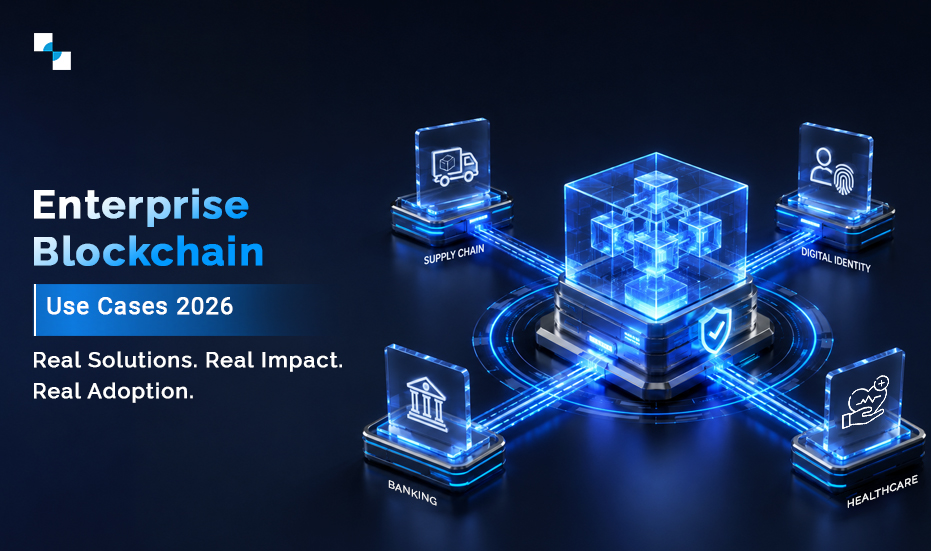
Enterprise blockchain has entered a new phase – one defined by measurable business outcomes rather than future potential. Across financial services, supply chains, healthcare, and digital identity, organizations are deploying blockchain to solve real operational challenges at enterprise scale. What was once viewed as an emerging technology is now powering mission-critical systems that move capital, secure sensitive data, and automate complex business processes.
This shift is already evident in global markets. For example, JPMorgan’s Onyx platform has processed over $300 billion in institutional transactions on blockchain infrastructure. These are no longer experimental pilots; they are production-grade systems driving real financial activity, data security, and enterprise automation at scale. As adoption grows, the role of every blockchain development company has also evolved significantly.
In this guide, we explore the top 10 enterprise blockchain use cases transforming industries in 2026. Each use case is supported by real-world deployments, showcasing how the best blockchain development companies are helping organizations build scalable, secure, and future-ready digital ecosystems.
1. Supply Chain Traceability: Improving Transparency, Trust, and Efficiency
Supply chain traceability is the ability to track and verify products from origin to final delivery. Blockchain enables this through a shared, tamper-proof ledger that records every movement and verification in real time across all participants. It reduces risks like counterfeiting, mislabeling, and loss by ensuring all supply chain data is transparent, immutable, and collectively maintained by a blockchain development company.
According to MarketsandMarkets, the global blockchain supply chain market is projected to reach $3.3 billion by 2026, reflecting the scale at which enterprises are now deploying these systems.
De Beers’ Tracr showcases enterprise blockchain traceability in action. Built with Accenture on Hyperledger Fabric, it has registered over 5 million rough diamonds, covering nearly two-thirds of De Beers’ production value. In 2026, GIA acquired a 30% stake, strengthening its role as an industry-wide provenance platform. Trace provides cryptographically verifiable diamond origin and custody records, enabling transparent and trusted supply chain verification.
2. Real-World Asset Tokenization: Unlocking Capital That Has Always Been Locked
Most of the world’s valuable assets – real estate, private equity funds, infrastructure, fine art, and government bonds are effectively inaccessible to the majority of investors. They require large minimum commitments, move slowly, and settle through intermediaries that add cost and delay at every step. Tokenization changes this by representing ownership of these assets as programmable digital tokens on a blockchain. Fractions of assets can be bought and sold instantly. Settlement happens in minutes. Distributions execute automatically via a smart contract. A blockchain development company building tokenization infrastructure is building the architecture that rewrites how capital moves.
According to Bitcoin.com News (May 2026), the tokenized real-world asset market more than doubled year-on-year, crossing $34.5 billion in on-chain value by May 2026.
BlackRock’s BUIDL fund highlights the future of tokenized finance. Launched as a tokenized U.S. Treasury money market fund, it has grown to around $2.4 billion in assets and operates across nine blockchain networks. In 2026, it became tradable on Uniswap and was accepted as collateral on Binance, signaling strong institutional adoption of decentralized finance infrastructure.
3. Cross-Border Payments: Faster, Cheaper, Blockchain-Based Global Transfers
Cross-border payments remain one of the slowest and most inefficient components of global finance. Despite major advances in digital banking, international transfers still depend on multiple intermediaries, creating delays, limited transparency, and inconsistent settlement outcomes. In many cases, transactions take days to complete and pass through several correspondent banks before reaching the final recipient. Blockchain introduces a fundamentally different approach by enabling shared, always-on settlement networks where value can move directly between financial institutions.
The average global cost of sending an international remittance sits at 6.49% of the amount transferred, according to the World Bank’s Q1 2025 data, far above the G20’s 5% target and generations behind what the technology now allows (World Bank, 2025). Traditional SWIFT transfers take 2-5 days, pass through multiple correspondent banks, and fail without explanation. Blockchain replaces this with a shared settlement ledger that operates 24 hours a day, seven days a week, settling transactions in seconds at near-zero cost. The blockchain development company building on these rails is building the replacement for a system that has not fundamentally changed since the 1970s.
In March 2026, SWIFT went live with a blockchain-based cross-border payment framework, bringing over 25 banks into its first production phase, including HSBC, Citi, BNP Paribas, Deutsche Bank, and JPMorgan. The system uses a distributed ledger to enable 24/7 tokenized deposit transfers between institutions. When SWIFT, the backbone of global banking, used by 11,000 institutions in 200 countries, makes this move, the direction of the entire industry becomes clear.
4. Decentralized Digital Identity: One Credential That Works Everywhere
The average person now manages more than 100 digital accounts, each with its own login, each a separate data silo, each a potential breach target. More significantly, each one requires re-verifying identity from scratch, uploading passports, waiting for manual KYC reviews, and trusting third parties with sensitive personal information. Blockchain software development for digital identity creates a self-sovereign model: a cryptographic identifier the individual controls, stored in a personal wallet, backed by verifiable credentials signed by trusted institutions. When a credential is presented for verification, the check is mathematical, not a phone call to a records office.
The global blockchain identity management market was valued at USD 1.57 billion in 2025 and is projected to reach USD 2.36 billion in 2026, growing to USD 207.12 billion by 2034 at a CAGR of 74.92%, according to Fortune Business Insights.
Microsoft Entra Verified ID shows how decentralized identity is entering enterprise use. Built on W3C standards for DIDs and Verifiable Credentials, it enables organizations to issue and verify digital credentials while giving users control over their identity data. Enterprises can verify employees, partners, and customers without repeated manual checks or centralized databases, enabling faster onboarding, stronger privacy, and secure identity verification at scale.
Partner with us to build enterprise-ready blockchain solutions.
5. Trade Finance: From Manual Paperwork to Instant Settlement
Global trade finance still runs largely on physical paper letters of credit, bills of lading, and certificates of origin that take 7-14 days to verify across multiple banks, shipping companies, and customs authorities. A single trade transaction can require over 20 documents, with each one verified manually by parties who cannot see each other’s records. Custom blockchain development for trade finance puts every document on a shared ledger and replaces manual verification with smart contract automation: when delivery is confirmed and conditions are met, payment is released without anyone needing to chase a signature.
The World Economic Forum identifies blockchain-enabled payments, stablecoins, and tokenized assets as key drivers of the next generation of financial infrastructure, helping institutions improve settlement speed, transparency, and operational efficiency.
Modern trade finance is shifting from paper-heavy processes to blockchain-enabled digital ecosystems using electronic bills of lading and smart contracts. Platforms like WaveBL, CargoX, and Komgo streamline documentation, reduce fraud, and speed settlement, improving transparency and access to financing across global supply chains, especially for SMEs.
6. Insurance Claims: From Weeks to Minutes with Automation
Insurance fraud is not a minor operational problem. According to the Coalition Against Insurance Fraud, fraud costs the U.S. insurance industry an estimated $308.6 billion annually – a figure that flows directly into higher premiums for every policyholder. Fragmented claims systems compound the problem: when each insurer operates its own siloed database, duplicate and fraudulent submissions routinely go undetected across the market. A blockchain development company addresses both challenges by building permissioned networks where smart contracts automate eligible payouts, and every claim record is immutable, cross-verifiable, and timestamped, making fraud structurally harder to execute and significantly easier to detect.
According to Mordor Intelligence, the blockchain insurance market was valued at $930 million in 2025 and is projected to reach $1.3 billion in 2026, growing at a 39.85% CAGR through 2031. This growth reflects increasing adoption across underwriting, claims processing, and fraud prevention use cases.
RiskStream’s RAPID X platform demonstrates what production-grade blockchain insurance infrastructure looks like today. Built by the Institutes RiskStream Collaborative on a permissioned distributed ledger, RAPID X is a live auto claims data-exchange network that allows insurers to share First Notice of Loss information directly and securely between carriers, eliminating the delays of manual document requests. The platform reduces time to First Notice of Loss by seven days, cutting one of the most friction-heavy stages in the entire claims lifecycle. In 2025, Allstate, Liberty Mutual, and The Hartford were recognized as Leadership Award winners for driving RAPID X into production – three of the largest U.S. insurers not piloting blockchain, but actively running it.
7. Healthcare Data and Pharma Traceability: Securing Records That Cannot Afford to Be Wrong
Healthcare data is among the most sensitive information in existence and among the most frequently breached. Centralized hospital databases are high-value single targets, and when they fail, the consequences extend far beyond financial loss. A blockchain development company building healthcare infrastructure creates a system where the actual patient records live in encrypted off-chain storage, while cryptographic fingerprints of those records are anchored on a permissioned ledger. Every access is logged permanently. Patient consent is enforced by a smart contract. The chain proves what was accessed, by whom, and when automatically, with no manual audit required.
According to IBM’s Cost of a Data Breach Report 2025, conducted by the Ponemon Institute, healthcare organizations incurred an average data breach cost of $7.42 million-the highest of any industry for the 14th consecutive year. As healthcare systems continue their digital transformation, securing patient data has become both a regulatory requirement and a business priority.
Blockchain is strengthening pharmaceutical supply chains by enabling secure, end-to-end traceability of prescription medicines. As regulations like the U.S. DSCSA push for greater interoperability, stakeholders are adopting digital verification systems to authenticate products and share trusted data. This improves transparency, reduces counterfeiting risks, and ensures tamper-evident records without exposing sensitive commercial information.
8. Energy Trading and Carbon Credits: Making Clean Energy Claims Verifiable
Two problems plague the global clean energy transition. First, renewable energy certificates can be double-counted – the same megawatt-hour sold as “green” to multiple buyers. Second, carbon offsets issued through voluntary markets have been repeatedly exposed as inaccurate, with organizations claiming carbon neutrality based on credits that did not represent real reductions. Blockchain solves both by representing each certificate and credit as a unique on-chain token: issued once, transferred transparently, retired permanently. The provenance of every unit is traceable from origin to retirement on a public ledger that no single party controls.
According to Precedence Research, the global blockchain in energy trading market is estimated at USD 2.61 billion in 2026 and is projected to reach USD 31.80 billion by 2035, expanding at a CAGR of 32.0% during the forecast period.
Blockchain is increasingly being used to create tamper-evident digital energy certificates and support transparent renewable energy accounting. Platforms such as Energy Web Foundation enable utilities and enterprises to verify clean energy generation through trusted digital records, helping organizations strengthen ESG reporting and compliance as demand for auditable sustainability data grows.
Build Secure, Scalable Blockchain Solutions for Business Growth
9. Government Services: Securing Public Records with Blockchain
Property fraud, forged identity documents, procurement irregularities, and manipulated public records all stem from the same challenge: centralized systems that can be altered or compromised. Blockchain enables public institutions to create tamper-resistant digital infrastructure where land records, licenses, permits, public contracts, and citizen credentials are secured on immutable distributed ledgers. Smart contracts further automate benefits distribution, grant disbursement, and eligibility verification, improving transparency while reducing administrative overhead and fraud.
Governments worldwide are shifting from isolated blockchain pilots to broader digital public infrastructure strategies that prioritize secure, verifiable, and interoperable public records. Blockchain and decentralized identity technologies are increasingly being evaluated to strengthen land registries, digital credentials, procurement systems, and cross-border document verification, helping public agencies improve trust, accountability, and service delivery in an increasingly digital world.
As digital government initiatives continue to expand, blockchain provides an immutable audit trail that makes public records significantly more resilient to unauthorized modification or tampering. From property ownership and licensing to public procurement and citizen services, distributed ledger technology enables governments to build transparent, auditable, and secure digital ecosystems. For public-sector organizations modernizing legacy infrastructure, blockchain is evolving from an emerging technology into a trusted foundation for digital governance.
10. HR Credential Verification: From Weeks to Seconds with Blockchain
Resume fraud, credential misrepresentation, and identity verification remain major challenges for enterprise hiring, especially when recruiting across multiple countries. Traditional background checks often require employers to contact universities, licensing bodies, and previous employers individually, creating delays that slow onboarding and increase hiring costs. Custom blockchain development enables organizations to issue cryptographically signed verifiable credentials for degrees, professional certifications, employment history, and occupational licenses. Stored securely in a digital wallet controlled by the individual, these credentials can be verified instantly without relying on manual document validation.
According to HireRight’s 2025 Global Benchmark Report, candidate discrepancies and identity fraud remain widespread, with one in six organizations affected. Employment and education verification are key problem areas, highlighting the need for trusted digital credentials. As AI-generated resumes and forged documents rise, enterprises are adopting verifiable credentials to improve trust and speed up hiring.
OpenCerts, developed by Singapore’s GovTech, shows how blockchain eliminates manual credential verification by enabling institutions to issue tamper-proof digital certificates. Employers can verify these credentials instantly without contacting issuers, reducing fraud and speeding up hiring. It replaces paper-based verification with cryptographically signed records, giving individuals full control over their qualifications.
Enterprise Blockchain in 2026: The Road Ahead
Enterprise blockchain has entered a new phase where measurable business outcomes matter more than technological promise. From financial services and blockchain in healthcare to supply chains, energy, government, and digital identity, organizations are using blockchain to improve transparency, automate operations, strengthen security, and build trusted digital ecosystems. In healthcare, blockchain enables secure patient data management, streamlined records sharing, and enhanced data integrity across providers. The next wave of competitive advantage will belong to businesses that strategically integrate blockchain into their core operations rather than treat it as a standalone innovation.
Frequently Asked Questions
01. What is the current state of enterprise blockchain technology?
Enterprise blockchain has transitioned to a phase focused on measurable business outcomes, with organizations deploying it to address real operational challenges across various sectors like financial services, supply chains, and healthcare.
02. How is blockchain being utilized in supply chain management?
Blockchain enhances supply chain traceability by providing a shared, tamper-proof ledger that tracks and verifies products in real time, improving transparency, trust, and efficiency while reducing risks like counterfeiting and mislabeling.
03. What are some examples of successful enterprise blockchain implementations?
Notable examples include JPMorgan’s Onyx platform, which has processed over $300 billion in transactions, and De Beers’ Tracr, which has registered over 5 million diamonds, showcasing the technology's capability in driving real financial activity and supply chain transparency.


