




✨ AI Summary
- The global prediction market experienced a 4x surge, reaching a total notional trading volume of $63.5 billion in 2025.
- It is no longer a niche DeFi experiment, but a major shift of financial attention towards outcome-based markets.
- The primary channel for this capital is now the crypto wallet.
- Cryptocurrency wallet apps, with their prediction markets, are fast becoming the highest-retention feature in the Web3 stack, outperforming yield farms, NFT galleries, and staking dashboards.
- This article explores the reasons behind this shift, how leading integrations are built, and what enterprise builders need to know before their competitors.
Global prediction markets processed $63.5 billion in total notional trading volume in 2025, a 4x surge from $15.8 billion in 2024, with combined monthly activity reaching $24 billion by April 2026. These figures do not describe a niche DeFi experiment. They describe a structural reallocation of financial attention toward outcome-based markets, and the primary distribution channel for that capital is now the crypto wallet.
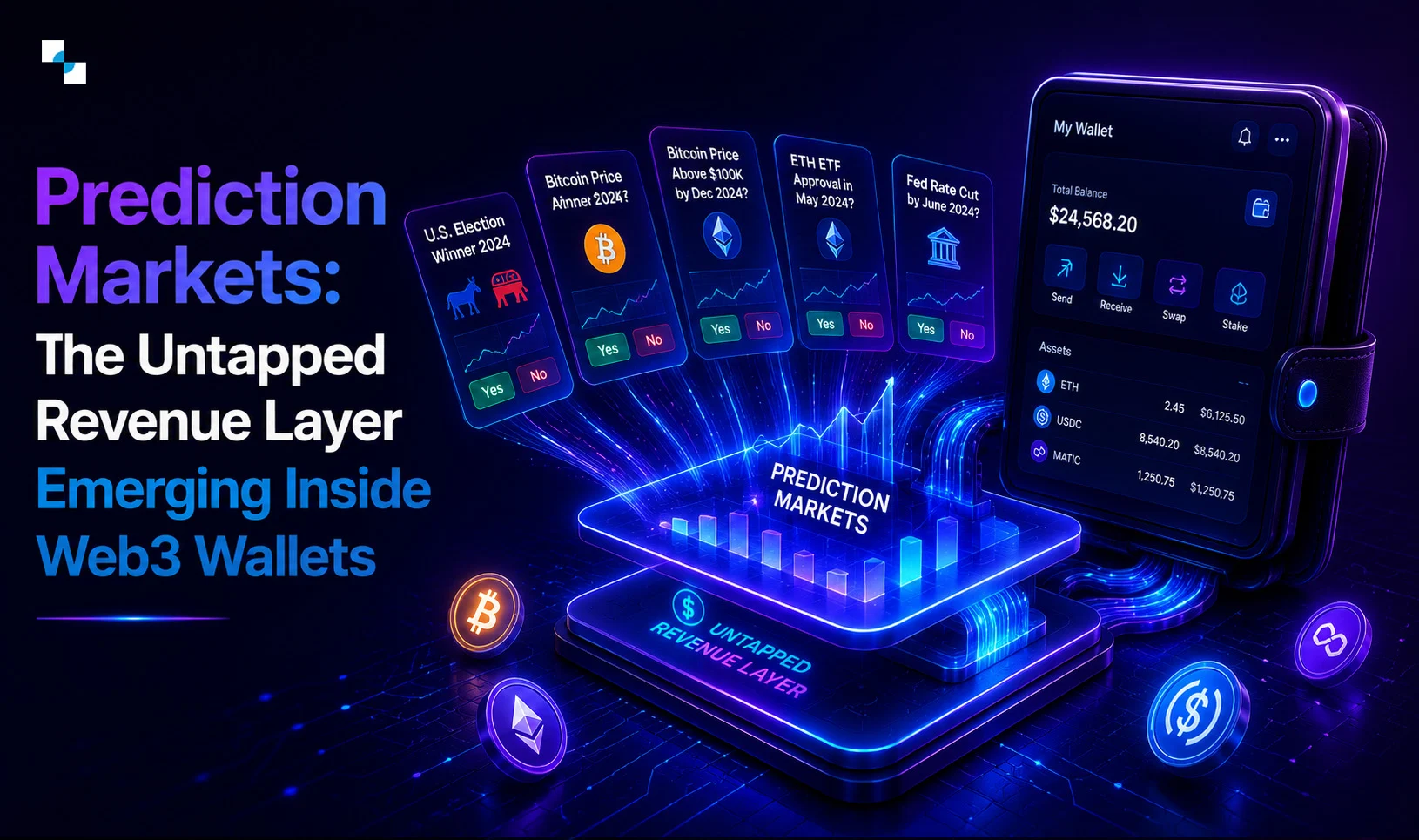
Prediction markets in cryptocurrency wallet apps are no longer a product novelty. They are fast becoming the highest-retention feature in the Web3 stack, outperforming yield farms, NFT galleries, and staking dashboards on every engagement metric that matters to wallet product teams. This article examines why the shift is happening, how the leading integrations are built, and what enterprise builders need to architect correctly before their competitors do.
What Are Prediction Markets, and Why Do They Belong Inside a Crypto Wallet?
A prediction market is a financial instrument where participants buy or sell outcome-based positions on real-world events: election results, macroeconomic data releases, sports outcomes, and cryptocurrency price benchmarks. Each position resolves to either zero or a fixed payout at settlement, creating a binary outcome token structure. The mechanism is grounded in the efficient markets hypothesis: when financial stakes attach to forecasts, aggregate position data reflects the best available market intelligence on any given event.
On-chain prediction markets run this mechanism on blockchain infrastructure. Positions are conditional tokens on smart contracts; settlement is automated by oracle feeds when real-world outcomes are confirmed. Chainlink, UMA, and Pyth Network are the dominant providers for financial and sports event contracts in 2026. Every trade is recorded on a public ledger, and every payout is executed by code, with no intermediary or clearinghouse.
The Web3 crypto wallet fit is structural. Because prediction market positions are tokenized assets, tradeable, transferable, and composable, they belong natively in the same wallet that holds ETH, USDC, and SOL. Building prediction markets in crypto wallets collapses the access barrier that standalone prediction platforms still face: no new account, no new application, and no separate custody arrangement for the user.
The Numbers That Made Enterprises Pay Attention
The commercial case for this integration closed in late 2025.
a) Prediction markets are now a major global financial market. Monthly transaction volume across prediction markets grew from USD 1.2 billion in early 2025 to over USD 20 billion in January 2026, with more than 800,000 unique wallets participating each month.
B) Polymarket recorded $21.5 billion in 2025 trading volume. Kalshi processed $17.1 billion. Together, they held 97.5% of the global prediction market share (KuCoin, 2025; Gambling Insider, 2026). Kalshi’s weekly volumes grew from $300 million in September 2025 to $3 billion by March 2026 (Norton Rose Fulbright, 2026).
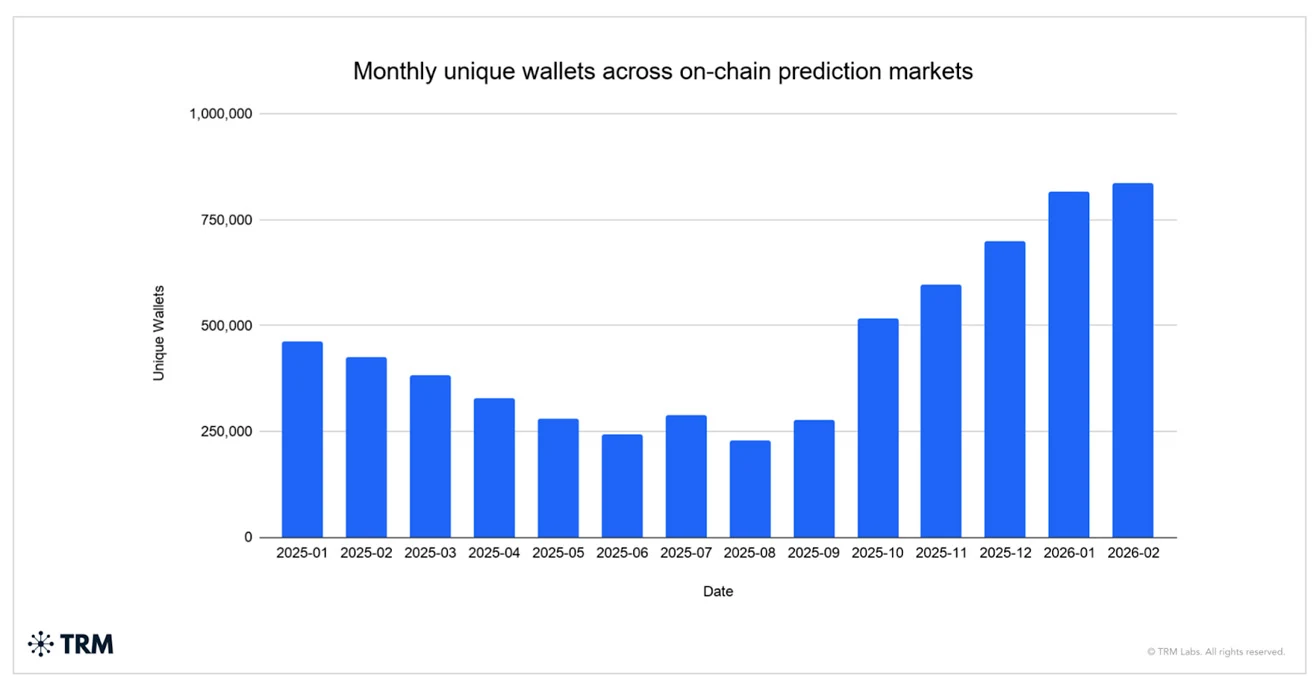
Source link: https://www.trmlabs.com/resources/blog/how-prediction-markets-scaled-to-usd-21b-in-monthly-volume-in-2026
c) Retention data reinforces the product case. Polymarket outperformed over 85% of crypto protocols in 30-day user retention as of December 2025 (Dune Analytics, cited by Cryptopolitan, 2025). Sports event contracts account for more than 80% of prediction market trading activity, confirming that this is consumer-grade financial engagement rather than a DeFi power-user niche. For teams building super crypto apps with diversified revenue layers, these numbers change the product calculus entirely.
Phantom X Kalshi: The Integration That Changed the Conversation
On December 11, 2025, Phantom, Solana’s leading wallet with 20 million active users, announced a direct integration with Kalshi, the CFTC-regulated prediction market exchange. Rather than building a standalone prediction product from the ground up, Phantom embedded an existing regulated marketplace directly into its wallet interface, setting the model for how super crypto wallet app platforms approach this feature category.
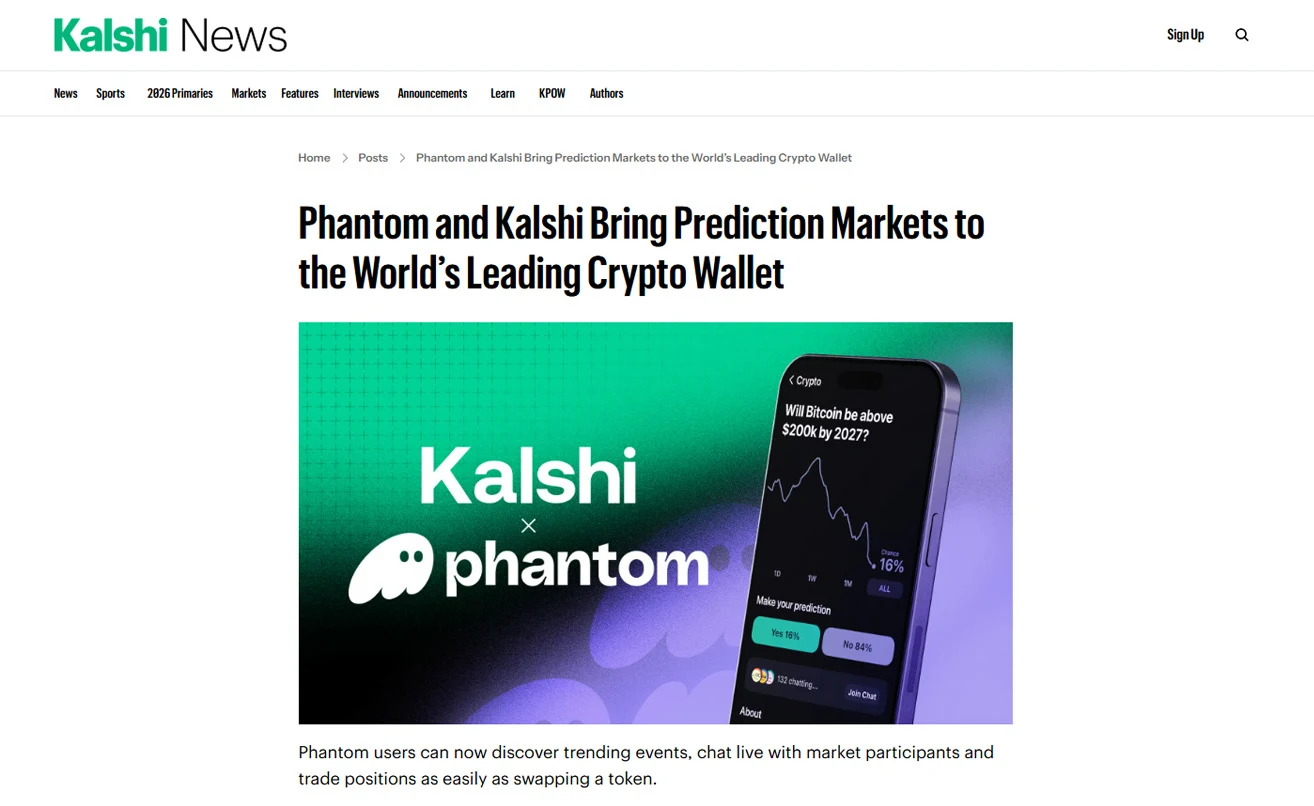
Users access Kalshi’s full market catalog, covering political events, macroeconomic indicators, and sports outcomes, without leaving the Phantom interface. Positions are funded using tokens already held in the wallet: SOL, USDC, or CASH, Phantom’s stablecoin issued through a Stripe partnership. Settlement runs through Solana’s transaction infrastructure, confirming positions in under 400 milliseconds at near-zero cost. For architecture reference on how a blockchain wallet platform should handle secure key management alongside high-frequency prediction positions, the Phantom model is the current benchmark.
The integration includes real-time odds feeds, live score and event tracking, push-based settlement notifications, and a community chat layer rendered inside the wallet UI. Kalshi’s CFTC oversight means every market offered is a federally regulated event contract, a compliance advantage that distinguishes this from purely on-chain alternatives. The business outcome was bilateral: Phantom’s millions of users gained access to a new asset class, and Kalshi gained distribution to a crypto-native audience unreachable through traditional fintech channels.
Technical Architecture of Prediction Markets Integrated Crypto Wallet
Integrating prediction market functionality into a cryptocurrency wallet development solution requires four coordinated infrastructure layers.
- Order Execution Model: Most production-grade platforms use a hybrid CLOB architecture. Polymarket processes orders signed off-chain with EIP-712 cryptographic signatures and settles positions on Polygon smart contracts in USDC. AMM-based prediction protocols like Azuro use liquidity pools with algorithmic pricing, better suited for long-tail markets where order book depth would be insufficient. Wallet integrators must select the execution model that matches their liquidity strategy and user base composition.
- Oracle Integration: Every prediction market is bound by its oracle quality. Chainlink’s Any API and UMA’s Optimistic Oracle are the two dominant resolution mechanisms for financial and political event contracts in 2026. For cryptocurrency price-based markets, Pyth Network delivers sub-second on-chain data. Any production integration must document the primary oracle source, the fallback data provider, and the dispute resolution timeline before deploying markets on ambiguous real-world events.
- Conditional Token Framework: Positions are issued as ERC-1155 conditional tokens: YES and NO shares for binary outcomes and multiple outcome tokens for categorical events. These tokens are fully composable, holdable in any ERC-20 crypto wallet, listable on secondary markets, usable as DeFi collateral, and transferable peer-to-peer. This composability makes prediction market positions genuinely wallet-native assets rather than isolated application state.
- MPC Key Management: Because prediction positions carry real financial value, the key management architecture of the host wallet defines the security floor of the entire integration. Wallets using MPC key management distribute private keys across multiple secure parties and never reconstruct them in full, providing the strongest available protection against single-point-of-failure key compromise. Institutional wallet deployments that include prediction market access consistently require MPC as a baseline security standard.
Why Prediction Markets Drive Wallet Retention Better Than Most DeFi Products?
Unlike yield farming or liquidity provision, prediction markets are easier to follow and use. Users place a bet, wait for the event to play out, and the smart contract settles it automatically. The feedback loop is short, the outcome is clear, and the topics already feel familiar, such as sports, elections, or central bank decisions. That makes prediction markets more engaging than many DeFi products, which often require constant monitoring, rebalancing, and a deeper understanding of risks like impermanent loss. Polymarket’s reported retention performance also shows the strength of this model, making it a strong product opportunity for wallets and DeFi platforms focused on DAU/MAU growth.
The AI layer strengthens this even more. As autonomous agents take on more on-chain activity, prediction markets become a natural use case for continuous, algorithm-driven trading. Agents can track price feeds, news, and macro data, then place or adjust positions in real time, which creates steady transaction volume. Wallets built on crypto payment gateway infrastructure with agent-ready signing support will be best positioned to capture that activity early.
The Regulatory Landscape: CFTC Rulemaking and What Builders Must Know
Enterprises planning to deploy prediction market features in their existing cryptocurrency wallets or create the overall solution from scratch in 2026, cannot treat compliance as a future concern.
| Region | Regulatory Focus | Enterprise Priority |
|---|---|---|
| U.S. (CFTC) | Event contract oversight and market eligibility | Build compliance, monitoring, and reporting controls |
| UAE (VARA) | Prediction market tokens classified as virtual assets | Implement licensing and KYC requirements |
| UK (FCA) | Review of event-linked digital asset products | Prepare for evolving compliance standards |
| Australia (ASIC) | Conditional tokens under licensing consultation | Assess financial product obligations |
| Global | KYC, AML, and geo-restrictions | Embed compliance into architecture from day one |
Key takeaway: Compliance is no longer a post-launch consideration. DeFi wallet solutions integrating prediction markets must build KYC, AML, geo-restrictions, and market eligibility controls into the product architecture from the start.
Frequently Asked Questions About Prediction Markets in Crypto Wallets
Q1. What is a prediction market in a Web3 wallet?
A prediction market in a Web3 crypto wallet is a built-in feature that lets users buy or sell outcome-based positions on real-world events, including elections, price benchmarks, sports results, and economic data releases, directly from their wallet interface. Positions are represented as conditional tokens on a blockchain smart contract. Settlement runs automatically when an oracle confirms the real-world outcome. No separate platform account is required; positions are held and transferred like any other digital asset in the wallet.
Build Your Prediction Market Wallet Feature Today!
Q2. How do prediction markets improve crypto wallet engagement?
Prediction markets improve wallet engagement because they create short, event-driven feedback loops that bring users back repeatedly around scheduled events: Fed rate decisions, elections, and major sports fixtures. Unlike passive DeFi strategies, prediction markets have binary, time-bound outcomes tied to events users already follow. Polymarket’s 30-day retention data, reviewed by Dune Analytics in December 2025, showed it outperforming over 85% of crypto protocols, the strongest retention signal recorded in the DeFi space during that period.
What to Look for When Building a Prediction Market Crypto Wallet Feature?
- Settlement chain selection: Solana (sub-400ms finality, near-zero fees), Polygon, and Base (Ethereum L2 with institutional custody support) are the primary chains for production-grade on-chain prediction market platform deployment in 2026. Chain selection determines latency, cost structure, and the universe of compatible wallets.
- Oracle reliability and dispute resolution: Chainlink and UMA are the benchmark providers. Document the fallback mechanism and dispute resolution timeline before deploying markets on ambiguous real-world events. A prediction market smart contract is only as reliable as the data source that resolves it.
- Compliance module: CFTC rulemaking, VARA requirements for UAE operators, and FCA guidance for UK-facing products require geo-restriction, KYC gating, and market eligibility logic built into the stack from day one. This is non-negotiable for any operator targeting regulated markets.
- Liquidity architecture: Evaluate access to existing order books, native AMM-based prediction liquidity pools, or a hybrid model combining depth with long-tail market coverage. Thin prediction market liquidity produces wide spreads and a poor user experience.
- UX depth and settlement notifications: Real-time odds, push settlement alerts, community engagement layers, and multi-asset funding options. Integrations that fall below this feature threshold risk low adoption against standalone prediction platforms.
- AI agent compatibility: As autonomous agents account for a growing share of on-chain activity, the wallet’s transaction signing architecture must support programmatic position management without exposing raw private keys. MPC-based signing with agent-scoped permissions is the current best practice for wallets entering this space.
- Mobile-first market discovery and watchlists- This matters because the live Phantom/Kalshi experience is mobile-only, and users can browse featured, trending, and live markets by category inside the wallet. That makes discovery UX a real product requirement, not a nice-to-have.
- Resolution transparency and dispute-status UI- Phantom’s own disclosures say market resolution depends on external data sources, and that feed failures or delayed data can lead to disputed outcomes. A blockchain wallet app should therefore show the oracle source, resolution rule, fallback source, and dispute status clearly.
- Broader funding rails and payout flexibility- Kalshi’s ecosystem messaging points toward more crypto funding options, including USDC and SOL, plus wider market coverage such as sports and entertainment. That makes seamless funding and multi-asset settlement worth calling out as a feature.
- Agent mode with permissions and limits- Add agent-scoped permissions, spend caps, session limits, and trade whitelists. AI agents and x402 micropayments are a major 2026 theme on Solana/Base, so this is a timely direction.
Can Prediction Markets Become the Next Major Revenue Stream for Crypto Wallets?
Yes, they can, and the reason is simple: prediction markets create repeat activity. Unlike passive wallet features that users check occasionally, prediction markets bring people back around events they already care about, such as elections, sports, macro announcements, and crypto price moves. That means more sessions, more trades, and more transaction flow inside the wallet. For wallet providers, that is not just engagement; it is a real monetization opportunity.
What makes this especially interesting is the business model. Wallets can earn through trading fees, spread capture, premium market access, partner integrations, or revenue-sharing arrangements with prediction market platforms. More importantly, prediction markets fit naturally inside the wallet experience. Users do not need to leave the app, create another account, or learn a new flow. That lowers friction and makes the feature easier to adopt at scale.
For mobile crypto wallet solutions trying to move beyond storage and swaps, prediction markets could become a strong new revenue layer. They combine utility, frequency, and monetization in a way that many Web3 features do not. In a market where retention matters as much as acquisition, that is a very strong position to be in.
Hire The Industry’s Most Efficient Team of Wallet Development Experts!
The prediction market is not a temporary feature or trend. Monthly trading volumes crossing $24 billion in April 2026, a federal rulemaking process underway at the CFTC, and the Phantom/Kalshi integration serving 20 million users are three converging signals that prediction markets in crypto wallets have reached infrastructure status, the same transition that swap functionality and staking completed earlier in Web3’s evolution. Crypto wallet service providers who architect this feature with proper oracle reliability, MPC-secured key management, geo-compliant eligibility logic, and AI agent compatibility will build the engagement layer that defines the next generation of Web3 wallets.
Antier is a leading crypto wallet development company that boasts a wide team of blockchain professionals who are adept at engineering production-grade wallets and crypto superapps built to carry composable financial infrastructure from day one. If your product roadmap includes prediction market functionality, our team delivers end-to-end architecture, from smart contract integration and oracle configuration to compliance modules and MPC key management, at enterprise production standards.
Get in touch with our experts to turn your vision and planning into reality.
Frequently Asked Questions
01. How do prediction markets work on blockchain?
Users trade YES/NO positions on real-world events, and smart contracts settle payouts automatically when the outcome is confirmed by an oracle.
02. What blockchain is best for prediction markets?
It depends on the use case, but fast and low-cost networks like Solana, Polygon, and Base are commonly preferred.
03. How do crypto wallets integrate prediction markets?
Wallets connect users to markets directly inside the app, letting them fund positions, trade, and track settlements without leaving the wallet.
04. Can AI agents trade prediction markets?
Yes. AI agents can monitor data, analyze events, and place or adjust positions if the wallet supports automated, permissioned signing.
05. What infrastructure is required to build a prediction market wallet?
A production-grade prediction market wallet typically requires smart contracts, oracle integrations, liquidity infrastructure, compliance controls, secure key management, and settlement mechanisms.
06. Are prediction markets regulated?
Regulation varies by jurisdiction. Markets operating in regions such as the United States, UAE, and the UK may be subject to licensing, compliance, and market eligibility requirements.