




✨ AI Summary
- The Solana Developer Platform (SDP) has revolutionized enterprise blockchain adoption by offering a full-stack financial API layer that simplifies integration and reduces costs.
- SDP is designed to accelerate blockchain adoption in large financial firms without needing them to become blockchain-native.
- The platform operates like a multi-layered infrastructure stack that turns blockchain complexity into a simple, API-driven experience.
- It eliminates the need for businesses to independently integrate various providers and systems, offering a seamless operation through five interconnected layers: API & Integration, Compliance & Governance, Custody & Asset Management, Settlement & Execution, and Partner Services.
- These layers transform SDP into a complete enterprise financial infrastructure, enabling firms to create, launch, and scale digital asset applications through a single framework.
For nearly a decade, enterprise blockchain adoption was caught in the same cycle: bold ambitions, cautious pilots, and quiet shutdowns. The technology promised to rewire global finance. The implementation exposed every gap in talent, tooling, and integration readiness.
Three blockers kept organizations from moving forward: a shortage of crypto engineering talent, fragmented infrastructure across custody and compliance, and prohibitive costs of connecting public blockchains with core banking systems.
The result? Expensive pilots. Impressive demos. Underwhelming ROI.
2026 changes that – structurally, not rhetorically. The Solana Developer Platform (SDP) has transformed Solana into a full-stack enterprise financial API layer, already in production with Mastercard, Worldpay, and Western Union. Let’s explore what SDP is, how it works, and why the world’s largest payment companies are building on it right now.
What Is the Solana Developer Platform (SDP)?
The Solana Developer Platform, launched March 24, 2026, by the Solana Foundation, is a unified enterprise infrastructure layer purpose-built to accelerate blockchain adoption for large financial institutions without requiring them to become blockchain-native organizations.
Think of it as the AWS moment for Solana blockchain development: just as cloud computing abstracted server infrastructure into consumable APIs, SDP abstracts blockchain complexity into plug-and-play financial modules that any enterprise engineering team can integrate.
The Core Architecture
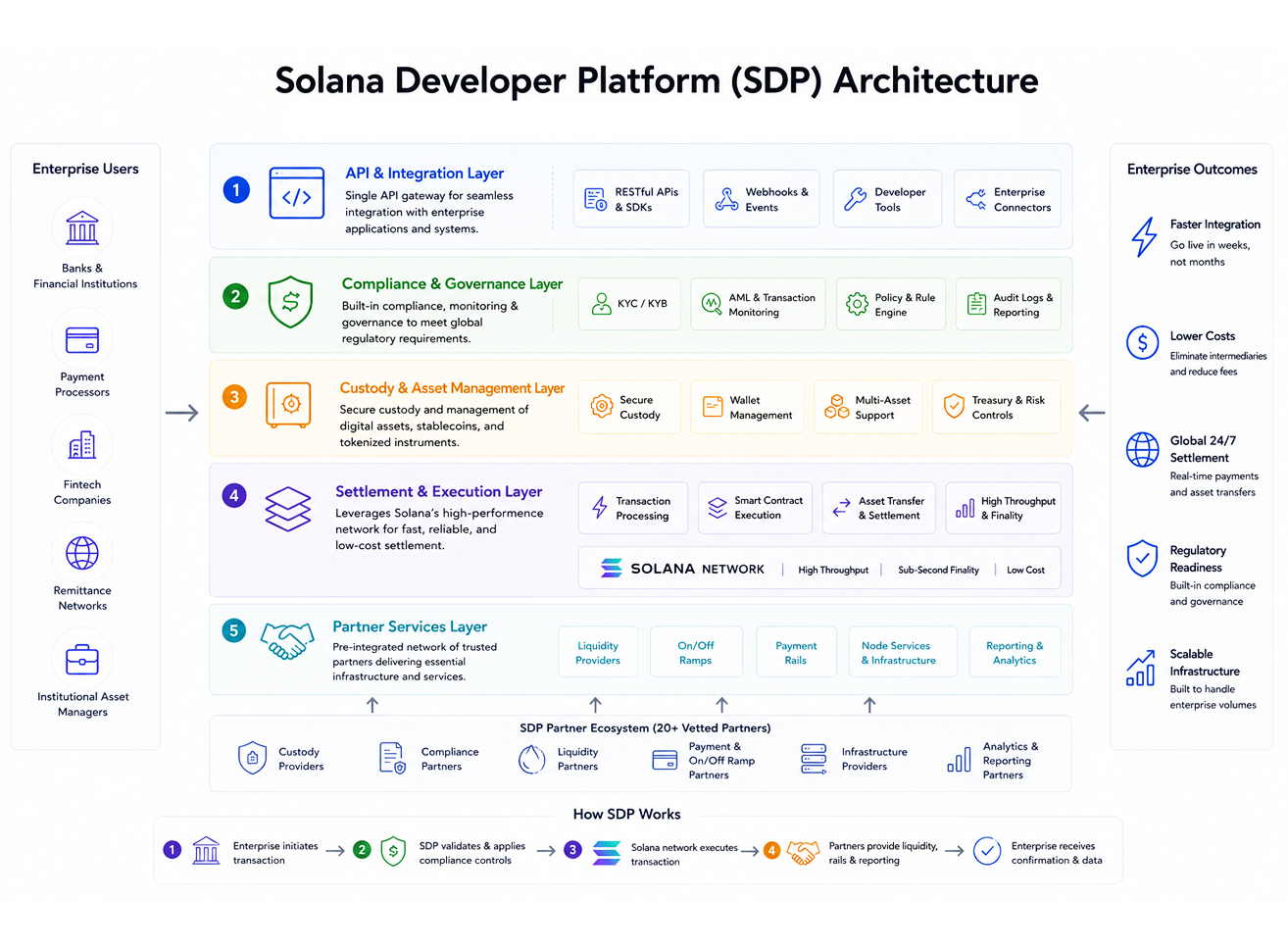
At its foundation, SDP is designed as a multi-layered enterprise infrastructure stack that abstracts blockchain complexity into a unified, API-driven experience. For organizations pursuing Solana blockchain development, SDP eliminates the need to independently integrate custody providers, compliance systems, liquidity networks, and settlement infrastructure.
The architecture consists of five interconnected layers:
- API & Integration Layer: Provides standardized APIs that connect banking, payment, treasury, and enterprise applications to blockchain infrastructure. This layer simplifies SDP Solana Developer Platform integration while reducing development effort and deployment complexity.
- Compliance & Governance Layer: Supports identity verification, transaction monitoring, governance controls, and regulatory workflows. Enterprises can incorporate compliance requirements directly into their digital asset operations and financial applications.
- Custody & Asset Management Layer: Enables secure management of stablecoins, tokenized assets, digital deposits, and enterprise treasury holdings. Integrated custody solutions help maintain security, control, and operational resilience at scale.
- Settlement & Execution Layer: Leverages Solana’s high-performance network to process transactions, asset transfers, and settlement operations. The layer delivers high throughput, predictable costs, and efficient transaction execution.
- Partner Services Layer: Connects enterprises to liquidity providers, payment rails, reporting tools, node operators, and on/off-ramp services. This ecosystem enables production-ready deployments without extensive third-party integration efforts.
Together, these layers transform SDP into a complete enterprise financial infrastructure platform, enabling organizations to build, launch, and scale digital asset applications through a single operational framework.
Who SDP Is Built For
- Banks and financial institutions seeking digital asset capabilities
- Payment processors modernizing settlement infrastructure
- Fintech companies building stablecoin-native products
- Cross-border remittance networks replacing SWIFT-dependent rails
- Institutional asset managers entering tokenized RWA markets
The defining characteristic of SDP is what it is not. It is not another developer SDK for crypto-native teams. It is not a sandbox for experimentation. SDP is a composable enterprise financial operating system built on Solana blockchain development architecture, designed from day one for compliance-sensitive, high-volume, production-grade financial applications.
How the Solana Developer Platform Works
At its core, SDP acts as an abstraction layer between enterprise applications and blockchain infrastructure. Instead of managing multiple vendors, APIs, custody providers, compliance systems, and liquidity partners independently, enterprises connect through a unified platform.
A typical SDP workflow includes:
- An enterprise application initiates a transaction
- SDP routes requests through compliance and custody layers
- Solana executes settlement and asset transfers
- Integrated partners provide liquidity, on/off ramps, and reporting
- Enterprise systems receive standardized API responses
This architecture dramatically reduces integration complexity while maintaining enterprise-grade security and compliance standards.
Why SDP Matters Right Now
Traditional Solana blockchain development company engagements required enterprises to build custody systems from scratch, integrate fragmented stablecoin rails, and manually manage compliance across jurisdictions. SDP eliminates these barriers by delivering:
- A unified API orchestration layer across all infrastructure partners
- Built-in compliance frameworks aligned with the GENIUS Act for stablecoin issuance
- Pre-integrated liquidity, settlement, and on/off-ramp partners
- Production-grade throughput via Solana’s high-performance network architecture
Looking for scalable blockchain solutions?
Inside SDP: The Three Modules Powering Enterprise Solana Blockchain Development
SDP is not a monolithic platform. It is a modular infrastructure suite – enterprises adopt the layers they need, when they need them. The architecture comprises three core modules, two of which are live in production today.
Module 1: Issuance – Tokenized Finance Infrastructure
The Issuance Module is where regulated digital assets are born. It enables enterprises to create, manage, and govern:
- Tokenized deposits that carry yield and settle 24/7
- GENIUS Act-compliant stablecoins issued under U.S. regulatory frameworks
- Real-world asset (RWA) tokens representing bonds, real estate, commodities, and private credit
- Programmable financial instruments with embedded compliance logic
For enterprises evaluating Solana blockchain development integration, this module eliminates the need to build token issuance infrastructure internally, replacing months of engineering work with a single API-driven workflow.
Status: Live in production.
The tokenized real-world asset market reached $33.69 billion in distributed asset value as of May 15, 2026.
Source Link: https://app.rwa.xyz/
Module 2: Payments – Global Money Movement Layer
The Payments Module is where SDP becomes immediately transformative for the enterprise payment stack. It supports:
- Fiat-to-stablecoin and stablecoin-to-fiat conversion via integrated on/off ramps
- B2B, B2C, and P2P payment orchestration across geographies
- Cross-border remittances at the institutional scale and institutional cost
- Programmable payment flows with conditional settlement logic
For organizations already exploring enterprise blockchain infrastructure, the Payments Module effectively replaces multiple legacy payment systems – ACH rails, SWIFT messaging, and correspondent banking intermediaries with a single programmable API layer operating at near-zero cost per transaction. Status: Live in production.
Module 3: Trading – Programmable Liquidity Layer (Coming Late 2026)
The Trading Module, scheduled for release in late 2026, completes SDP’s transformation into a full financial operating system:
- Atomic settlement swaps across asset classes with guaranteed finality
- Institutional vault management for digital asset treasury operations
- On-chain FX routing across currency pairs and blockchain networks
- Real-time settlement infrastructure for financial market participants
When live, this module will position Solana as a global financial execution layer – not just a blockchain network, but core market infrastructure for the institutions that move capital at scale.
| Module | Use Case | Status | Key Benefit |
|---|---|---|---|
| Issuance | Stablecoins, RWAs, Tokenized Deposits | Live | GENIUS-compliant digital asset creation |
| Payments | B2B, B2C, Cross-Border, On/Off Ramps | Live | Replace legacy rails with programmable flows |
| Trading | Atomic Swaps, Vaults, On-Chain FX | Late 2026 | Institutional-grade liquidity management |
Key Benefits of Solana Developer Platform for Enterprises
| Benefit | Enterprise Impact |
|---|---|
| Faster Integration | Reduce development cycles |
| Unified Infrastructure | Eliminate vendor fragmentation |
| Regulatory Readiness | Simplify compliance |
| Global Settlement | Operate 24/7 |
| Lower Costs | Reduce intermediary fees |
| Scalability | Support enterprise transaction volumes |
How Mastercard Is Using SDP: Stablecoin Settlement at Card-Network Scale
Mastercard’s integration with SDP is arguably the most significant enterprise blockchain deployment of 2026, not because of what it promises, but because of what it has already delivered.
Mastercard is using SDP’s Payments and Issuance modules to enable stablecoin settlement across its global card network. This is not a proof of concept. Banks in the United States and Latin America are already live, with global expansion planned through the remainder of 2026.
What Mastercard Is Actually Building
As confirmed by TheStreet Crypto, Mastercard’s SDP deployment covers:
- Multi-asset stablecoin settlement supporting USDC, RLUSD, and PYUSD on Solana
- Near-real-time settlement replacing T+1 to T+3 legacy card settlement cycles
- On-chain settlement infrastructure accessible to payment providers globally
The Rollout Timeline
Per The Block’s coverage:
- Phase 1 (Active): United States – banks live on stablecoin settlement rails
- Phase 2 (Active): Latin America – expanding stablecoin settlement to key payment corridors
- Phase 3 (H2 2026): Global rollout across all Mastercard merchant and issuing networks
What This Means for Card Payment Infrastructure
Card networks have historically operated on settlement windows measured in days – not seconds. Mastercard’s SDP Solana Developer Platform integration resets that benchmark entirely: on-chain settlement finality in under a second, at a fraction of legacy infrastructure cost.
For any organization currently building or evaluating payment infrastructure with a Solana blockchain development company, this deployment is the clearest proof point that public blockchain settlement is production-ready at card-network scale. Not someday. Right now.
How Worldpay Is Using SDP: Reinventing Merchant Settlement
Following its 2026 integration with Global Payments, Worldpay processes approximately $3.7 trillion in annual payment volume across 94 billion transactions, making it one of the largest payment processors globally. Its adoption of SDP underscores the growing role of Solana blockchain development in modernizing enterprise payment infrastructure.
Worldpay is deploying SDP’s Payments and Issuance modules to build next-generation merchant settlement infrastructure and tokenized asset capabilities on the Solana blockchain.
Worldpay’s Core Applications
- On-chain merchant settlement using tokenized assets, reducing payout cycles from days to minutes
- Programmable disbursement flows with conditional logic for marketplace and platform payouts
- Tokenized treasury operations enabling yield-bearing merchant float
- Cross-border merchant settlement at significantly reduced FX and intermediary costs
The Business Impact
For merchants operating at scale, the reduction in settlement time from 48-72 hours to near-real-time is not a convenience – it is a working capital advantage measured in millions of dollars annually. Worldpay’s SDP integration makes this available as a platform feature, not a bespoke engineering project.
From a Solana blockchain development perspective, Worldpay’s adoption validates Solana as a production-grade settlement layer for enterprise commerce infrastructure, not just DeFi or crypto-native applications.
How Western Union Is Using SDP: From Remittances to Its Own Solana-Powered Stablecoin
Western Union’s involvement with the Solana Developer Platform goes far beyond optimizing payment rails.
On May 4, 2026, Western Union launched USDPT, its own U.S. dollar-backed stablecoin built on Solana and initially deployed across key remittance corridors, including Bolivia and the Philippines. The launch represents one of the clearest examples of a traditional financial institution moving beyond blockchain experimentation and into production-grade digital asset infrastructure.

Source link: https://x.com/solana/status/2051263551470227705
For an organization that operates one of the world’s largest cross-border payment networks, serving customers across more than 200 countries and territories, the decision to launch a stablecoin on Solana sends a powerful message: blockchain has become a viable foundation for global money movement at an institutional scale.
Why Western Union Chose Solana
Cross-border remittances remain one of the most expensive and operationally complex segments of global finance. Traditional transfers often involve multiple intermediaries, fragmented settlement networks, foreign exchange markups, and delays that can stretch from one to five business days.
By leveraging SDP’s Payments Module alongside its USDPT stablecoin infrastructure, Western Union gains access to:
- Near-instant settlement across global remittance corridors
- Significantly lower transaction and intermediary costs
- 24/7 payment availability independent of banking hours
- Full transaction transparency and auditability
- Programmable payment workflows for future financial products
The Problem SDP Solves for Western Union
| Metric | Traditional Remittance Infrastructure | Solana SDP Infrastructure |
| Settlement Time | 1-5 Business Days | Under 1 Second |
| Intermediary Costs | High (3-7% Average) | Near-Zero On-Chain Costs |
| Transparency | Multiple Intermediaries | Full On-Chain Visibility |
| Availability | Banking Hours & Holidays | 24/7/365 |
| Settlement Certainty | Delays & Reconciliation Risk | Deterministic Finality |
Building the Next Generation of Remittance Infrastructure
Western Union is using SDP’s Payments Module to route cross-border transfers through blockchain-based settlement rails, while USDPT serves as a programmable digital dollar for faster value transfer across international corridors.
This approach is particularly impactful in high-volume remittance regions across Asia, Africa, and Latin America, where traditional settlement infrastructure often introduces unnecessary delays and costs for both providers and recipients.
With global remittance flows expected to exceed $900 billion in 2026, Western Union’s SDP Solana Developer Platform integration demonstrates something the financial industry has been waiting to see: public blockchain infrastructure can support institutional-scale payment volume, regulatory requirements, and real-world consumer demand simultaneously.
More importantly, it shows that leading financial institutions are no longer simply connecting to blockchain networks; they are building proprietary financial products directly on them.
Ready to Build on Solana’s Enterprise Infrastructure?
Why Enterprises Are Choosing Solana and SDP in 2026
As enterprise blockchain adoption matures, infrastructure decisions are increasingly driven by operational requirements rather than ecosystem size alone. Organizations evaluating blockchain platforms today are prioritizing performance, integration simplicity, compliance readiness, and proven production deployments.
Performance at Enterprise Scale
Solana’s architecture delivers high throughput, fast transaction confirmation, and predictable low-cost execution, making it well-suited for payment systems, stablecoin infrastructure, and tokenized asset platforms. While Ethereum L2 ecosystems improve scalability, they often introduce additional complexity through bridge dependencies, fragmented liquidity, and multiple integration layers.
API-First Enterprise Design
A key differentiator of SDP is its unified integration model. Rather than connecting separately to custody providers, compliance vendors, liquidity partners, and payment infrastructure, enterprises can access these capabilities through a single API-driven framework. This significantly reduces deployment complexity and accelerates time-to-market.
Built-In Regulatory Alignment
SDP’s Issuance Module is designed to support regulated digital asset issuance, including stablecoins and tokenized financial products. By incorporating compliance and governance considerations into the platform architecture, enterprises can build on infrastructure that aligns more closely with evolving regulatory expectations.
Growing Enterprise Adoption
The launch of production deployments from major payment and financial services organizations demonstrates increasing confidence in blockchain-based settlement and digital asset infrastructure. These implementations highlight a broader shift in enterprise strategy, where public blockchain networks are becoming part of real-world financial operations rather than remaining limited to pilot programs and experimentation.
Industries That Can Build on SDP Beyond Payments
While financial services dominate early SDP adoption, the platform’s modular architecture creates enterprise opportunities across a much broader landscape. Any industry with high-value settlement, asset management, or cross-border financial flows has a legitimate use case.
Banking & Financial Institutions
- Tokenized deposit accounts with programmable yield distribution
- Digital currency issuance for retail and institutional clients
- 24/7 interbank settlement replacing correspondent banking infrastructure
Insurance & Trade Finance
- Automated claims settlement triggered by verified on-chain events
- Tokenized risk instruments for reinsurance and structured finance
- Programmable trade finance instruments with embedded compliance logic
Real-World Asset (RWA) Tokenization Platforms
- Real estate fractionalization with on-chain ownership and settlement
- Commodity-backed digital assets for institutional trading
- Private credit tokenization for institutional investors
Fintech & Neobanks
- Embedded cross-border payment products with stablecoin rails
- Programmable savings and treasury products for business clients
- Instant merchant payout infrastructure competing with legacy processors
For any organization in these verticals evaluating a Solana blockchain development company, SDP provides the infrastructure layer – the question becomes how to integrate it strategically, not whether the technology is ready.
How to Get Started with SDP: A Practical Integration Pathway
For enterprise teams moving from evaluation to implementation, SDP adoption follows a structured pathway. The architecture is designed for incremental integration – organizations do not need to adopt all three modules simultaneously.
Step 1: Infrastructure Assessment (Week 1-2)
Audit existing payment rails, custody arrangements, compliance frameworks, and core banking system integration points. Identify which SDP modules address the highest-value gaps in your current infrastructure.
Step 2: API Integration Planning (Week 2-4)
Map business objectives to SDP module capabilities. Define the data flows between SDP and existing enterprise systems. Establish compliance and governance requirements for each use case.
Step 3: Pilot Deployment (Week 4-10)
Deploy in a controlled environment targeting one specific use case – cross-border payments, merchant settlement, or tokenized asset issuance. Measure against existing infrastructure benchmarks: settlement time, cost per transaction, error rate, and compliance coverage.
Step 4: Scale to Production (Month 3+)
Expand integration across geographies, asset classes, and financial workflows. Integrate the Trading Module when it launches in late 2026 for atomic settlement and on-chain FX capabilities.
As a specialized Solana blockchain development company, Antier provides the technical expertise and enterprise integration experience that bridges the gap between SDP’s API capabilities and your organization’s existing financial infrastructure.
Blockchain Is Now Infrastructure, Not Experimentation
The Solana Developer Platform is not a product launch – it is proof that enterprise blockchain has graduated from pilot to production. Mastercard is replacing settlement rails. Worldpay is modernizing merchant payouts. Western Union is cutting remittance timelines from days to seconds. These are not experiments. These are infrastructure decisions made at a global scale.
The strategic window is narrowing. Organizations that build SDP Solana Developer Platform integration capabilities in 2026 will hold a decisive infrastructure advantage entering 2027. The question is no longer whether to adopt blockchain – it is how fast you move. Antier is a leading Solana blockchain development company helping financial institutions, fintechs, and payment processors build SDP-integrated, production-grade blockchain systems – compliant by design, built to scale, and ready for what’s next.
Frequently Asked Questions
01. What is the Solana Developer Platform (SDP)?
The Solana Developer Platform (SDP) is a unified enterprise infrastructure layer launched on March 24, 2026, designed to accelerate blockchain adoption for large financial institutions without requiring them to become blockchain-native organizations.
02. How does the SDP simplify blockchain integration for enterprises?
SDP abstracts blockchain complexity into plug-and-play financial modules, providing standardized APIs that connect banking, payment, treasury, and enterprise applications to blockchain infrastructure, thereby reducing development effort and deployment complexity.
03. What are the main components of the SDP architecture?
The SDP architecture consists of five interconnected layers: API & Integration Layer, Compliance & Governance Layer, and others that collectively streamline the integration of custody providers, compliance systems, liquidity networks, and settlement infrastructure.