





✨ AI Summary
- The Guiding and Establishing National Innovation for U.S.
- Stablecoins (GENIUS) Act is a landmark legislation that provides a federal framework for payment stablecoins, offering regulatory clarity for banks, fintech companies, and other enterprises planning to launch stablecoin solutions.
- The act sets clear standards for issuer eligibility, reserve backing, redemption, transparency, and regulatory oversight.
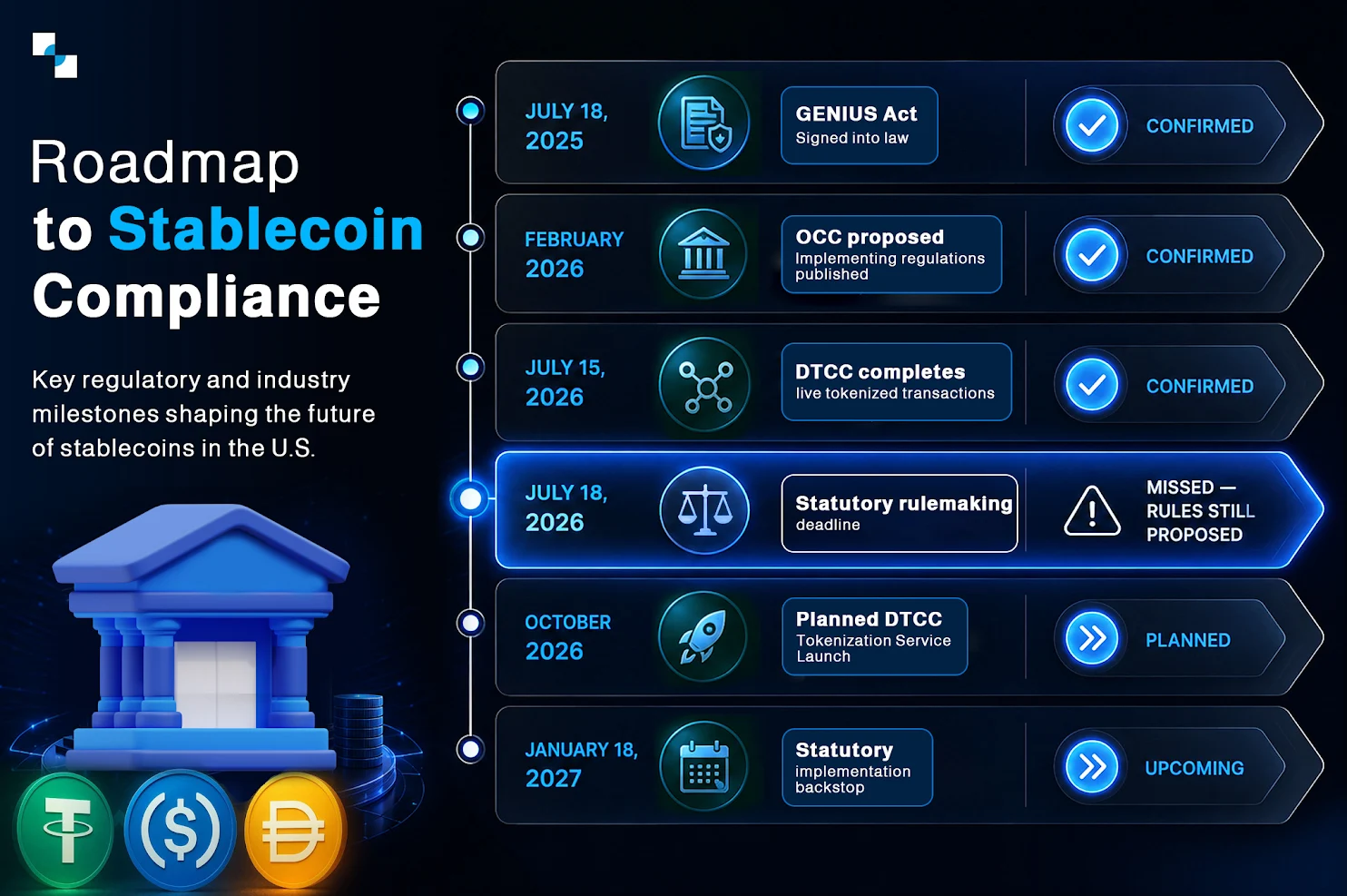
- Although the final rules are yet to be implemented, the act is anticipated to be effective from January 18, 2027.
- The finance industry is already leaning towards a tokenized infrastructure.
The Guiding and Establishing National Innovation for U.S. Stablecoins (GENIUS) Act marks a significant milestone in the evolution of digital finance, establishing the United States’ first federal framework for payment stablecoins. The GENIUS Act stablecoin compliance framework provides long-awaited regulatory clarity for banks, fintech companies, payment providers, and enterprises planning to launch compliant stablecoin solutions by establishing clear standards for issuer eligibility, reserve backing, redemption, transparency, and regulatory oversight.
The need to prepare is becoming increasingly urgent. Although the GENIUS Act’s final implementing rules are still pending, the Act is expected to take effect on January 18, 2027, or 120 days after the final rules are issued. Meanwhile, the financial industry is already moving toward tokenized infrastructure.
“The future of payment stablecoins belongs to issuers that prioritize compliance as much as innovation.”
This Guide Covers:
- The GENIUS Act’s impact on payment stablecoins
- Compliance requirements for stablecoin issuers
- Infrastructure needed for enterprise-ready stablecoin development
- A roadmap to compliance before 2027
Why 2026 Marks a Turning Point for Stablecoins
For years, the U.S. stablecoin industry operated without a unified federal framework. While payment stablecoins gained adoption across crypto trading, cross-border payments, remittances, and decentralized finance (DeFi), issuers lacked clear federal standards for reserve backing, supervision, redemption, and governance. This regulatory uncertainty slowed institutional adoption.
Yet, despite the absence of a comprehensive regulatory framework, the financial industry continued advancing tokenized infrastructure. On July 15, 2026, the Depository Trust & Clearing Corporation (DTCC) successfully processed live tokenized transactions involving more than 30 leading financial institutions, including BlackRock, JPMorgan, Goldman Sachs, Vanguard, NYSE, and CME Group, reinforcing growing institutional confidence in blockchain-powered financial systems.
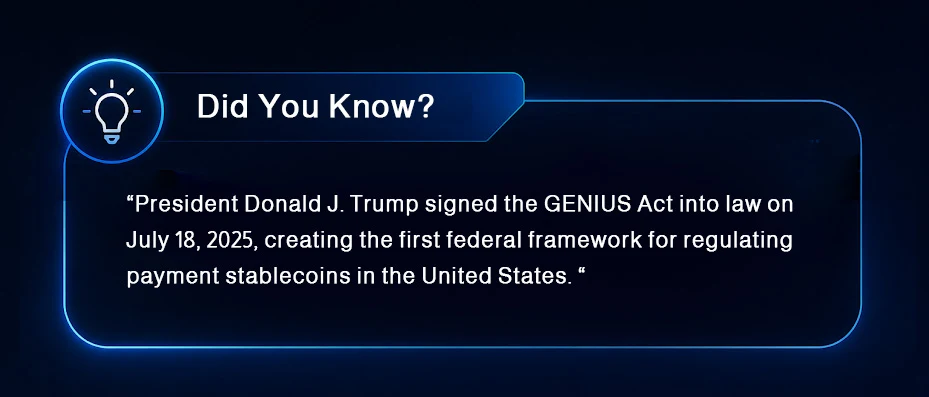
The GENIUS Act final rules change that by establishing the first federal framework for payment stablecoins in the United States. At the same time, financial markets are moving beyond experimentation.
What Makes This a Turning Point?
- Federal regulatory clarity: The GENIUS Act establishes standards for issuer oversight, reserve backing, redemption, transparency, and governance.
- Institutional adoption: DTCC’s live tokenized transactions demonstrate that tokenized assets can operate within existing financial market infrastructure.
- Expanding use cases: Stablecoins now support cross-border payments, real-time settlement, treasury management, tokenized asset transfers, merchant payments, and enterprise liquidity.
- Higher compliance expectations: Regulators increasingly expect issuers to meet standards for consumer protection, operational resilience, and risk management.
- Enterprise readiness: Building a stablecoin is no longer only a blockchain initiative. Success now depends on combining compliant infrastructure, governance, cybersecurity, reserve management, and interoperability.
Understanding Stablecoin Compliance Under the GENIUS Act
The GENIUS Act establishes a structured federal framework for payment stablecoins, replacing the fragmented regulatory approach that previously governed the market. Rather than treating compliance as a requirement to address after launch, the framework integrates regulatory expectations into every stage of a stablecoin’s lifecycle—from issuance and reserve management to governance, consumer protection, and ongoing operations.
For organizations planning to issue payment stablecoins, compliance is no longer limited to meeting legal obligations. It influences how the platform is designed, how reserves are managed, how users redeem their assets, and how risks are identified and controlled. Building these capabilities early can reduce implementation risk, improve regulatory readiness, and strengthen confidence among banking partners, institutional investors, and enterprise customers.
Timeline: The Road to Compliance
Core Requirements of the GENIUS Act Compliance Framework
Capital and Reserve Requirements
The OCC’s proposed rule (NPRM, published in the Federal Register on March 2, 2026) outlines several quantitative requirements. These proposals focus on maintaining sufficient capital, supporting redemption obligations, and ensuring adequate liquidity.
| Requirement | Proposed Threshold | Who It Applies To |
|---|---|---|
| Minimum capital requirement | $5 million | Federally qualified stablecoin issuers |
| Same-day redemption liquidity | 10% of outstanding stablecoin supply | All issuers |
| Five-business-day redemption liquidity | 30% of outstanding stablecoin supply | All issuers |
| Standard redemption completion | Within two business days | All issuers |
| Insured deposit requirement | 0.5% of reserves (capped at $500 million) | Issuers with more than $25 billion in outstanding stablecoin supply |
Note: the 10%/30% liquidity figures come from the OCC’s proposed rule, which offers two paths: a flexible standard with these numbers as a voluntary safe harbor, or a stricter version making them mandatory for all issuers. Which path wins is still being decided.
Not sure where your stablecoin plans stand against the GENIUS Act’s proposed rules?
Financial Crime Compliance
Under the OCC’s proposed rule, payment stablecoin issuers would be classified as financial institutions under the Bank Secrecy Act (BSA). As a result, issuers are expected to implement financial crime compliance controls similar to those required of traditional financial institutions.
These controls include:
- Know Your Customer (KYC) procedures
- Anti-Money Laundering (AML) compliance
- Customer due diligence
- Transaction monitoring
- Regulatory reporting where applicable
These compliance capabilities should be built into the issuance platform from the start, rather than added after deployment, regardless of how additional FinCEN guidance may shape implementation details.
Infrastructure Readiness
Beyond regulatory compliance, issuers should evaluate whether their technology infrastructure can support secure issuance, redemption, compliance monitoring, and interoperability with emerging tokenized financial networks. As tokenized securities and payment stablecoins increasingly operate within the same financial ecosystem, infrastructure flexibility will become an important operational consideration.
A production-ready stablecoin platform should support:
| Infrastructure Component | Purpose |
|---|---|
| Smart contract infrastructure | Supports issuance, redemption, and supply management. |
| Identity verification systems | Enables KYC and customer onboarding. |
| Compliance monitoring tools | Supports AML and transaction monitoring. |
| API integrations | Connects banking systems, payment rails, and enterprise applications. |
| Interoperability capabilities | Supports integration with tokenized settlement infrastructure. |
| Scalable architecture | Adapts to evolving regulatory and operational requirements. |
Selecting the appropriate blockchain is only one part of fiat- backed stablecoin development. Organizations should also ensure the surrounding infrastructure can support compliance, operational resilience, and future regulatory updates.
No-Yield Rule:
The GENIUS Act prohibits permitted payment stablecoin issuers from paying direct interest or yield to holders. This shapes product design from day one; issuers can’t compete on yield the way some DeFi platforms do, so differentiation has to come from redemption speed, integrations, and use-case fit instead.
What Changed After the GENIUS Act?
The GENIUS Act introduces a federal regulatory framework for payment stablecoins. As a result, stablecoin development now extends beyond token issuance to include reserve management, redemption, financial crime compliance, and operational requirements.
| Before the GENIUS Act | After the GENIUS Act |
|---|---|
| Limited federal oversight | Structured federal regulatory framework |
| Flexible reserve practices | Proposed capital, liquidity, and redemption requirements |
| Compliance varied by issuer | BSA/AML obligations for issuers |
| Focus on token issuance | Focus on compliant and operationally ready stablecoins |
| Built mainly for crypto markets | Designed for banks, fintechs, and enterprise adoption |
The shift reflects a new era of stablecoin development, where success depends not only on blockchain technology but also on meeting emerging regulatory and operational expectations.
A Step-by-Step Stablecoin Development Process Under the GENIUS Act
As organizations prepare for its implementation, enterprise stablecoin development must account for regulatory requirements alongside technical design. The following six-step process outlines the key stages involved in developing a payment stablecoin under the Act’s proposed framework.
Step 1: Define the Stablecoin Strategy
Every stablecoin project begins with a clearly defined business objective. Organizations should identify the intended users, payment use cases, reserve model, and blockchain network before development begins.
Key considerations include:
- Define the stablecoin’s use case and target users.
- Choose the blockchain network.
- Determine how the stablecoin will maintain 1:1 backing with eligible reserve assets.
- Establish the issuance and redemption model.
- Plan banking and payment integrations.
Step 2: Plan for Regulatory Compliance
Compliance planning should begin before development starts. Organizations should evaluate the proposed GENIUS Act requirements and incorporate them into the development process.
This stage typically includes:
- Reserve management strategy.
- Capital and liquidity planning.
- AML and KYC compliance.
- Redemption policies and procedures.
- Legal and regulatory assessment.
- Reserve reporting and disclosure planning.
Step 3: Design the Stablecoin Architecture
Once the business and compliance requirements are defined, the technical architecture can be designed.
Core components generally include:
- Smart contracts for issuance, transfers, and redemption.
- Wallet integration.
- Identity verification systems.
- Reserve management infrastructure.
- Banking and payment rail integrations.
- Compliance monitoring tools.
- API infrastructure.
Step 4: Develop and Test the Stablecoin
After the architecture is finalized, development begins. Before deployment, the stablecoin should undergo comprehensive testing to validate functionality, security, and operational performance.
Typical activities include:
- Smart contract development.
- Functional testing.
- Independent security audits.
- Performance and scalability testing.
- Redemption workflow validation.
- Infrastructure testing.
Step 5: Prepare for Launch
Launching a payment stablecoin involves more than deploying smart contracts. Organizations should establish the operational processes required to support ongoing issuance, reserve management, and redemption.
Preparation may include:
- Reserve monitoring procedures.
- Issuance and redemption operations.
- Compliance reporting.
- Transaction monitoring.
- Internal operating procedures.
- Liquidity management.
Step 6: Monitor and Maintain Compliance
Stablecoin development does not end at launch. Organizations should continuously review operations and adapt to regulatory updates as new guidance becomes available.
Ongoing activities include:
- Monitoring 1:1 reserve backing and liquidity levels.
- Reviewing redemption performance.
- Monitoring transaction activity for AML compliance.
- Updating compliance procedures.
- Applying smart contract improvements when necessary.
- Tracking regulatory developments.
View the full Enterprise Stablecoin Readiness Checklist as a PDF
Common Mistakes to Avoid During Stablecoin Development
Developing a payment stablecoin requires balancing technical implementation with regulatory and operational considerations. Addressing these areas early can help reduce development delays, compliance gaps, and costly rework.
Common mistakes include:
- Treating compliance as an afterthought instead of incorporating regulatory requirements from the planning stage.
- Failing to maintain a clear 1:1 reserve strategy, making it difficult to support redemption obligations.
- Designing smart contracts without comprehensive security testing and independent audits.
- Delaying AML, KYC, sanctions screening, and transaction monitoring until after development is complete.
- Ignoring redemption workflows and focusing only on token issuance.
- Choosing a blockchain solely based on transaction speed or fees without evaluating scalability, ecosystem support, and compliance needs.
- Overlooking banking and payment rail integration, which is essential for issuing and redeeming fiat-backed stablecoins.
- Building systems that cannot adapt to regulatory changes or future reporting requirements.
- Neglecting reserve monitoring and reconciliation, increasing operational and financial risks after launch.
By addressing these challenges during the development process, organizations can build payment stablecoins that are better prepared for regulatory expectations and long-term operational requirements.
Expert Insight!
“The GENIUS Act signals a shift in how payment stablecoins are developed and operated. For enterprises, long-term success depends on combining regulatory compliance, reserve management, security, and operational controls from the outset.”
Technology Infrastructure That Supports Compliance
Technology decisions made during development directly influence an organization’s ability to meet future regulatory expectations.
Rather than selecting stabelcoin infrastructure based solely on transaction speed or network fees, enterprises should evaluate how technology supports compliance, scalability, security, and interoperability.
A production-ready stablecoin platform typically includes:
| Infrastructure Component | Compliance Value |
|---|---|
| Smart contract framework | Supports transparent issuance, redemption, and supply management. |
| Secure wallet integration | Protects customer assets and enables controlled access. |
| Identity management systems | Facilitates KYC and customer verification. |
| Compliance monitoring tools | Enables AML screening and transaction oversight. |
| API integrations | Connects banking systems, payment networks, and enterprise applications. |
| Audit logging | Creates immutable operational records for regulatory review. |
| Multi-layer security architecture | Protects against cyber threats and operational failures. |
Selecting the right blockchain is only one part of the equation. The surrounding infrastructure ultimately determines whether the platform can operate within a regulated financial environment.
Conclusion
The GENIUS Act represents more than a new regulatory framework. It signals the maturation of the U.S. digital asset ecosystem and establishes a clearer path for institutional participation in payment stablecoins. As blockchain infrastructure becomes increasingly integrated into mainstream finance, success will depend on more than launching a digital token. Organizations must build platforms that meet enterprise expectations for governance, security, transparency, interoperability, and operational resilience.
The institutions that begin preparing today will be better equipped to navigate evolving US stablecoin regulations, strengthen stakeholder confidence, and capitalize on the growing adoption of digital payments and tokenized financial assets. Whether you’re a financial institution modernizing payment infrastructure, a fintech launching a fiat-backed stablecoin, or an enterprise exploring blockchain-powered settlement, the opportunity extends beyond regulatory compliance. It is about building a resilient digital financial platform designed for long-term growth.
How Antier Supports Stablecoin Development?
Our expertise includes:
- Fiat-backed stablecoin development
- Smart contract development
- Multi-chain integration
- Wallet & custody solutions
- AML/KYC integration
- Banking & payment integration
- Reserve management
- Post-launch support
Get a free compliance gap assessment from Antier’s stablecoin team
Frequently Asked Questions
01. What is GENIUS Act stablecoin compliance?
GENIUS Act stablecoin compliance refers to preparing payment stablecoin platforms to align with the regulatory framework established under the Guiding and Establishing National Innovation for U.S. Stablecoins Act. It encompasses governance, reserve management, consumer protection, operational resilience, and financial crime controls.
02. Who is expected to issue payment stablecoins under the GENIUS Act?
The legislation establishes a framework for permitted issuers operating under federal or qualifying state supervision, subject to applicable regulatory requirements.
03. When should organizations begin preparing?
Organizations should begin planning well before the statutory implementation timeline. Building enterprise infrastructure, governance processes, and compliance capabilities often takes many months before production deployment.
04. Why is reserve management so important?
Reserve assets underpin user confidence in payment stablecoins. Effective reserve management supports redemption, liquidity, financial stability, and regulatory trust.
05. What technology capabilities are essential?
A production-ready stablecoin platform typically includes secure smart contracts, wallet infrastructure, identity verification, compliance monitoring, banking integrations, audit logging, treasury management, and cybersecurity controls.
06. Can compliance be added after launch?
While some operational processes can evolve over time, governance, security, reserve architecture, and compliance controls should be incorporated during platform design. Retrofitting these capabilities later can increase cost, complexity, and implementation risk.