




✨ AI Summary
- Stablecoin payout APIs enable streamlined payroll and disbursement workflows by handling blockchain interactions and local fiat conversions in the background.
- According to a joint study by McKinsey and Artemis Analytics, B2B stablecoin payments grew by 733% in 2025, reaching an estimated $226 billion.
- This surge has created opportunities for fintech operators and payroll platform CTOs to build infrastructure that facilitates compliance, throughput, and multi-jurisdictional growth.
- This article covers key aspects of stablecoin payout API, such as intent resolution, idempotency controls, bulk payout primitives, and last-mile off-ramp integration.
- It also discusses the impact of the GENIUS Act on payout API compliance architecture and how to approach multi-chain routing for payroll across different networks.
A stablecoin payout API serves as a programmable infrastructure layer for payroll and disbursement workflows. It receives payout instructions, evaluates the appropriate stablecoin network and routing path, applies recipient-level compliance checks, coordinates local fiat conversion at the destination, and returns settlement confirmation to the calling system. The experience can remain streamlined for recipients, with the infrastructure handling blockchain interactions and gas requirements in the background.
By 2026, stablecoin payouts have developed into a meaningful infrastructure category. B2B stablecoin payments grew 733% year-over-year in 2025, reaching an estimated $226 billion and accounting for approximately 60% of real stablecoin payment activity, according to a joint study by McKinsey and Artemis Analytics reported by Bancoli. For fintech operators and payroll platform CTOs, the opportunity now centers on building infrastructure that supports compliance, throughput, and multi-jurisdictional growth from the ground up.
What This Guide Covers:
- What a stablecoin payout API handles at the infrastructure level and the capabilities required for production
- How the GENIUS Act shapes compliance architecture for payout APIs
- How to approach multi-chain routing for payroll across Solana, Arbitrum, Base, and Optimism
- How to evaluate in-house development, API-integrated partner development, and white-label deployment, including realistic timelines
- What a production-grade stablecoin payout infrastructure journey looks like from architecture to deployment
- Key questions around timelines, technology, specialist development, and infrastructure performance
What Does a Stablecoin Payout API Do at the Infrastructure Level?
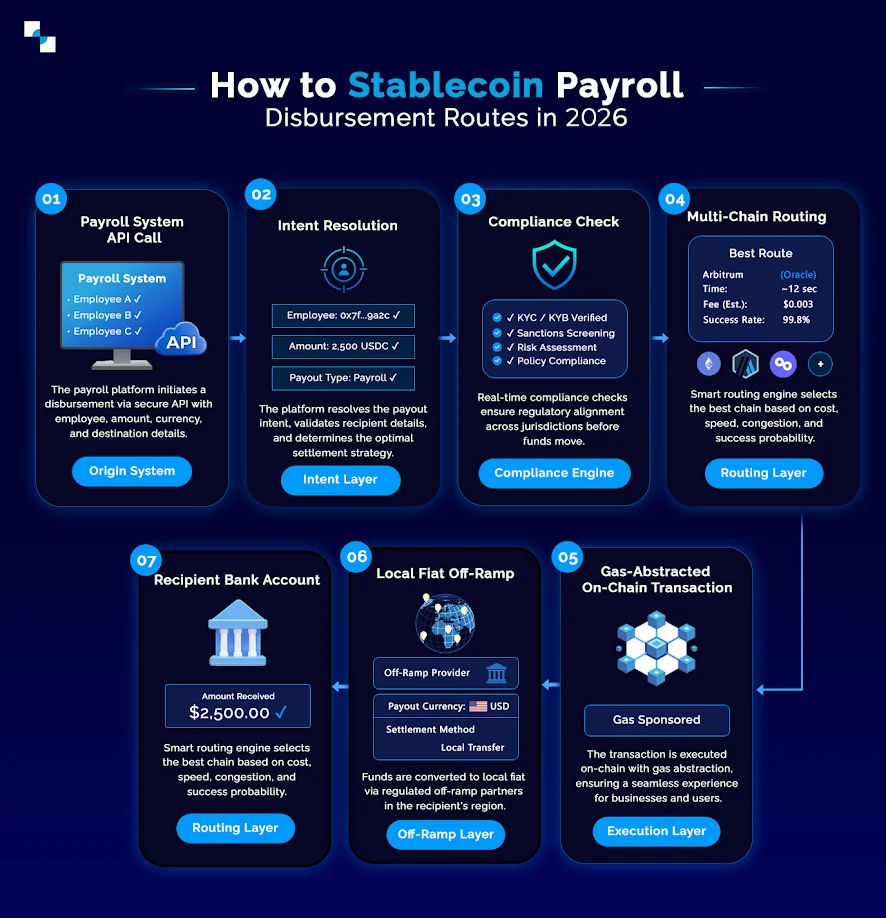
A stablecoin payout API coordinates a broader set of technical functions than a simple transfer between two wallet addresses. At production scale, payroll and B2B disbursement systems bring together several infrastructure layers to support reliable execution, compliance, reconciliation, and settlement.
- Intent Resolution: The API receives a payout instruction containing details such as the recipient identifier, amount, currency, and settlement deadline. It then converts that instruction into an executable transaction by selecting the appropriate network, token, and routing path. The calling system can work with a consistent API interface while the infrastructure manages the underlying blockchain decisions.
- Idempotency Controls: Each payout request carries a unique idempotency key. This allows payroll systems to safely handle retries while maintaining a single payout record for each instruction. The control supports accurate processing across automated and high-volume disbursement workflows.
- Bulk Payout Primitives: Production infrastructure can expose batch endpoints capable of receiving thousands of recipients in one request. The system distributes the workload across parallel on-chain transactions and returns recipient-level status information through a unified response.
- Per-Recipient Compliance Hooks: Every recipient can move through AML screening, sanctions checks, and jurisdiction-specific eligibility rules before transaction execution. Applying these controls during the payout workflow supports a compliance architecture designed around the current transaction and recipient context.
- Gas Abstraction: ERC-4337 account abstraction and paymaster models can allow the infrastructure to manage network fees on behalf of recipients. As a result, recipients can receive stablecoin value without maintaining native tokens solely for transaction fees. This creates a smoother experience for workforce payroll and other use cases involving recipients with varying levels of blockchain familiarity.
- Last-Mile Off-Ramp Integration: The API can connect with local fiat on-ramp and off-ramp providers across destination corridors, supporting conversion from stablecoin value into the recipient’s preferred local currency during final settlement. Traditional remittance costs average 6.49% globally, according to the Rise State of Crypto Payroll Report 2026. Stablecoin rails combined with integrated off-ramp infrastructure can support more efficient settlement models across documented deployments.
- On-Chain Audit Trails: Each disbursement creates a verifiable transaction record that can be associated with its idempotency key. Indexed transaction data gives finance and compliance teams a structured view of payout activity and supports efficient record retrieval.
Here’s how these infrastructure layers work together to move a payroll disbursement from an API call to final settlement:
How Does the GENIUS Act Shape Payout API Compliance Architecture?
The GENIUS Act, signed into U.S. law on July 18, 2025, established a federal framework that gives stablecoin infrastructure operators greater clarity when designing payment systems for the U.S. market. Its implications extend into several core components of the payout API architecture. For a deeper breakdown of the legislation and its evolving requirements, see our GENIUS Act Stablecoin Compliance Guide (2026).
- Issuer Reserve Requirements Influence the API Layer
The GENIUS Act establishes 1:1 reserve backing requirements for payment stablecoins issued in the United States. API operators processing USDC or USDT at scale can incorporate stablecoin eligibility and issuance verification into their routing and compliance architecture. - Transaction-Time Sanctions Screening
Payout infrastructure can perform OFAC and relevant sanctions screening as part of the disbursement workflow. This approach evaluates the recipient against current compliance data at the point of transaction execution and complements onboarding and KYC processes. - Jurisdiction-Aware Compliance Routing
The federal framework operates alongside applicable state-level requirements. A production-ready system can maintain jurisdiction mapping that applies the relevant compliance rules based on recipient location and the transaction corridor. - Machine-Readable Audit Records
Transaction data can be indexed and stored in formats that support compliance review and operational reconciliation. When on-chain records are structured and linked correctly, they can contribute to a comprehensive audit architecture aligned with broader BSA recordkeeping expectations. - MiCA Support for EU Payroll Corridors
Cross-border payroll systems serving EU recipients can incorporate MiCA-aligned stablecoin routing alongside GENIUS Act considerations for U.S.-origin flows. Since the two frameworks address different authorization and compliance requirements, infrastructure benefits from routing logic that considers the relevant origination and destination jurisdictions.
Take Your Payout Infrastructure to Production
Multi-Chain Routing for Payroll: Solana, Arbitrum, Base, and Optimism
Selecting a blockchain for stablecoin payroll involves evaluating settlement time, transaction costs, finality characteristics, developer tooling, and stablecoin liquidity. USDC and USDT accounted for 57% of all off-ramp transactions during the first half of 2026, up from 25% a year earlier, according to Mercuryo data reported by Crypto Reporter. Both stablecoins are available across the major networks discussed below.
| Network | Avg. Settlement Time | Typical Transaction Cost | USDC Native Support | Payroll Suitability Notes |
|---|---|---|---|---|
| Solana | ~400ms | Sub-cent | Yes, Circle native | High throughput for bulk disbursements and high-volume payroll runs. |
| Arbitrum | ~1–2 seconds | Low, L2 pricing | Yes | Strong finality characteristics with EVM-compatible development tooling |
| Base | ~2 seconds | Low, L2 pricing | Yes, Circle native | Deepening liquidity and an expanding fiat off-ramp ecosystem |
| Optimism | ~2 seconds | Low, L2 pricing | Yes | Mature smart contract ecosystem and active developer tooling |
A production-grade payout system can evaluate multiple networks dynamically instead of relying on a single settlement path. An orchestration layer can assess stablecoin liquidity, transaction costs, settlement speed, and network conditions before selecting the route for each disbursement.
This architecture allows the payment layer to maintain a consistent interface while routing decisions take place behind the API. Choosing the right infrastructure model is essential when building a stablecoin payouts API for payroll.
Build In-House, API-Integrated Partner, or White-Label: A Decision Framework
Fintech operators can approach stablecoin payout infrastructure through three primary models. Each option offers a different balance of development speed, customization, compliance configuration, and infrastructure ownership.
| Dimension | Build In-House | API-Integrated Partner Build | White-Label |
|---|---|---|---|
| Compliance Architecture Ownership | Full | Low, L2 pricing | Yes |
| Multi-Chain Routing Control | Fully custom | Low, L2 pricing | Yes, Circle native |
| GENIUS Act / MiCA Coverage | Dedicated legal and engineering resources | Low, L2 pricing | Yes |
| HRMS / ERP Integration | Fully customized | Low, L2 pricing | Yes |
| Infrastructure Ownership | Full | Low, L2 pricing | Yes |
Create Infrastructure Built for High-Volume Payouts
When Does In-House Development Fit?
In-house development can suit operators with an established blockchain engineering team, significant development capacity, and highly specialized requirements. This route provides complete architectural control and supports deeply customized infrastructure decisions.
When Does an API-Integrated Partner Build Fit?
An API-integrated partner build can combine custom infrastructure ownership with specialist expertise in stablecoin payments, compliance architecture, multi-chain routing, and off-ramp integration. It is well suited to operators that require configurable compliance hooks, bulk payout capabilities, and HRMS connectivity designed around their existing technology stack.
When Does White-Label Fit?
White-label deployment can support organizations looking to introduce stablecoin payout functionality quickly through an established infrastructure platform. This approach can work well when payouts represent an additional product capability and standardized provider configurations align with operational requirements.
For organizations prioritizing recipient-level compliance hooks, jurisdiction-aware routing, and ownership of their disbursement infrastructure, an API-integrated partner build offers a strong balance between customization and speed to production.
Step-by-Step: How a Stablecoin Payout Infrastructure Build Reaches Production
The following sequence outlines an API-integrated partner build designed for payroll and B2B disbursement use cases. Building a stablecoin payouts API for payroll requires a connected approach to infrastructure, compliance, routing, and settlement.
Phase 1: Architecture Scoping and Chain Selection
- Define expected disbursement volumes, recipient geographies, and target stablecoins such as USDC, USDT, or both
- Select primary and alternative chains using corridor-level cost, liquidity, and finality considerations
- Map applicable compliance requirements by jurisdiction, including the GENIUS Act, MiCA, and FATF-aligned considerations
- Identify HRMS and ERP integration points and establish the API authentication model
Phase 2: Core API and Smart Contract Development
- Build bulk disbursement endpoints with idempotency key support
- Implement ERC-4337 paymaster functionality for gas abstraction across selected networks
- Develop the smart contract layer and settlement logic aligned with the product architecture
- Integrate on-chain audit trail indexing connected to payout and idempotency records
Phase 3: Compliance Hook Integration
This phase can progress alongside core API development.
- Connect OFAC and relevant sanctions screening to the transaction workflow
- Build a jurisdiction mapping layer for applying the appropriate compliance rules by recipient and corridor
- Integrate AI-driven AML and transaction risk scoring at the API middleware layer
- Configure KYC verification connectors for payroll recipient onboarding
Phase 4: Off-Ramp and Multi-Currency Settlement
- Integrate local fiat off-ramp providers across priority payment corridors
- Implement automated FX conversion mechanisms for efficient rate execution
- Configure settlement confirmation callbacks for the calling payroll system
- Enable multi-currency settlement capabilities across supported destination markets
Phase 5: HRMS/ERP Connectivity and Quality Assurance
- Build and test integrations with target HRMS and ERP environments, including SAP, Workday, or custom systems
- Conduct bulk disbursement load testing at expected payroll-run volumes
- Complete end-to-end compliance workflow testing and audit log validation
- Coordinate smart contract audit support before production deployment
Phase 6: Production Deployment and Monitoring, Week 16+
- Deploy to mainnet with on-chain audit capabilities active from launch
- Enable real-time transaction visibility for finance and compliance teams
- Configure anomaly detection and alerting for disbursement patterns
- Establish SLA monitoring for settlement confirmation across payment corridors
Wrapping UP
The GENIUS Act provides a clearer regulatory framework for stablecoin infrastructure operators building for the U.S. market. At the same time, growing stablecoin activity continues to expand the importance of reliable infrastructure for payroll and B2B disbursements. The Rise State of Crypto Payroll Report 2026 places stablecoin supply above $315 billion and stablecoin-adjusted transaction volume at approximately $10.2 trillion in 2026. As B2B adoption continues to develop, payroll and disbursement infrastructure represents an increasingly important layer of the broader stablecoin ecosystem. A production-ready architecture brings together several core capabilities: idempotent bulk payout operations, transaction-aware compliance workflows, dynamic multi-chain routing, gas abstraction, comprehensive audit records, and last-mile off-ramp connectivity across relevant currency corridors. When these components are designed as part of a connected infrastructure layer, operators can build stablecoin payout platforms around their specific transaction volumes, jurisdictions, integration requirements, and growth plans.
At Antier, we build complete stablecoin payout API platforms covering smart contract infrastructure, compliance workflows, multi-chain routing, off-ramp integration, and HRMS connectivity. The approach focuses on delivering infrastructure designed around each operator’s product requirements and technical environment. Looking to move payroll onto stablecoin rails? Let’s map your payout volumes, recipient markets, compliance requirements, and HRMS integrations into a production-ready infrastructure plan.
Frequently Asked Questions
01. What is a stablecoin payout API and what functions does it perform?
A stablecoin payout API serves as a programmable infrastructure layer for payroll and disbursement workflows, handling payout instructions, compliance checks, local fiat conversions, and providing settlement confirmations while managing blockchain interactions in the background.
02. How has the market for stablecoin payouts evolved recently?
By 2026, stablecoin payouts have become a significant infrastructure category, with B2B stablecoin payments growing 733% year-over-year in 2025, reaching approximately $226 billion and accounting for about 60% of real stablecoin payment activity.
03. What key considerations should fintech operators focus on when developing stablecoin payout infrastructure?
Fintech operators and payroll platform CTOs should focus on building infrastructure that supports compliance, throughput, and multi-jurisdictional growth, while evaluating options for in-house development, API-integrated partner development, and white-label deployment.