





✨ AI Summary
- Blockchain security, which relies heavily on cryptography, is under scrutiny due to advancements in quantum computing.
- The blog post explores the potential impacts that quantum-resistant security could have on existing blockchain architectures and applications.
- The recent Ethereum proposal focuses on validator deposits, allowing for a gradual transition to quantum-resistant keys.
- The wider Ethereum roadmap identifies four key areas of cryptography that need attention: transaction authorization, wallet security, validator authentication, and consensus mechanisms.
- Quantum computing poses a growing threat to blockchain security as it introduces algorithms capable of solving difficult mathematical problems more efficiently.
Blockchain security relies heavily on cryptography, from transaction signatures and wallet keys to validator authentication and network consensus. As quantum computing advances, some of the cryptographic assumptions behind today’s blockchain infrastructure are receiving closer scrutiny.
The potential impact extends beyond public blockchain networks. Financial institutions, enterprises, Web3 infrastructure providers, and businesses building long-term blockchain systems must consider how quantum-resistant security could affect existing architectures, applications, and cryptographic dependencies.
Post-quantum blockchain development focuses on identifying vulnerable components, strengthening cryptographic mechanisms, and creating practical upgrade paths without disrupting network performance or compatibility.
In this blog, we’ll explore Ethereum’s quantum-resistance efforts, the role of post-quantum cryptography, key considerations for quantum-resistant blockchain development, and how businesses can prepare their blockchain infrastructure.
What Ethereum’s Latest Quantum-Resistance Proposal Means for Businesses
Ethereum’s recent proposal focuses on validator deposits, placing staking infrastructure among the areas receiving a concrete path toward quantum resistance.
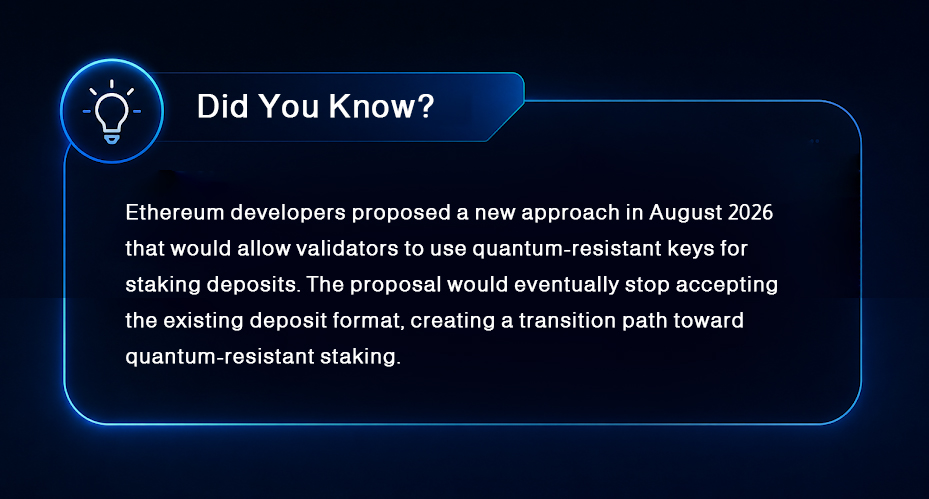
The proposed mechanism would allow validators to use quantum-resistant keys for deposits and eventually prevent new deposits from using the current format. This provides a gradual transition rather than requiring every participant to change its cryptographic setup simultaneously.
The wider Ethereum roadmap goes beyond staking. Ethereum’s post-quantum security work identifies four distinct areas of cryptography that need attention, with different technical challenges and potential solutions for each. That approach offers a useful reference point for businesses developing their own networks.
Cryptography can be embedded across multiple parts of a blockchain system, including:
- Transaction authorization
- Wallet and account security
- Validator authentication
- Consensus mechanisms
- Cross-chain communication
- Smart-contract interactions
- Custody and key-management systems
- Infrastructure access controls
Replacing one cryptographic primitive without reviewing its dependencies can create compatibility or operational problems.
For organizations planning quantum-resistant blockchain development, the first step is therefore understanding the existing security architecture. That assessment helps determine which components need replacement, which can remain unchanged, and where an upgrade mechanism should be introduced.
Ethereum is also running weekly post-quantum interoperability devnets, with core infrastructure milestones currently targeting around 2029.
This development shows that quantum resistance is moving from long-term cryptographic research into practical blockchain protocol planning.
Why Quantum Computing Is a Growing Threat to Blockchain Security
Most blockchain networks use public-key cryptography to authenticate transactions and establish control over digital assets. The security of these systems depends on mathematical problems that are difficult for conventional computers to solve.
Quantum computing introduces algorithms capable of solving some of these problems more efficiently.
A sufficiently capable quantum computer could eventually threaten certain public-key cryptographic schemes currently used across digital infrastructure. That does not mean existing blockchain networks are currently being broken by quantum machines. The technology required for such attacks remains beyond today’s practical capabilities.
The concern is the lifecycle of blockchain infrastructure.
A network launched today may remain operational for a decade or longer. During that period, its users, smart contracts, integrations, validators, wallets, and applications can become deeply dependent on the original architecture.
Changing cryptography after that infrastructure has grown can be considerably more complicated than designing an upgrade path from the beginning.
NIST’s post-quantum migration guidance recommends organizations begin applying standardized quantum-resistant cryptography and start identifying the cryptographic assets present across their systems.
For blockchain businesses, this makes cryptographic inventory and dependency mapping important parts of security planning.
A quantum resistant blockchain should account for the possibility that cryptographic mechanisms will need to change during its operational lifetime.
Don’t Let Quantum Risk Become a Blockchain Upgrade Crisis
Post-Quantum Cryptography: The Foundation of a Quantum-Resistant Blockchain
Post-quantum cryptography (PQC) consists of cryptographic algorithms designed to withstand attacks from sufficiently capable quantum computers while running on conventional computing systems.
The technology is already moving beyond research. In August 2024, NIST finalized its first three principal post-quantum cryptography standards and encouraged organizations to begin transitioning to the new standards.
For blockchain networks, however, implementing PQC requires more than selecting an algorithm.
Cryptographic mechanisms interact with the underlying protocol. A change to digital signatures can affect transaction sizes, verification times, bandwidth requirements, storage, validator workloads, and application compatibility.
These factors become especially important for high-throughput networks.
A blockchain development team therefore needs to evaluate PQC according to the requirements of the specific network. Security strength matters, but so do:
- Signature and key sizes
- Transaction throughput
- Verification performance
- Storage requirements
- Network bandwidth
- Validator workload
- Wallet compatibility
- Application integration
NIST’s migration work also emphasizes making asymmetric cryptographic functions easier to update, which aligns closely with the concept of cryptographic agility used in Ethereum’s post-quantum strategy.
For businesses, this makes post-quantum cryptography an architectural consideration rather than an isolated security feature.
What Makes a Blockchain Quantum-Resistant?
A quantum-resistant blockchain needs security mechanisms that can address future cryptographic threats without creating unnecessary disruption across the network.
1. Quantum-resistant transaction signing
Transaction authorization is one of the most visible areas of cryptographic dependency. Account and wallet architecture should support stronger signature mechanisms and provide a controlled migration path for users.
2. Validator and consensus security
Validators protect the integrity of proof-of-stake networks. Their keys and signing mechanisms therefore deserve specific attention when designing a post-quantum blockchain solution.
Ethereum’s work on quantum-resistant staking illustrates the importance of this layer.
3. Key management
Quantum readiness also extends beyond protocol code. Private-key generation, storage, custody, signing infrastructure, recovery mechanisms, and administrative access all form part of the broader security environment.
4. Cryptographic agility
Cryptographic agility allows a system to replace cryptographic primitives without requiring a complete redesign.
Ethereum’s dedicated post-quantum work explicitly identifies cryptographic agility as a core principle of its approach.
5. Performance and compatibility
Quantum-resistant algorithms may have different computational and data characteristics from the cryptography used today. Testing is therefore required to understand their effect on throughput, latency, storage, bandwidth, and application compatibility.
A strong post-quantum blockchain solution combines these layers rather than treating quantum resistance as a single algorithmic upgrade.
Post-Quantum Blockchain Development: Build New or Upgrade Existing Infrastructure?
The right approach depends largely on the condition of the existing blockchain.
An established network may be suitable for modernization when its architecture supports protocol upgrades and modular cryptographic components.
The process can begin with a cryptographic inventory, followed by vulnerability assessment, algorithm evaluation, implementation, testing, and phased migration.
A new blockchain provides a different opportunity.
With custom blockchain development, quantum-readiness can be incorporated into the protocol architecture before the network accumulates large numbers of users and integrations.
Developers can consider cryptographic agility alongside:
- Account architecture
- Transaction formats
- Consensus design
- Validator infrastructure
- Key management
- Upgrade mechanisms
- Smart-contract compatibility
- Interoperability
This does not mean every new blockchain needs to adopt every available post-quantum mechanism immediately. Technology selection should reflect the network’s actual requirements and the maturity of available standards.
Existing infrastructure may also benefit from hybrid migration strategies, where conventional and quantum-resistant mechanisms coexist temporarily while users and applications transition.
The choice between modernization and rebuilding should ultimately be based on architecture, business requirements, migration complexity, and expected network lifespan.
Where Businesses Can Apply Quantum-Resistant Blockchain Solutions
Quantum resistance becomes particularly relevant when blockchain infrastructure is expected to protect valuable information or operate over long periods.
- Financial services
Banks, financial institutions, and payment providers are exploring blockchain for settlement, payments, digital assets, identity, and shared financial infrastructure.
These systems can have long operational lifecycles and involve high-value transactions, making cryptographic resilience an important architectural consideration.
- Enterprise blockchain networks
Businesses using blockchain for supply-chain coordination, shared records, workflow automation, and multi-party data exchange can benefit from infrastructure that supports future security upgrades.
- Digital identity
Blockchain-based identity systems depend on cryptographic authentication to establish control over credentials. Their long-term security therefore depends partly on the resilience of the underlying cryptographic mechanisms.
- Long-term records
Applications designed to preserve records over extended periods need to consider whether their security architecture can remain reliable as cryptographic standards evolve.
- Critical business infrastructure
Once blockchain becomes integrated with enterprise applications, APIs, databases, identity systems, and operational workflows, replacing the underlying security architecture can become increasingly complex.
Planning post-quantum blockchain solutions during the architecture stage can give businesses greater flexibility when standards change.
A Practical Roadmap for Post-Quantum Blockchain Development
A structured post-quantum blockchain development roadmap helps businesses identify cryptographic risks, implement Post-quantum cryptography, and build upgrade paths for more resilient blockchain infrastructure.
Step 1: Audit cryptographic dependencies
Create an inventory of cryptographic algorithms, keys, signatures, certificates, wallets, validators, bridges, applications, and infrastructure components.
NIST’s migration guidance identifies cryptographic asset discovery and inventory as an important starting point for PQC migration.
Step 2: Identify vulnerable components
Map each dependency according to its exposure, business importance, migration complexity, and expected lifespan.
Step 3: Define the security architecture
Determine where quantum-resistant signatures, authentication mechanisms, key-management controls, and other security measures should be introduced.
Step 4: Evaluate PQC options
Assess candidate algorithms according to security, implementation maturity, performance, compatibility, and the requirements of the blockchain network.
NIST currently maintains three principal PQC standards while continuing work on additional algorithms and migration guidance.
Step 5: Introduce cryptographic agility
Separate cryptographic functions from business and protocol logic wherever practical. This makes future replacements easier to manage.
Step 6: Test network impact
Measure transaction size, throughput, verification performance, latency, storage, bandwidth, validator workload, and application compatibility.
Step 7: Deploy in stages
Use development environments and testnets to validate migration mechanisms before introducing changes into production infrastructure.
This phased approach makes post-quantum blockchain development easier to manage and gives businesses measurable checkpoints throughout the transition.
How Blockchain Development Services Can Help Businesses Prepare for Quantum Risk
Quantum readiness sits at the intersection of cryptography, protocol engineering, application development, and infrastructure management. For businesses without specialized blockchain engineering resources, determining how quantum risk affects an existing system can be difficult. Professional blockchain development services can cover the technical work required to evaluate and modernize that infrastructure.
Depending on the project, this can include:
- Blockchain architecture assessment
- Cryptographic dependency mapping
- Quantum-risk analysis
- Quantum-resistant protocol design
- PQC implementation
- Wallet and transaction-signing upgrades
- Validator and consensus security
- Key-management architecture
- Smart-contract modernization
- Testnet implementation
- Performance benchmarking
- Migration planning
- Post-deployment upgrades
For a new blockchain, these considerations can be incorporated into the architecture from the beginning. For an existing network, development teams can focus on identifying vulnerable components and introducing changes through controlled migration stages.
Build Blockchain Infrastructure That Can Adapt as Security Standards Evolve
The implementation also needs to match the business environment. A financial institution may place greater emphasis on transaction integrity, security controls, and regulatory requirements. A Web3 infrastructure provider may prioritize throughput, interoperability, validator performance, and developer compatibility.
There is no universal migration blueprint. The architecture needs to reflect the workload, technology stack, and expected lifespan of the network.
Why Choose a Quantum-Ready Blockchain Development Company?
Quantum readiness involves more than replacing a cryptographic algorithm. It requires careful consideration of blockchain architecture, key management, application compatibility, performance, and future upgrades. A specialized quantum-resistant blockchain development approach can address these requirements across the technology stack.
- Deep Blockchain Architecture Expertise
Quantum-resistant infrastructure can affect protocols, smart contracts, wallets, validators, applications, and supporting infrastructure. Experienced blockchain development services can evaluate these dependencies together and identify where quantum-related changes may be required.
- Built-In Cryptographic Agility
New networks can incorporate modular cryptographic components that make algorithms easier to replace or upgrade. Custom blockchain development can integrate cryptographic agility into the protocol architecture instead of treating quantum resistance as a later modification.
- Existing Network Modernization
Established blockchain systems may contain quantum-vulnerable cryptographic dependencies across multiple layers. A structured assessment can identify these dependencies and establish a practical path for post-quantum blockchain development without unnecessarily disrupting existing infrastructure.
- Performance and Compatibility Testing
Post-quantum cryptographic mechanisms can introduce different computational and data requirements. Testing helps evaluate their effect on transaction processing, validation, storage, latency, interoperability, and application performance before production deployment.
- Secure Key and Identity Management
Quantum readiness extends beyond transaction signatures. Wallets, validator credentials, custody infrastructure, authentication systems, and access controls may also require modernization as organizations adopt post-quantum blockchain solutions.
- Structured Migration and Upgrade Planning
Moving toward quantum resistance may require phased upgrades, compatibility planning, user migration, and operational safeguards. A blockchain development company with modernization capabilities can help structure these changes around the existing network architecture and business requirements.
- Enterprise-Scale Integration
For organizations operating complex technology environments, enterprise blockchain development must consider quantum readiness alongside scalability, interoperability, security, system integration, and maintainability. This broader architectural view helps prevent isolated security upgrades from creating downstream issues.
- Long-Term Cryptographic Adaptability
Quantum-resistant blockchain infrastructure should be designed to evolve as cryptographic standards and threat models change. A modular architecture, upgradeable security mechanisms, and ongoing testing can provide the flexibility required for long-term quantum resistant blockchain infrastructure.
Build Blockchain Infrastructure That Can Evolve With Cryptography
Quantum risk is becoming an architectural consideration for organizations building blockchain systems with long operating lifecycles. Waiting until quantum attacks become practical could leave businesses facing rushed upgrades, compatibility issues, and costly infrastructure changes.
A stronger approach is to evaluate cryptographic dependencies early, establish clear upgrade paths, and design security components that can be replaced as standards and threat models evolve. This applies to both new blockchain networks and existing systems undergoing modernization.
For businesses, post-quantum blockchain solutions can provide a structured way to strengthen security while preserving performance, interoperability, and operational continuity. The goal is not to predict exactly which cryptographic technologies will dominate, but to build infrastructure capable of adapting when requirements change.
With the right blockchain development services, organizations can make quantum resilience part of their broader security and modernization strategy rather than treating it as a standalone upgrade.
The most resilient blockchain infrastructure is built with change in mind especially when the cryptography securing it will not remain static forever.
Ready to strengthen your blockchain infrastructure against emerging quantum risks? Explore Antier’s blockchain development services to build, modernize, and upgrade infrastructure with post-quantum security in mind.
Frequently Asked Questions
01. Why is post-quantum blockchain development important?
Post-quantum blockchain development helps organizations identify cryptographic dependencies that could become vulnerable to quantum attacks and introduce appropriate migration and upgrade mechanisms. This is particularly important for blockchain networks expected to operate for many years, where replacing cryptography later could become complex and disruptive.
02. What is post-quantum cryptography and how does it protect blockchain networks?
Post-quantum cryptography refers to cryptographic algorithms designed to resist attacks from quantum computers while operating on conventional systems. For blockchain networks, PQC can be applied to areas such as transaction signatures, validator authentication, key management, and other cryptographic functions. NIST has finalized standards including ML-KEM, ML-DSA, and SLH-DSA as a foundation for broader migration.
03. How does quantum computing threaten blockchain security?
Quantum computers could eventually threaten public-key cryptographic systems used by many blockchain networks. Ethereum, for example, identifies ECDSA account signatures and BLS consensus signatures among the cryptographic components requiring post-quantum upgrades. Post-quantum blockchain development addresses this risk through stronger cryptographic mechanisms, migration strategies, and cryptographic agility.
04. How can businesses start post-quantum blockchain development?
Businesses can begin post-quantum blockchain development by creating a cryptographic inventory, identifying quantum-vulnerable dependencies, assessing migration priorities, selecting appropriate Post-quantum cryptography, and designing upgrade mechanisms. NIST specifically recommends cryptographic discovery and inventory as important early steps in PQC migration.
05. Can an existing blockchain be upgraded to become quantum resistant?
Yes. Existing networks can undergo quantum-resistant blockchain development through cryptographic dependency analysis, protocol modernization, signature upgrades, key-management changes, performance testing, and phased migration. The feasibility depends on the network architecture, upgrade mechanisms, application dependencies, and interoperability requirements.
06. How much does quantum-resistant blockchain development cost?
The cost of quantum-resistant blockchain development depends on whether the project involves a new network or an existing system. Custom blockchain development may require investment in protocol architecture, PQC integration, key management, testing, and infrastructure. Existing networks may additionally require cryptographic audits, migration planning, compatibility work, and modernization.