



Blockchain networks have become an enormous source of financial and operational data. Every block adds transactions, token transfers, wallet activity, smart contract events, and asset movements that can reveal how digital assets are being used and distributed. The challenge is making this information useful at business scale. A blockchain asset analytics platform brings fragmented on-chain data into a structured environment where businesses can monitor assets, analyze wallets, study transaction flows, identify ownership patterns, and track activity across networks. For investment firms, token issuers, fintech platforms, Web3 businesses, and blockchain data providers, such a platform can become a critical intelligence layer. This guide explains the architecture, features, technology stack, development process, challenges, and cost involved in building a scalable blockchain asset analysis platform with the right blockchain development services.
Why Build a Blockchain Asset Analytics Platform?
Blockchain data is transparent, but transparency alone does not make it useful. A business working with digital assets may have access to blockchain explorers, RPC endpoints, node infrastructure, market-data platforms, and third-party APIs. Yet these sources often provide fragmented information that still needs to be collected, cleaned, interpreted, and connected before it can support a business decision.
A blockchain asset analytics platform solves this problem by creating a dedicated analytical layer over blockchain data. It collects information from supported networks, indexes relevant records, standardizes the data, calculates business-specific metrics, and presents the results through dashboards or APIs. The result is a shift from simply accessing blockchain data to using blockchain data as business intelligence.
1. Turn Raw Blockchain Data Into Business Intelligence
A blockchain contains facts. An analytics platform adds context. Raw records such as transactions, logs, token transfers, and contract interactions become significantly more useful when they are processed into metrics around asset activity, holder distribution, wallet behavior, transaction flows, and historical changes.
A blockchain asset analysis platform can transform raw on-chain records into indicators such as:
- Asset transfer volume
- Holder concentration
- Wallet activity
- Asset inflows and outflows
- Large-value transactions
- Token distribution
- Historical activity
- Smart contract usage
- Liquidity-related indicators
This allows analysts and business teams to work with aggregated intelligence rather than manually interpreting thousands or millions of individual blockchain records.
2. Bring Assets, Wallets, and Transactions Into One View
Digital asset activity rarely exists in isolation. An asset may be distributed across thousands of wallets, traded through different protocols, transferred between networks, and interacted with through multiple smart contracts.
A blockchain asset analysis software solution can connect these activities within a unified data model.
Users can move from an asset-level view to wallet activity, transaction history, holder distribution, and related contract activity without switching between unrelated tools.
This is particularly useful for organizations managing multiple assets or monitoring large volumes of on-chain activity.
3. Understand Ownership and Activity Patterns
Asset performance cannot always be understood through market price alone. Changes in holder concentration, wallet activity, transaction frequency, and asset flows can provide additional context. A growing number of holders may indicate broader distribution, while increasing concentration among large wallets may indicate a very different ownership pattern. A well-designed blockchain asset analytics platform allows users to compare these metrics over time and identify changes that deserve closer investigation.
The important point is that the platform should not simply report numbers. It should establish relationships between them.
4. Create a Unified Multi-Chain Intelligence Layer
As businesses operate across more blockchain networks, their data becomes increasingly fragmented. A multi-chain blockchain asset analysis platform can consolidate information from supported networks and expose it through a consistent analytical interface.
The underlying architecture still needs to respect chain-specific differences. EVM networks, for example, can share common concepts but differ in implementation details, while non-EVM networks may use entirely different transaction and data models.
A normalization layer allows the platform to preserve those differences internally while presenting comparable analytical concepts to users.
5. Build Proprietary Analytics Instead of Depending on Generic Intelligence
Third-party analytics platforms can be useful when a business needs standard blockchain data. But they may become restrictive when the organization needs analytics designed around its own products, users, or methodology.
Custom blockchain asset analysis software can incorporate proprietary:
- Asset classifications
- Wallet categories
- Risk rules
- Scoring models
- Business-specific KPIs
- Analytics APIs
- Reports
- Dashboards
- Data-access policies
This gives businesses control over how blockchain information is processed, interpreted, and delivered. For a blockchain data provider, these proprietary analytics can become part of a commercial product. For a fintech platform, they can power customer-facing intelligence. For an investment or research firm, they can support internal analytical workflows.
The bigger advantage is flexibility: the platform can evolve according to the organization’s roadmap instead of being limited by the feature set of a third-party product.
6. Build an Analytics Layer That Can Grow With the Business
A blockchain analytics product rarely remains limited to its initial use case. A platform may begin with asset and wallet analytics and later expand into multi-chain monitoring, advanced transaction analysis, APIs, alerts, reporting, or specialized risk intelligence. Building the underlying architecture as modular infrastructure makes this expansion easier.
The ingestion layer can add new networks, the analytics engine can introduce new metrics, and the API layer can expose new datasets without requiring the entire platform to be rebuilt.
This makes blockchain platform development more than a one-time software project. It creates an extensible data and intelligence layer that can support new assets, networks, analytical models, and business requirements as the product matures.
Turn Your Blockchain Data Into Business Intelligence
Who Needs Blockchain Asset Analysis Software?
The strongest market for a custom analytics platform is not every blockchain user. It is a business where on-chain data directly influences investment decisions, product functionality, operational visibility, risk monitoring, or customer experience. A blockchain asset analytics platform helps these organizations turn raw on-chain activity into structured intelligence that supports analysis, monitoring, and data-driven decision-making.
Digital Asset and Investment Firms
Investment firms can combine traditional market information with on-chain intelligence. A blockchain asset analytics platform can help research teams monitor:
- Holder concentration
- Wallet accumulation and distribution
- Large transfers
- Asset flows
- Transaction activity
- Wallet growth
- Historical asset behavior
These signals can complement conventional market analysis and provide additional context around asset activity.
Token Issuers and Web3 Businesses
Launching a token does not end the need for asset intelligence. Once an asset is live, its distribution and usage can change continuously. Token issuers can use a blockchain asset analysis platform to monitor:
- Holder growth
- Token distribution
- Large-wallet activity
- Transfer patterns
- Treasury movements
- Asset liquidity
- Wallet participation
This information can support treasury management, token monitoring, community analysis, and internal reporting.
Fintech and Digital Asset Platforms
Fintech companies can integrate blockchain asset analysis software directly into their own products. For example, a digital asset application may provide customers with:
- Portfolio analytics
- Asset profiles
- Wallet exposure
- Transaction insights
- Historical performance
- Multi-chain holdings
Rather than redirecting users to an external analytics product, the company can make analytics part of its own customer experience.
Blockchain Data and Research Companies
Blockchain data companies can use a blockchain asset analytics platform as the foundation for commercial datasets, APIs, dashboards, and research products. Their requirements are usually more demanding because the platform may need to process large historical datasets, support multiple networks, provide high-performance queries, and maintain data quality at scale.
Risk and Compliance Teams
Risk teams can use on-chain analytics to surface activity that requires further review. Potential indicators include:
- Large-value transfers
- Unusual transaction frequency
- Sudden changes in wallet behavior
- Significant changes in asset concentration
- Unexpected asset movements
- Cross-chain activity
The platform should provide analytical evidence and signals rather than automatically labeling activity as fraudulent or illicit.
Key Features of a Blockchain Asset Analytics Platform
The right feature set depends on the target users and business model. However, a production-grade blockchain asset analytics platform generally needs capabilities across asset intelligence, wallet analytics, transaction analysis, visualization, APIs, and monitoring.
Asset and Token Analytics
The platform should provide a structured profile for every supported asset. Depending on the asset type, this may include:
- Supply
- Holder count
- Transfer volume
- Asset balances
- Historical activity
- Contract details
- Distribution metrics
- Liquidity indicators
The data model should account for the characteristics of different token standards instead of treating every blockchain asset as identical.
Wallet and Holder Analytics
Wallet intelligence provides visibility into ownership and activity. A blockchain asset analysis platform can track:
- Wallet balances
- Asset holdings
- Transaction history
- Holder rankings
- Wallet activity
- Concentration metrics
- Wallet-to-wallet transfers
- Historical behavior
The platform can also calculate derived metrics that are not directly available from the blockchain.
Transaction and Fund-Flow Analysis
Transaction analytics should provide more context than simple transaction counts. A blockchain asset analysis software platform can analyze:
- Transfer volume
- Transfer value
- Transaction frequency
- Sender and recipient relationships
- Asset inflows
- Asset outflows
- Large transactions
- Contract interactions
Fund-flow visualization can make complex movement patterns easier to investigate, particularly when transactions span multiple addresses or entities.
1. Smart Contract Activity Analytics
Smart contracts produce events and logs that contain important information about application activity.
For EVM-based networks, event logs can be indexed and decoded using contract interfaces such as ABIs. This allows encoded blockchain activity to be transformed into structured information that can be analyzed. Ethereum’s developer documentation describes event logging and indexed event parameters as a core mechanism for exposing contract activity.
A blockchain asset analytics platform can use this data to analyze:
- Contract interactions
- Event activity
- Token transfers
- Protocol usage
- Function calls
- Application-level activity
2. Multi-Chain Asset Tracking
Multi-chain analytics allows users to view asset activity across supported networks from a common interface.
Capabilities can include:
- Multi-chain balances
- Network-specific transactions
- Cross-chain transfers
- Wallet exposure
- Token movements
- Bridge-related activity
The ingestion architecture should remain chain-aware while the analytical layer uses normalized concepts wherever possible.
3. Risk and Anomaly Detection
Advanced blockchain asset analysis software can include rules and statistical models to identify unusual activity.
For example, the platform can flag:
- Transfers above defined thresholds
- Sudden increases in wallet activity
- Unusual transaction patterns
- Abrupt changes in holder concentration
- Unexpected asset movements
Rule-based detection can provide the initial layer, while statistical or machine-learning models can be introduced when sufficient historical data exists.
4. Analytics Dashboard and Visualization
The dashboard should make complex data understandable without hiding important context.
Core views can include:
- Asset overview
- Wallet profile
- Holder distribution
- Transaction timeline
- Fund-flow visualization
- Historical trends
- Risk indicators
- Asset comparison
A strong interface prioritizes the information users need for investigation and decision-making rather than attempting to display every available blockchain field.
5. APIs, Alerts, and Reporting
Not every analytics user will work directly from the dashboard. A blockchain asset analytics platform can expose analytical data through APIs for integration with:
- Fintech applications
- Investment platforms
- Internal systems
- Research tools
- Customer-facing products
Alerts can trigger when predefined conditions occur, while reporting tools can support recurring operational, investment, treasury, or risk reviews.
Need a Custom Blockchain Analytics Solution?
Blockchain Asset Analytics Platform Architecture
The architecture determines how reliably the platform can collect, process, query, and serve blockchain data. A practical architecture can be organized as:
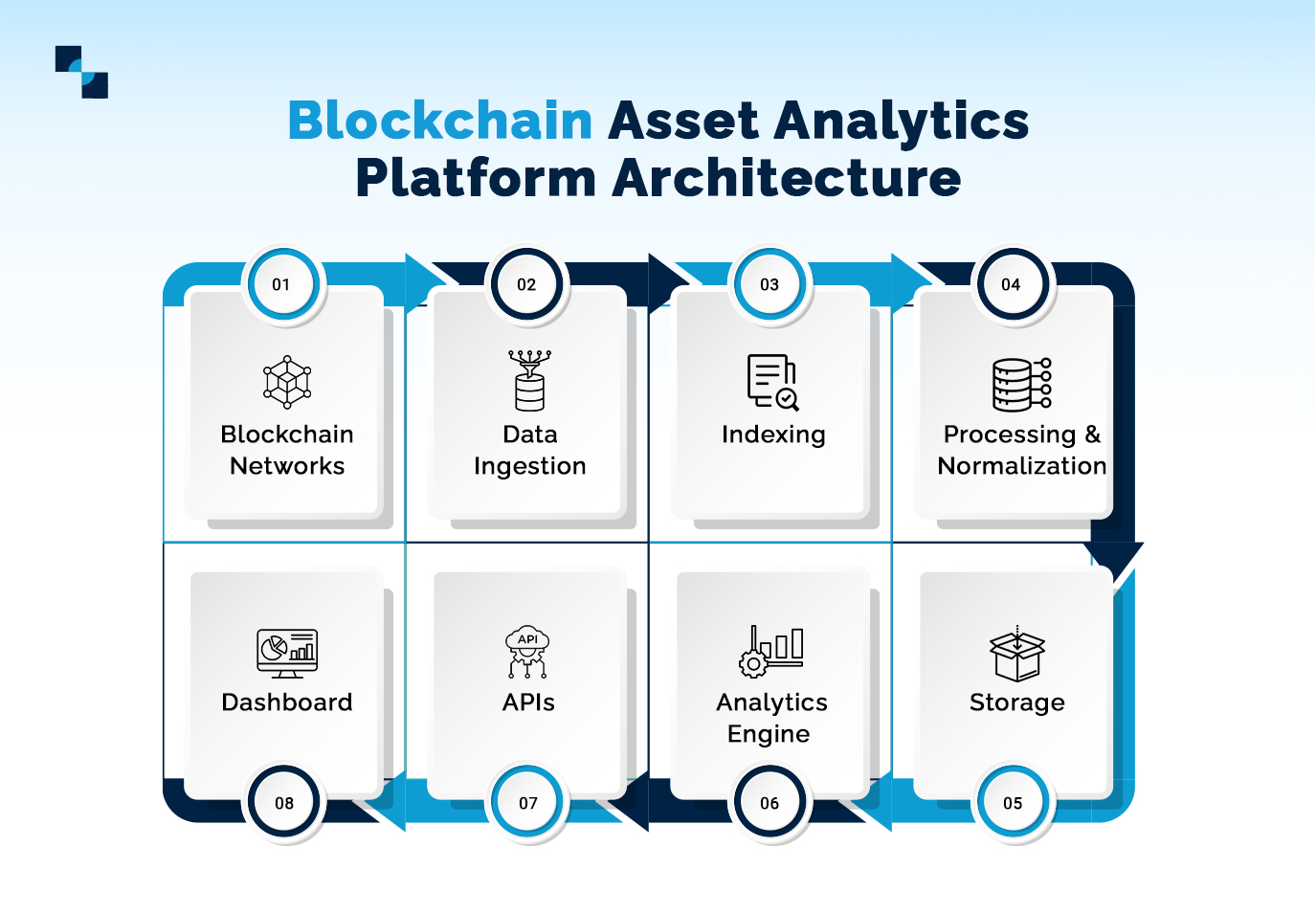
Each layer has a distinct responsibility.
1. Blockchain Networks and Data Sources
The platform begins by connecting to the networks and external data sources relevant to the product.
These may include:
- Blockchain nodes
- RPC providers
- Blockchain APIs
- Indexing services
- Market-data providers
- Asset metadata sources
For EVM-compatible networks, applications commonly interact with blockchain nodes through JSON-RPC methods that expose blockchain state and transaction-related data.
The choice between self-hosted nodes and managed infrastructure depends on network coverage, data volume, latency requirements, reliability, and operating cost.
2. Data Ingestion and Indexing Layer
The ingestion layer continuously retrieves blockchain information and feeds it into the indexing pipeline.
Depending on requirements, this may include:
- Blocks
- Transactions
- Receipts
- Logs
- Token transfers
- Contract events
- Traces
The indexer transforms this information into structures that analytical queries can access efficiently.
This is a major part of Blockchain platform development because the quality of the index directly affects the quality of everything built above it.
3. Data Processing and Normalization Layer
Raw blockchain data is not automatically ready for analysis.
This layer can handle:
- Event decoding
- Address normalization
- Token classification
- Metadata enrichment
- Balance calculations
- Derived metrics
- Chain-specific transformations
Normalization is particularly important for multi-chain systems. Similar analytical concepts need consistent representations while preserving network-specific information where it affects interpretation.
4. Blockchain Analytics Data Storage
The storage architecture should reflect the workload. Depending on requirements, separate systems may be used for:
- Raw blockchain data
- Normalized records
- Wallet data
- Token transfers
- Time-series metrics
- Aggregated analytics
- Search
For example, large-scale blockchain analytics systems commonly organize blockchain records into structured datasets for blocks, transactions, logs, token transfers, and other entities. The objective is efficient analytical access—not simply storing the maximum amount of data.
5. Analytics and Intelligence Engine
This is where the platform’s business logic lives. The analytics engine can calculate:
- Holder concentration
- Wallet activity
- Asset flows
- Transfer trends
- Large-holder activity
- Asset velocity
- Liquidity indicators
- Risk signals
- Custom KPIs
For a company building proprietary blockchain asset analysis software, this layer can become one of its most valuable components because the calculations reflect its own methodology.
6. API and Application Layer
The API layer makes analytics available to applications and users. It should address:
- Authentication
- Authorization
- Query handling
- Pagination
- Rate limiting
- Caching
- Webhooks
- Version management
A well-designed API layer also allows the same analytics infrastructure to serve multiple applications without duplicating the underlying data pipeline.
7. Dashboard and Visualization Layer
The final layer turns analytical outputs into usable product experiences. A blockchain asset analytics platform can provide separate interfaces for:
- Asset intelligence
- Wallet intelligence
- Transaction analysis
- Holder distribution
- Fund-flow analysis
- Historical trends
- Alerts
- Reports
The interface should follow the user’s workflow rather than mirror the technical structure of the underlying database.
How to Build a Blockchain Asset Analytics Platform
Successful Blockchain platform development begins with defining the intelligence the business needs not with selecting a database or frontend framework.
1. Define Business Requirements and Analytics Use Cases
Start by documenting:
- Target users
- Business objectives
- Supported assets
- Supported networks
- Required metrics
- Historical data requirements
- Real-time requirements
- API requirements
- Reporting requirements
An investment product may prioritize holder and asset intelligence, while a risk platform may need transaction monitoring and anomaly detection. The use case determines the architecture.
2. Select Blockchain Networks and Data Sources
Choose the networks that are genuinely relevant to the target audience. Evaluate each network based on:
- Asset relevance
- Activity levels
- Data availability
- Infrastructure requirements
- Historical accessibility
- RPC reliability
- Indexing complexity
The initial release does not need every blockchain. A modular architecture makes it possible to expand coverage as the product grows.
3. Design the Platform Architecture
Define how blockchain data will move through:
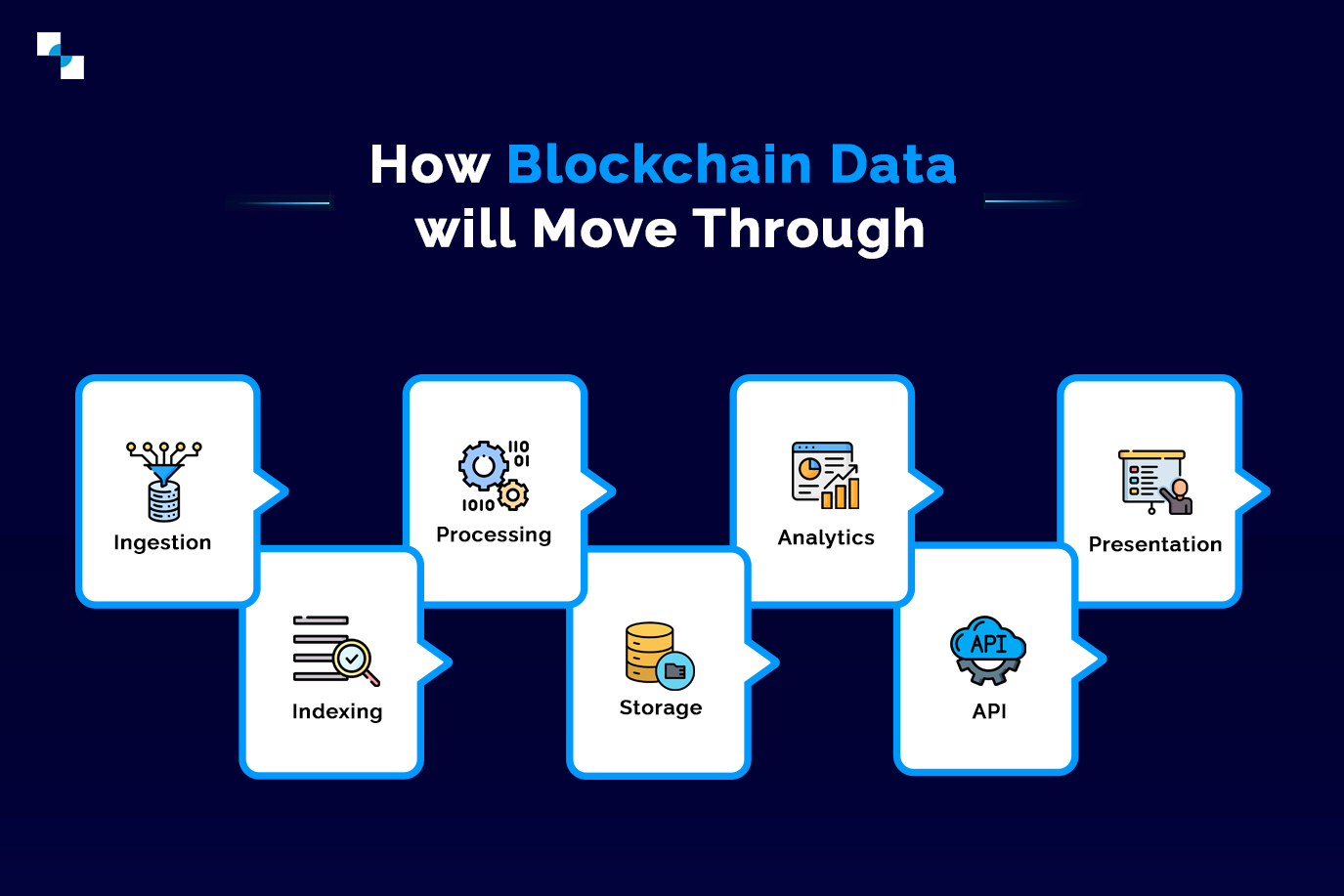
At this stage, determine which data must be available in real time and which metrics can be calculated periodically.
This decision can have a significant impact on infrastructure complexity and operating costs.
4. Build the Data Ingestion and Indexing Pipeline
Develop the infrastructure responsible for collecting blockchain data. For EVM networks, the pipeline may process blocks, transactions, receipts, logs, events, and token transfers. Smart contract events can provide structured application-level signals when correctly indexed and decoded. Historical backfilling and live data ingestion should be designed as coordinated but distinct workloads.
5. Process, Normalize, and Enrich Blockchain Data
Transform raw blockchain records into analytical datasets.
Typical operations include:
- Event decoding
- Asset classification
- Address normalization
- Metadata enrichment
- Balance calculation
- Wallet categorization
- Historical aggregation
This creates the consistent data foundation required by the analytics engine.
6. Develop the Asset Analytics Engine
Build the calculations that deliver the platform’s actual intelligence.
Depending on the product, this can include:
- Holder analytics
- Wallet activity
- Asset flows
- Transaction patterns
- Concentration metrics
- Liquidity indicators
- Risk signals
- Custom scoring
A modular analytics engine makes it easier to introduce new metrics without rebuilding the underlying data pipeline.
7. Build Dashboards, APIs, and Reporting
Develop the user-facing experience around the highest-value workflows.
Include:
- Search
- Filters
- Time ranges
- Asset profiles
- Wallet profiles
- Historical charts
- Alerts
- Reports
- API access
The interface should make the analytical output easier to understand, compare, and act upon.
8. Test, Deploy, and Scale the Platform
Testing needs to cover both software behavior and data correctness.
Validate:
- Data completeness
- Indexing accuracy
- Query performance
- API reliability
- Data synchronization
- Failure recovery
- Security
- Scalability
Blockchain reorganizations also need to be considered. For example, Geth can report logs from a reorganized chain as removed, meaning downstream analytics systems need mechanisms to identify and reconcile affected records.
Have an Idea for a Blockchain Analytics Platform?
Technology Stack for Blockchain Asset Analytics Platform Development
There is no single technology stack that fits every blockchain asset analytics platform. The right combination depends on the number of networks, data volume, query patterns, latency requirements, and expected user load.
Blockchain Networks and RPC Infrastructure
The platform may connect to:
- EVM-compatible networks
- Non-EVM networks
- Self-hosted nodes
- RPC providers
- Blockchain data APIs
A chain-adapter architecture helps isolate network-specific logic from the rest of the platform.
Blockchain Indexing and Data Processing
The indexing layer may include:
- Custom indexers
- Event listeners
- Message queues
- Stream-processing systems
- ETL/ELT pipelines
- Managed indexing infrastructure
The right architecture depends on whether the product needs real-time analytics, deep historical coverage, or both.
Databases and Data Warehousing
Different workloads may require different storage technologies. A blockchain asset analysis platform may combine:
- Relational databases
- Analytical warehouses
- Time-series databases
- Search indexes
- Object storage
The important consideration is whether the storage architecture can efficiently serve the platform’s analytical queries.
Backend and API Development
The backend handles:
- Data access
- Analytics queries
- Business rules
- Authentication
- Authorization
- Alerts
- API delivery
Caching, precomputed aggregates, and query optimization can significantly improve performance for frequently requested metrics.
Frontend and Data Visualization
The frontend should turn complex datasets into clear analytical views.
Useful components include:
- Trend charts
- Holder distributions
- Asset comparisons
- Transaction timelines
- Wallet graphs
- Flow diagrams
- Activity heatmaps
The goal is not visual complexity. It is faster to interpret.
Cloud and Infrastructure
Cloud infrastructure can support:
- Scalable compute
- Managed databases
- Object storage
- Monitoring
- Logging
- Containerized services
- Automated deployment
A well-planned Blockchain platform development architecture should allow high-volume ingestion, analytical workloads, API traffic, and dashboard requests to scale independently.
How Much Does It Cost to Build a Blockchain Asset Analytics Platform?
The cost of building blockchain asset analysis software depends on what the platform is expected to analyze, how much historical data it must process, and how many users and networks it needs to support. A single-chain MVP with basic asset and wallet metrics is significantly different from a multi-chain platform with historical indexing, real-time analytics, risk intelligence, APIs, and advanced visualization.
Factors That Influence Development Cost
- Blockchain coverage: More networks mean more integrations, indexing logic, testing, and ongoing maintenance.
- Historical data: Large historical datasets require additional storage, processing capacity, and backfill infrastructure.
- Analytics complexity: Holder metrics are simpler than behavioral analytics, wallet clustering, entity attribution, or advanced risk models.
- Real-time requirements: Low-latency streaming adds engineering and infrastructure requirements.
- Dashboard functionality: Advanced investigation tools, graph visualization, filtering, and reporting increase frontend and backend complexity.
- API requirements: External APIs require authentication, rate limiting, monitoring, versioning, and scalable infrastructure.
- Advanced analytics: Statistical and machine-learning capabilities add data-science and infrastructure requirements.
Blockchain Asset Analytics Platform Development Cost by Scope
A practical project can be structured into three broad levels.
- MVP: Limited network coverage, core asset analytics, wallet and transaction analysis, basic dashboards, and essential APIs.
- Mid-Level Platform: Multi-chain support, historical analytics, wallet intelligence, alerts, reporting, and expanded API capabilities.
- Advanced Platform: Large-scale multi-chain indexing, real-time analytics, advanced risk intelligence, proprietary scoring, sophisticated APIs, and high-performance infrastructure.
For most businesses, starting with a focused MVP is more practical than building the complete infrastructure on day one. The platform can expand as user requirements, data volume, and commercial opportunities become clearer.
How Blockchain Development Services Help Build Your Analytics Platform
A serious analytics platform requires multiple engineering disciplines to work together. Blockchain connectivity alone does not produce a usable analytics product. Specialized Blockchain development services can cover the architecture, data layer, analytics engine, APIs, application interface, and infrastructure required to take the platform from concept to production.
- Blockchain Data Architecture and Indexing : A development partner can design the ingestion, indexing, processing, and storage layers required for reliable blockchain analytics.
- Multi-Chain Blockchain Integration : Chain-specific integrations can be built within a modular architecture, making it easier to expand network coverage without rebuilding the complete platform.
- Custom Analytics Engine Development : Business-specific metrics, scoring systems, wallet intelligence, asset analytics, and risk indicators can be implemented around the organization’s actual requirements.
- Blockchain Platform Development : can encompass the complete product from blockchain data infrastructure and analytics engines to APIs, dashboards, access controls, and cloud deployment.
- API and Dashboard Development : The analytics engine can be exposed through secure APIs and intuitive interfaces for internal teams, customers, or third-party applications.
- Deployment and Ongoing Platform Support : A capable Blockchain development company can also support production deployment, infrastructure optimization, monitoring, data-quality management, network upgrades, and additional chain integrations as the platform evolves.
Build the Intelligence Layer Behind Your Digital Asset Strategy
Blockchain analytics platform is more than a dashboard for viewing transactions. It is a data product built on blockchain infrastructure, designed to turn complex on-chain activity into information businesses can actually use. Its success depends on reliable data pipelines, relevant analytics, scalable architecture, and an intuitive product experience.
Antier helps businesses design and build custom blockchain platforms around their specific asset, data, analytics, and product requirements. Our Blockchain development services cover blockchain architecture, multi-chain integration, data infrastructure, analytics engines, APIs, dashboards, and production deployment.
If you’re planning a blockchain asset analytics platform, Antier’s tech experts can turn your concept into a scalable, production-ready solution built around your business goals. Partner with Antier to build your custom platform and turn on-chain data into actionable intelligence. Talk to our blockchain experts to plan your Blockchain platform development roadmap.