



✨ AI Summary
- This blog post provides an in-depth guide on decentralized stablecoin development, discussing key considerations including collateral models, smart contracts, security audits, governance tools, and target networks.
- The post highlights the significant regulatory changes in the stablecoin market, with the global decentralized stablecoin market projected to reach $182.79 billion by 2033.
- It discusses the implications of the GENIUS Act, a law that creates a federal framework for payment stablecoins in the U.S., and provides a comparison of decentralized and centralized stablecoins.
- The three architecture types for stablecoins – crypto-collateralized, algorithmic, and hybrid – are also explored.
- A step-by-step guide to the development process is provided, along with tips on selecting a development partner.
Decentralized stablecoin development timelines typically depend on the collateral model, smart contract complexity, security audit requirements, governance tooling, and number of target networks. Based on the phased development plan outlined below, a production-ready first release may take approximately 5 to 8 months, although simpler implementations may require less time and complex multi-chain protocols may take longer. If you’re building a decentralized stablecoin in 2026, the technical challenge hasn’t changed much. The regulatory challenge has changed significantly.
In this blog, we’ll walk you through stablecoin models, the development process, and key security and regulatory considerations to help you build with confidence.
The Market Context: Why 2026 Is a Pivotal Year for Decentralized Stablecoins
The global decentralized stablecoin market was valued at $3.33 billion in 2025 and is projected to reach $182.79 billion by 2033, growing at a 69% CAGR, according to Grand View Research.
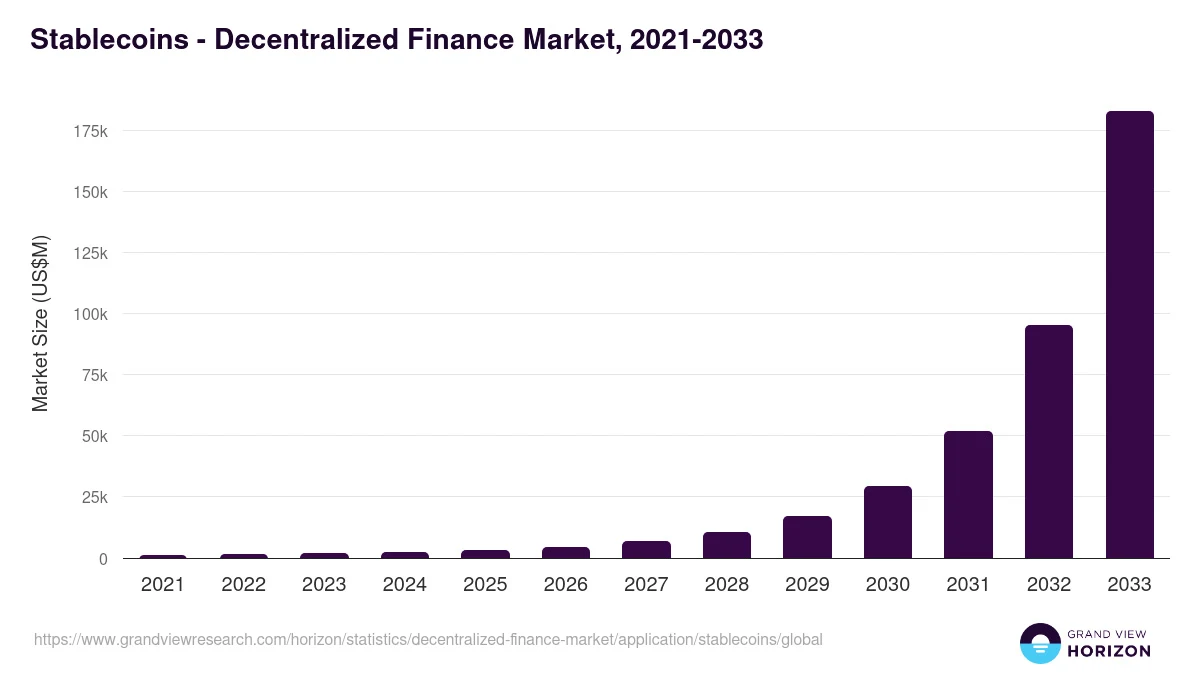
That projection reflects genuine structural demand from DeFi lending protocols, on-chain treasuries, and cross-border payment rails, not speculative trading volume alone.
The sheer scale of stablecoin activity clarifies the stakes. Total stablecoin circulating supply reached $314 billion in mid-June 2026, roughly 4.4 times total DeFi TVL of $71.77 billion, according to CoinLaw’s DeFi Market Statistics report. According to BCG’s Stablecoin Payments: The Truth Behind the Numbers, cited in Deutsche Bank’s 2026 digital assets outlook, gross stablecoin transaction volume was estimated at $62 trillion in 2025. After excluding bots and internal transactions, adjusted transaction volume was approximately $4.2 trillion.
Tyler Sloan, co-founder and CPO of Neura, said: “In 2026, we will see stablecoins shift from ‘crypto primitives’ to core settlement infrastructure across DeFi and the broader financial system.” That shift is already visible in TVL composition, cross-chain payment volumes, and the legislative attention the sector is drawing.
Let’s talk through your use case, technical requirements, and roadmap with our blockchain experts.
The GENIUS Act and the Decentralized Protocol Gap
The GENIUS Act, signed into law on July 18, 2025, created the first federal framework for payment stablecoins in the United States. Its core provision is straightforward: only permitted payment stablecoin issuers may issue a payment stablecoin. The OCC’s Notice of Proposed Rulemaking published in the Federal Register on March 2, 2026 confirms this prohibition explicitly.
But there’s a meaningful gap. As K&L Gates noted in their March 2026 analysis, “neither the statute nor the NPRM meaningfully addresses how these obligations would apply to decentralized protocols that operate without a centralized intermediary.” That ambiguity is not a loophole to exploit. It’s an architectural design question that every decentralized stablecoin team needs to resolve before writing production code.
The practical implications:
- The application of the GENIUS Act to decentralized protocols depends on their structure, activities, and the roles of the entities involved. Whether a protocol operating through DAO governance falls within the Act’s requirements requires case-specific legal analysis and should not be assumed solely from the absence of an identifiable centralized issuer.
- On-chain collateral transparency can improve verifiability and accountability, helping decentralized protocols prepare for evolving regulatory expectations. However, transparency alone does not establish regulatory compliance.
- Under the EU’s Markets in Crypto-Assets Regulation (MiCA), asset-referenced tokens are subject to applicable authorization, reserve, disclosure, and redemption requirements. Whether a decentralized stablecoin falls within this framework depends on its design, backing assets, and the activities performed by the entities involved. Fully decentralized arrangements may require a different legal assessment.
- Audit-ready smart contracts and verifiable on-chain collateral help decentralized protocols strengthen transparency, security, and regulatory readiness in 2026.
Decentralized vs. Centralized Stablecoins: A Decision Framework
Before committing to a decentralized stablecoin development solution, the architecture choice itself deserves explicit analysis. Decentralized models are not the right fit for every use case. If your primary distribution channel is a regulated payment processor, a fiat-backed model with reserve attestation may face a cleaner compliance path in the short term. Decentralized structures offer meaningful advantages in censorship resistance, composability, and DeFi-native interoperability, but they carry higher collateral capital requirements and more complex liquidation risk.
| Dimension | Decentralized Stablecoin | Centralized Stablecoin |
|---|---|---|
| Collateral type | Crypto assets, RWAs, or asset baskets | Fiat currency and permitted reserve assets |
| Peg mechanism | Overcollateralization, algorithms, or arbitrage | Typically reserve-backed, with redemption rights subject to issuer terms and applicable regulations |
| Governance model | DAO or on-chain governance | Centralized corporate issuer |
| GENIUS Act exposure | Depends on structure and applicable rules | Compliance obligations for permitted issuers |
| Transparency method | On-chain collateral verification | Reserve disclosures and independent attestations |
| DeFi integration | Generally high | Depends on issuer controls and restrictions |
| Liquidation risk | Collateral volatility and liquidation events | Reserve, liquidity, and counterparty risks |
DAI is a prominent example of a crypto-collateralized decentralized stablecoin that uses collateral management and protocol mechanisms to support its dollar peg. The Maker Protocol ecosystem has evolved alongside changes in its governance and product structure.
Frax also illustrates how stablecoin architectures can evolve, with its original fractional-algorithmic approach differing from its later collateralized designs. These examples highlight the importance of collateral management, liquidation mechanisms, oracle reliability, and risk controls in stablecoin protocol design.
The Three Architecture Types and When Each Fits
Crypto-collateralized (overcollateralized)
- Best for: DeFi lending protocols, on-chain treasury products, and use cases requiring censorship resistance
- Key components: collateral vault contracts, liquidation bots, price oracle feeds (Chainlink, Pyth Network), and health factor monitoring
- Tradeoff: Capital inefficiency. A protocol requiring 150% collateral cannot compete with fiat-backed issuers on cost of capital for users
Algorithmic (non-collateralized or partially collateralized)
- Best for: Protocols targeting elastic monetary policy, experimental DeFi primitives, or high-liquidity ecosystems with strong demand anchors
- Core mechanism: Smart contracts adjust token supply or incentives in response to price signals and market conditions. Purely algorithmic models may operate without direct collateral backing, while partially collateralized models combine these mechanisms with reserve assets or other forms of backing.
- Key components: rebase logic, seigniorage modules, demand oracle, and secondary stability token design
Hybrid (fractional-algorithmic or multi-asset)
- Best for: Protocols balancing capital efficiency with peg stability, or those targeting cross-border payment use cases alongside DeFi integration
- Core mechanism: Partial collateral backing (fiat, crypto, or RWA) combined with algorithmic supply adjustment
- Key components: multi-asset collateral vaults, reserve ratio governance module, rebase engine, and cross-chain bridge contracts
Let’s find the right approach for your business, from collateral design to governance and deployment.
Step-by-Step Build Process: From Protocol Design to Mainnet
Decentralized stablecoin development timelines typically depend on the collateral model, smart contract complexity, security audit requirements, governance tooling, and number of target networks. Based on the phased development plan outlined below, a production-ready first release may take approximately 5 to 8 months, although simpler implementations may require less time and complex multi-chain protocols may take longer.
Phase 1: Protocol Architecture and Tokenomics Design (Weeks 1–3)
- Define collateral type, collateralization ratio, and liquidation threshold
- Map the peg mechanism: overcollateralization, rebasing, fractional reserve, or hybrid
- Design the stability fee and interest rate model
- Select oracle providers: Chainlink is the most widely integrated; Pyth Network offers high-frequency price feeds suited to volatile collateral
- Draft the governance framework: DAO structure, proposal thresholds, emergency pause logic
Phase 2: Smart Contract Development (Weeks 4–10)
- Collateral vault contracts with deposit, mint, burn, and withdrawal functions
- Liquidation engine contracts with bot-compatible interfaces and health factor logic
- Rebase or seigniorage module (if applicable)
- Oracle integration contracts consuming Chainlink or Pyth price feeds
- Governance contracts: voting, timelock, and parameter adjustment modules
- Cross-chain bridge contracts if multi-chain deployment is planned
- Development environment: Hardhat or Foundry for Ethereum-compatible chains; Anchor for Solana; CosmWasm for Cosmos-based chains
Phase 3: AI Integration and Risk Tooling (Weeks 8–13, parallel to audit prep)
- AI-assisted peg and collateral monitoring: models that identify emerging risks, track collateral ratio deterioration, and flag positions approaching liquidation thresholds.
- Dynamic risk adjustment: parameter recommendations based on market volatility signals
- Fraud detection: anomalous minting or redemption pattern identification
Phase 4: Smart Contract Audit (Weeks 11–16)
- Engage a recognized audit firm (Trail of Bits, OpenZeppelin, Halborn, or Certik) for a formal audit
- Audit-ready contracts require clear documentation, comprehensive testing, and security validation of critical functions.
- Plan for a remediation cycle of 2 to 4 weeks post-initial audit report
Phase 5: DAO Governance Launch and Testnet (Weeks 14–20)
- Deploy governance contracts to testnets such as Ethereum Sepolia, Polygon Amoy, or equivalent supported development networks.
- Run community governance simulations: parameter adjustment proposals, emergency pause votes
- Stress-test liquidation bots under simulated price shock conditions
Phase 6: Mainnet Deployment and Cross-Chain Expansion (Weeks 21–32)
- Staged mainnet deployment with collateral caps during initial liquidity bootstrapping
- Multi-chain expansion using verified bridge contracts (LayerZero, Wormhole, or Axelar)
- Real-time on-chain reserve dashboards for public verification
What “Good” Looks Like When Evaluating a Development Partner
Most teams evaluating a decentralized stablecoin development partner focus on the wrong signals: website case counts, years in business, chain coverage lists. The real differentiators are narrower and more testable.
Technical depth markers to verify:
- Can the team design a custom liquidation engine rather than forking an existing one?
- Have they built DAO governance modules with emergency pause and timelock logic, or only simple voting contracts?
- Can they deliver AI-integrated peg monitoring, not just static threshold alerts?
- Are their contracts structured to pass a Tier 1 audit firm’s review without requiring significant structural rewrites?
Regulatory-readiness markers
- Do they understand the distinction between the GENIUS Act’s issuer obligations and the regulatory gray zone for decentralized protocols?
- Can they design for on-chain reserve verifiability from the protocol architecture phase, not as a retrofit?
- Have they worked with multi-jurisdictional compliance requirements, including MiCA’s asset-referenced token provisions?
Final Words
The stablecoin market’s $314 billion circulating supply and the GENIUS Act’s unresolved treatment of decentralized protocols together define the opportunity space for 2026: protocols that get the architecture right now, before regulatory clarity arrives, will hold a meaningful structural advantage over those that retrofit compliance into a poorly designed system later.
The technical decisions made in Phases 1 and 2 of a decentralized stablecoin build, oracle selection, collateralization ratios, liquidation engine design, and governance module structure- determine whether a protocol is defensible at scale. At Antier, we bring DAO-driven governance engineering, AI-integrated peg maintenance, audit-ready smart contracts, and multi-chain deployment into every decentralized stablecoin development solution we deliver.
Frequently Asked Questions
01. What factors influence the development timeline of decentralized stablecoins?
The development timeline typically depends on the collateral model, smart contract complexity, security audit requirements, governance tooling, and the number of target networks.
02. How long does it generally take to develop a production-ready decentralized stablecoin?
A production-ready first release may take approximately 5 to 8 months, although simpler implementations may require less time, while complex multi-chain protocols may take longer.
03. What significant regulatory change occurred for decentralized stablecoins in 2026?
The GENIUS Act, signed into law on July 18, 2025, established the first federal framework for payment stablecoins in the U.S., allowing only permitted issuers to issue payment stablecoins.