
Blockchain networks generate large volumes of transaction records, block metadata, smart contract events, and state changes. However, retrieving this information directly from a blockchain node does not necessarily make it easy to search, analyze, or use in applications. Blockchain explorers address this challenge by transforming raw on-chain data into structured, searchable, and accessible information. Behind their familiar search interfaces is an engineering architecture that combines node connectivity, data ingestion, indexing pipelines, databases, APIs, and real-time processing. For businesses building proprietary networks, enterprise blockchain platforms, or multi-chain applications, custom blockchain development helps create explorer infrastructure tailored to their data access, monitoring, and reporting requirements. Understanding how these components work together is essential to developing reliable and scalable blockchain explorer solutions.
What Is a Blockchain Explorer and How Does It Work?
A blockchain explorer is a software application that allows users to search, inspect, and analyze information recorded on a blockchain network. It provides a readable interface for accessing blockchain data that would otherwise require direct interaction with nodes, RPC endpoints, or specialized developer tools. Depending on the network and the explorer’s capabilities, users can examine:
- Blocks: Block height, timestamp, block hash, validator or miner information, and transaction count.
- Transactions: Transaction hashes, sender and recipient addresses, execution status, fees, and block inclusion details.
- Addresses: Transaction history, balances, token transfers, and associated contract interactions.
- Smart contracts: Contract addresses, verified source code, functions, events, and interaction interfaces.
- Network activity: Block production, transaction throughput, gas utilization, and validator performance.
For example, when a user searches for an Ethereum transaction hash, the explorer retrieves the corresponding indexed transaction record and presents its execution status, block reference, gas information, and event logs.
The explorer does not independently validate the transaction or authorize its execution. Those responsibilities belong to the blockchain protocol and its participating nodes. The explorer reads and presents information obtained from the network or its supporting data infrastructure.
How Does a Blockchain Explorer Retrieve Information?
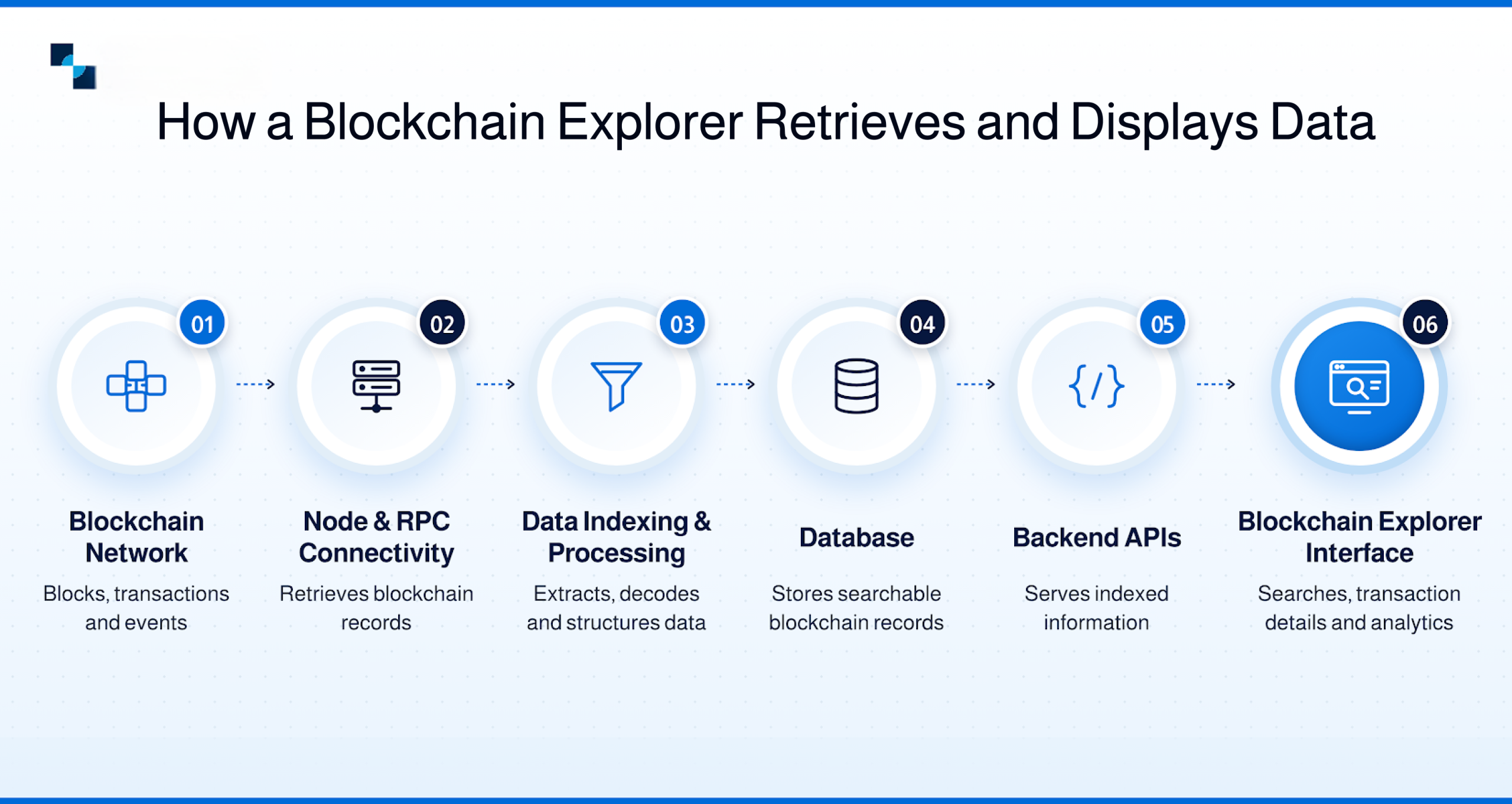
A typical explorer follows a data retrieval process:
- A blockchain node exposes network information through an RPC interface or another protocol-specific data interface.
- An indexing service retrieves blocks, transactions, receipts, events, and other required records.
- Processing components decode and transform the retrieved information into structured data.
- The database stores the processed records and creates indexes for efficient searches.
- Backend APIs retrieve the requested information.
- The frontend presents the results through searchable transaction pages, block details, address histories, and network dashboards.
The distinction between raw blockchain access and indexed data access is particularly important.
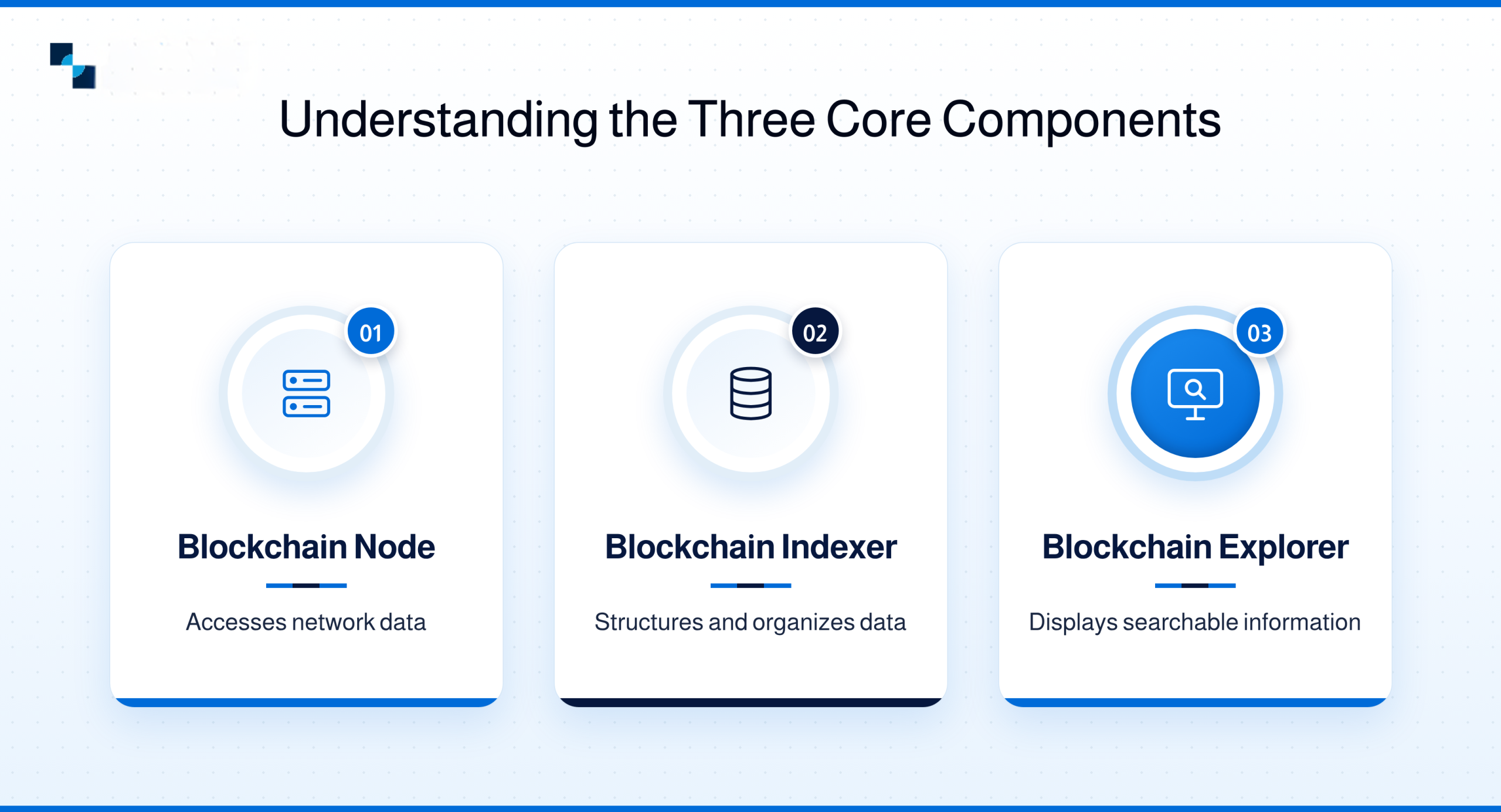
A node provides access to protocol-level information. An indexer reorganizes selected information into structures that are easier to search and analyze. An explorer combines this data infrastructure with application interfaces.
Blockchain Explorer vs. Blockchain Node vs. Blockchain Indexer
These three components perform different functions, although they work together in an explorer architecture.
| Component | Primary responsibility | Example functionality |
|---|---|---|
| Blockchain node | Participates in or provides access to a blockchain network | Retrieves blocks, validates protocol data, exposes RPC methods |
| Blockchain indexer | Extracts and organizes blockchain data | Builds address histories, transaction records, and event indexes |
| Blockchain explorer | Presents blockchain information to users | Searches transactions, displays blocks, and visualizes network activity |
A blockchain explorer may operate its own nodes and indexing infrastructure or consume data from external providers. The architecture depends on the network, operational requirements, data access needs, and desired degree of infrastructure control.
How Does Blockchain Explorer Architecture Work?
Blockchain explorer architecture is designed around a fundamental engineering requirement: converting continuously generated blockchain records into accurate, searchable information without overwhelming the underlying network infrastructure. A production-ready architecture generally separates data retrieval, processing, storage, application services, and presentation.
Blockchain Node and RPC Connectivity Layer
The node connectivity layer establishes communication between the explorer and its target blockchain network. For EVM-compatible networks, applications commonly interact with nodes through JSON-RPC methods. These interfaces provide access to information such as block headers, transaction details, receipts, account state, and contract logs.
For example, commonly used Ethereum JSON-RPC methods include:
- eth_blockNumber to retrieve the latest block height known to the connected node.
- eth_getBlockByNumber to retrieve block information.
- eth_getTransactionByHash to retrieve a transaction using its hash.
- eth_getTransactionReceipt to retrieve execution results and event logs.
- eth_getLogs to retrieve logs matching specified address and topic filters.
A production explorer must also account for node capabilities. Not every endpoint supports the same historical queries, tracing methods, throughput, or retention policies.
For instance, retrieving historical state at an old block may require an archive-capable node or a provider that supports the relevant historical state queries. This is different from simply retrieving historical block headers or transaction receipts.
Engineering considerations include:
- Dedicated versus third-party RPC infrastructure.
- Node synchronization and availability.
- Request batching and concurrency limits.
- Historical data access requirements.
- Endpoint failover and load balancing.
- Rate limits and retry policies.
For custom blockchain networks, the connectivity layer must also accommodate protocol-specific interfaces rather than assuming every chain supports EVM JSON-RPC.
Data Ingestion and Indexing Layer
The ingestion layer retrieves blockchain records and transfers them into the explorer’s processing pipeline. This can involve two distinct workloads:
Historical ingestion: Retrieves previously generated blocks to build the explorer’s initial dataset. This process is commonly called backfilling.
Continuous ingestion: Monitors new blocks and transactions as the network progresses, keeping the explorer’s dataset updated.
A robust architecture separates these workloads because historical backfilling can consume significant processing and storage resources, while continuous ingestion is usually more sensitive to latency. Indexers may retrieve data sequentially, process independent workloads concurrently, or use streaming infrastructure to increase throughput. The appropriate approach depends on the blockchain protocol, available node interfaces, ordering guarantees, and the required indexing latency.
Data Processing and Decoding Layer
Blockchain records are not automatically meaningful to end users. A transaction receipt, for example, may contain execution status, cumulative gas information, and event logs. The processing layer interprets these structures and transforms them into application-readable records.
For EVM networks, this can involve:
- Decoding event logs using contract ABIs.
- Interpreting transaction input data.
- Identifying contract creation and interaction events.
- Extracting token transfer information from recognized event signatures.
- Normalizing addresses, timestamps, numeric values, and transaction references.
The processing logic must also distinguish between protocol-level facts and inferred application information.
For example, a Transfer event emitted by an ERC-20 contract is evidence that the contract emitted that event. It should not automatically be treated as proof that every contract emitting a similarly named event implements the ERC-20 standard correctly.
This distinction becomes important when an explorer supports arbitrary smart contracts and multiple token standards.
Database and Search Infrastructure
After processing, the data is stored in databases designed to support the explorer’s search and retrieval requirements.
A typical implementation may use:
- PostgreSQL: Structured storage for blocks, transactions, addresses, and decoded events.
- Redis: Caching frequently requested information and temporary application data.
- Elasticsearch or OpenSearch: Supporting advanced search and text-based discovery when required.
- Object storage: Retaining large historical datasets, exports, or archival processing files.
The database schema must reflect the blockchain’s underlying data model. For an EVM-based explorer, the system may maintain relationships between blocks, transactions, receipts, logs, contracts, and addresses. A UTXO-based explorer needs different structures for transaction inputs, outputs, and spending relationships. These differences affect query design, database indexes, and data retrieval strategies.
Backend API and Application Services
The backend API layer connects indexed blockchain data with the explorer interface and external applications.
It handles requests for:
- Transaction and block details.
- Address activity and token transfers.
- Contract metadata and decoded events.
- Network statistics.
- Search and filtering.
- Paginated historical records.
The backend also manages authentication, authorization, rate limits, caching policies, and API access controls. For an enterprise explorer, these services may additionally enforce organizational roles and participant-specific permissions.
Frontend and Data Visualization Layer
The frontend converts backend responses into information that users can understand and act upon. Typical interface elements include transaction tables, block detail pages, address dashboards, contract information panels, charts, and network monitoring views. Frontend frameworks such as React, Next.js, and Vue.js can be used depending on application requirements.
The user interface should also account for data freshness. A newly observed transaction, a transaction included in a block, and a transaction considered finalized are different states. Presenting them as equivalent can mislead users. The architectural objective is to keep the interface responsive while ensuring that the information it displays accurately reflects the underlying network’s state.
Make Your Blockchain Data Easier to Explore
How Does Blockchain Data Indexing Work?
Blockchain data indexing is the process of retrieving on-chain records, transforming them into structured information, and organizing that information for efficient querying. This is one of the most technically demanding components of blockchain explorer development. Blockchains are primarily designed to maintain and verify distributed state transitions. They are not general-purpose analytical databases. Searching for every transaction associated with an address, calculating token transfer histories, or aggregating contract events can require extensive processing if the application relies exclusively on raw node queries. An indexing system solves this problem by creating a query-optimized representation of selected blockchain data.
Historical Blockchain Data Ingestion
When an explorer is launched, its database may initially contain no historical records. The indexing service must retrieve data from the network’s available history, beginning from the selected starting block and progressing toward the current chain tip. This process is called historical backfilling.
For example, an explorer supporting a network that has already produced millions of blocks must process the required historical range before it can offer complete historical searches.
A backfilling pipeline generally involves:
- Selecting the starting block or deployment height.
- Retrieving block data and associated transactions.
- Fetching receipts and relevant event logs.
- Processing and decoding the retrieved records.
- Writing normalized information to the database.
- Updating indexing checkpoints.
- Verifying that processed records match the expected canonical chain history.
For large datasets, indexing can be parallelized across independent block ranges. However, the implementation must preserve ordering and dependency requirements wherever processing logic relies on the previous state. AWS’s published blockchain indexer architecture provides a useful implementation reference, combining historical backfilling, real-time extraction, stream processing, and structured storage.
Real-Time Block and Transaction Indexing
Historical ingestion builds the initial dataset. Continuous indexing keeps it current. A real-time indexing service monitors the blockchain for newly available blocks and retrieves the associated transactions, receipts, and events. The system typically maintains a checkpoint indicating the last successfully processed block.
A simplified processing sequence is:
- Detect the next available block.
- Retrieve the block and required transaction data.
- Fetch execution receipts and relevant logs.
- Process and validate the records.
- Commit the processed information to the database.
- Advance the indexing checkpoint.
The checkpoint should only advance after the required data has been successfully persisted. Otherwise, a failure between retrieval and storage can cause missing or duplicated records. This is why production indexers need retry mechanisms, idempotent processing, and recovery procedures. Idempotency means that processing the same block or event again does not create duplicate or inconsistent records.
Event Decoding and Data Normalization
Smart contracts often emit events to make important state changes observable. However, raw event logs contain encoded data. An explorer needs the appropriate contract ABI to interpret event signatures and decode indexed and non-indexed parameters. Consider an ERC-20 token transfer.
A typical Transfer event contains:
- The sending address.
- The receiving address.
- The transferred token amount.
The indexer decodes the event and stores the information in a structured format, allowing users to search token transfers without interpreting raw hexadecimal data. Data normalization also helps maintain consistent formats across the application.
For example, timestamps, addresses, transaction references, token quantities, and block identifiers should follow predictable storage and API conventions.
One important implementation detail is preserving the original raw data alongside decoded representations where appropriate. This makes it easier to reprocess records when decoding logic changes or additional contract metadata becomes available.
Database Synchronization and Query Optimization
A blockchain explorer must retrieve information quickly even when its dataset contains millions or billions of records. Database optimization therefore needs to be considered during schema design rather than added only after performance problems appear.
Common techniques include:
- Indexing frequently queried fields such as transaction hashes, addresses, block heights, and contract addresses.
- Using pagination for large transaction histories.
- Partitioning large tables based on suitable keys or time ranges.
- Caching frequently requested block and transaction details.
- Separating analytical workloads from latency-sensitive application queries.
- Using materialized views or precomputed aggregates where appropriate.
The objective is to avoid repeatedly scanning large datasets for information that can be retrieved through optimized database access paths.
Chain Reorganization Handling and Data Consistency
Critical engineering requirement. A blockchain explorer must account for the possibility that recently observed blocks may no longer belong to the canonical chain. A chain reorganization occurs when the network adopts a different chain history according to its consensus rules. This can invalidate blocks that an indexer has already processed.
Consider a simplified example:
- The indexer processes block 1,005.
- The network reorganizes its recent chain history.
- Block 1,005 is no longer part of the canonical chain.
- A replacement block is adopted at the same height.
- The explorer must correct records associated with the displaced block.
A height alone is not enough to identify a block permanently. The indexer should track block hashes and parent hashes to detect changes in chain history.
A reorganization-aware indexing system should:
- Compare newly observed block ancestry with previously indexed records.
- Identify the common ancestor between the old and replacement chains.
- Roll back or invalidate affected records.
- Process the replacement canonical blocks.
- Restore dependent transaction, event, and address indexes.
- Verify that database checkpoints and chain references are consistent.
For networks with different finality models, the explorer should also distinguish between observed, confirmed, and finalized records. These terms should not be treated as interchangeable. Their precise meaning depends on the network’s consensus mechanism and finality rules.
The key engineering insight: An explorer is not simply a database that grows with every new block. It is a continuously reconciled representation of the blockchain’s current canonical history.
Essential Features of a Modern Blockchain Explorer
A modern blockchain explorer should make on-chain information easy to search, understand, and analyze. Its features may range from basic block and transaction tracking to smart contract analysis, token monitoring, and network analytics. For businesses investing in custom blockchain development solutions, feature selection should reflect the target network, user requirements, and intended applications.
Block and Transaction Tracking
Block and transaction tracking are the core features of any blockchain explorer.
A block detail page typically displays:
- Block height, hash, and parent hash.
- Timestamp and transaction count.
- Validator or miner information, where applicable.
- Gas utilization or network resource metrics.
- Confirmation and finality status.
Transaction pages provide details such as transaction hash, sender, recipient, value, execution status, fees, and event logs.
For EVM networks, transaction receipts indicate whether execution succeeded or reverted. This status should remain distinct from block finality, which depends on the network’s consensus mechanism.
Wallet and Address Activity Monitoring
Address monitoring helps users examine blockchain activity associated with a specific address. Depending on the network, explorers can display:
- Incoming and outgoing transactions.
- Native asset balances and token holdings.
- Contract interactions and transaction history.
- Associated event logs.
Account-based networks retrieve balances from account state, while UTXO-based networks such as Bitcoin derive address balances from unspent transaction outputs. This distinction affects how address activity is indexed and displayed.
Smart Contract Verification and Interaction
Smart contract verification allows users to examine the source code associated with a deployed contract. On supported EVM networks, verification involves recompiling submitted source code with the specified compiler settings and comparing the resulting bytecode with the deployed contract.
Verified contract pages can display:
- Source code, compiler settings, and ABI.
- Contract functions and decoded events.
- Read and write interfaces, where supported.
Users may execute read-only calls or submit state-changing transactions through a connected wallet. Proxy contract support is also important because an address may delegate execution to a separate implementation contract. Source-code verification confirms a relationship between published code and deployed bytecode; it does not establish that a contract is secure.
Token and NFT Transaction Tracking
Token and NFT tracking helps users examine asset transfers and contract activity across supported standards. For EVM networks, explorers may support ERC-20 transfers, ERC-721 ownership transfers, and ERC-1155 token events.
Token detail pages can display:
- Contract address, name, and symbol.
- Decimals and total supply, where applicable.
- Holder information and transfer history.
- Contract verification status.
NFT explorers may also retrieve names, descriptions, and image references from external metadata storage. Such information should be distinguished from records stored directly on-chain.
Mempool and Transaction Status Monitoring
On networks that expose transaction-pool information, explorers can display transactions awaiting block inclusion.
Common details include:
- Pending transaction hashes.
- Submission details and fee parameters.
- Estimated inclusion information.
- Replacement or dropped transaction status, where observable.
Pending transactions have not yet been included in a block. Their visibility depends on the connected node or mempool data source, as different nodes may maintain different transaction pools.
Network Analytics and Validator Monitoring
Network analytics help infrastructure teams and operators examine blockchain performance beyond individual transactions.
An explorer can display metrics such as:
- Block production intervals and transaction throughput.
- Block utilization and resource consumption.
- Validator participation and performance.
- Missed block proposals or other consensus duties.
- Historical network activity trends.
These metrics should reflect the underlying consensus mechanism. For example, Ethereum explorers may track block proposals, attestations, participation rates, and slashings.
Advanced Search, Filtering, and API Access
Advanced search allows users to retrieve blockchain information using more than transaction hashes. Common search parameters include block heights, addresses, contract addresses, token identifiers, and event topics.
Additional filters can organize results by date, transaction status, event type, and asset activity. Pagination and indexed queries help maintain performance when handling large datasets.
API access allows external applications, analytics platforms, and enterprise dashboards to retrieve indexed blockchain records without independently processing every block and transaction.
What Are the Different Types of Blockchain Explorers?
Blockchain explorers are designed around different network architectures, data access requirements, and application needs. A public blockchain explorer may provide open access to transaction records, while an enterprise explorer may need to enforce participant-level permissions. Similarly, multi-chain and Layer 2 explorers must account for differences in protocol structures and transaction processing.
Understanding these categories helps organizations identify the right explorer architecture, data indexing approach, and infrastructure requirements before starting custom development.
Public Blockchain Explorers
Public blockchain explorers provide searchable access to information recorded on publicly accessible blockchain networks. Users can examine blocks, transaction histories, wallet addresses, smart contract activity, and other network-specific data.
Examples include:
- Etherscan: Ethereum blockchain explorer.
- Blockchair: Multi-blockchain search and analytics platform.
- Blockchain.com Explorer: Blockchain explorer with Bitcoin data.
- Blockscout: Open-source blockchain explorer supporting EVM-compatible networks.
These explorers retrieve blockchain information through node interfaces, RPC providers, and indexing services. Their backend systems organize raw network data into searchable records, allowing users to investigate transactions and monitor network activity through a web interface.
Private and Permissioned Blockchain Explorers
Private and permissioned blockchain explorers serve networks where access to transaction information depends on organizational roles and network permissions. They are particularly relevant to enterprise environments involving multiple participants, business entities, and confidential workflows.
Hyperledger Fabric provides an example through its private data collections. These collections allow defined organizations to access specific private data, while other channel participants can see the corresponding hash recorded on the shared ledger without accessing the underlying information.
Consequently, an enterprise explorer must account for the permissions enforced by the blockchain network and its application layer. Its data retrieval, storage, API, and presentation components should ensure that users only access information they are authorized to view.
Multi-Chain Blockchain Explorers
Multi-chain blockchain explorers provide access to information from multiple blockchain networks through a unified interface. They are useful for organizations managing applications, transactions, or infrastructure across different protocols.
However, supporting multiple networks requires more than connecting additional RPC endpoints. Different blockchains may have different:
- Transaction structures and execution models.
- Consensus mechanisms and finality rules.
- Address formats and account models.
- Smart contract and event structures.
- Fee mechanisms and data retrieval interfaces.
A multi-chain architecture therefore needs protocol-specific adapters and data processing logic. These components translate network information into a consistent application model while preserving chain-specific details required for accurate transaction tracking and analysis.
Layer 1 and Layer 2 Blockchain Explorers
Layer 1 explorers provide visibility into the base blockchain, including blocks, transactions, validators, network activity, and protocol-specific metrics.
Layer 2 explorers require additional data handling because transactions may execute on a secondary network while data publication and settlement take place on the underlying Layer 1 blockchain.
Depending on the Layer 2 architecture, an explorer may need to display:
- Sequencer activity and L2 transaction execution.
- Batch submission and data publication to Layer 1.
- L1 settlement references.
- Proof generation, submission, and verification status.
- Deposits, withdrawals, and cross-layer message execution.
For rollups, transaction execution on Layer 2 and settlement on Layer 1 represent different stages of the transaction lifecycle. Optimistic and zero-knowledge rollups also use different verification mechanisms.
An explorer should represent these stages separately so users can understand transaction execution, data availability, settlement, and finality without treating them as a single event.
Application-Specific Blockchain Explorers
Application-specific blockchain explorers are designed around the data requirements of a particular product, industry, or business workflow. Instead of displaying only general blockchain activity, they organize network information around specific operational needs.
For example, a supply chain explorer may prioritize asset movement, shipment milestones, and participant activity. An enterprise financial network may require transaction approvals, audit records, and organization-specific visibility.
These explorers can combine on-chain records with application-level metadata retrieved from authorized off-chain systems. The interface should clearly distinguish information recorded directly on the blockchain from data obtained through external business applications. This helps maintain data transparency and prevents users from confusing externally sourced information with verified on-chain records.
How to Build a Custom Blockchain Explorer: A Step-by-Step Development Process
Custom blockchain explorer development requires decisions about the target network, data requirements, infrastructure, indexing strategy, security, and user experience. The development process should start with the information the explorer must deliver, not simply the frontend features it should display.
Step 1: Define Network Requirements and Explorer Objectives
The first step is to identify the network and the purpose of the explorer. A team developing an explorer for an existing public blockchain has different requirements from a team building one for a newly deployed application-specific chain.
The project assessment should establish:
- Target blockchain and supported networks.
- Required historical data coverage.
- Expected transaction and query volumes.
- Required search and analytics features.
- User roles and data access requirements.
- Real-time data freshness expectations.
- Integration requirements with external systems.
The team should also determine whether the explorer will serve developers, general users, network operators, enterprise participants, or multiple user groups. This decision influences the architecture, database schema, API design, and interface.
Step 2: Select the Blockchain Protocol and Technology Stack
The selected blockchain protocol determines how the explorer retrieves and processes data.
- For EVM-compatible networks, developers can use JSON-RPC interfaces, transaction receipts, contract ABIs, and event logs.
- For UTXO-based networks, the indexing model must represent transaction inputs, outputs, and spending relationships.
- For permissioned networks, the explorer may need to integrate with identity services and authorized peer interfaces.
Technology selection should account for the network’s protocol, developer ecosystem, indexing requirements, operational skills, and long-term maintenance needs.
Step 3: Design the Explorer Architecture and Data Model
The architecture should define the responsibilities and communication patterns of each component.
This includes:
- Node and RPC connectivity.
- Historical and real-time data ingestion.
- Processing and decoding services.
- Database schema and search indexes.
- Backend APIs.
- Authentication and authorization.
- Frontend interfaces.
- Monitoring and infrastructure management.
The data model deserves particular attention.
For example, an EVM explorer may represent blocks, transactions, receipts, logs, contracts, and addresses as related records. A UTXO explorer needs to model inputs and outputs differently. Designing these structures correctly at the beginning reduces costly database and indexing changes later.
Step 4: Configure Blockchain Nodes and RPC Connections
The next step is establishing reliable data access. Depending on operational requirements, the team can deploy dedicated nodes, use managed RPC services, or combine both approaches.
The configuration should consider:
- Node synchronization.
- Historical data availability.
- RPC method support.
- Request capacity.
- Network security.
- Failover mechanisms.
- Monitoring and endpoint health.
For high-volume applications, the explorer should avoid depending on one endpoint without a recovery strategy. Multiple endpoints can improve availability, but the system must account for possible differences in synchronization state and chain observations.
Step 5: Develop the Blockchain Indexing Pipeline
The indexing pipeline is responsible for turning blockchain records into searchable data.
Development includes:
- Implementing historical backfilling.
- Building continuous block ingestion.
- Retrieving transactions, receipts, and logs.
- Decoding protocol-specific data.
- Implementing deduplication and retry logic.
- Managing indexing checkpoints.
- Handling chain reorganizations.
- Verifying data consistency.
For complex networks, indexing can be divided into specialized workers that process blocks, transactions, events, contracts, and derived application entities. The system should also track indexing lag so operators know whether the explorer is keeping pace with the network.
Step 6: Implement Backend APIs and Database Infrastructure
Once the indexing pipeline is established, backend services expose the processed information. API development should cover transaction searches, block lookups, address histories, contract data, analytics, and other application-specific queries. The database must be optimized around actual query patterns.
For example, an address activity page may require a large historical dataset to be retrieved in chronological order. This calls for appropriate indexing, pagination, and possibly precomputed summaries. API security should include authentication where required, rate limiting, input validation, and protection of administrative endpoints.
Step 7: Develop the Explorer Interface and Analytics Dashboard
The frontend should organize information around user tasks. A developer may need transaction input data, contract ABI information, and event logs. A network operator may prioritize block production, validator status, and indexing lag. An enterprise participant may need authorized workflow and audit information. The interface should therefore be designed around actual user requirements rather than displaying every available data field on every page.
Useful components include:
- Global search.
- Transaction and block detail pages.
- Address and contract pages.
- Token and event history.
- Network analytics.
- Role-specific dashboards.
- API documentation and access management.
Step 8: Test, Optimize, Deploy, and Maintain the Explorer
Testing should cover both functional correctness and infrastructure performance.
Important validation areas include:
- Block and transaction data accuracy.
- Historical backfill completeness.
- Event decoding correctness.
- Reorganization recovery.
- Database consistency.
- API response performance.
- Authentication and authorization.
- High-volume query handling.
- Node failover and recovery.
Load testing should use realistic blockchain data volumes and expected query patterns. After deployment, continuous monitoring should track node health, indexing lag, database performance, API errors, storage utilization, and application availability. Explorer maintenance is an ongoing engineering responsibility because blockchain protocols evolve, contracts change, and indexing requirements grow over time.
7. Technology Stack for Building a Blockchain Explorer
The technology stack for a blockchain explorer depends on the target protocol, expected data volume, search requirements, and deployment environment. While some technologies support specific infrastructure layers, others handle data processing, storage, application development, and monitoring.
There is no single technology combination suitable for every explorer. The following table outlines commonly used options across the development stack.
| Architecture layer | Technology examples | Primary purpose |
|---|---|---|
| Blockchain node clients | Geth, Reth, Erigon, Bitcoin Core | Accessing blockchain data and network interfaces |
| RPC communication | JSON-RPC, WebSocket, protocol-specific APIs | Communicating with blockchain nodes |
| Backend development | Go, Rust, Node.js, Python, Elixir | Building data services and application logic |
| Indexing solutions | The Graph, Blockscout components, custom ETL pipelines | Extracting and structuring blockchain data |
| Stream processing | Apache Kafka, Apache Flink | Processing continuous data streams |
| Database | PostgreSQL, MySQL | Storing structured blockchain records |
| Search and caching | OpenSearch, Elasticsearch, Redis | Improving search and data retrieval |
| Frontend development | React, Next.js, Vue.js | Building explorer interfaces and dashboards |
| Infrastructure | Docker, Kubernetes, cloud infrastructure | Deploying and scaling application services |
| Monitoring and observability | Prometheus, Grafana, OpenTelemetry | Tracking system health and performance |
Blockchain Node Clients
Blockchain node clients provide access to network data through protocol-specific interfaces. Their capabilities depend on the blockchain architecture and the type of client being used.
Geth, Reth, and Erigon are Ethereum execution clients that process transactions and maintain execution-layer state. A production Ethereum node also requires a consensus client. Bitcoin Core, on the other hand, is a full-node implementation for accessing Bitcoin’s blockchain data.
Client selection should account for RPC support, synchronization requirements, historical data availability, performance, and compatibility with the target network.
Backend Programming Languages and Frameworks
Backend technologies coordinate data ingestion, processing, API requests, and application logic. Go and Rust are suitable for performance-sensitive infrastructure services, while Node.js and Python can support API development, integrations, and data-processing workloads.
Elixir is another option for blockchain data infrastructure, including components of the Blockscout ecosystem.
The selection should consider performance requirements, available libraries, development expertise, and long-term maintainability.
Indexing and Data Processing Frameworks
Indexing technologies help transform raw blockchain data into structured information that applications can query and display.
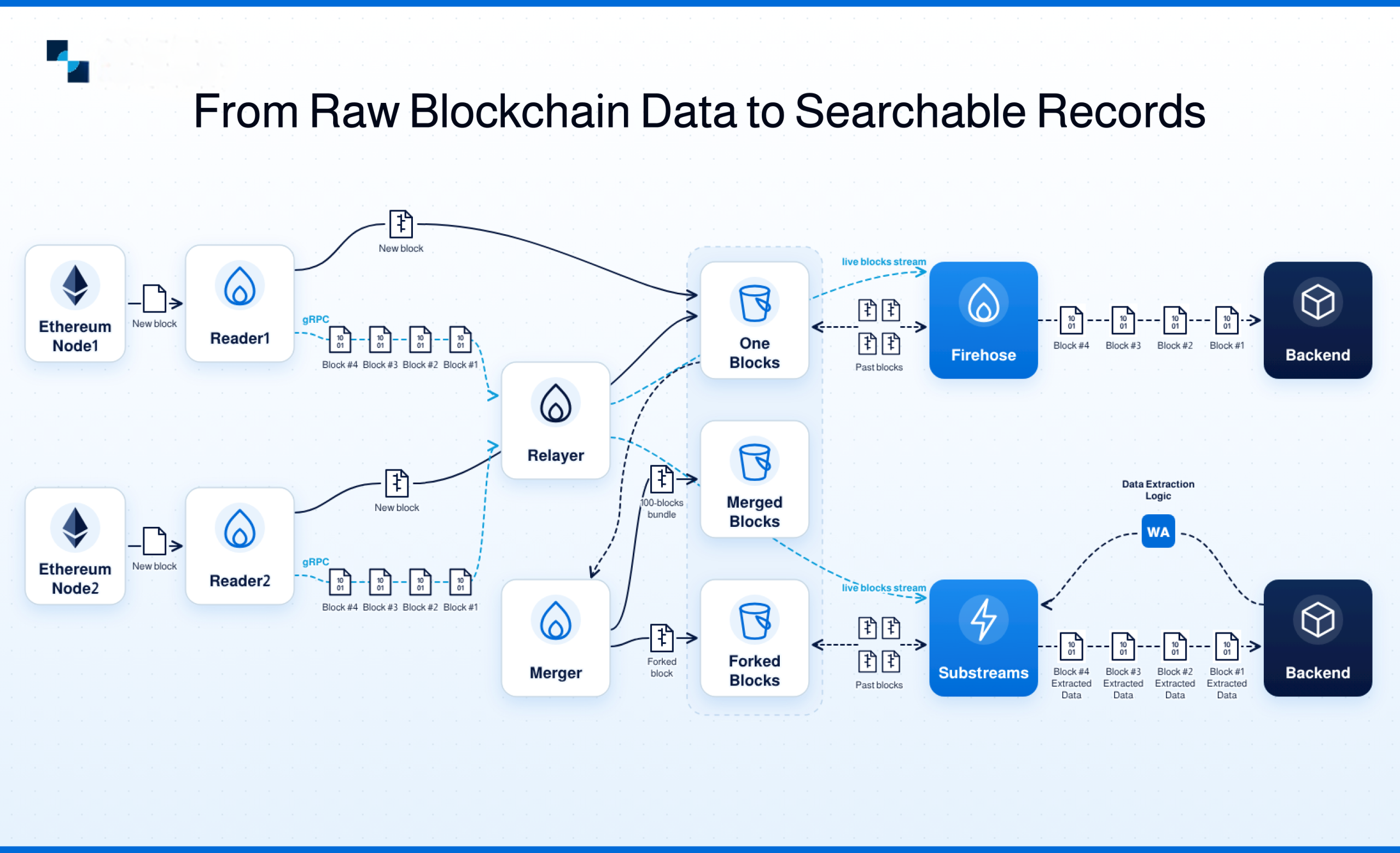
- The Graph: Supports blockchain data indexing through Subgraphs, while Substreams provides a separate approach for high-throughput, streaming data extraction and processing.
- Blockscout: Offers an open-source block explorer with indexing, data-processing, and API components.
- Custom ETL pipelines: Allow developers to control data extraction, transformation, validation, and storage according to application-specific requirements.
The choice depends on the target network, required data coverage, indexing complexity, and query requirements.
Stream Processing Technologies
Stream processing becomes useful when an explorer needs to handle continuous blockchain events, large transaction volumes, or data from multiple networks.
Apache Kafka supports distributed event streaming and message delivery between system components. Apache Flink processes continuous data streams and supports stateful computations.
These technologies can help separate data ingestion from downstream processing, allowing indexing services to handle workloads more efficiently.
Database and Caching Technologies
Database selection depends on the type of blockchain data being stored and how users need to retrieve it. PostgreSQL and MySQL can store structured information such as blocks, transactions, addresses, and contract events.
Redis can cache frequently requested records and API responses, while OpenSearch or Elasticsearch can support advanced search and filtering across indexed blockchain data.
Each component should have a clearly defined responsibility. Caching and search indexes should not replace the primary source of truth for persistent blockchain records.
Frontend Development Frameworks
Frontend frameworks determine how blockchain information is presented through search interfaces, transaction pages, block details, dashboards, and analytics views.
React, Next.js, and Vue.js are common options for developing responsive explorer interfaces. The selection should account for application complexity, rendering requirements, API integration, and maintainability.
Cloud Infrastructure and Monitoring Tools
Cloud infrastructure provides the computing, storage, networking, and deployment resources required to operate an explorer. Docker supports containerization, while Kubernetes helps orchestrate and scale distributed services.
Prometheus and Grafana can monitor resource consumption, node health, indexing delays, database performance, and API availability. OpenTelemetry provides instrumentation for collecting traces, metrics, and logs across application services.
Production deployments should connect monitoring with alerting, incident response, and recovery procedures.
Make Your Blockchain Data Easier to Explore
How Antier Approaches Blockchain Explorer and Indexer Development
Blockchain explorers and indexers require more than a searchable interface. They depend on reliable node connectivity, accurate data processing, efficient indexing, and backend systems that can handle continuous network activity. Antier approaches explorer development by combining blockchain protocol engineering with data infrastructure and application development.
Our engineering approach covers the key components required to build custom blockchain explorers and indexing systems, including node and RPC integration, historical and real-time data ingestion, transaction indexing, smart contract event decoding, database design, and API development. These components can be tailored to the underlying network architecture and the information users need to access.
For businesses operating public, private, or multi-chain networks, Antier can develop explorer solutions with capabilities such as:
- Transaction and block tracking: Access block details, transaction records, addresses, and network activity through searchable interfaces.
- Custom data indexing: Organize on-chain data into structured records for faster retrieval, filtering, and analysis.
- Smart contract event monitoring: Decode contract events and present application-specific activity in a readable format.
- API and data integration: Connect indexed blockchain data with applications, dashboards, analytics platforms, and external systems.
- Network monitoring and analytics: Track relevant network metrics, validator activity, transaction patterns, and operational performance.
- Enterprise access controls: Configure data visibility and permissions for private and permissioned blockchain environments.
The development process also accounts for network-specific requirements, including differences in transaction models, indexing methods, data availability, and blockchain finality. This helps ensure that the explorer reflects the underlying protocol accurately rather than treating every network as a standard data source.
A reliable blockchain development company can support businesses throughout the explorer development lifecycle, from architecture planning and infrastructure integration to implementation, testing, deployment, and ongoing optimization. This ensures the explorer is built around the network’s technical requirements, data access needs, and the business applications that depend on accurate on-chain information.
Building a Blockchain Explorer That Makes On-Chain Data Actionable
A blockchain explorer is more than a searchable interface; it is a data infrastructure layer that makes blockchain activity accessible to applications, developers, and business stakeholders. Its reliability depends on the engineering behind node connectivity, historical ingestion, real-time indexing, data consistency, and secure API access. As networks become more specialized, standard explorer platforms may not address every requirement, particularly for custom protocols, multi-chain environments, and permissioned enterprise systems. Building the right solution starts with understanding the network’s data model and operational objectives. Antier, a blockchain development company, helps businesses engineer custom blockchain development solutions, from protocol and infrastructure integration to application-ready data systems designed around specific network requirements.
Frequently Asked Questions
01. What is blockchain explorer development?
Blockchain explorer development involves building an application that retrieves, indexes, and displays blockchain data. It includes node integration, data processing, database design, API development, and frontend implementation. As part of custom blockchain development, explorers can be built for public, private, permissioned, and application-specific networks.
02. How much does it cost to develop a blockchain explorer?
The cost of blockchain explorer development depends on the target network, required features, indexing complexity, historical data coverage, and infrastructure requirements. A basic explorer built using an existing platform generally costs less than a custom multi-chain or enterprise solution. Businesses evaluating blockchain development services should also consider ongoing infrastructure, maintenance, and scalability costs.
03. How long does it take to build a blockchain explorer?
The development timeline depends on the network architecture, feature requirements, data availability, and infrastructure complexity. An explorer built using an existing framework may take less time, while a custom solution involving multi-chain integration, historical indexing, and enterprise functionality requires additional development and testing. An experienced blockchain development company can help define the scope and establish a realistic delivery timeline.
04. Can a blockchain explorer be built for a private blockchain?
Yes. A blockchain explorer can be developed for private and permissioned networks, including Hyperledger Fabric. Through enterprise blockchain development, organizations can build explorers that connect to authorized network interfaces and enforce identity-based access controls, organization-level permissions, and restricted data visibility according to the network's privacy model.
05. How does a blockchain explorer retrieve real-time transaction data?
A blockchain explorer connects to blockchain nodes through RPC interfaces or protocol-specific APIs. Its indexing system monitors new blocks, retrieves transaction data and execution records, processes relevant events, and stores the results in a searchable database. Backend APIs then make this information available through the explorer interface. These capabilities are important when developing scalable blockchain development solutions that require reliable access to network data.
06. What is the difference between a blockchain explorer and a blockchain indexer?
A blockchain indexer retrieves, processes, and organizes blockchain data into structured records for efficient querying. A blockchain explorer uses this indexed information to display blocks, transactions, address histories, and network activity. In simple terms, the indexer prepares the data, while the explorer makes it accessible to users. Both components can be engineered as part of custom blockchain development solutions.