




AI agents now buy API access, data, and compute as part of their workflows. x402 is an open standard that lets them pay for those services over HTTP.
Visa and Artemis counted 109.6 million adjusted x402 transactions between its May 2025 launch and April 21, 2026. The adjusted count excludes identified fake and test activity, and raw on-chain totals are higher. The average payment is very small, making x402 a micropayment market. It is also an early market.
Serving it requires payment APIs, wallet controls, verification, settlement, and reconciliation to work together. This guide covers the payment economics, the x402 flow, three build-ready use cases, and the infrastructure enterprises need.
Why Agentic Commerce Needs a Different Payment Architecture
A software agent can complete several commercial activities in one workflow. An AI financial research agent might retrieve market data, buy a credit report, query a company registry, and request a risk analysis from an external provider. Each service has its own pricing and access rules, and each can involve a separate payment.
A subscription covers some of these services. Individual payments fit better when access is occasional, or usage varies widely.
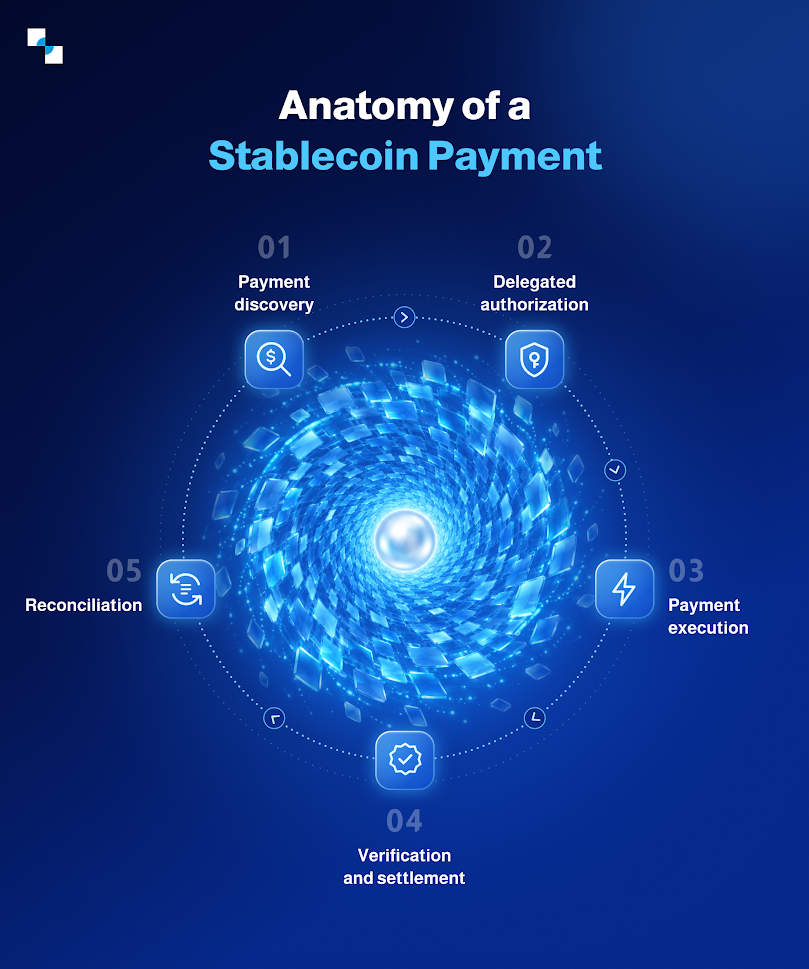
Software can send an API request on its own. A payment adds further questions: who authorized it, which wallet can spend the funds, what amount is permitted, and how the receiving service verifies payment. An enterprise-ready agentic payment workflow has five connected capabilities:
- Payment discovery: The application receives the price, payment asset, network, and recipient for a service.
- Delegated authorization: The agent acts through an approved wallet or signing mechanism with predefined spending permissions.
- Payment execution: The application prepares and signs a payment authorization under the selected payment scheme.
- Verification and settlement: The receiving service validates the authorization and settles the payment according to its payment model.
- Reconciliation: The business links each payment to the customer, application, agent identity, usage record, and ledger.
A stablecoin payment API connects these functions to the application layer. The broader infrastructure keeps payment execution secure, observable, and consistent with enterprise financial controls.
The Economics of Small Payments
Micropayments are small-value transactions tied to individual API requests, datasets, content access, or compute operations. They support usage-based pricing. A SaaS provider can charge per query, an AI infrastructure provider can bill per model call, and a data marketplace can collect payment each time an agent retrieves a dataset.
Stablecoins provide a programmable payment asset for these interactions. Supported blockchains enable transactions beyond conventional banking hours, although confirmation times, finality, and transaction costs depend on the network and supporting infrastructure.
Traditional card payments involve percentage-based and fixed processing fees, which can make very small transactions economically challenging. Stablecoin payment infrastructure offers an alternative, although its overall cost depends on network fees, wallet operations, conversion, liquidity, and payment facilitation.
The metric that matters is total cost per successfully settled payment, including:
| Cost component | What enterprises need to evaluate |
|---|---|
| Network fees | Gas or transaction fees on the selected blockchain |
| Wallet infrastructure | Custody, signing, key management and account operations |
| Payment facilitation | Verification, settlement and service charges |
| Conversion | Fiat-to-stablecoin and stablecoin-to-fiat costs |
| Liquidity | Funding, rebalancing and capital requirements |
| Compliance | Screening, monitoring and regulatory operations |
| Reconciliation | Accounting integrations, reporting and transaction records |
Model these costs against your average transaction size, payment frequency, and expected revenue.
How the x402 Protocol Works
x402 is an open standard for payments over HTTP. Coinbase and Cloudflare incubated it, and the x402 Foundation now stewards it under the Linux Foundation. The foundation became operational on July 14, 2026, with 40 members, including Visa, Mastercard, Stripe, and Google.
The protocol uses the HTTP 402 Payment Required status code to signal that a resource costs money. The server returns its payment requirements, and a compatible client prepares and submits payment. A facilitator can verify payment payloads and submit blockchain transactions on behalf of the resource server, although the resource server can also perform verification and settlement directly. Most x402 activity runs on Base, Solana, and Polygon.
Discuss the architecture and settlement needs for automated stablecoin payments.Start a Conversation!
How an x402 payment works
Consider an AI agent requesting a financial data API that charges a small fixed price per request.
Step 1: The client requests a resource. The agent sends an HTTP request to the API endpoint.
Step 2: The server returns HTTP 402. The response carries a payment requirement in the PAYMENT-REQUIRED header (x402 v2). It lists the amount, recipient, asset, network, and payment scheme.
Step 3: The client prepares a payment payload. The agent’s payment software selects a compatible option and prepares a payment authorization through its assigned wallet.
Step 4: The client retries the request. The agent sends the request again with the signed payment payload in the PAYMENT-SIGNATURE header.
Step 5: The payment is verified. The resource server or a facilitator checks that the submitted payment meets the declared requirements.
Step 6: The resource is processed. After the required pre-execution checks succeed, the server performs the requested operation.
Step 7: Settlement is completed. The payment is submitted for settlement under the selected payment flow. The facilitator can perform this on behalf of the resource server.
Step 8: The client receives the response. The server returns the resource with payment response information in the PAYMENT-RESPONSE header.
- Payment flows: The order of verification, execution, and settlement depends on the selected payment flow. The x402 v2 specification describes three flow patterns: Authorization, Upfront, and Escrow. Their availability depends on the payment scheme and network implementation.
- Authorization (default): Verify, run the resource, settle, respond. Funds move after the resource completes successfully, so the seller carries settlement risk.
- Upfront: Settle, run the resource, respond. The server has payment finality first, so the buyer needs a refund path if the resource fails.
- Escrow: Settle a deposit, run the resource, settle the final charge, respond.
- Payment schemes: x402 also defines payment schemes that match different pricing models. The exact scheme suits fixed-price requests, where the buyer authorizes the advertised amount. Theup-too scheme suits usage-based billing, where the buyer authorizes a maximum amount, and the seller settles only the actual usage. The batch-settlement scheme suits high-volume or repeated micropayments. Clients and facilitators must support the specific scheme, and the network pair a service advertises.
x402 is one of two open machine payment protocols that Visa and Artemis studied. The other, the Machine Payments Protocol (MPP), was built by Stripe and Tempo with contributions from Visa and launched in mid-March 2026.
Payment Networks Are Building for Machine-to-Machine Commerce
On June 10, 2026, Mastercard announced Agent Pay for Machines, a service for high-frequency, low-latency and low-value payments between agents and machines. More than 30 organisations support or participate in the initiative, including Adyen, Cloudflare, Coinbase, Stripe and Tempo. The service supports multiple payment types, including cards and stablecoins, and has four foundational capabilities:
- Credentialing: Establishing trusted identities for participating agents.
- Permissioning: Enforcing transaction authorization rules and spending limits.
- Transacting: Enabling automated transactions between participating services.
- Settling: Completing payments across supported payment methods.
Jorn Lambert, Mastercard’s Chief Product Officer, described the requirement as “very high volumes, very small values, very fast, and at extremely low latency.”
Software that transacts continuously needs clear authorization, reliable execution, and traceable settlement.
Three Use Cases
Payment infrastructure supplies the financial capabilities. Stablecoin payment software development connects them to the product. A SaaS platform, a fintech application, and an AI agent marketplace each need different billing logic, volumes, and controls.
Use case 1: Pay-per-use SaaS and AI infrastructure billing
A SaaS or AI infrastructure provider charges for what customers consume, such as each dataset retrieved, report generated, model call, or compute operation. The cost is often known only after the work is done, which fits the up-to scheme: the buyer authorizes a maximum, and the seller charges actual usage.
Required components:
- Usage metering.
- Stablecoin payment API.
- Customer and wallet management.
- Payment verification and settlement.
- Billing and reconciliation integration.
Use case 2: Agent-to-agent commerce and autonomous procurement
An agent buys services from another application or agent to complete a larger task. A procurement agent might request supplier information, purchase verification services, and pay for data access. A logistics agent might pay for shipment tracking or temporary monitoring access. Fixed-price purchases fit the exact scheme.
The payment system must establish the agent’s identity, authorized spending limit, and accepted payment methods before execution. These workflows also need defined purchasing authority, approved counterparties, and traceability across the whole transaction.
Required components:
- Agent identity and authentication.
- Delegated wallet permissions.
- Recipient restrictions.
- Payment protocol integration.
- Transaction monitoring and authorization records.
Use case 3: API and data marketplaces
API providers can move from subscriptions or prepaid access to transaction-based pricing for financial market data, identity verification, geospatial information, research databases, computing resources, and data processing. Per-request pricing fits the exact scheme. High-volume endpoints can use batch-settlement, which lets sellers redeem multiple small charges on-chain in batches.
x402 provides the payment interaction for compatible endpoints. The underlying infrastructure handles wallet operations, verification, and settlement.
Explore stablecoin micropayments and programmable payment integration.
Explore Solutions!
Stablecoin Payment Infrastructure vs. Traditional Payment Systems
Stablecoin payment systems and conventional payment systems serve different operational requirements.
Businesses should evaluate them according to transaction size, customer preferences, geography, settlement requirements, regulatory obligations, and total payment costs.
| Evaluation factor | Conventional card and payment infrastructure | Stablecoin payment infrastructure |
|---|---|---|
| Payment initiation | Commonly designed around cardholder and merchant interactions | Supports programmatic wallet-based transactions, subject to authorization and integration |
| Billing | Supports subscriptions, invoices and individual payments | Supports subscriptions, transfers and usage-based payments through appropriate wallet and smart contract logic |
| Settlement | Depends on payment processor, banking and network settlement schedules | Depends on blockchain confirmation, network finality, and applicable conversion or redemption processes |
| Operating availability | Depends on payment networks, processors, and banking operations | Blockchain networks generally support continuous transaction processing, subject to network availability and confirmation requirements |
| Transaction costs | Percentage-based and/or fixed processing fees | Network fees, wallet, custody, conversion, liquidity, facilitator and service-provider costs |
| Programmability | Processor APIs and payment workflows | Programmable wallets, smart contracts and conditional payment workflows |
| Agent integration | Requires suitable agent authorization and payment integrations | Supports programmable wallet-based payment interactions through compatible protocols and authorization controls |
| Compliance | Established payment and financial compliance controls | Depends on the asset, provider, business role, and applicable jurisdiction |
| Reconciliation | Processor records and accounting integrations | On-chain transaction records linked with application, invoice and accounting data |
Stablecoins do not replace every conventional payment method. Card networks remain important for consumer purchases, familiar checkout experiences, and established payment acceptance. Bank transfers remain relevant for many business-to-business payment flows. A hybrid payment architecture can support conventional payment methods alongside stablecoin settlement, allowing businesses to select the appropriate payment rail for each transaction.
The decision should be based on customer requirements, settlement needs, regulatory obligations, and payment economics rather than assuming that one payment method is universally superior.
What Enterprises Should Evaluate Before Launching Agentic Payments
Key decisions before building stablecoin payment infrastructure include:
- Business model: Will customers pay per API request, service, or usage unit? Will the platform use subscriptions, metered billing, or prepaid balances?
- Payment assets: Which stablecoins will the platform support? Are their liquidity, issuer redemption mechanisms, and smart contract standards suitable?
- Blockchain selection: Which networks meet transaction cost, throughput, confirmation time, and finality requirements?
- Agent permissions: What can an AI agent purchase? How will delegated authorization, transaction limits, and approval policies work?
- Wallet security: How will private keys, transaction signing, MPC/HSM-based key management, and approval workflows be handled?
- Compliance: Which KYC, KYB, AML, sanctions screening, licensing, and reporting requirements apply?
- Settlement: Will funds remain in stablecoins or be converted into fiat? How will liquidity and redemption be managed?
- Financial reporting: How will on-chain payments connect with invoices, customer records, usage data, and accounting systems?
- Scalability: Can the system handle high transaction volumes, retries, idempotency, network congestion, and pending settlements?
- Transaction verification: How will the platform determine when a payment has achieved the required confirmation and finality before delivering a service?
- Refunds and disputes: How will failed transactions, incorrect payments, refunds, and customer disputes be managed?
- Risk management: How will duplicate payments, replay attacks, compromised agents, and unauthorized recipients be detected and prevented?
Addressing these questions early gives product, engineering, finance, and compliance teams a clearer implementation foundation.
Conclusion
Agentic commerce is creating demand for payment infrastructure that supports automated transactions. Stablecoin micropayments enable programmable payments, while x402 standardises payment interactions for HTTP-based services. Enterprise deployment requires more than a payment protocol. Secure wallets, payment APIs, transaction verification, authorization, compliance, treasury management, and financial reconciliation are essential.
Antier supports enterprises with custom stablecoin payment infrastructure, including payment API integrations, wallet development, smart contracts, x402 implementation, and multi-chain payment applications.
Frequently Asked Questions
01. What is x402 and how does it relate to AI agents?
x402 is an open standard that allows AI agents to buy API access, data, and compute services over HTTP, facilitating micropayments for various transactions.
02. What are the key components of an enterprise-ready agentic payment workflow?
An enterprise-ready agentic payment workflow includes payment discovery, delegated authorization, payment execution, verification and settlement, and reconciliation.
03. Why are micropayments important in the context of AI agents?
Micropayments enable small-value transactions for individual API requests and services, making it easier for AI agents to access and pay for services on an as-needed basis.