

Enterprise businesses rarely operate on a single technology platform. Their digital infrastructure is built around interconnected ERP systems, CRM applications, cloud environments, databases, payment gateways, and third-party software that manage different aspects of daily operations. However, when these systems need to exchange critical business information across multiple organizations, fragmented data, disconnected workflows, and limited transaction visibility can create operational challenges.
Blockchain introduces a shared layer of transaction verification that allows different systems and authorized participants to access consistent, verifiable records without replacing their existing applications. By connecting distributed ledger technology with established enterprise software, organizations can strengthen data integrity, automate business processes, and improve coordination across complex digital ecosystems.
The real challenge, however, lies in making blockchain work within an existing technology environment. This requires the right network architecture, API integrations, middleware, smart contracts, and data synchronization mechanisms. With strategically designed blockchain integration services, enterprises can extend their existing infrastructure with blockchain capabilities while preserving critical technology investments and preparing their operations for future requirements.
Why Enterprises Are Integrating Blockchain Into Existing Digital Infrastructure
Enterprise organizations depend on multiple digital systems to manage operations, financial transactions, customer relationships, supply chains, and business data. However, when these activities involve multiple departments, external partners, or independent organizations, maintaining consistent records and coordinating transactions across different platforms can become challenging. Traditional enterprise applications often operate within separate environments, making it difficult for stakeholders to establish a common view of business activities.
Blockchain introduces a shared, verifiable transaction layer that allows authorized participants to access consistent records without requiring organizations to replace their existing software. When integrated with established enterprise applications, it can support more transparent business processes, automate predefined operations, and improve the reliability of information exchanged between participating organizations.
Several business requirements are driving enterprises to incorporate blockchain into their existing technology environments.
Shared Data Visibility Across Business Networks
Businesses frequently collaborate with suppliers, distributors, logistics providers, and financial institutions that maintain independent databases and applications. Blockchain provides a shared record of validated transactions, allowing authorized participants to verify relevant business information without depending entirely on records maintained by individual organizations.
For example, manufacturers and logistics providers can record shipment milestones on a shared blockchain network. Each participating organization can access the transaction history relevant to its role, improving visibility into product movement and ownership changes.
Automated Business Processes Through Smart Contracts
Manual approvals, transaction verification, and payment processing can introduce delays when business operations involve multiple stakeholders. Smart contracts allow enterprises to execute predefined business rules when specified conditions are satisfied.
For instance, a manufacturing company can configure a smart contract to initiate a payment workflow after receiving confirmation that a shipment has been delivered and accepted. The delivery information can originate from an existing logistics application, while the smart contract evaluates the agreed conditions before triggering the next action.
This enables organizations to introduce blockchain-based automation into established business processes without rebuilding their entire operational workflow.
Verifiable Transaction Records and Auditability
Maintaining accurate transaction histories is important for enterprises handling procurement, financial reconciliation, asset transfers, contractual agreements, and regulatory reporting. Blockchain creates a chronological record of validated transactions that authorized participants can independently verify according to the network’s rules.
The National Institute of Standards and Technology (NIST) describes blockchain as a distributed ledger technology that provides tamper-evident and tamper-resistant records. This capability makes blockchain relevant to business environments where transaction integrity, traceability, and reliable audit trails are important.
For example, an enterprise can record procurement approvals and supplier transaction milestones on a blockchain network, creating a verifiable history that supports internal reviews and inter-organizational accountability.
Greater Transparency Across Multi-Party Transactions
Business transactions often pass through several organizations before completion. Procurement, cross-border trade, asset transfers, and supply chain operations may involve multiple approvals, ownership changes, and delivery confirmations. When participants maintain separate records, verifying the current transaction status can require repeated communication and manual reconciliation.
A shared blockchain transaction history allows authorized stakeholders to verify important events and track changes across the business process.
For example, an enterprise purchasing components from international suppliers can use blockchain records to track order approvals, shipment updates, and delivery confirmations. This provides participating organizations with a consistent reference for monitoring transaction progress and resolving discrepancies.
Digital Identity and Credential Verification
Enterprises regularly exchange business credentials, certifications, authorization records, and identity information when onboarding employees, suppliers, customers, and external partners. Repeatedly validating these credentials across different organizations can increase administrative effort and create delays.
Blockchain-based identity frameworks can support the verification of digitally signed credentials while allowing organizations to retain control over how identity information is issued, presented, and accessed.
For example, a supplier can present a digitally signed certification to a business partner, who can verify its authenticity without repeatedly requesting the original documentation.
The W3C Verifiable Credentials Data Model 2.0, published as a Recommendation in May 2025, provides a standardized framework for representing and verifying digital credentials. It can complement blockchain-based identity architectures where trusted credential exchange is an important business requirement.
Make Your Existing Infrastructure Blockchain-Ready
Understanding the Role of Blockchain in an Enterprise Technology Ecosystem
Before implementing blockchain, enterprises need to understand how it fits into their existing technology environment. Enterprise blockchain solutions do not have to function as standalone business applications. Instead, they can operate as a shared transaction and verification layer connected to existing software through integration services. This allows businesses to maintain their current systems while improving data transparency, transaction traceability, and coordination across multiple stakeholders. A typical enterprise technology ecosystem contains several interconnected components:
| Existing technology | Role in the enterprise | Blockchain integration opportunity |
| ERP systems | Manage procurement, inventory, finance, and operations | Record and verify important business transactions |
| CRM platforms | Manage customer information and interactions | Verify agreements, consent, and selected customer-related records |
| Databases | Store operational and transactional information | Synchronize selected records or transaction proofs |
| Cloud platforms | Host applications, infrastructure, and services | Deploy blockchain nodes, APIs, and supporting services |
| Payment systems | Process financial transactions | Connect payment confirmations with smart contract workflows |
| Supply chain software | Manage shipments, suppliers, and inventory | Establish shared product and shipment histories |
| Identity management systems | Manage users and access permissions | Support blockchain-based credential verification |
The most effective approach to blockchain integration services connects blockchain with specific business processes rather than transferring every enterprise activity onto a distributed ledger.
For instance, an ERP system can continue managing purchase orders, inventory, and accounting. Blockchain can record selected transaction milestones, approvals, or verification proofs that need to be shared with external participants.
This creates a connected enterprise environment in which each technology performs the function it is designed to handle.
Key Components Required for Enterprise Blockchain Integration
A successful enterprise integration architecture requires well-defined enterprise blockchain infrastructure, with several technical components working together. Each component has a specific responsibility, from connecting applications and managing transactions to maintaining data consistency across the enterprise technology ecosystem.
1. Blockchain Network
The blockchain network provides the shared ledger where validated transactions are recorded. Enterprises can select a permissioned or public network depending on their business requirements, participant model, transaction visibility, and governance structure.
Permissioned networks are particularly relevant when participating organizations need controlled membership and defined transaction permissions.
Platforms such as Hyperledger Fabric and enterprise-oriented EVM networks can support different enterprise blockchain requirements.
2. APIs and Integration Middleware
APIs establish communication between blockchain applications and existing enterprise software.
For example, an ERP application can send a purchase order event to an integration service through an API. The service validates the information, prepares a blockchain transaction, and submits it to the network.
Middleware manages communication between systems with different data formats, protocols, and processing requirements.
Common integration components include:
- REST APIs and GraphQL interfaces.
- API gateways.
- Enterprise service buses.
- Message brokers and event streaming platforms.
- Custom integration services.
3. Smart Contracts
Smart contracts define the business rules that execute on a blockchain network.
They can manage approvals, transaction validation, asset transfers, settlement conditions, and other predefined processes.
For enterprise integration, smart contracts should reflect existing business rules and approval structures. Their inputs, outputs, permissions, and interactions with external applications must be clearly defined.
4. Off-Chain Data Storage
Enterprise applications generate large volumes of operational data, including customer information, invoices, contracts, product specifications, and transaction documents.
Storing all this information directly on a blockchain is not always appropriate. A hybrid architecture can retain detailed information in existing databases or secure storage systems while recording transaction references, cryptographic hashes, or selected events on-chain.
This approach helps enterprises maintain their existing data management processes while creating verifiable records.
5. Identity and Access Management
Enterprise blockchain networks require clearly defined identities for participating organizations, applications, and users.
Identity management determines:
- Who can join the network?
- Which users can submit transactions.
- Who can access particular records?
- Which organizations can approve transactions.
- How credentials and permissions are updated.
Hyperledger Fabric, for example, uses Membership Service Providers (MSPs) to establish organizational identities and manage membership-related trust within a network.
6. Monitoring and Analytics
Blockchain integration also requires operational visibility.
Monitoring tools help enterprises track transaction processing, API performance, node availability, failed requests, network activity, and application-level events.
These capabilities allow IT teams to manage blockchain infrastructure alongside their existing enterprise technology environment.
How to Integrate Blockchain Into Existing Enterprise Systems
Integrating blockchain into an existing technology environment requires a structured implementation approach. Enterprises must evaluate their current applications, identify suitable blockchain capabilities, establish communication between systems, and ensure that business data moves accurately across the integrated environment. The following steps explain how organizations can integrate blockchain solutions into their existing digital infrastructure.
Assess the Existing Digital Infrastructure
The first step is to understand the enterprise’s current technology landscape. Organizations may operate multiple ERP platforms, databases, cloud applications, internal software, and third-party services. Before introducing blockchain, technology teams should identify how these systems communicate and which business processes can benefit from distributed ledger capabilities.
The assessment should cover:
- Existing applications and their technology stacks.
- Database structures and data exchange formats.
- Available APIs and integration endpoints.
- Existing authentication and authorization mechanisms.
- Business workflows that involve multiple organizations.
- Data ownership, storage, and access requirements.
- Infrastructure capacity and transaction volumes.
For example, a manufacturing enterprise may want to introduce blockchain-based product traceability. Its assessment would identify the existing inventory management system, warehouse software, supplier applications, and logistics platforms that generate product movement information.
This assessment helps define the integration requirements without disturbing established business operations.
Identify the Right Blockchain Network
Selecting the right blockchain platform is an important architectural decision. Enterprises should evaluate networks according to their business requirements, transaction patterns, governance structure, and integration capabilities.
Different blockchain platforms support different enterprise use cases.
| Blockchain platform | Enterprise relevance |
| Hyperledger Fabric | Permissioned business networks, organizational identities, and controlled data sharing |
| Hyperledger Besu | Enterprise Ethereum applications and EVM-compatible blockchain infrastructure |
| Ethereum | Smart contract applications and integration with the broader public blockchain ecosystem |
| Polygon CDK | Development of customized blockchain networks using the Polygon CDK framework |
| Cosmos SDK | Development of application-specific blockchains with configurable architecture |
| Substrate / Polkadot SDK | Building customized blockchain networks with modular components |
For example, an enterprise consortium involving manufacturers, suppliers, and distributors may prefer a permissioned network with defined organizational membership.
A business developing applications that interact with Ethereum-based smart contracts may consider an EVM-compatible platform.
The selection should also account for transaction throughput, finality requirements, privacy, interoperability, node operations, developer tooling, and long-term network maintenance.
A specialized blockchain software development company can help evaluate these requirements and recommend an architecture that aligns with the enterprise’s technology environment.
Design the Blockchain Integration Architecture
Once the network is selected, enterprises need to define how blockchain will communicate with their existing applications. A well-designed architecture establishes clear responsibilities for each layer.
A typical enterprise blockchain integration architecture includes:
- Application layer: Existing ERP, CRM, supply chain, finance, and customer-facing applications.
- API and middleware layer: Manages communication, request validation, data transformation, and application connectivity.
- Business logic layer: Contains smart contracts and application-level rules.
- Blockchain network layer: Processes and records validated transactions across participating nodes.
- Data storage layer: Maintains enterprise databases, document repositories, and off-chain information.
- Monitoring and security layer: Handles identity verification, access permissions, transaction monitoring, and infrastructure health.
Consider an enterprise procurement workflow. When a purchase order is approved in the ERP system, an integration service can capture the approval event and submit the relevant transaction to the blockchain network. The smart contract verifies the predefined conditions, and the resulting transaction status becomes available to authorized participants.
The ERP system continues managing procurement operations, while blockchain maintains the shared transaction record.
Connect Enterprise Applications Through APIs and Middleware
APIs are among the most important components of enterprise blockchain integration because they allow different applications to exchange information without requiring the same underlying technology.
An enterprise may use Java-based ERP software, a Node.js application, Python-based data services, and cloud-hosted databases. APIs and middleware can connect these components with blockchain applications.
The integration process generally involves:
- Creating API endpoints for blockchain interactions.
- Establishing secure communication between applications.
- Mapping enterprise data fields to blockchain transaction structures.
- Validating incoming requests.
- Submitting transactions to the blockchain network.
- Returning transaction identifiers and processing statuses.
- Managing errors, retries, and asynchronous responses.
For example, a CRM platform may trigger a blockchain transaction when a business agreement receives final approval. The integration service captures the relevant agreement reference, sends it to the smart contract, and retrieves the resulting transaction status.
Hyperledger Fabric provides a practical example through Fabric Gateway. Introduced in Fabric v2.4, it simplifies application interaction with the network by handling transaction evaluation, endorsement, submission, and commit-status monitoring through client APIs.
This type of integration enables enterprise developers to connect blockchain functionality with familiar application development environments.
Integrate Smart Contracts With Existing Business Workflows
Smart contracts connect blockchain transactions with predefined enterprise business rules.
However, their implementation should be based on actual operational requirements rather than simply transferring existing processes onto a blockchain.
Enterprises should identify which business conditions can be automated and which activities require human approval or external verification.
For example, consider a supplier payment process:
- A supplier receives a purchase order through the enterprise procurement system.
- The supplier dispatches the goods.
- The logistics application records shipment information.
- The warehouse management system confirms delivery.
- The integration layer submits the verified delivery event.
- The smart contract checks the agreed delivery conditions.
- The payment workflow receives the resulting confirmation.
In this model, the blockchain smart contract manages the agreed conditions, while the existing enterprise applications continue handling their respective operational responsibilities.
Smart contract development should include clearly defined permissions, validation rules, exception handling, and testing procedures.
Establish Data Synchronization and Interoperability
Enterprise blockchain integration involves exchanging information between systems that may use different data formats, databases, and communication protocols.
A data synchronization strategy ensures that applications receive the correct transaction information at the appropriate time.
Organizations can use several approaches:
- Event-driven synchronization: Applications publish events when important business activities occur. Integration services consume these events and trigger relevant blockchain operations.
- API-based synchronization: Applications exchange information through predefined API requests and responses.
- Message queues: Message brokers manage communication between systems, particularly when transactions need asynchronous processing.
- Scheduled synchronization: Applications exchange selected records at defined intervals when real-time updates are not required.
Enterprises should also define how transaction statuses, timestamps, unique identifiers, and data references will be represented across applications.
Industry standards can simplify this process. For example, GS1 EPCIS 2.0 provides a standardized approach for capturing and sharing supply chain visibility events across applications and organizations. It supports event capture, querying, and data exchange through defined interfaces.
Combining standardized event structures with blockchain-based verification can support more consistent information exchange across supply chain participants.
Implement Identity, Access Control, and Security
Security architecture must be considered throughout the integration process.
Enterprise environments involve different categories of users, applications, organizations, and external service providers. Each participant requires appropriate authentication and authorization based on its responsibilities.
Important implementation elements include:
- Role-based or attribute-based access control.
- Secure API authentication.
- Organizational identity management.
- Encryption of data during transmission and storage.
- Private transaction and data-sharing mechanisms.
- Secure key generation, storage, and rotation.
- Smart contract security testing.
- Audit logging and continuous monitoring.
For example, a supplier may be allowed to submit shipment information, while a financial institution may have permission to verify settlement-related transactions. Other participants can receive access to selected records according to predefined policies.
Hyperledger Fabric supports private data collections, allowing specified organizations to access private information while other channel participants can still share the broader transaction context.
API security also deserves dedicated attention. OWASP’s API Security Top 10 highlights areas such as broken authentication, authorization weaknesses, unrestricted resource consumption, and security misconfiguration. These considerations should be included in the enterprise integration testing process.
Test, Deploy, and Monitor the Integrated Environment
Before production deployment, enterprises should validate how blockchain interacts with existing applications under different business conditions.
Testing should cover:
- Functional testing of smart contracts.
- API integration and data validation.
- Transaction processing and confirmation.
- Access control and permission management.
- Performance under expected transaction volumes.
- Data synchronization and recovery.
- Network availability and node health.
- Application compatibility.
A pilot deployment is a practical way to validate the integration architecture using a limited business process or participating group.
Once the pilot meets defined performance and operational requirements, the implementation can expand to additional applications, departments, or business partners.
After deployment, monitoring systems should track API response times, transaction confirmation status, blockchain node performance, application errors, and network activity.
This gives enterprise IT teams the operational visibility required to manage blockchain as part of their wider technology environment.
Enterprise Blockchain Integration Architecture: How Different Systems Work Together
Understanding the interaction between enterprise applications and blockchain becomes easier through an example. Consider a global manufacturing enterprise that wants to establish a shared product traceability system involving suppliers, warehouses, logistics providers, and distributors. The company already operates an ERP platform, warehouse management software, supplier portals, and cloud-based databases. Instead of replacing these systems, it introduces a blockchain integration layer.
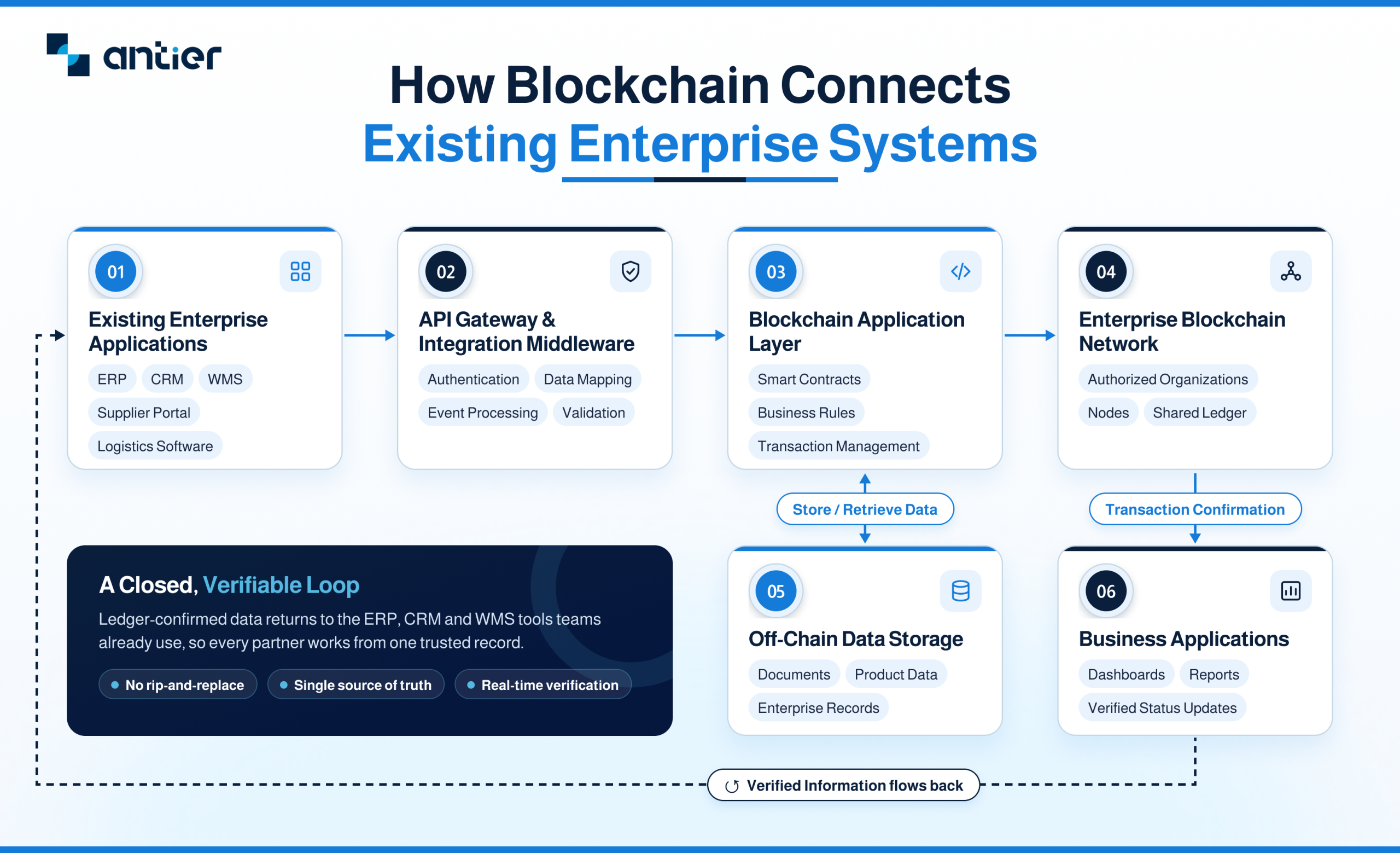
Conceptual architecture showing how blockchain can connect existing enterprise systems with shared transaction records and off-chain information.
Here is how the integrated environment works:
- A supplier enters product information into the existing supplier portal.
- The ERP or inventory system generates a transaction event.
- The API gateway validates the request and forwards the relevant information to the integration layer.
- The integration service prepares a blockchain transaction.
- A smart contract validates the transaction according to predefined business rules.
- The blockchain network records the validated transaction.
- The application receives the transaction status and updates the relevant business dashboard.
- Authorized participants can retrieve the verified information through connected applications.
Detailed product documents and operational records can remain in enterprise databases or document storage. The blockchain can retain transaction references or cryptographic proofs that help verify the integrity of those records.
The architecture creates a connected business environment without requiring every participant to replace its existing software.
Enterprise Systems That Can Be Connected With Blockchain
Blockchain integration can extend across different layers of an enterprise technology environment. The following systems offer practical opportunities for introducing shared records, automated workflows, and transaction verification.
| Enterprise system | Blockchain integration opportunity | Example |
| ERP | Procurement and transaction verification | Recording approved purchase orders |
| CRM | Agreement and consent verification | Maintaining verifiable agreement references |
| Supply chain management | Product traceability | Recording shipment milestones |
| Warehouse management | Inventory movement tracking | Verifying goods received and dispatched |
| Financial applications | Transaction reconciliation | Connecting settlement confirmations |
| Document management | Document integrity verification | Recording document hashes |
| HR platforms | Credential verification | Validating employee certifications |
| IoT platforms | Trusted event recording | Recording verified sensor events |
| Identity management | Digital identity and credentials | Verifying organizational credentials |
| Business intelligence | Verified data references | Combining operational analytics with blockchain records |
The integration scope depends on the business objective, data sensitivity, application architecture, and participating organizations.
For example, an enterprise may begin by connecting its ERP and supplier management systems before extending blockchain functionality to logistics applications and financial workflows.
This phased approach makes it easier to establish a consistent integration model across the organization.
Real-World Enterprise Blockchain Integration Use Cases
The practical value of blockchain integration becomes clearer when applied to specific enterprise operations. Different industries can connect blockchain with their existing applications to improve transaction verification, information sharing, and workflow automation.
1. Banking and Financial Services
Financial institutions manage multiple systems for payments, settlements, customer verification, transaction monitoring, and financial reporting.
Blockchain can connect selected financial workflows through APIs and smart contracts.
For example, a bank can integrate blockchain with its existing payment processing system to maintain shared transaction records between participating financial institutions. Smart contracts can manage predefined settlement conditions, while existing banking applications continue handling customer accounts and financial operations.
Integration opportunities:
- Payment and settlement applications.
- Transaction reconciliation systems.
- Customer identity verification platforms.
- Financial document management systems.
- Interbank transaction networks.
2. Supply Chain and Logistics
Supply chains involve manufacturers, suppliers, warehouses, distributors, and transportation providers operating across different digital platforms.
Blockchain integration can establish a shared record of product movement and ownership-related events.
For example, a logistics application can submit shipment updates through an API. The blockchain network records relevant milestones, allowing authorized participants to verify shipment history through their existing applications.
Integration opportunities:
- ERP and inventory management systems.
- Warehouse management software.
- Transportation management platforms.
- Supplier management applications.
- IoT-based shipment monitoring.
3. Healthcare and Life Sciences
Healthcare organizations manage electronic health records, laboratory systems, pharmaceutical databases, insurance platforms, and patient management applications.
Blockchain can support selected information-sharing and verification processes across authorized healthcare participants.
For example, a pharmaceutical company can connect its manufacturing and distribution systems with a blockchain network to record product batch information and supply chain milestones.
Similarly, healthcare organizations can explore credential verification and controlled exchange of selected record references.
Integration opportunities:
- Electronic health record systems.
- Laboratory information management systems.
- Pharmaceutical supply chain platforms.
- Healthcare identity management.
- Clinical document verification.
Sensitive medical information should remain within appropriately governed storage environments, with blockchain used for selected proofs, references, or authorized transaction records.
4. Manufacturing and Industrial Operations
Manufacturing businesses operate production management systems, industrial IoT platforms, quality control applications, and supplier networks.
Blockchain can connect these systems to maintain verifiable records of production events, component sourcing, quality approvals, and equipment maintenance.
For example, an IoT platform can generate a machine maintenance event, which an integration service validates before recording the relevant information on a blockchain network.
Integration opportunities:
- Manufacturing execution systems (MES).
- Industrial IoT platforms.
- Quality management software.
- Equipment maintenance applications.
- Supplier and procurement systems.
5. Real Estate and Property Management
Real estate businesses use property management platforms, financial applications, document repositories, and customer management systems.
Blockchain can connect these applications with digital record verification and property transaction workflows.
For example, an enterprise property management platform can integrate with a blockchain network to maintain verifiable records of selected ownership-related documents, approvals, and transaction milestones.
Integration opportunities:
- Property management software.
- Digital document management.
- Contract management systems.
- Payment and accounting applications.
- Property record verification platforms.
Build Connected Enterprise Blockchain Solutions With Antier
How to Choose the Right Blockchain Integration Company
Selecting the right technology partner is an important part of enterprise blockchain adoption. Businesses need a development team that understands blockchain technology and knows how to connect it with existing applications, databases, and business processes. Before choosing a Blockchain integration company, consider the following capabilities:
1. Platform Expertise
Check whether the company has experience working with blockchain platforms such as Hyperledger Fabric, Hyperledger Besu, Ethereum, Polygon CDK, and other relevant frameworks. The team should understand their architecture, transaction processing, identity management, and integration capabilities to recommend the right platform for your business requirements.
2. Integration Expertise
Blockchain should work with your existing business applications rather than operate separately. Evaluate the team’s experience in connecting blockchain networks with:
- REST APIs and GraphQL.
- ERP and CRM systems.
- Enterprise databases.
- Cloud infrastructure.
- Middleware and message brokers.
- Existing authentication systems.
This ensures that blockchain applications can exchange information with your existing software and support established business workflows.
3. Security Practices
Security plays an important role in enterprise blockchain integration. Check whether the development team can handle smart contract security, access permissions, transaction validation, and cryptographic key management. Ask about their approach to code reviews, automated testing, vulnerability assessments, and security audits to understand how they protect applications and transaction data.
4. Network Interoperability
Businesses may need to connect multiple blockchain networks, manage dedicated nodes, or enable communication between different protocols. Your development partner should understand cross-chain communication, RPC connectivity, node infrastructure, and interoperability requirements. This helps build an integration architecture that can support additional networks and applications as business needs grow.
5. Ongoing Support
Blockchain integration requires continuous monitoring and technical improvements after deployment. Evaluate whether the company can support infrastructure monitoring, application upgrades, smart contract maintenance, network migrations, and performance optimization. A reliable Blockchain software development company should provide long-term engineering support to keep integrated systems functional, secure, and aligned with changing business requirements.
A capable Blockchain software development company should approach enterprise integration as an ongoing engineering initiative rather than an isolated development project.
Making Blockchain a Connected Part of Enterprise Technology
Blockchain integration is an opportunity for enterprises to extend the capabilities of their existing digital infrastructure. By connecting ERP platforms, databases, APIs, cloud environments, and business applications with distributed ledger technology, organizations can establish shared transaction records, automate workflows, and improve information verification across business networks. The key is to select the right blockchain architecture, define clear integration requirements, and establish reliable data exchange between systems. With experienced engineering support, enterprises can introduce blockchain capabilities through a structured implementation approach. Antier, a Blockchain software development company, helps businesses develop and integrate enterprise blockchain solutions that support evolving technology requirements and long-term digital transformation objectives.
Frequently Asked Questions
01. Why do enterprise businesses struggle with their digital infrastructure?
Enterprise businesses often operate on multiple technology platforms, leading to fragmented data, disconnected workflows, and limited transaction visibility when exchanging critical business information across different organizations.
02. How does blockchain improve enterprise operations?
Blockchain provides a shared layer of transaction verification, allowing different systems and authorized participants to access consistent, verifiable records, which enhances data integrity, automates processes, and improves coordination across complex digital ecosystems.
03. What are the challenges of integrating blockchain into existing technology environments?
The main challenges include establishing the right network architecture, API integrations, middleware, smart contracts, and data synchronization mechanisms to ensure that blockchain capabilities enhance existing infrastructure without replacing critical technology investments.