




✨ AI Summary
- Supply chains have become increasingly complex, leading to data fragmentation, limited visibility, and manual coordination issues.
- This blog post highlights how blockchain technology can resolve these challenges by creating a centralized, tamper-proof ledger that provides real-time information to all authorized participants.
- The article details how blockchain enhances traceability, workflow automation, and collaboration, contributing to greater confidence in product journeys.
- The post also emphasizes that most supply chain blockchain deployments are run on private, permissioned networks, ensuring confidentiality and control.
- The text outlines the key benefits of implementing blockchain in supply chains, including end-to-end real-time visibility, tamper-proof provenance, smart contract automation, faster dispute resolution, and built-in compliance documentation.
Supply chains have become more connected than ever, yet most businesses still struggle with fragmented data, limited visibility, and manual coordination across suppliers, manufacturers, logistics providers, and distributors. As global supply networks grow more complex, even a small disruption can trigger delays, compliance issues, financial losses, and damaged customer trust. The problem isn’t a lack of data; it’s that every participant maintains separate records, making it difficult to establish a single source of truth when products move across multiple organizations.
Blockchain in supply chain addresses this challenge by creating a shared, tamper-proof ledger where every authorized participant works from the same real-time information. Instead of relying on disconnected systems and paper-based processes, businesses can improve traceability, automate workflows, strengthen collaboration, and verify every product’s journey with confidence.
In this guide, you’ll discover how blockchain technology in supply chain works, the benefits it delivers, real-world applications across industries, and the key steps to building a successful blockchain supply chain solution.
What Is Blockchain in Supply Chain Management?
At its core, a blockchain is a shared digital ledger – a record that every authorized participant in a network can read, but that no single party can alter unilaterally.
In a supply chain context, that means every handoff from manufacturer to freight carrier, from port to distributor, from distributor to retailer gets logged as a permanent, timestamped entry on a record that every participant in the network sees simultaneously. No competing records. No “your data vs. my data” disputes. No manual reconciliation at the end of a long and fragmented chain. Blockchain in supply chain creates one shared truth that every party trusts because no single party controls it.
The critical distinction for decision-makers: most supply chain blockchain deployments run on private, permissioned networks not public blockchains like Ethereum or Bitcoin. Participants are verified and credentialed before they join. Data is selectively visible based on role – a logistics provider sees shipment data, not pricing agreements. A regulator sees compliance documentation, not commercial terms. This architecture is what makes blockchain in supply chain viable for regulated industries, large enterprises, and global logistics networks where confidentiality and control are non-negotiable.

The blockchain supply chain market is projected to grow from USD 1.80 billion in 2026 to USD 42.55 billion by 2034, at a CAGR of 48.45%.
Source: https://www.fortunebusinessinsights.com/blockchain-supply-chain-market-116838?
Why Traditional Supply Chains Are Falling Behind in 2026
Modern supply chains connect manufacturers, suppliers, logistics providers, distributors, and retailers across the globe. While this level of connectivity enables businesses to scale, it also creates challenges that traditional systems struggle to manage. Here are some of the biggest pain points organizations face today:
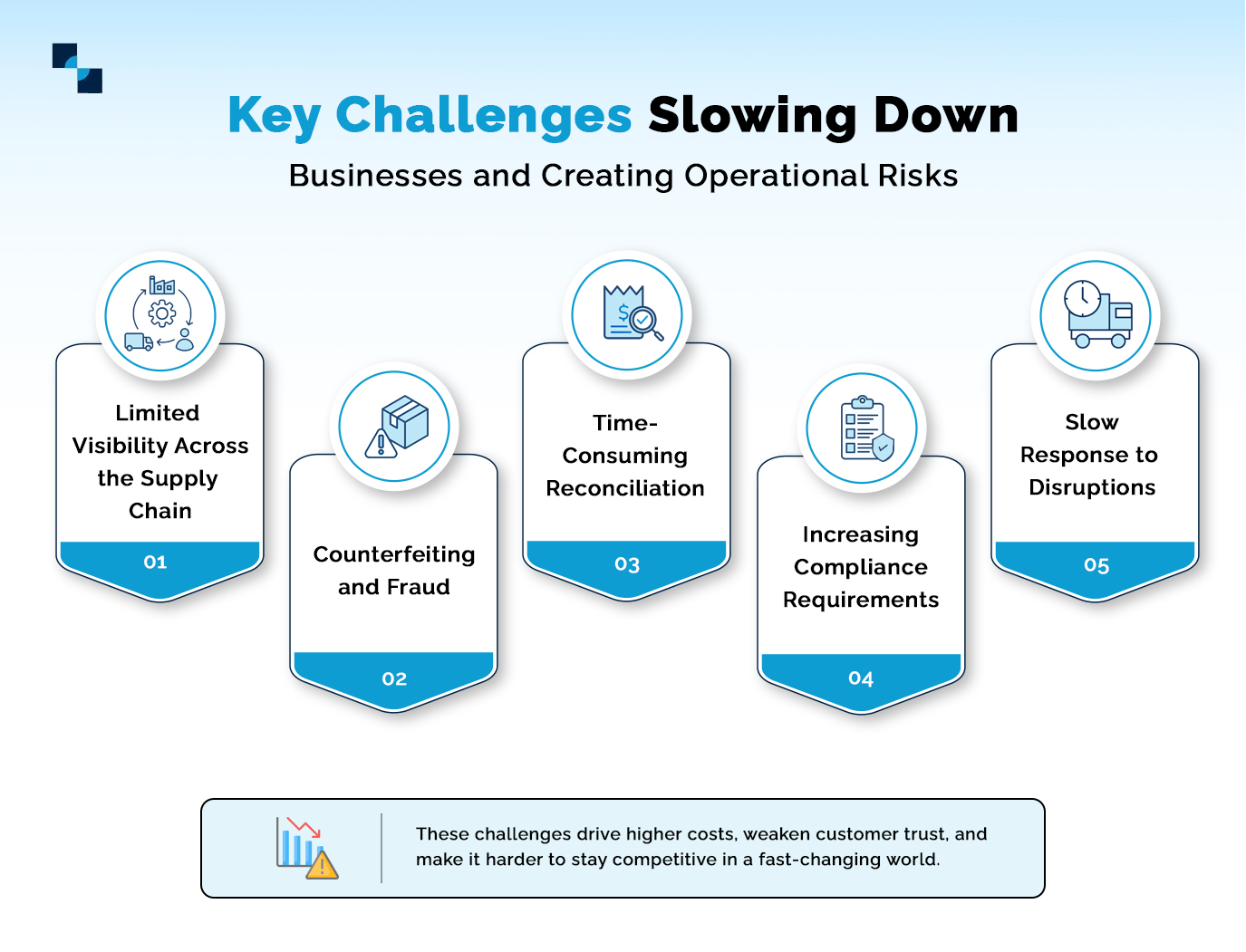
- Limited visibility across the supply chain
Most businesses have visibility into their direct suppliers, but tracking products beyond the first tier is often difficult. This lack of transparency makes it challenging to identify the source of quality issues, verify ethical sourcing, or respond quickly to disruptions.
- Counterfeiting and fraud
Global counterfeit trade continues to grow, affecting industries such as pharmaceuticals, food, electronics, and luxury goods. Paper-based documentation and disconnected systems make it easier for counterfeit products to enter the supply chain and harder to verify product authenticity.
- Time-consuming reconciliation
Every participant maintains separate records, creating multiple versions of the same information. When shipment details, invoices, or inventory records don’t match, businesses spend valuable time resolving disputes instead of focusing on operations.
- Increasing compliance requirements
Governments and regulators are demanding greater transparency around product origin, sustainability, and safety. Managing compliance with manual records and disconnected systems is becoming more complex, expensive, and prone to errors.
- Slow response to disruptions
Whether it’s a product recall, delayed shipment, or quality issue, businesses need accurate information immediately. Traditional supply chains often rely on manual verification, making it difficult to trace products and respond quickly when every minute matters.
These challenges are no longer occasional setbacks – they have become everyday operational hurdles for businesses managing complex supply networks. That’s why organizations across industries are turning to blockchain supply chain solutions to improve visibility, strengthen trust, and build more resilient supply chains.
Are you Ready to Transform your Supply Chain with Blockchain?
Key Benefits of Blockchain Technology in Supply Chain
The growing adoption of blockchain technology in supply chain is driven by the measurable business value it delivers. By replacing disconnected systems with a shared, trusted ledger, businesses gain greater visibility, stronger security, faster collaboration, and more efficient operations. Here are the key benefits of implementing blockchain in supply chain.
- End-to-end real-time visibility. Every authorized party in the network sees the same live picture of goods in transit where they are, who handled them, what condition they are in. The status calls, the follow-up emails, the “let me check and get back to you” disappear when verified data is shared across the network in real time.
- Tamper-proof provenance. Once a product’s journey is recorded on the blockchain, it cannot be altered. Every origin claim, quality certification, and custody transfer is permanently logged and verifiable by any authorized party. This is what makes blockchain technology in supply chain the structural solution to counterfeiting and provenance fraud not a procedural fix, but an architectural one.
- Smart contract automation. Payments, compliance triggers, and logistics instructions can be automated through smart contracts – self-executing code that fires when predefined conditions are met. A payment releases the moment a shipment is confirmed received. A compliance flag raises automatically when a temperature threshold is breached. Manual approval chains collapse into automated execution that is faster, cheaper, and audit-ready by design.
- Faster dispute resolution. When every event is timestamped and immutable, disputes that previously required weeks of back-and-forth across competing records resolve in hours. The shared ledger is the single source of truth and it is not subject to interpretation.
- Built-in compliance documentation. Sustainability reports, provenance certifications, safety records – all captured as a natural byproduct of normal operations. Regulatory audits become a straightforward data export rather than a multi-week scramble. Supply chain transparency becomes infrastructure, not overhead.
Did You Know?
Modern blockchain supply chain networks don’t just record transactions – they create a tamper-proof, shared source of truth that helps businesses improve transparency, product traceability, fraud prevention, and regulatory compliance
Blockchain Supply Chain Use Cases Delivering Real Results in 2026
Blockchain is no longer limited to pilot projects or proof-of-concepts. Today, businesses across industries are using blockchain supply chain solutions to improve traceability, strengthen compliance, reduce fraud, and create more transparent supply networks. Here are some of the most impactful real-world applications:

Food Safety & End-to-End Traceability
Food manufacturers, retailers, and distributors use blockchain to track products from farm to shelf through a shared, immutable record. When a contamination or quality issue occurs, businesses can quickly identify the affected batches, accelerate recalls, protect consumers, and minimize financial and reputational damage.
Pharmaceutical Traceability & Anti-Counterfeiting
Counterfeit medicines continue to pose serious risks to both businesses and public health. Blockchain in supply chain enables pharmaceutical companies to assign a tamper-proof digital identity to every batch or product, making it easier to verify authenticity, monitor distribution, and comply with global serialization and track-and-trace regulations.
Cross-Border Trade & Logistics
International trade often relies on paper-based documents that slow down shipments and increase the risk of fraud. By digitizing bills of lading, certificates of origin, and other trade documents, blockchain supply chain solutions enable faster document verification, smoother cross-border transactions, and greater trust between trading partners.
Manufacturing & Supplier Collaboration
Manufacturers working with multiple suppliers need accurate, real-time information across every stage of production. Blockchain provides a shared source of truth for materials, components, quality inspections, and inventory movements, helping businesses improve collaboration, identify issues earlier, and maintain consistent product quality.
Luxury Goods & Product Authentication
Leading luxury brands are using blockchain to create verifiable digital identities for high-value products. Customers, retailers, and resale platforms can instantly confirm a product’s authenticity, ownership history, and origin, making counterfeit goods significantly harder to introduce into the market.
Sustainability & ESG Compliance
As consumers and regulators demand greater transparency, businesses are using blockchain to verify ethical sourcing, measure carbon emissions, and track sustainability data throughout the supply chain. This creates reliable audit trails that simplify ESG reporting while strengthening stakeholder trust.
Across these use cases, the business outcome remains the same: greater transparency, stronger collaboration, faster decision-making, improved compliance, and more resilient supply chains. As adoption continues to grow, blockchain technology in supply chain is becoming a strategic advantage for organizations looking to build trusted, future-ready operations.
How Blockchain Supply Chain Solutions Work: Core Components Explained
Understanding blockchain supply chain solutions does not require a technical background. Four components make the whole system work:
The shared ledger. Every authorized participant – suppliers, carriers, distributors, retailers, regulators accesses the same record, updated in real time. No one can alter a past entry. This is the foundational trust layer of any blockchain in supply chain network.
Permissioned access. Enterprise supply chain networks are permissioned by design. Participants are verified before joining. Data visibility is role-based – a logistics provider sees what they need, not what they don’t. A regulator accesses compliance records, not commercial terms. Privacy and transparency coexist within the same network architecture.
Smart contracts. Self-executing code that lives on the blockchain. When defined conditions are met – a temperature check passes, a delivery is confirmed, an inspection is signed off – the smart contract automatically triggers the next step: a payment, a compliance record, a customs notification. Business logic becomes automated infrastructure.
IoT integration. Temperature sensors, GPS trackers, RFID tags, and weight sensors feed real-world data into the ledger automatically. This eliminates manual data entry and the errors, delays, and disputes that come with it. The blockchain records what sensors report, creating an objective, continuous record of product condition throughout the journey.
Together, these components transform a fragmented, paper-based supply chain into a shared, automated, auditable network that every participant can trust.
What Blockchain Supply Chain Development Actually Involves
Most enterprises understand the benefits of blockchain in supply chain well before they understand what building one actually involves. Here is what a professional blockchain supply chain development engagement looks like end to end:
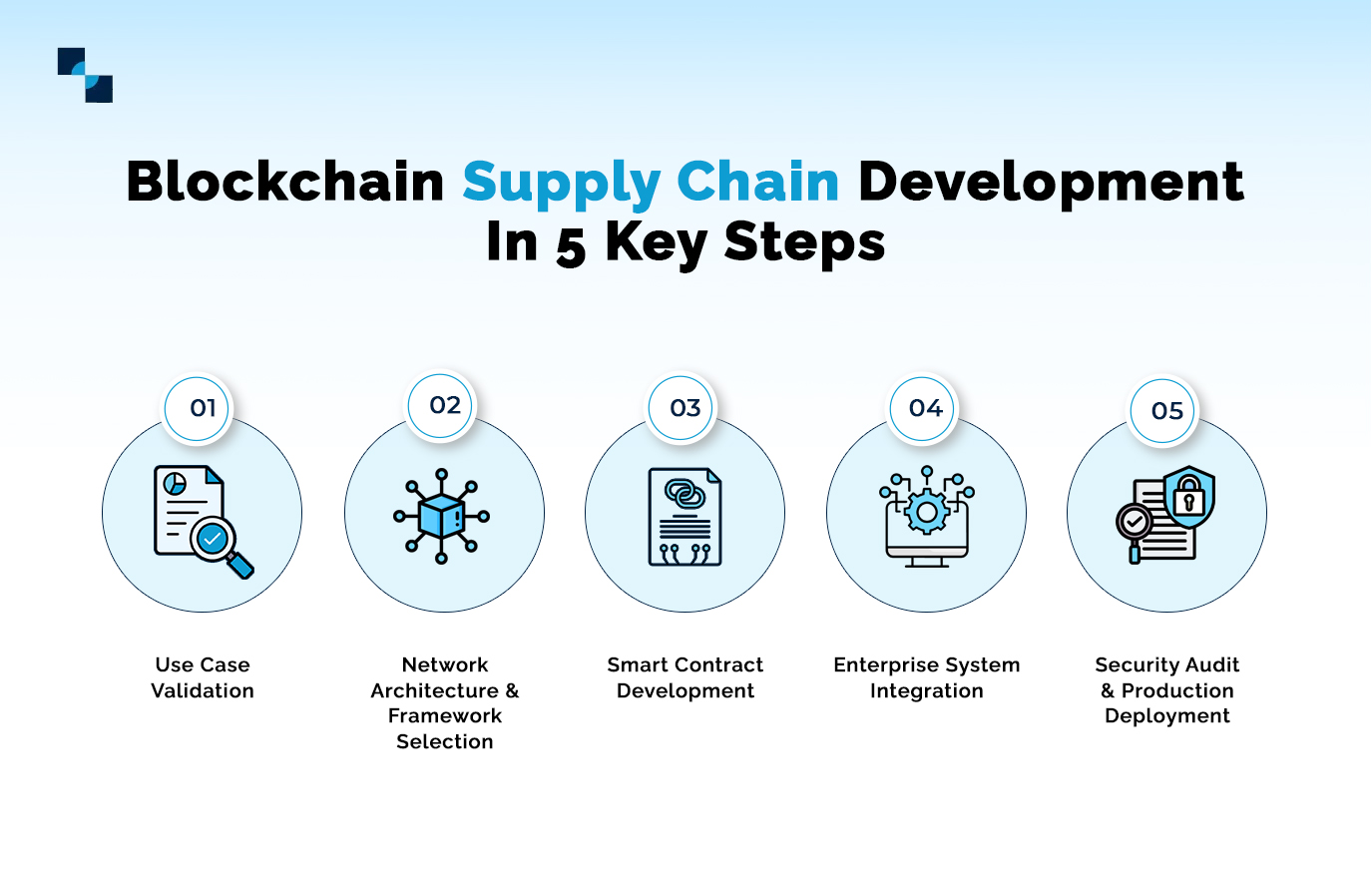
- Use case validation. The first question is never “which blockchain?” – it is “does this supply chain problem actually require blockchain?” The right use case has multiple parties, shared data, and a trust or reconciliation gap that existing systems cannot close. The right blockchain supply chain development partner asks this before recommending anything.
- Network architecture and framework selection. Hyperledger Fabric suits complex enterprise data networks and multi-tier supply chains. R3 Corda is built for financial market infrastructure and trade settlement. Quorum fits Ethereum-compatible deployments where smart contract compatibility matters. Network size, participant roles, data channels, and governance model are all defined here before any code is written.
- Smart contract development. Business logic payment triggers, compliance checks, quality thresholds, automated alerts gets encoded into self-executing smart contracts. Every edge case in your supply chain process needs explicit handling. This is where your operational reality becomes on-chain code.
- Enterprise system integration. The blockchain layer only delivers value when it connects cleanly to your existing ERP, WMS, and logistics platforms. Integration is the most consistently underestimated phase of blockchain supply chain development and the one most absent from early vendor proposals. Any partner that does not scope this work explicitly has not priced the actual engagement.
- Security audit and production deployment. Before any live traffic touches the network, independent security review of smart contracts and network configuration is non-negotiable. Then deployment across all consortium participants with monitoring, incident response procedures, and operational governance established from day one, not figured out after go-live.
How to Choose the Right Blockchain Supply Chain Development Company
Choosing the right blockchain development company is one of the most important decisions for your project’s success. Here are six factors to evaluate before making your choice:
- Proven Industry Experience
Choose a partner with experience delivering blockchain solutions for supply chain, logistics, manufacturing, or related industries. Real-world expertise helps reduce implementation risks and accelerate deployment.
- Successful Production Deployments
Look beyond case studies and ask for examples of blockchain networks that are running successfully in production. This demonstrates the company’s ability to build scalable and reliable enterprise solutions.
- Expertise in Enterprise Blockchain Platforms
Your development partner should have hands-on experience with platforms such as Hyperledger Fabric, R3 Corda, and Quorum, and recommend the right technology based on your business needs.
- Seamless Enterprise Integration
Ensure the company can integrate your blockchain solution with existing ERP, WMS, CRM, logistics, IoT, and other enterprise systems to create a connected digital ecosystem.
- Security and Compliance Focus
Choose a company that follows security best practices, performs smart contract audits, and builds solutions that support industry regulations and compliance requirements.
- Post-Launch Support and Scalability
Blockchain projects require ongoing maintenance, upgrades, monitoring, and support. Select a partner that offers long-term assistance to keep your network secure, scalable, and future-ready.
Build a Smarter, More Transparent Supply Chain with Blockchain.
Conclusion
Blockchain in supply chain has evolved from an emerging technology into a practical solution for businesses seeking greater transparency, efficiency, and trust across complex supply networks. By providing real-time visibility, immutable records, automated workflows, and seamless collaboration, it helps organizations reduce fraud, improve traceability, strengthen compliance, and streamline operations. As supply chains become increasingly global and regulations continue to evolve, adopting blockchain is becoming a strategic business advantage rather than a technology upgrade.
At Antier, we help businesses design, develop, and deploy secure, scalable, and future-ready blockchain supply chain solutions tailored to their needs. From consulting and architecture to smart contract development, enterprise integration, security audits, and ongoing support, our experts guide you through every stage of your blockchain journey. Connect with our experts to build a smarter, more transparent, and resilient supply chain.
Frequently Asked Questions
01. What challenges do businesses face in supply chain management?
Businesses struggle with fragmented data, limited visibility, and manual coordination across various participants, leading to delays, compliance issues, financial losses, and damaged customer trust.
02. How does blockchain technology improve supply chain management?
Blockchain creates a shared, tamper-proof ledger that allows all authorized participants to access real-time information, improving traceability, automating workflows, and enhancing collaboration across the supply chain.
03. What is the key difference between public and private blockchains in supply chain applications?
Most supply chain blockchain deployments operate on private, permissioned networks where participants are verified and data visibility is role-based, ensuring confidentiality and control, unlike public blockchains like Ethereum or Bitcoin.