




✨ AI Summary
- This blog post delves into the world of crypto neo bank development and its potential to rapidly capture financial flows.
- It explains how an API-first architecture enables seamless integration of services like custody, KYC, card issuance, and stablecoin rails, bypassing traditional banking systems which can take years to evolve.
- The post also provides detailed insights into what regulators in the US, UK, UAE, and Australia expect, and how to select a partner that won't require re-platforming shortly after launch.
- The blog post reveals that stablecoins processed $33 trillion in transaction volume during 2025, a significant increase from the prior year, highlighting the shift towards programmable money.
- Importantly, it clarifies what a crypto-friendly neo banking app is and the underlying architecture that supports it.
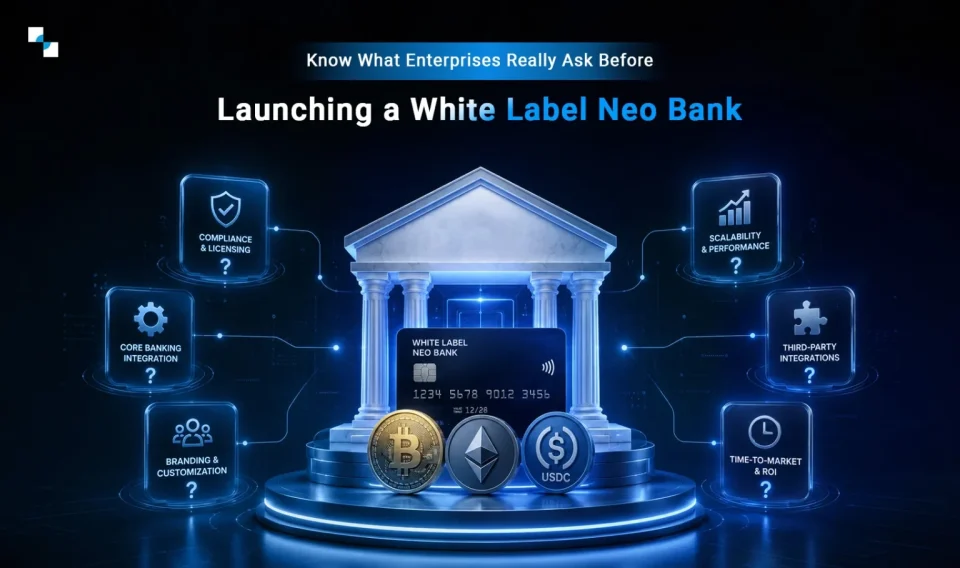
Banks, fintechs, and digital asset firms are watching this shift closely. For them, crypto neo bank development has become the fastest path to capturing that flow without waiting years for legacy vendors to catch up. An API-first architecture lets a founder plug in custody, KYC, card issuance, and stablecoin rails as modular services rather than commit to a five-year core banking rebuild. This guide sets out what an API-first build actually requires and which modules matter. It also covers what regulators in the US, UK, UAE, and Australia expect, and how to select a partner that will not leave a business re-platforming eighteen months after launch. Anyone comparing vendors, budgets, or licensing paths for a first crypto-linked account product should find a direct answer here rather than another marketing brochure.
Money moves through code now, and the settlement rails already prove it. Stablecoins processed 33 trillion dollars in transaction volume during 2025, a 72 percent jump from the year before (Bloomberg, 2026; Artemis Analytics, 2025). That volume did not route through legacy core banking systems. It moved through APIs, smart contracts, and wallet infrastructure engineered for programmable money, settling in seconds what correspondent banking once took days to clear.
What Is a Crypto-Friendly Neo Banking App?
A crypto-friendly neo banking app is a digital-first financial platform that lets a user hold, spend, and move both fiat currency and digital assets from one account. Crypto activity never routes through a separate exchange login. A traditional neobank often bolts on a crypto wallet as an afterthought. A genuinely crypto-friendly neo banking app instead treats stablecoins, tokenized deposits, and multi-currency wallets as core parts of the ledger from day one.
Architecture decides whether that promise holds up at scale. Three layers typically sit underneath a functioning platform:
- Ledger and settlement layer: reconciles fiat balances against on-chain stablecoin positions in real time
- Custody and key management: MPC-based wallet infrastructure that removes single-point-of-failure private key risk
- Compliance orchestration: KYC, transaction monitoring, and travel rule reporting wired into every transfer, not bolted on afterward
A modular crypto banking solution treats ledger, custody, and compliance as separate, API-connected services rather than one rigid stack. That design lets an operator swap a custody provider or add a jurisdiction’s compliance module without rebuilding the ledger. It is the real test of crypto-friendly banking solutions built for scale, rather than a single-jurisdiction pilot that stalls the moment a second market opens.
Infographic: The API-First Stack – Ledger & Settlement >> MPC Custody & Key Management >> Compliance Orchestration
API-First Build vs. White Label: What Changes
| Factor | Building the Stack In-House | Deploying a White Label Neo Banking Solution |
|---|---|---|
| Timeline to first live account | 12 to 18 months | 90 to 120 days |
| Custody engineering | Owned entirely by the internal team | Pre-audited MPC modules, configured not coded |
| Compliance ownership | Built and maintained from zero | Modules updated centrally as rules shift |
| Capital exposure before revenue | High, spread across build and licensing | Lower, concentrated in configuration and licensing fees |
| Best fit | Firms with existing core banking engineering teams | Fintechs, exchanges, and banks entering a new market fast |
The pattern holds across every region covered in this guide: teams that select a white label neo banking solution reach a licensed, live product roughly four times faster than teams that commit to a ground-up build, without giving up control over branding or customer experience.
Why Enterprises Are Building Crypto Neo Banking Apps Now
The push is no longer speculative. The global neobanking market crossed roughly 210 billion dollars in value in 2025 (Grand View Research, 2025; 360iResearch, 2025). The fastest-growing segment inside that figure is the crypto neo banking app category. These are platforms that let users hold stablecoins, receive payroll in USDC, or settle cross-border invoices in tokenized dollars without touching a centralized exchange.
Three forces are converging:
- Regulatory clarity: MiCA in the EU and the VARA Rulebook in Dubai give firms an actual license path instead of a gray zone
- Institutional stablecoin rails: JPMorgan’s JPMD deposit token and Citi Token Services show incumbent banks are already tokenizing deposits, raising the bar for anyone still running batch settlement
- Unified customer expectations: users want payroll, card spend, and stablecoin savings inside one balance sheet view, not four separate apps
Infographic: Why Crypto Neo Banking Is Scaling in 2026 – Regulatory Clarity (MiCA, VARA) >> Institutional Rails (Tokenized Deposits) >> Unified Customer Interface
For a builder, this shift changes the buy-versus-build calculus. Waiting for an in-house core banking rebuild while stablecoin volume compounds at double-digit rates carries a measurable opportunity cost, not just a caution worth noting on a roadmap slide.
Demand also looks different by region. US fintechs are racing to pair a crypto neo banking app with GENIUS Act-compliant stablecoin issuance before competitors lock in banking partners. UK challenger brands are adding tokenized dollar accounts to retain customers who would otherwise move balances to exchange-based wallets. UAE-based platforms are using VARA’s licensing clarity to position Dubai as a base for regional expansion across the Gulf. Australian fintechs are pairing ASIC-guided crypto products with existing AFSL licenses rather than filing for a new one from zero. The common thread: a crypto neo banking app now competes on licensing speed and module depth, not just on interface design.
Frequently Asked Questions About Crypto Neo Bank Platforms
Q1. How long does neo bank app development take when crypto rails are involved?
A regulated crypto neo bank platform built on white label infrastructure typically launches in 90 to 120 days. Core modules, ledger, custody, KYC, and card issuance are pre-built, so only configuration, branding, and licensing remain. Building the same stack from scratch, including in-house custody and compliance engineering, commonly runs 12 to 18 months before a single customer account goes live.
Explore the API-First Neo Banking Stack!
Q2. What is the difference between a white label neo banking solution and building in-house?
A white label neo banking solution provides pre-built, audited modules for ledger, custody, and compliance that an operator configures and brands, cutting time to market to a matter of weeks. Building in-house means owning every line of custody and compliance code, which raises audit scope, security liability, and licensing timelines, often past a year before regulators sign off on a live product.
Q3. Does a crypto neo bank platform need its own banking license?
Not always. Many operators launch under a partner bank’s license or an e-money authorization while pursuing a full banking license in parallel. That path lets a crypto neo bank platform go live for customers within months. A full standalone license, by contrast, can take twelve months or longer, depending on the region and the scope of activities the platform intends to offer.
Crypto Neo Bank App Development Company Checklist: Compliance Across Regions
| Region | Regulatory Anchor | What It Requires |
|---|---|---|
| United States | State money transmitter licensing plus the GENIUS Act stablecoin framework | Reserve-backed stablecoin issuance, dual federal and state review as final rules are issued |
| United Kingdom | FCA cryptoasset regime | Registration under the Money Laundering Regulations, consumer duty compliance |
| UAE | VARA Rulebook (Dubai) | Virtual asset service provider license, capital adequacy, marketing rule compliance |
| Australia | ASIC digital asset guidance | Australian Financial Services Licence for platforms offering crypto-linked financial products |
Any crypto neo bank app development company worth evaluating should produce a live license map, not a slide deck promise. Confirm registration status directly against the VARA Rulebook, the MiCA text, or the FCA register rather than taking a vendor’s claim at face value. Regulatory diligence up front is what keeps crypto neo bank development on schedule instead of stalled in a licensing review for two extra quarters.
What to Look for in a Crypto Banking Build Partner
Selecting a build partner determines whether launch happens in one quarter or three. Evaluate candidates against these criteria before signing a statement of work:
- Multi-region license support across at least two of the four major regimes covered above (US, UK, UAE, Australia), evidenced by named client deployments rather than a general claim of coverage
- MPC custody, not single-key wallets, for institutional-grade key management and reduced insider risk, with third-party security audit reports available on request
- Modular API architecture so ledger, card issuance, and compliance modules can be swapped independently as rules change, instead of a monolithic build that requires a full re-deployment for every update
- Reference deployments live in production, not only pilot sandboxes or demo environments, with uptime and transaction volume a prospective client can verify directly
- Transparent post-launch support SLAs covering compliance updates as regulatory frameworks shift, including a documented response time for license or rulebook changes
A partner that satisfies all five earns a shortlist spot. A partner that dodges the license map or reference-check question turns a 90-day roadmap into a 300-day one. That delay compounds quickly in a market where stablecoin volume and neobanking adoption are both climbing month over month.
Where Web3 Neo Banking Is Headed Next
Stablecoin settlement volume, institutional tokenized deposits, and regional licensing clarity are converging into a single signal: web3 neo banking is moving from pilot to production faster than most roadmaps accounted for.
Antier delivers the API-first infrastructure behind that shift: ledger, MPC custody, compliance orchestration, and card issuance in one modular stack. Banks, fintechs, and digital asset firms use it to launch a compliant crypto neo bank platform in months rather than years. See the module stack in the White Label Neo Bank Development overview.