




✨ AI Summary
The CryptoCurrency Security Standard (CCSS), published by the CryptoCurrency Certification Consortium (C4), is the industry's de facto security standard for crypto exchanges and custodians. It rates systems at Level I, II or III across ten aspects of key management and operations. Binance's recovery shows why the operational aspects matter as much as key storage: halting withdrawals, refilling hot wallets, covering losses and publishing proof of reserves all need to be designed before launch.
If you are a bank or broker scoping cryptocurrency exchange software, the Binance hack of 29 October 2026 has probably already come up in a risk committee. Antier’s earlier post on how to build a hack-resistant crypto wallet, already covers how the attack worked and how a similar one can be prevented.
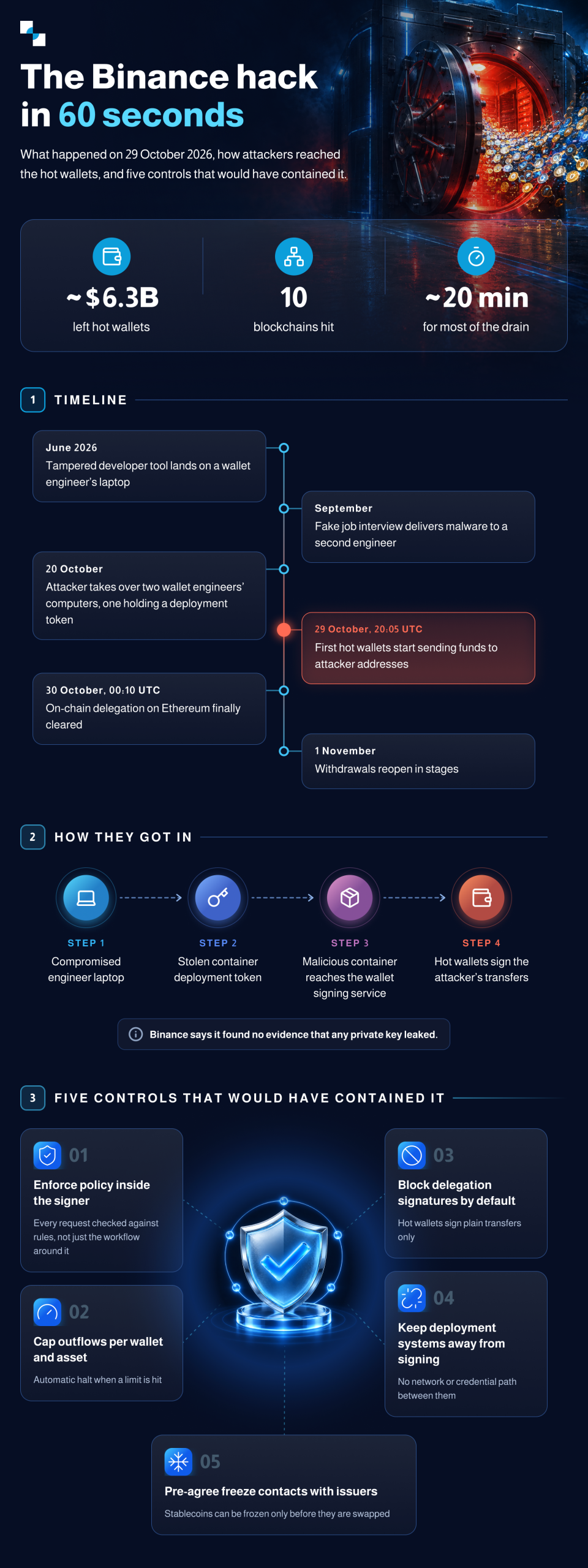
This infographic below also briefs the Binance 2026 attack:
This article covers the part of Binance hack discussion that matters once you are a cryptocurrency exchange operator, including:
- Cryptocurrency exchange security standard to build against
- How much to keep in hot wallets
- What to decide before launch about halting, and reopening
- What a credible Proof-of-reserves looks like after an incident
The blog ends with eight questions for rating any cryptocurrency exchange development company.
What Is the Cryptocurrency Security Standard (CCSS)?
CCSS is a free, universal security rulebook designed for any technology that handles crypto in any sense including, storing, transacting, or accepting. Cryptocurrency exchange software solutions are explicitly required to follow its guidelines to prove their systems are safe. It is maintained by C4 and currently published as version 9.0. It doesn’t replace general information-security frameworks but covers the crypto-specific layer on top of them.
The standard groups ten aspects into two domains.
Six cover key and wallet management:
- Key and seed generation
- Wallet creation
- Key storage
- Key material access
- Key usage
- Key compromise
Four cover assurance and operations:
- Security audits
- Data sanitization
- Proof of reserve
- Audit logs
Each aspect is scored at one of three levels:
- Level I: This represents that most risks are addressed, with controls independently tested and found to be operating effectively.
- Level II: This represents enhanced security controls, such as multi-signature authorization, ensuring that the loss or compromise of one key or person doesn’t halt or expose the system.
- Level III: This represents maximum security enforcement across every layer, with multiple actors required for critical actions and assets distributed geographically and organizationally.
A cryptocurrency exchange software’s or any crypto processing system’s overall rating is its lowest aspect score, so one weak area caps the whole rating.
Which CCSS Level Should a Regulated Exchange Target?
For a bank or regulated broker, CCSS Level III is the appropriate target for cold storage infrastructure and governance policies around it. It should be paired with at least level II for hot wallet operations and automated signing environments. While regulatory compliance often treats certification as a periodic audit exercise, several Level II and Level III controls map directly onto the operational failures exposed during the Binance 2026 Breach.
1. Key usage (Aspect 1.05): Level II requires multi-party authorization for high-value transactions alongside strict destination address whitelisting. During the Binance breach, hot wallets signed unauthorized transfers directly to attacker addresses and executed an EIP-7702 delegation to a malicious sweeper contract.
For a regulated cryptocurrency exchange software or financial institution, enforcing the following cryptographic policy rules prevents a compromised signing service from draining funds:
- Blocking unapproved contract delegations
- Restricting outbound transfers exclusively to pre-vetted internal or institutional addresses
2. Key Material Access (Aspect 1.04): This control governs the structured granting reviewing, and immediate revocation of keyholder and service access. Binance noted post-incident that its Multi-Party Computation (MPC) architecture lacked a single master credential it could revoke instantaneously, forcing engineers to build a custom revocation procedure mid-crisis.
Banks and brokers must design key-share architectures with pre-built “kill switches” and automated shard rotation so compromised signing nodes can be isolated in seconds without halting the entire platform.
3. Key Compromise Protocol (Aspect 1.06): CCSS requires a documented incident response plan specifically tailored to compromised keys or signing paths. At higher levels, it even expects teams at cryptocurrency exchange software and regulated financial institutions to rehearse those procedures before an attack occurs.
Improvising key-rotation workflows while attackers are actively draining hot wallets costs critical minutes. So, regulated exchanges must run regular tabletop and live-fire key compromise drills, ensuring engineering, compliance, and executive teams know exact escalation paths and freeze authority.
4. Audit logs (Aspect 2.04): CCSS Level II and III standards call for tamper-evident audit trails paired with real-time alerting and on-chain event monitoring. In the Binance 2026 security breach, rapid detection and circuit-breaking made the difference between a contained hot-wallet loss and a catastrophic reserve drain.
An institutional exchange setup must correlate internal signing logs with live mempool and blockchain telemetry. This prevents anomalous transaction patterns, such as unexpected contract approvals, or rapid sequential outflows, triggering an automated signing halt within minutes.
Evaluating Crypto Exchange Infrastructure Vendors? See our CCSS-aligned custody and recovery stack in action.
Crypto Custody for Banks: Hot, Warm and Cold Wallets, and How Much to Keep in Each
A custody design for a cryptocurrency exchange software usually has three tiers.
- Hot wallets are online, and sign withdrawal requests automatically.
- Warm wallets are online but sit behind extra approvals, and refill the hot tier.
- Cold storage keeps keys offline and holds the bulk of client assets.
How much goes in each tier depends on where you are licensed:
| Jurisdiction | Cold storage rule |
|---|---|
| Hong Kong (SFC) | At least 98% of client virtual assets in cold storage |
| Japan | 95% of customer funds in cold wallets |
| Dubai (VARA) | Risk-based choice of storage, with documented and independently audited movements between hot, warm and cold wallets |
| EU (MiCA) | Custody policy that reduces the risk of loss from fraud, cyber threats or negligence. VASPs are liable for losses from incidents attributable to it. |
Where the regulators set no number, cryptocurrency exchanges must size the hot tier to real withdrawal demand plus a buffer.
Binance’s reopening provides a clear benchmark for post-crisis withdrawal demand. When withdrawals resumed on 1 November, it reported $4.65 billion withdrawn against $1.01 billion deposited, which meant a net outflow of $3.64 billion in about nine and a half hours. It was roughly 2.1% of the $171 billion in its 28 October proof of reserves.
Two crypto exchange custody design points should be considered for a post-incident recovery:
- First, the hot custody tier needs enough headroom for a post-incident run, or withdrawals stall and the run gets worse.
- Second, moving funds from warm or cold storage to refill the hot wallet must follow a separate, pre-approved workflow, so the team is not rushing or improvising high-security key approvals mid-crisis.
Crypto Exchange Crisis Management: How to Halt, Reopen, and Absorb Losses Post Security Breach
- Halting : Decide What A Halt Actually Stops
Binance halted trading and suspended withdrawals after the attack. Its incident report says the halt did not cancel the EIP-7702 delegation the attacker had already set up on Ethereum, because that permission lived on-chain, outside the withdrawal system. The delegation was cleared at 00:10 UTC on 30 October, about four hours after the first transfer.
Before launch, cryptocurrency exchange software should document, per chain and per wallet type, exactly what its halt switch disables and what still requires a separate on-chain revocation step. Pairing that map with pre-tested revocation runbooks ensures engineers can neutralize active smart-contract permissions in minutes rather than hours.
- Reopening : Plan The Order Before you Need It
Binance reopened in stages, starting with Ethereum, USDT, USDC, and some tokens on its own chain on 1 November. A staged plan lets a cryptocurrency exchange software restore its most liquid assets first, with refills pre-staged, rather than reopening everything into a run.
- Covering Losses : SAFU is Smaller Than People Think
Binance’s Secure Asset Fund For Users (SAFU) was created in 2018 as an emergency reserve. In February 2026 Binance finished converting it to 15,000 BTC, worth about $1B at the time, and committed to top it back up to $1B if it falls below $800M.
That was not enough on its own. To cover losses of about $6.3B, Binance also drew on its future insurance fund, a bitcoin reserve, and corporate treasury, and said it had replenished 98% of affected tokens by 31 October. Most exchanges don’t have that balance sheet.
Cryptocurrency exchanges must therefore size their reserve or insurance cover against realistic hot-wallet exposure, and decide in advance who can authorize its use.
Proof of Reserves Audit: What a Credible Attestation Looks Like After an Incident
Proof of reserves (PoR) shows that an exchange holds enough assets to cover customer balances. Most exchanges publish it using a Merkle tree, which lets each customer confirm their balance is included without exposing anyone else’s. Antier’s guide to implementing Merkle tree proof of reserves in crypto exchange software covers the mechanics.
PoR has known limits. A snapshot shows one moment in time, and liabilities are often not verified. That is why the difference between a self-published proof and independent attestation matters. CCSS addresses it by labelling the differences in the following ways:
- Internal reserve verification and reconciliation is considered as a Level I control
- Independent third-party reserve attestation is considered as the Level II CCSS.
Post a security breach, regulators and customers ask these two usual questions:
Are reserves still at least equal to liabilities, and who checked?
Binance had published a proof of reserves on 28 October, the day before the hack, which gave it a baseline to measure the recovery against. Any cryptocurrency exchange software planning for the worst should be able to produce an attested proof within days of an incident, and not wait for the next scheduled cycle.
Crypto Exchange Security Rating: 8 Questions to Score Any Build Partner
Use these questions with any crypto exchange infrastructure vendors, including Antier. Each maps to a CCSS aspect, so a risk committee can score answers against a recognized standard rather than a vendor’s own claims. This list also helps businesses analyze the security of white label crypto exchanges.
| Question | CCSS aspect | Strong answer | Red flag |
|---|---|---|---|
| Where is the withdrawal policy enforced? | Key usage | Inside the signer, on every request | Only in the API or workflow layer |
| Are high-value transfers multi-party approved? | Key usage | Quorum of approvers outside engineering | Single approver or automated only |
| Are destination addresses whitelisted? | Key usage | Allowlists enforced at signing | Any valid address accepted |
| How is signer access granted and revoked? | Key material access | Documented, rehearsed per wallet type | Not tested |
| What is the key compromise protocol? | Key compromise protocol | Written runbook with drills | Handled ad hoc |
| What is in cold storage, and how is it refilled? | Key storage | Target ratio per jurisdiction, separate refill process | Manual top-ups by operations staff |
| How is signing activity monitored? | Audit logs | Tamper-evident logs, real-time alerts, auto-halt | Logs reviewed after the fact |
| How is proof of reserves produced? | Proof of reserve | Independent attestation on a fixed schedule and after incidents | Self-published on request |
Takeaway
The Binance hack showed how attackers got in and its recovery is a lesson for exchange operators and builders, specifying what they need on day one:
- A security standard to build against
- Hot wallets sized for a run and anything beyond
- A halt switch whose limits are known
- A reopening order
- A loss reserve that matches real exposure
- A proof of reserves that can be independently attested within days
CCSS, being a common cryptocurrency security standard, gives banks and brokers a common way to measure the security of crypto exchange infrastructure they’re building.
Schedule a crypto exchange security architecture review with Antier’s exchange team to see how your planned custody setup scores against CCSS and the eight questions above.