


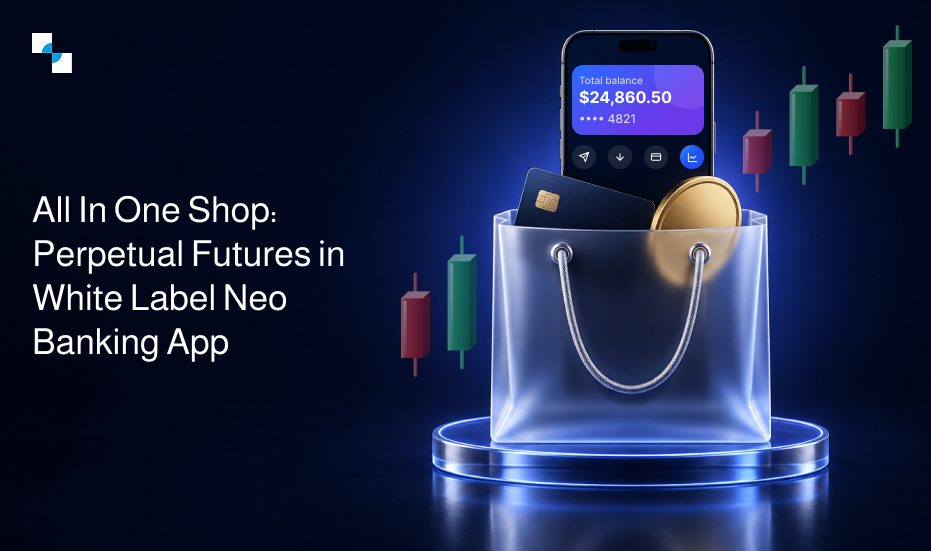

A white label neo bank with perpetual futures trading puts everyday banking and leveraged crypto trading inside one app, behind one login, powered by seamless one-tap collateral sweeps from a unified app interface. A customer receives a salary in fiat, parks savings in stablecoins, pays for dinner with a card, and opens a long BTC position from the same screen. For the business that owns the app, deposits stay in-house, trading fees stay in-house, and so does the customer relationship.
The timing tells its own story. In May 2026, the CFTC approved Kalshi to list a domestic Bitcoin perpetual (BTCPERP) and issued staff no-action relief (Letter No. 26-17) enabling Coinbase Financial Markets to offer marginated Deribit perpetuals to US customers via Coinbase Bermuda Limited (CoinDesk, 2026). Four months later, Robinhood announced in-app perpetual futures for eligible US users through Robinhood Derivatives, offering up to 10x leverage on BTC and ETH backed by Bitstamp’s liquidity infrastructure (The Block, 2026). By November 2026, Coinbase, Kalshi, and Kraken were actively backing the CFTC in federal court over single-stock perpetuals, signaling that perpetual contracts are expanding from crypto into mainstream equities despite ongoing jurisdictional battles. Companies that already hold the primary banking relationship are best placed to capture this shift.
This guide is for the people signing off on that decision: banks, exchanges, PSPs, fintech founders, and the investors backing them. It covers what buyers weigh, how the stack fits together, the build sequence, and how to choose a partner.
Why the White Label Neo Bank App with Perpetual Futures Has Board Attention
Two markets that grew up separately are now converging. The global neobanking market was valued between $97 billion (GMI, 2026) and $210.7 billion (Straits Research, 2026) in 2025, depending on how analysts define the category. On the trading side, perpetual DEX volume hit a monthly record of $1.36 trillion in October 2025 and closed the year near $7.9 trillion (Cointelegraph, 2026).
Volumes cooled in early 2026, with March at $699 billion (Cointelegraph, 2026), and that matters for planning. Trading moves in cycles. Banking runs every day. A product that pairs the two earns from card spending, FX and deposits in quiet months, and from trading fees and funding spreads when markets heat up. That revenue mix is why the model keeps showing up in board decks and investor memos.
There is also a behavior problem the unified app fixes. A typical crypto-active customer keeps their salary in one bank app, sends money to an exchange, trades, and then withdraws it back. Every transfer is a moment where that customer can drift to a competitor. When the banking account, the card, and the perps engine connect through instant internal collateral sweeps, the money stays inside your ecosystem, and so does the user.
The Buyer Psychology Behind the Decision
Behind every RFP for this kind of platform sits a buying committee, and each member is answering a different question:
- The CEO or founder wants a growth story: higher revenue per user and a product competitors cannot copy in a quarter.
- The CFO wants a payback period, a clear cost of building, and a view of which revenue lines arrive first.
- The compliance head wants to know where leverage is capped, how retail users are screened, and who holds custody of client assets.
- The CTO wants clean APIs, a ledger that reconciles every night, and an exit path if the vendor relationship ends.
Deals stall on three predictable fears: a regulator’s letter, a liquidation cascade during a volatile weekend, and an eighteen-month build that eats the runway. Answer those three up front, and the conversation moves from whether to launch to how fast.
How Perpetual Futures Trading Works Inside a Crypto Neo Banking Solution
A perpetual future tracks the price of an asset with no expiry date. A funding payment, exchanged between longs and shorts at set intervals, keeps the contract price close to the spot index. Traders post margin, choose leverage, and hold the position as long as their margin covers it.
Inside a neo-banking solution, the difference is where that margin comes from. Here is a typical flow:
- A user’s salary lands in their fiat account, and part of it converts to USDC in one tap.
- They open a 3x long on ETH, and the margin engine locks the required collateral from the same balance.
- The risk engine marks the position against a multi-source index price, and funding settles into the account automatically.
- They close with a profit, and the gains are spendable on their card right away.
Users choose isolated margin, where each position carries its own collateral, or cross margin, where the whole balance backs open positions. Retail users usually default to isolated margin with low leverage. Professional traders get cross and portfolio margin. If margin falls below the maintenance level, the liquidation engine closes the position, an insurance fund absorbs any shortfall, and auto-deleveraging acts as the last safeguard.
Launch Your Perps-Ready Neo Bank Solution!
The Full Perps Stack: Layer by Layer
Selling or buying the entire stack means every layer below shares one ledger and one risk view. These are the components that make it work:
- Matching engine: order book, market, limit, stop, and take-profit orders, with latency suited to active traders.
- Liquidity layer: market maker onboarding, plus hedging and routing to external venues so books stay deep from launch day.
- Pricing and oracles: index price from several spot venues, mark price logic, and protection against single-source manipulation.
- Risk and margin engine: pre-trade checks, real-time margin, isolated, cross, and portfolio margin, and leverage caps by user tier and region.
- Liquidation stack: tiered liquidation, insurance fund management, and auto-deleveraging rules.
- Unified collateral wallet: one unified view across fiat, stablecoins, and crypto, secured by MPC wallet infrastructure with client assets segregated.
- Banking layer: accounts, virtual IBANs, ACH, SEPA, and Faster Payments through a BaaS partner network, plus crypto-linked card issuing.
- Compliance and surveillance: KYC and KYB, AML monitoring, Travel Rule messaging, appropriateness tests, and trade surveillance for spoofing and wash trading.
- Back office: treasury, real-time exposure dashboards, PnL by product, fee configuration, and regulatory reporting.
3 Integration Paths for White Label Crypto Neo Banking With Perps
Buyers come from different starting points, so we sell the stack in three shapes.
Perps Module Into an Existing Banking App
For banks and neobanks that already run accounts and cards. The perps engine connects through APIs and an embeddable trading UI, reusing your KYC, login, and ledger. Collateral moves between the banking balance and the margin account through internal transfers, and every trade posts back to your core. Teams already running a crypto banking solution usually go live fastest on this path.
Banking Layer Onto an Existing Exchange
For exchanges with a Perps book that want daily usage. Accounts, IBANs, cards, and payroll deposits plug into the trading engine, so traders can fund margin with their salary and spend profits directly. The exchange becomes the app users open every morning, not only during volatile weeks.
The Full Stack Under Your Brand
For PSPs, Web2 fintechs, consumer brands, and investors starting fresh. Banking, custody, cards, the perps engine, liquidity, compliance, and back office arrive as one branded product with one vendor, one ledger, and one support line. This is the cleanest route for a Web2 company moving into digital assets, because licensed partners cover the regulated pieces, and nothing needs reconciling across separate providers.
Who Buys a White Label BaaS Solution With Perpetual Futures Built In
Each buyer group has a different reason to add perps:
- Banks and licensed financial institutions want to stop deposits flowing to offshore exchanges and keep leveraged trading under their own control.
- Crypto exchanges want sticky banking balances that reduce dependence on trading volume alone.
- PSPs want trading fees and float income from merchants and users they already onboard.
- Web2 fintechs, brokerages, and crypto super apps want a crypto trading product their customers already ask for, launched under a brand those customers trust.
- Investors want a business with several income lines, with perps fees and funding as the highest-margin line.
The end users split two ways as well. Retail traders want a simple ticket, low default leverage, clear liquidation prices, and plain-language warnings. Institutional and professional traders want REST, WebSocket, and FIX APIs, sub-accounts, portfolio margin, higher limits, and exportable reports. One core serves both through tiered permissions.
Launching a Customized Banking Solution With Perps in Six Phases
- Set jurisdiction and product scope. The US has a CFTC route for perps (CoinDesk, 2026), the EU treats crypto derivatives under MiFID II while MiCA covers spot services, and the UAE regulates under VARA. Your markets decide your contracts, maximum leverage, and who can trade.
- Secure liquidity. Sign market makers, configure hedging to external venues, and set spread targets before the first user arrives.
- Configure risk. Define margin tiers, maintenance levels, funding intervals, position limits, and insurance fund sizing per market.
- Connect the ledgers. Link margin accounts to banking balances so collateral, PnL and fees post in real time with zero manual reconciliation.
- Stress test. Replay historic crash days, simulate liquidation cascades and oracle failures, and run penetration tests on custody and trading flows.
- Launch in cohorts. Start with major pairs and capped leverage, then add assets, raise limits, and open institutional APIs as the data supports it.
This sequence puts the budget into the parts that protect a white label neo bank under stress, which is exactly what regulators, boards, and users test first.
Essential Things to Know Before Adding Perps to a Crypto Neo Banking Solution
Q1. Can a neobank legally offer perpetual futures to retail users?
Yes, through the right licensed entity in each market. In the US, perps now run on CFTC-regulated venues, with Kalshi and Coinbase among the first approved in May 2026 (CoinDesk, 2026). Other regions set their own leverage caps and appropriateness rules, so most neobanks route perps through a licensed derivatives partner per market.
Q2. Where does liquidity come from on day one?
From market makers onboarded before launch and from hedging or routing orders to established external venues. Robinhood’s US perps, for example, run with liquidity support from Bitstamp (The Block, 2026). As in-house volume grows, more flow can be matched internally.
What to Look for in a White Label Neo Bank Solution Provider for Perps
- A perps engine already live in production, with references you can call.
- Liquidation, insurance fund, and auto-deleveraging logic tested through real volatility.
- Existing market maker and venue connections for launch-day depth.
- Multi-source oracle pricing with manipulation safeguards.
- One shared ledger across banking, custody, and trading.
- MPC custody, independent audits, and client-asset segregation.
- Built-in KYC, AML, Travel Rule, appropriateness tests, and trade surveillance.
- Source code options, defined SLAs, and support for entering new markets.
Your Next Step Toward a White Label Neo Bank App With Perps Built In
You now know where perps fit in a banking product, what the full stack includes, and which integration path matches your starting point: a perps module for your bank, a banking layer for your exchange, or the complete stack under your brand. The open questions are which markets you launch in, how much leverage you offer, and how fast you want the first trade.
That is what a scoping session settles. Antier has spent years building trading engines, neo banking, custody, and compliance systems for enterprises across the US, UK, UAE, and beyond, and our team stays with you from architecture through launch and every market after. Talk to our neo bank and perps development experts and leave with a launch plan built around your business.
Frequently Asked Questions
01. What is a white label neo bank with perpetual futures trading?
A white label neo bank with perpetual futures trading is a financial app that combines everyday banking services and leveraged crypto trading into one platform, allowing users to manage their finances and trade cryptocurrencies seamlessly.
02. How does the integration of banking and trading benefit users?
Users benefit from the integration by being able to receive salaries in fiat, save in stablecoins, make purchases, and trade cryptocurrencies all from a single app interface, enhancing convenience and efficiency.
03. Why is the convergence of neobanking and perpetual futures trading significant for businesses?
This convergence is significant because it allows businesses to capture revenue from both banking and trading activities, providing a diversified income stream that can be advantageous during varying market conditions.