




✨ AI Summary
- Private equity is increasingly leveraging blockchain technology to simplify ownership administration, investor onboarding, compliance, and asset lifecycle management.
- This blog post explores the concept of private equity tokenization, which allows eligible private equity interests to be digitized.
- Tokenization can ease management, verification, and auditing processes, as well as ensure compliance with investor eligibility requirements and jurisdictional restrictions.
- However, the implementation of tokenization involves numerous considerations such as legal structure, smart contracts, investor experience, and integration with existing financial systems.
- The post also discusses the infrastructure required for private equity tokenization, its potential secondary market efficiency, as well as the leading providers of such services.
Private equity is increasingly exploring blockchain infrastructure to simplify ownership administration, investor onboarding, compliance, and asset lifecycle management. Private equity tokenization services enable eligible private equity interests to be represented as digital assets while supporting programmable transfer rules, investor verification, ownership management, and reporting. However, successful tokenization requires much more than issuing a token. Legal structure, compliance, custody, smart contracts, investor experience, and integration with existing financial systems all influence the viability of the implementation.
This guide examines why private equity is moving toward tokenization, the infrastructure required, leading providers, the platform stack, key selection criteria, and the risks organizations should consider before implementation.
Why Private Equity Is Moving Toward Tokenization
Private equity has traditionally depended on controlled investment structures and highly structured administrative processes. Investor qualification, subscription documentation, ownership records, capital movements, distributions, and transfers often involve multiple stakeholders and technology systems.
For fund managers and asset owners, this can create operational complexity. Information may need to move between administrators, legal teams, compliance systems, investor portals, accounting platforms, and custody providers. This is where leading private equity tokenization companies are increasingly focused on building infrastructure that connects these fragmented processes through a unified digital framework.
Tokenization introduces an opportunity to connect several of these processes through programmable digital infrastructure. The objective is not to replace established private equity practices. Instead, tokenization can provide a digital layer that makes specific activities easier to manage, verify, automate, and audit.
Digitized ownership management
One of the fundamental applications of tokenization is the digital representation of an eligible investment interest. Instead of relying entirely on disconnected ownership records, a blockchain-based system can maintain a transparent transaction history for authorized participants.
The token can be connected to the legal documentation governing the investment, creating a relationship between the digital asset and the underlying legal rights.
This architecture can support:
- Digital ownership records
- Transfer history
- Investor balances
- Permission management
- Ownership reconciliation
- Automated transaction records
For organizations considering a private equity tokenization service provider, ownership management should therefore be evaluated alongside token issuance capabilities.
Programmable compliance
Compliance is another important reason for exploring tokenization. Private equity investments can be subject to investor eligibility requirements, KYC and AML obligations, jurisdictional restrictions, accreditation requirements, and transfer limitations.
A tokenization platform can incorporate these conditions into the transaction workflow. For example, a token transfer can be restricted if the receiving wallet has not completed the required verification process or does not meet the applicable eligibility criteria.
This creates a more systematic relationship between investor identity and asset ownership. Importantly, programmable compliance does not eliminate regulatory obligations. It provides technology for enforcing predefined rules.
More efficient investor onboarding
Investor onboarding can involve several steps, including identity verification, eligibility checks, documentation, subscription agreements, payment processing, and wallet creation.
A digital tokenization environment can connect these activities within a unified investor journey. Private equity tokenization providers can integrate identity, compliance, subscription, and wallet workflows to reduce unnecessary handoffs between systems and provide administrators with a clearer view of investor status.
A well-designed platform can also give investors access to relevant documents, holdings, transaction records, and distribution information through a single interface.
Streamlined asset administration
Private equity investments require ongoing administration after issuance.
This can include:
- Capital calls
- Distributions
- Redemptions
- Ownership changes
- Corporate actions
- Investor communications
- Reporting
- Transfer approvals
Tokenized infrastructure can automate selected activities through smart contracts and integrated workflows. The result is not complete automation of fund administration. Rather, it creates programmable infrastructure around processes that can be standardized.
Did You Know?
Tokenization does not automatically change the legal nature of an underlying private equity investment. The rights represented by the token continue to depend on the legal structure, contractual documentation, regulatory framework, and jurisdiction governing the investment.
Potential secondary market efficiency
Private equity remains fundamentally different from highly liquid public markets. Tokenization cannot guarantee buyers, sellers, or continuous liquidity. However, it can create infrastructure for digitally transferring eligible interests when regulatory and contractual conditions permit. Transfer rules can be incorporated into the asset infrastructure, helping ensure that only eligible investors can participate.
This creates an important distinction between technical transferability and actual market liquidity. For private equity organizations, tokenization is therefore better understood as an infrastructure modernization initiative rather than a guaranteed liquidity mechanism.
Build a secure and scalable private equity tokenization platform with Antier
What Infrastructure Does Private Equity Tokenization Require?
A private equity tokenization initiative requires multiple interconnected technology and operational layers. The token itself is only one component. Behind it sits the legal framework, compliance infrastructure, investor identity layer, smart contract system, custody environment, ownership management, reporting, and integration architecture. Organizations should assess these components together before selecting a technology model.
Legal and regulatory infrastructure
The first consideration is determining exactly what the token represents. Depending on the structure, it may represent an ownership interest, fund interest, security, contractual right, or another legally defined economic interest.
The relationship between the digital token and the underlying legal interest should be established before the technology architecture is finalized. Leading private equity tokenization companies typically address this layer by aligning token design with the applicable legal structure, investor rights, and jurisdictional requirements.
Key considerations include:
- Investor rights
- Transfer restrictions
- Redemption conditions
- Distribution rights
- Governance rights where applicable
- Jurisdictional requirements
- Legal ownership records
This ensures the technology supports the investment structure rather than operating independently from it.
Investor identity and compliance
Investor verification is central to a compliant tokenization environment.
The platform may need to integrate:
- KYC verification
- AML screening
- Accreditation checks
- Sanctions screening
- Jurisdiction screening
- Investor classification
- Wallet whitelisting
- Transfer eligibility
The verified investor identity can then be associated with the relevant wallet or account permissions.
This creates a controlled connection between off chain identity and on chain asset activity.
Token issuance infrastructure
The issuance layer creates the digital representation of the underlying interest.
A properly designed token framework can define:
- Token supply
- Ownership rules
- Transfer permissions
- Investor restrictions
- Distribution mechanisms
- Redemption rules
- Corporate actions
- Administrative permissions
Token design should reflect the characteristics of the underlying private equity structure rather than rely on a generic blockchain asset model.
Smart contracts
Smart contracts provide the programmable logic behind tokenized assets.
They can support predefined functions such as issuance, transfers, permission checks, distributions, redemptions, and other lifecycle activities.
Because these contracts can become part of financial infrastructure, security is essential.
A robust implementation should include:
- Secure development practices
- Automated testing
- Independent security review
- Smart contract auditing
- Role based permissions
- Monitoring
- Upgrade mechanisms
- Governance procedures
Organizations evaluating private equity tokenization companies should examine the security and governance model behind their smart contract architecture rather than focusing solely on token functionality.
Ownership and cap table management
Tokenization does not remove the need for accurate ownership administration.
A platform should provide a reliable mechanism for tracking:
- Current holders
- Ownership percentages
- Token balances
- Historical transfers
- Investor status
- Subscription activity
- Distribution eligibility
The system should also maintain an appropriate relationship between blockchain records and the legal records governing the investment.
Custody and wallet infrastructure
Institutional tokenization requires secure methods for holding and transferring digital assets.
Depending on the operating model, the infrastructure may incorporate:
- Institutional custody
- Custodial wallets
- Non-custodial wallets
- Multi signature controls
- Key management
- Transaction approval
- Role based permissions
- Recovery mechanisms
The objective should be to integrate digital asset custody into existing institutional security practices.
Distribution and payment infrastructure
Private equity investments can involve recurring financial events. The platform should be capable of connecting eligible token holders with distribution processes and maintaining an auditable record of relevant transactions. Payment infrastructure may remain off chain while blockchain systems maintain the associated ownership and eligibility information.
Reporting and analytics
Institutional users require more than a blockchain transaction history. Reporting should combine relevant blockchain activity with information from investor management, fund administration, compliance, and accounting systems.
This can provide a consolidated view of:
- Investor holdings
- Transactions
- Distributions
- Ownership changes
- Compliance status
- Asset activity
For organizations exploring private equity tokenization solutions for institutional investors, this integration between blockchain infrastructure and conventional financial operations is particularly important.
Leading Private Equity Tokenization Companies
The private equity tokenization market includes several provider models, ranging from standardized platforms to customized technology development partners. Some organizations require an existing tokenization environment that can be configured for their needs. Others require a more customized architecture that can integrate with established fund administration, custody, compliance, and investor management systems. The five companies below represent different approaches to tokenization infrastructure and should be assessed according to the specific requirements of each private equity use case.
1. Antier
Antier approaches tokenization primarily from a blockchain development and enterprise infrastructure perspective. Its capabilities can be applied across private equity tokenization architecture, smart contract development, blockchain integration, investor applications, digital asset infrastructure, compliance integrations, wallet connectivity, and lifecycle management. The customized development model can be relevant for organizations that require greater control over the underlying technology architecture.
Potential capabilities include:
- Private equity tokenization architecture
- Smart contract development
- Permissioned token infrastructure
- Investor portals
- KYC and AML integrations
- Digital wallet connectivity
- Ownership management
- Distribution workflows
- API based integrations
- Secondary market connectivity
The broader objective is to create infrastructure that can adapt to specific asset structures, investor models, and operational requirements.
2. Securitize
Securitize provides digital securities infrastructure designed around the issuance and management of tokenized financial assets. Its technology environment covers areas such as digital securities issuance, investor onboarding, compliance, asset management, and digital transfer infrastructure.
For private market applications, the platform approach provides an example of how regulated investment structures can be connected with blockchain-based asset infrastructure. Organizations assessing the platform can consider its capabilities across issuance, compliance, investor management, and lifecycle administration.
3. Tokeny
Tokeny focuses on infrastructure for compliant tokenized assets and digital securities. Its technology addresses areas including token issuance, investor identity, compliance, transfer restrictions, and asset lifecycle management.
For private equity use cases, these capabilities can support a controlled digital environment where investor permissions and transfer conditions are connected with blockchain-based ownership.
Relevant evaluation areas include:
- Token standards
- Compliance controls
- Investor identity
- Transfer restrictions
- Asset lifecycle management
- Interoperability
4. Stobox
Stobox provides infrastructure for tokenized securities and digital asset issuance. Its platform capabilities cover areas such as token creation, investor onboarding, compliance, ownership management, and tokenization workflows. For organizations considering a tokenization platform, relevant areas to assess include investor verification, token lifecycle management, ownership records, and digital distribution capabilities. The platform model can be relevant for businesses seeking to introduce blockchain-based ownership structures without building every component internally.
5. TokenSoft
TokenSoft provides infrastructure associated with digital asset issuance, investor onboarding, compliance, and token distribution. Its technology can support organizations looking for an integrated environment for managing regulated digital asset offerings.
For private equity applications, organizations can assess capabilities across investor verification, token distribution, compliance workflows, and asset administration. The suitability of any platform ultimately depends on the underlying investment structure, regulatory environment, investor profile, custody requirements, and level of customization required.
When comparing private equity tokenization providers, organizations should therefore focus on how well each provider’s infrastructure aligns with the intended operating model.
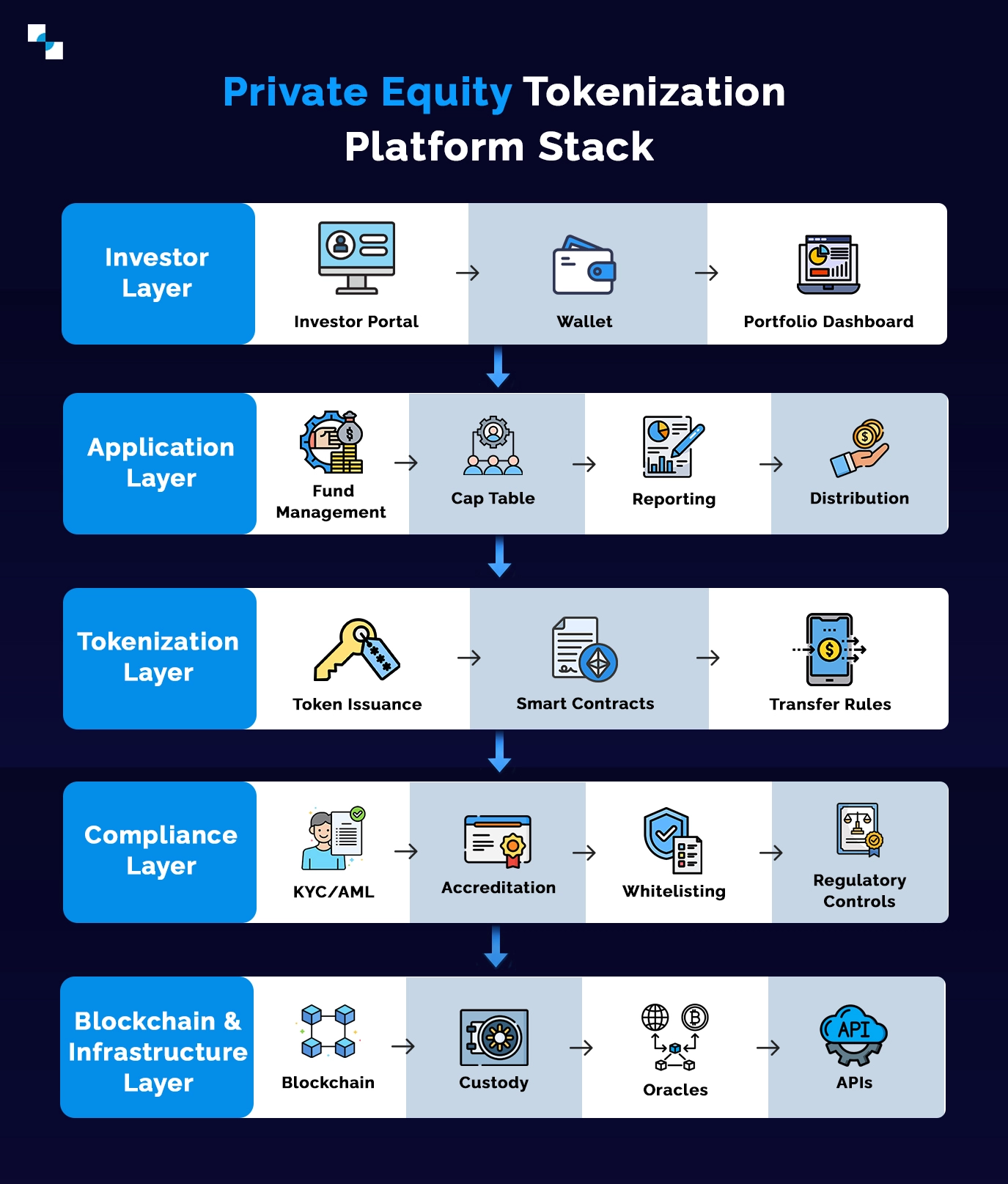
A private equity tokenization platform operates as a layered technology environment connecting investors, compliance systems, asset administration, and blockchain infrastructure. The investor layer includes portals, wallets, portfolio dashboards, document access, and transaction interfaces. The application layer manages investor onboarding, subscriptions, ownership, cap tables, distributions, and reporting.
The tokenization layer handles token issuance, smart contracts, transfer rules, permissions, and lifecycle events. The compliance layer connects KYC, AML, investor eligibility, accreditation, whitelisting, and jurisdictional controls with asset transactions. Beneath these layers sits the infrastructure environment covering blockchain networks, custody, APIs, security systems, and external integrations. A modular architecture allows these components to operate independently while maintaining data and workflow connectivity across the complete private equity lifecycle. This becomes particularly important when a platform needs to expand from one tokenized investment into multiple funds, asset classes, investor categories, or jurisdictions.
Private Equity Tokenization: Risks, Limitations & Considerations
Tokenization can modernize private equity infrastructure, but it does not eliminate the legal, financial, regulatory, and operational complexities associated with private markets.
The technology should therefore be evaluated alongside its limitations.
Regulatory complexity
The regulatory treatment of a tokenized private equity interest depends on several factors, including the underlying asset, legal structure, investor profile, jurisdiction, offering method, and transfer mechanism.
Requirements can also evolve over time.
A tokenization platform should therefore be designed with compliance as a core architectural consideration.
Regulatory requirements should not be treated as an additional feature that can be integrated after the technology has been developed.
Legal ownership and token ownership
A blockchain token does not automatically establish legal ownership in every structure.
The legal relationship between the token, underlying entity, shareholder records, contractual rights, and investor agreements must be clearly defined.
Organizations should establish:
- What the token represents
- What rights it provides
- Who legally owns the underlying interest
- How transfers are recognized
- How distributions are administered
- How corporate actions are executed
- How disputes are addressed
This becomes one of the most important considerations when implementing private equity tokenization services.
Liquidity limitations
Tokenization is often associated with improved liquidity, but the relationship is not automatic.
A blockchain can make a transfer technically possible without creating an active market.
Secondary market activity depends on factors such as:
- Investor demand
- Regulatory permissions
- Eligible counterparties
- Transfer restrictions
- Pricing mechanisms
- Market infrastructure
- Asset attractiveness
Private equity organizations should therefore avoid presenting tokenization as a guaranteed liquidity solution.
Smart contract risks
Smart contracts introduce programmable logic into investment infrastructure.
An error in contract logic or permissions could affect ownership, transfers, distributions, or other financial activities.
Security should therefore include:
- Code review
- Automated testing
- Independent audits
- Access controls
- Monitoring
- Upgrade governance
- Emergency procedures
Smart contract security should be considered a continuing operational requirement rather than a one-time development task.
Custody and key management
Digital asset custody introduces additional operational considerations. Organizations should determine how private keys will be managed, who can authorize transactions, how institutional wallets are protected, and what recovery mechanisms will be available.
Important considerations include:
- Key security
- Transaction authorization
- User permissions
- Wallet recovery
- Custody integration
- Operational controls
These processes should align with the organization’s broader security and governance policies.
Data privacy
Blockchain systems are designed around durable transaction records. This creates important considerations around investor information, confidential financial data, and personally identifiable information.
A well-designed architecture can keep sensitive information within controlled off-chain systems while using blockchain infrastructure for relevant ownership, transaction, and permission records. Private equity tokenization providers should therefore design the data architecture before deployment, clearly defining what information is stored on-chain, what remains off-chain, and how access is controlled.
Integration challenges
Private equity firms already rely on multiple technology systems.
A tokenization platform may need to connect with:
- Fund administration systems
- Accounting software
- CRM platforms
- Compliance systems
- Custody providers
- Payment infrastructure
- Investor portals
- Reporting tools
- Secondary marketplaces
API based connectivity can help prevent tokenization from becoming another isolated technology environment.
Investor experience
Blockchain technology should not create unnecessary complexity for investors.
The platform should provide a clear interface for viewing:
- Investment information
- Ownership
- Transactions
- Documents
- Distributions
- Portfolio activity
- Eligibility status
The underlying infrastructure can remain technically sophisticated while the investor interface remains accessible and intuitive.
Governance and upgradeability
Tokenized private equity infrastructure needs clearly defined governance. Organizations should determine who can modify smart contracts, update compliance rules, approve transfers, manage administrative permissions, and initiate emergency procedures.
Upgrade mechanisms should be transparent, controlled, and appropriately documented.
Scalability
The first tokenized private equity offering is unlikely to be the final requirement for a growing organization. Future requirements may include additional funds, asset classes, jurisdictions, investor categories, custody providers, or blockchain networks.
A modular architecture can make these expansions easier by allowing reusable components across multiple offerings. Organizations evaluating private equity tokenization companies should therefore consider the long-term technology roadmap rather than focusing only on the initial issuance.
The Importance of Choosing the Right Technology Model
There is no universal tokenization architecture for every private equity organization. A standardized platform may be suitable for a straightforward use case with established workflows.
A customized architecture may be more appropriate where the organization requires:
- Unique fund structures
- Complex compliance rules
- Multiple integrations
- Institutional custody
- Custom investor workflows
- Multiple asset classes
- Jurisdiction specific functionality
The decision should be based on operational requirements rather than the novelty of the underlying technology. Ultimately, successful private equity tokenization depends on the alignment of legal structure, regulatory compliance, blockchain infrastructure, financial operations, security, investor experience, and governance.
The strongest implementation is not necessarily the one with the most blockchain functionality. It is the one where technology addresses genuine operational requirements while remaining flexible enough to support future changes.
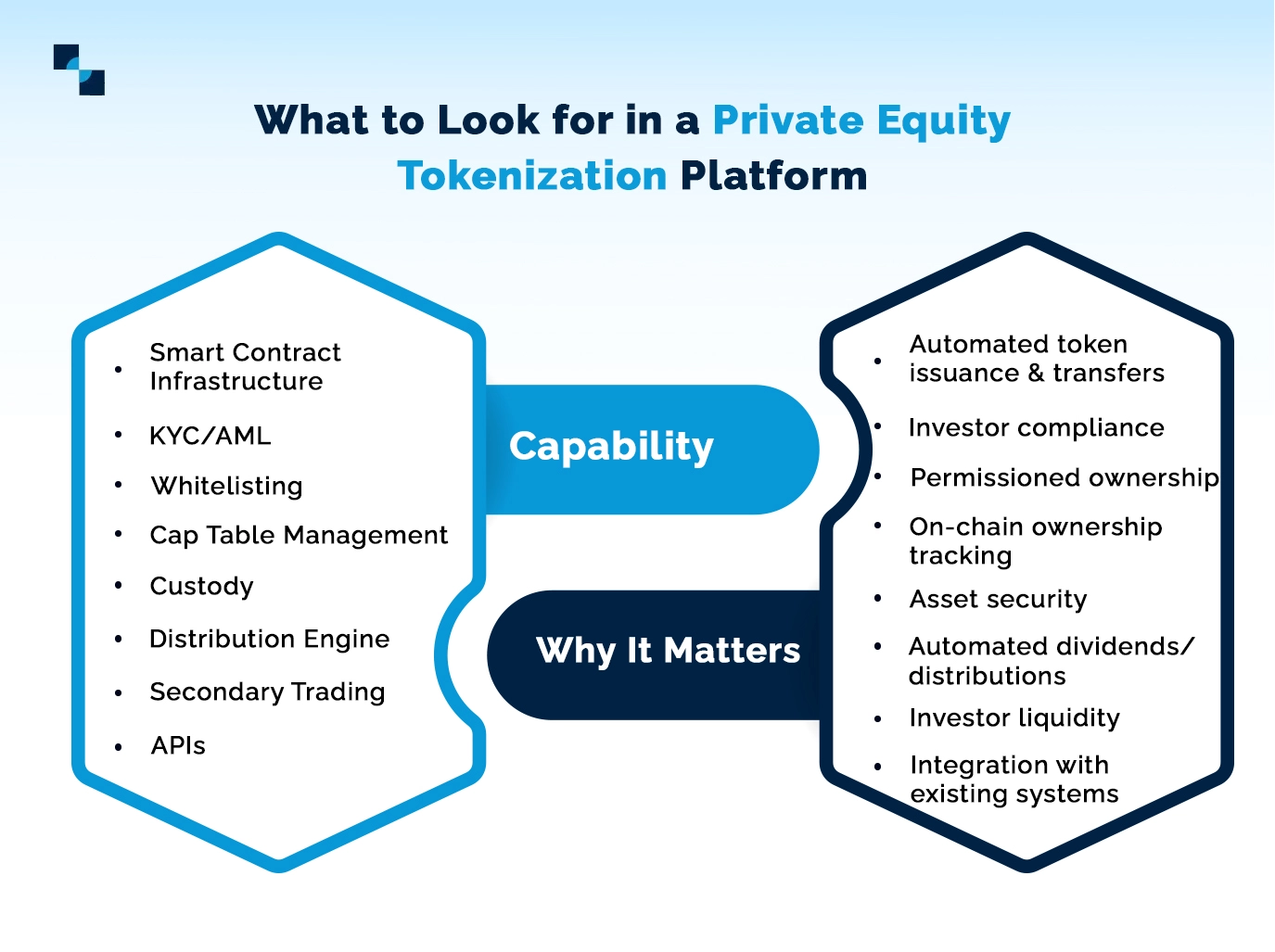
Selecting a private equity tokenization service provider should begin with the complete asset lifecycle rather than token issuance alone. A suitable platform should support investor verification, configurable compliance rules, secure smart contracts, ownership and cap table management, custody connectivity, distribution workflows, reporting, transfer controls, and API based integrations. Security should be examined across smart contracts, wallets, administrative permissions, identity information, and transaction authorization. Scalability is equally important because an infrastructure created for a single fund may eventually need to support additional assets, jurisdictions, investor groups, and blockchain networks.
Organizations should also assess interoperability with existing accounting, CRM, fund administration, compliance, payment, and custody systems. Governance and upgradeability should receive equal attention, particularly where regulatory requirements or investment structures may change over time. The strongest platform is therefore not necessarily the one with the largest feature list, but the one capable of fitting securely into the organization’s existing financial infrastructure.
Build a Private Equity Tokenization Platform with Antier
Private equity tokenization requires more than blockchain development. It requires an architecture capable of connecting smart contracts, compliance, investor management, custody, ownership administration, reporting, and enterprise systems.
Antier can support organizations with private equity tokenization services aligned with their investment structure and operational requirements.
Its capabilities span blockchain development, smart contract engineering, tokenization architecture, wallet integration, investor applications, compliance integrations, APIs, and broader digital asset infrastructure.
Organizations exploring a customized private equity tokenization service provider can work toward an architecture designed around the complete lifecycle of the investment, from token design and issuance through investor onboarding, ownership management, transfers, distributions, reporting, and future integrations.
The focus should remain on building infrastructure that can operate securely today while providing the flexibility required for tomorrow’s private market environment.
FAQs
What is private equity tokenization?
Private equity tokenization is the process of representing eligible private equity ownership interests or economic rights through blockchain based digital tokens within an appropriate legal and regulatory framework.
What does a private equity tokenization platform do?
A tokenization platform can support token issuance, investor onboarding, compliance, ownership management, smart contracts, custody connectivity, distributions, reporting, transfers, and other investment lifecycle functions.
What should organizations look for in a private equity tokenization platform?
Organizations evaluating private equity tokenization solutions for institutional investors should assess smart contract security, compliance controls, investor management, ownership administration, custody, interoperability, reporting, APIs, scalability, governance, and ongoing technical support.
Can private equity tokenization platforms be customized for different investment structures?
Yes. Private equity tokenization platforms can be configured around different fund structures, ownership models, investor eligibility requirements, jurisdictions, distribution mechanisms, and transfer rules. The technology can also be tailored to integrate compliance workflows, smart contracts, custody, investor portals, and existing financial systems. Antier develops customized tokenization infrastructure that can be aligned with an organization’s investment structure, operational requirements, and long-term digital asset strategy.
How much does it cost to build a private equity tokenization platform?
The cost depends on factors such as platform complexity, token architecture, blockchain selection, compliance integrations, investor functionality, custody, smart contract requirements, APIs, security, and the number of features required. A detailed technical and business assessment is generally needed before estimating development costs.