




✨ AI Summary
- OKX launched an AI marketplace in June 2026, enabling decentralized AI agents to hire each other autonomously and settle payments with stablecoins.
- In the same week, Kraken added Bittensor subnet tokens to its listing roadmap, marking a significant step towards mainstream liquidity for decentralized AI assets.
- These developments highlight the evolution of tokenization, from bringing real-world assets on-chain to powering digital assets, including autonomous AI agents.
- The blog post also explains the four types of tokenized AI assets: AI agent tokens, tokenized AI models, tokenized GPU and compute (DePIN), and AI Inference-token and compute futures.
- It emphasizes the importance of understanding each asset's unique technical and economic demands when building a tokenized AI asset trading platform or crypto exchange software.
On June 30, 2026, OKX launched an AI marketplace that allows decentralized AI agents to autonomously hire one another, settle payments via stablecoins, and establish portable on-chain reputations. The same week, Kraken became the first Tier-1 crypto exchange software to add Bittensor subnet tokens to its listing roadmap. This marked a major milestone, bringing mainstream liquidity to niche decentralized AI assets that were previously restricted to decentralized platforms. A few months ago, Intercontinental Exchange, parent of the NYSE, put roughly $200M into OKXICE, a joint venture aimed at modernizing markets through tokenization of financial products.
All of these moves are directed at the fact that tokenization isn’t a niche technology. With the advent of tokenized AI assets, they have also stopped being two separate crypto narratives since they are now covered by a single, tradeable asset class.
Tokenization began by bringing real world assets on-chain. Now, it’s evolving to power inherently digital assets, transforming autonomous AI agents and automating real-world workflows.
#tokenizedRWA #realworldworkflows #AIagents #AIassets
— Harshu (@Scribita) July 3, 2026
If you are
- a tokenization platform expanding into AI,
- a founder launching your first crypto exchange software
- a regulated venue adding AI-asset trading
- or a market maker sourcing liquidity for these thin new AI asset markets,
The build decisions you make today will determine whether you capture this wave or spend 12 months rebuilding your tokenized AI asset trading platform. This guide breaks down the four asset classes, the core architecture, the 2026 regulatory picture across the US, UK, UAE, and EU, and a phased build roadmap.
What are tokenized AI assets?
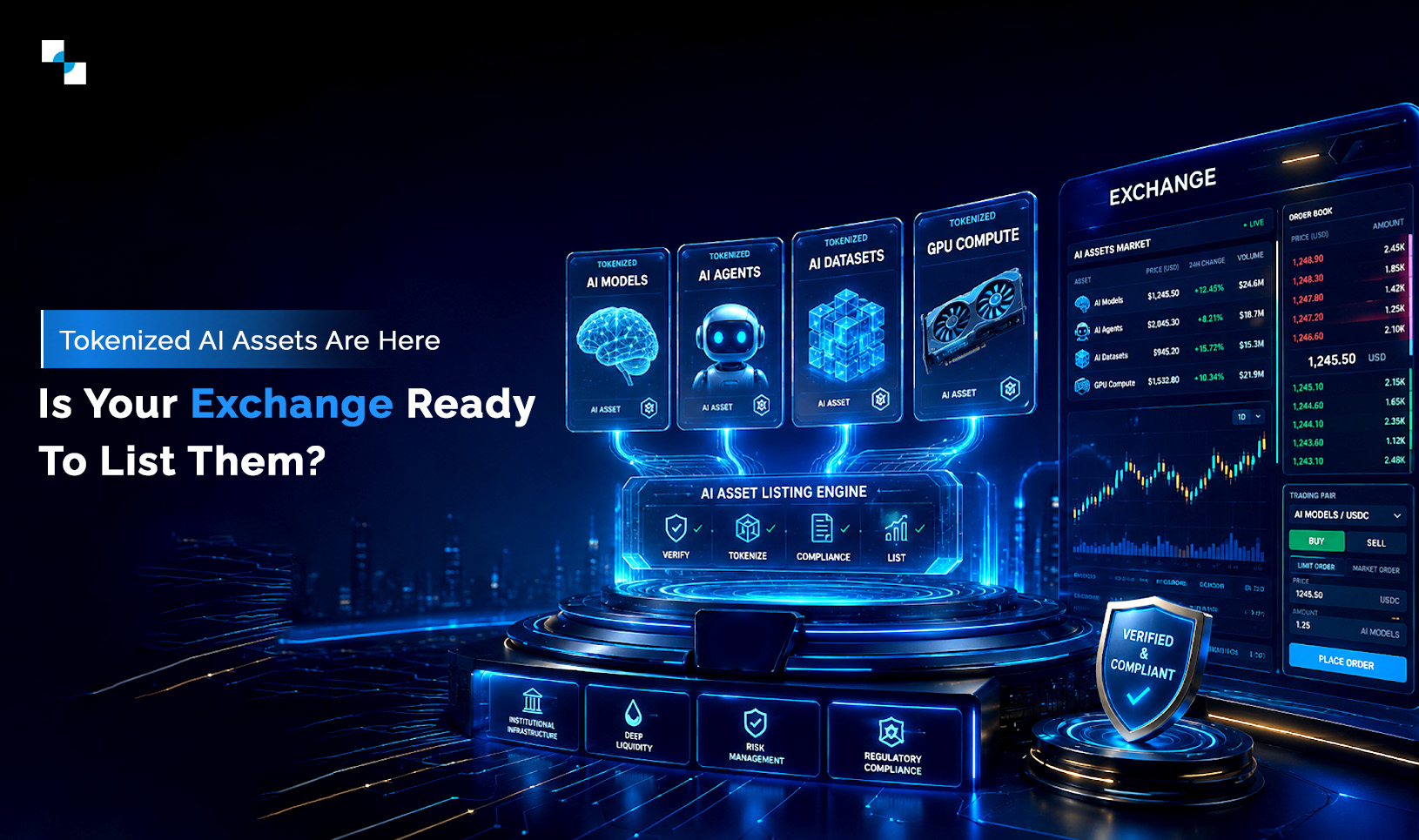
Tokenized AI assets on-chain representations of AI value (autonomous agents, trained models, GPU compute, and the inference they produce) that can be owned, fractionalized, and traded like any other digital asset. They are not one thing but four distinct classes, each with its own economics and technical demands on crypto exchanges. If you’re planning to build a tokenized AI asset trading platform or crypto exchange software for AI assets, you must be aware of the four types of tokenized AI assets:
1. AI agent tokens and agent-to-agent commerce
These represent a dual-sided ecosystem including:
- Autonomous AI agents that are tradable assets (like crypto or stocks) for humans: Platforms like Virtuals Protocol allow creators to mint dedicated tokens for individual AI agents, letting the market price their value.
- AI agents that act as independent economic actors with each other: Ecosystems like OKX AI and marketplaces built on the Agent Payments Protocol allow these agents to discover work, collaborate, and pay one another autonomously.
Source: Coingecko
Reflecting this massive shift toward machine-to-machine economies, the CoinGecko AI Agents category observed a market capitalization of $3.03 billion in July 2026.
2. Tokenized AI models
This category of tokenized AI assets introduces fractional ownership and revenue rights to trained AI models. LedgerMind reports that tokenized AI-model marketplaces have processed huge trade volumes in Q1 2026. The AI models that consume tens of millions and months to train have transformed into assets that a wider pool of investors can hold. Existing crypto exchanges are already preparing to list tokenized AI models, as it is a high-potential market.
| Venue / Protocol | Core Action | Classification | Primary Focus / Utility |
| OKX | Joint venture with Intercontinental Exchange to develop tokenized and digitally native financial products. | Exchange ecosystem | Tokenized financial infrastructure. |
| Intercontinental Exchange (ICE) | Entered a 50-50 joint venture with OKX. | Institutional venue | Tokenized and digitally native financial products. |
| Coinbase | Publicly lists price pages for AI-themed assets | Centralized exchange venue (CEX) | Public asset information and price discovery for AI-themed tokens. |
| Binance | Announced AI Agent Skills for Binance and Binance Wallet. | CEX | AI-agent tooling and market infrastructure. |
3. Tokenized GPU and compute (DePIN)
Decentralized Physical Infrastructure Networks (DePIN) like Render and Akash are transforming raw processing power into a liquid asset by tokenizing GPU-hours directly on-chain. But this shift isn’t exclusive to Web3 since traditional finance is validating the same thesis from the top down.
As GPUs solidify their status as a major institutional asset class, a landmark April 2026 paper by KPMG and Nuway examined how physical compute functions as an alternative real asset (much like aircraft or real estate). This institutionalization is fully visible in Wall Street’s capital markets, where major players like CoreWeave successfully secured multi-billion-dollar, investment-grade rated financing facilities backed entirely by their physical GPU clusters.
4. AI Inference-token and compute futures
This is the most forward-looking and compelling use case of tokenization in AI that treats AI processing power as a basic commodity, much like electricity or internet bandwidth. Financial researchers are already proposing “Standard Inference Token” futures contracts that allow companies to lock in their AI computing costs years in advance. For operators developing crypto exchange software, engineering the infrastructure to handle these complex derivative contracts early on will offer a distinct competitive edge before the market matures between 2027 and 2028.
Why Build a Crypto Exchange Software for AI Assets in 2026?
The infrastructure, demand, and regulatory clarity for crypto exchanges, tokenization, and agentic trading/transactions have all arrived at once in 2026. Grayscale’s Q1 2026 research states that the outlook for AI tokens has completely shifted from a speculative asset to one with structural utility. The report also notes that AI-based tokens are outperforming as developers leverage blockchain as “on-chain financial rails for AI agents”.
For a crypto exchange operator or one planning cryptocurrency exchange software development, being early is the entire opportunity. The venues that added spot crypto first, then perpetuals, and finally spot and perpetual RWAs are building the next layer to accommodate different categories of AI-based digital assets. Almost no crypto exchange software is built to handle all four classes of tokenized AI assets under one roof.
The Core Architecture behind Tokenized AI Asset Trading Platform
An AI-asset exchange is a superset of a modern digital asset exchange for tokenized RWAs, plus an agent-native payments layer. The core architectural components include:
- Matching engine and order book
A low-latency, CEX-grade matching engine remains the heart of the tokenized AI asset trading platform. AI-based asset markets are often thin and volatile early on, so market makers need configurable order types, tight spread control, and multi-venue liquidity routing to keep books functional.
- Multi-asset tokenization layer
The crypto exchange software for AI assets must offer support for the standards that govern each asset class, including:
- ERC-3643 and ERC-1400 for regulated/permissioned tokens
- Emerging agent-specific standards such as
- ERC-8004 for trustless agent identity
- ERC-8226, i.e., the regulated agent mandate for scoped, time-bounded, capped delegation of authority to agents trading regulated tokens.
- Oracle layer
Pricing model performance, GPU-hour rates, and inference throughput are far harder than pricing a stock. The crypto exchange software for AI assets needs robust oracles for compute and model pricing. Antier has also flagged in prior RWA exchange work that several oracle providers fail in after-hours and off-market pricing. Such challenges must be addressed while developing cryptocurrency exchange software for AI assets.
- Agent-native payment rails
This is the layer that separates an AI-asset exchange from an RWA exchange. Agents transact millions of times a day in micropayments, which conventional rails cannot handle. Therefore, the stack required to build a tokenized AI asset exchange includes:
- X402, Coinbase’s HTTP-native micropayment protocol, which Stripe added support for on February 11, 2026
- The Agent Payments Protocol for quoting/negotiation/escrow/settlement
- Agent wallets with policy engines (per-agent spend caps, recipient allowlists, rate limits)
- TEE-based key management so agents sign transactions without ever touching private keys
- Custody, compliance, and settlement
Cryptocurrency exchange software development for tokenized AI assets also includes building:
- Qualified custody integration
- A KYC/AML and whitelist engine enforcing transfer restrictions across jurisdictions
- Fiat on/off-ramps and stablecoin settlement rails (USDC, USDT, USDG) for round-the-clock micro-settlement
How Does Each AI-Asset Class Change The Tokenized AI Asset Trading Platform Build?
Just like RWA perpetuals and tokenized RWAs, all four tokenized AI asset classes are different. Though they are differentiated by different principles, each of them requires a separate tech stack and compliance modules before they are listed on crypto exchanges.
- When the agent’s ability to earn and spend is the product, agent token infrastructures need on-chain identity, portable reputation scoring, and micropayment infrastructure.
- Tokenized AI asset trading platforms listing tokenized models need IP and royalty logic, plus usage oracles that measure interference calls so revenue flows to token holders.
- A simple buy-and-sell order book crypto exchange cannot trade AI compute. To make the asset class tradable, a tokenized AI asset trading platform must integrate
- DePIN-style performance metering to verify that the bought compute (speed, error rates, and uptime) is actually delivered
- Complex Asset-Backed Security (ABS) to manage legal collateral, hardware depreciation, and institutional debt yields right within the software, since institutions treat microchips as real estate
- For those planning cryptocurrency exchange software development for facilitating trading of inference and compute futures, the essentials include margin systems, mark-to-market, and settlement against a standardized inference-token benchmark. Crypto exchange software must build these as separate product tracks that share the core engine, custody, and compliance spine, but not as one undifferentiated AI section.
How To Build A Crypto Exchange For AI Assets?
1. Research and compliance mapping
Spans 1-4 Weeks
At this time, the tokenized AI asset trading platform operators
- Define target markets, asset classes, and technical specifications
- Map each against US/UK/UAE/EU rules
- Confirm custodian and issuer partners
The cryptocurrency exchange software development company produces a technical specification and compliance roadmap before the tokenized AI exchange platform design starts.
2. UX and product design
Happens between Weeks 3-8
During this phase, the cryptocurrency exchange software development company will create wireframes for distinct product tracks, entailing:
- an investor-oriented flow for tokenized models/RWAs (redemption, disclosures)
- a trader-oriented flow for agent tokens and futures (charts, position controls).
3. Core exchange build
Occurs between months 2-5
The crypto exchange development company builds the following essentials and a lot more on a microservices architecture, so each component scales independently:
- Matching engine
- Wallet infrastructure
- API gateway
- Admin panel
4. AI-asset and agent-rail integration
Happens between months 4-7
The technology provider sets up and integrates the following during this phase of tokenized AI asset exchange development:
- Required tokenization standards
- Oracle layer
- x402/Agent payments protocol rails
- Agent wallets with policy engines
- Compliance/whitelist engines
- The rest of the tech stack required for specific tokenized AI asset categories
5. Security audit and regulatory documentation
Executed during months 6-8
During this final phase of tokenized AI asset trading platform development, the crypto exchange development company executes:
- Third-party smart-contract and infrastructure audits
- Penetration testing
- The documented audit trails FCA and VARA registration require.
6. Staged launch
Happens during months 8-12
At this phase, initially, the crypto exchange development company enables beta cohorts. Then the progressive geographic and asset-class rollout occurs with weekly performance and compliance review.
Also Read: How RWA Tokenization and DeFi Are Redefining Crypto Exchange Development in 2026
How Much Does It Cost To Build a Tokenized AI Asset Exchange?
When hiring an experienced cryptocurrency exchange software development company, operators can expect 6-12 months end-to-end, and a build cost in the $100k-$3M range depending on smart-contract complexity, legal audits, and integrations. However, if you’re building in-house, it can take up to 24 months and may cost around $1.8M-$2.5M. For a clear tokenized AI asset trading platform build vs buy comparison, you can refer to the table below:
| Area | Build in-house | Buy / partner | Why it matters |
|---|---|---|---|
| Time to launch | 12-24 months is typically required for a serious tokenized AI asset exchange stack. | 3-6 months, when you leverage Antier’s white-label crypto exchange software or custom solutions. | Faster launch usually wins on market timing. |
| Team cost | 15-20 specialists at roughly $1.8M-$2.5M per year in salaries alone. | About 20-30% of that cost. | Partnership lowers fixed burn and hiring risk. |
| Engineering burden | You own matching, custody, compliance, monitoring, upgrades, and incident response. | The partner absorbs much of the platform build and maintenance. | This reduces execution complexity. |
On the revenue side, an AI-asset exchange has more levers than a spot crypto trading venue, so it is always more profitable. The revenue streams include:
- Listing fees
- Trading fees of roughly 0.1-0.5% per trade
- Compliance-as-a-service for external token issuers
- A fee-take on the high-frequency agent-transaction flow settling across your agent-friendly stablecoin rails.
What Are The Challenges That Must Be Addressed While Building Crypto Exchange Software For AI Assets?
- Treating all four asset classes as a single product instead of separate tracks on shared infrastructure
- Underestimating oracle complexity, especially off-hours pricing for compute and models
- Writing smart contracts before the compliance and custody stack is decided
- Ignoring the new fraud surface that agent-initiated transactions introduce, during the crypto exchange security setup (which is exactly what ERC-8226 mandates, and agent-wallet policy engines exist to contain)
Build it with a partner who has built exactly this
Forward-thinking Web3 builders planning to develop crypto exchange software for AI assets are already building for future cycles that look vastly different from the spot-crypto ones.
The AI-asset window has just opened, and it rewards the venues that ship a compliant, multi-asset platform before the market consolidates. Antier has built tokenization, exchange, and AI infrastructure together and helped operators launch across regulated jurisdictions. If you’re planning to build a tokenized AI asset exchange, the next step is to build a roadmap mapped to your target assets and regulators.
Frequently Asked Questions
01. What are tokenized AI assets?
They are on-chain representations of AI value across four classes: autonomous agent tokens, fractionalized AI models, tokenized GPU/compute, and AI inference or compute futures. Each can be owned, traded, and in many cases, fractionally held like other digital assets.
02. Can you trade AI models and GPU compute on a crypto exchange?
Yes. Tokenized-model marketplaces processed roughly $847 million in Q1 2026, and DePIN networks like Render and Akash already tokenize GPU compute. An exchange needs specialized oracles and metering to price and settle these instruments.
03. How much does it cost to build an AI-asset exchange?
Typically $100k-$3M depending on complexity, legal audits, and integrations, plus ongoing compliance and Oracle costs. Building in-house instead runs roughly $1.8M-$2.5M per year in engineering salaries alone.
04. How long does it take to build one?
A gated, phased build usually takes 6-12 months from research to staged launch, with the core exchange and agent-rail integration consuming the middle months.
05. What tech stack does an AI-asset exchange need?
A low-latency matching engine, multi-asset tokenization standards (ERC-3643, ERC-8004, ERC-8226), a compute/model oracle layer, agent-native payment rails (x402, Agent Payments Protocol), agent wallets with policy engines and TEE key management, custody, and a KYC/AML compliance engine.tended to provide is missing. Please share the content, and I'll be happy to generate the FAQ Q/A pairs for you!